 0
0
 0
0
You type the message. You delete it. You type it again.
Maybe it is a brother you have not spoken to in two years. Maybe it is an old friend, and you cannot even remember who stopped calling first. You want to send something. You just do not know if it is enough.
People call that small first message “extending an olive branch.” Thousands of people look up the olive branch meaning every month, and most of them are standing exactly where you are, phone in hand, wondering if peace is still possible.
Here is something that might help. The most famous olive in the Bible was not a branch at all.
What Is the Olive Branch Meaning?
Today, to “offer an olive branch” means to make the first move toward peace. You reach out after a fight. You say, “I don’t want this to go on.”
The idea comes from two old streams that flowed together.
The first stream is Greek and Roman. In ancient Greece, a person asking for mercy or protection would sometimes come carrying an olive branch, often wrapped with wool, as a sign they came in peace. The Romans pictured Pax, their figure of peace, holding an olive branch, and that image shows up on Roman coins. So it is honest to say the phrase is not only biblical. Long before English speakers used it, olive branches already meant “I come in peace” around the Mediterranean.
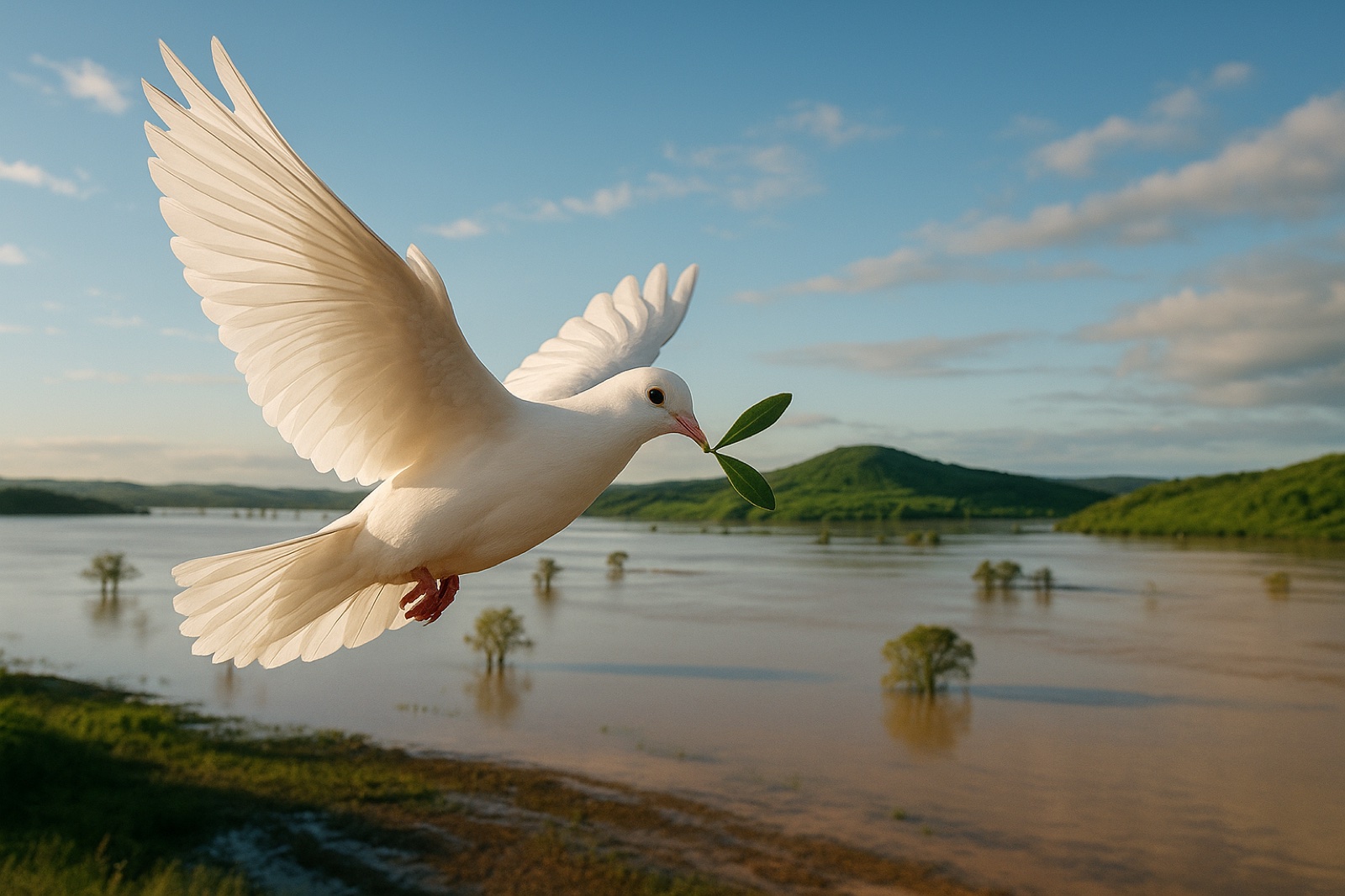
The second stream is the Bible. At the end of the Flood, a dove flew back to Noah carrying something green from an olive tree. Christian art painted that dove for centuries, and the dove with the olive became one of the world’s best-known signs of peace.
But if you open Genesis and read slowly, the dove is carrying something smaller than most pictures show.
Genesis 8:11 Says a Leaf, Not a Branch
Here is the verse in the King James Version:
“And the dove came in to him in the evening; and, lo, in her mouth was an olive leaf pluckt off: so Noah knew that the waters were abated from off the earth.” (Genesis 8:11, KJV)
An olive leaf. One leaf. Not a branch, not a wreath, not a whole sprig of fruit.
Think about what that looked like. A small bird landing on the edge of a huge boat at the end of the day, with one thin green leaf in its beak. If Noah had blinked, he might have missed it.
And yet the verse says that one leaf was how Noah knew. Not guessed. Knew.
The word “pluckt off” is stronger than it sounds
The Hebrew word behind “pluckt off” is taraph. It comes from a root that usually means “torn.” It is the same root Jacob uses when he sees Joseph’s bloody coat and cries, “Joseph is without doubt rent in pieces” (Genesis 37:33, KJV).
That is why many modern Bibles translate Genesis 8:11 as “a freshly plucked olive leaf.” The dove did not find an old dead leaf floating on the water. It tore a fresh one off a living tree.
That is the whole point. Something was growing again. Somewhere out there, a tree had come through the Flood and was putting out new green leaves. Olive trees are famously hard to kill, and they often send up new shoots even after being cut down. The leaf was not proof that everything was fine. It was proof that life had started again.
Noah still did not open the door
Here is the part almost nobody mentions. After the leaf, Noah did not run outside.
The very next verse says, “And he stayed yet other seven days; and sent forth the dove; which returned not again unto him any more” (Genesis 8:12, KJV). Then Noah lifted the covering of the ark and looked out. The ground was drying. Still, he waited.
If you follow the dates Genesis gives, it was nearly two more months before the earth was fully dry. Noah only left when God spoke: “Go forth of the ark” (Genesis 8:16, KJV).
So the story goes like this. A small sign. A long wait. Then the door opens. And the one who opened it was God, not Noah.
Peace Usually Starts With One Leaf
This is where the old story walks straight into your phone.
When we hear “extend an olive branch,” we often picture something big. A long apology. A family dinner where everything gets talked out. A hug at the end. That picture can freeze us, because it feels too heavy to carry. So we send nothing at all.
But Genesis does not start with a branch. It starts with a leaf. One small, fresh, living thing.
Your leaf might be one line: “I saw this and thought of you.” “Happy birthday.” “I miss how things used to be.” It is not the whole conversation. It is just proof that something between you is still alive.
And notice two more things the story quietly teaches:
- A leaf is a sign, not a finish line. Noah got good news and still waited. If the other person sends a small kind word back, that is a real sign. It does not mean you have to rush into everything at once.
- The arrival of peace was not Noah’s achievement. Noah did not grow the tree. He did not dry the ground. His job was to send the dove out, watch, and wait. God brought the green back.
That takes pressure off. You are not in charge of fixing the whole relationship. You are only in charge of your leaf.
Paul says it like this: “If it be possible, as much as lieth in you, live peaceably with all men” (Romans 12:18, KJV). Look at those two little phrases: if it be possible and as much as lieth in you. Paul knew that sometimes peace is not possible, and that part of it never lies in your hands.
A word if the person hurt you badly
If the person on the other side was cruel or unsafe, you do not owe them a leaf. Making peace in your own heart is not the same as letting someone back into your life. We wrote more about that difference in what the Bible says about forgiveness, and why letting go isn’t letting them back in. Boundaries are allowed. Sometimes the leaf you send is only a quiet prayer for them, and that is enough.
If you are not sure where your heart is yet, the free Am I Ready to Forgive? quiz can help you sort it out in a few minutes.
The Bigger Promise Behind the Leaf
The leaf was the first sign. A few verses later comes the promise that stood behind it: “While the earth remaineth, seedtime and harvest, and cold and heat, and summer and winter, and day and night shall not cease” (Genesis 8:22, KJV). We looked at that promise more closely in the fall equinox biblical meaning.
The God who brought one leaf back after the whole world went under water is the same God who sees the cold silence in your family. Growth can come back after a flood. It usually starts smaller than we expect.
Actions to Take
- Name your flood. Write down the one name that came to mind while you read this. Just the name. You do not have to do anything else yet.
- Write your leaf. Type one short, kind sentence to that person, with no apology speech and no explaining. Read it back and ask, “Is this small enough to be a leaf?”
- Send it, or pray it. If the person is safe, send it today and then leave the reply to God. If they are not safe, say their name in prayer instead, and let that be your leaf.
Journaling Prompts
- What would a “branch-sized” peace look like to you, and why does it feel so heavy?
- Where in this relationship have you been trying to dry the ground yourself, instead of waiting on God?
- If a small sign of peace came back to you this week, what would you be afraid of?
A Prayer
God, you know the name I keep thinking about. I am tired of the silence, but I am scared to be the one who moves first. Give me the courage to send one small leaf, and the patience to wait for what only you can grow. If peace is not possible right now, help me hold my own heart in peace anyway. I trust you with the parts that do not lie in my hands. Amen.
Discussion Question
Do you think the person who was hurt more should be the one to offer the olive branch, or does it not matter who goes first? Share your thoughts in the comments below.
Share This
- “Noah’s dove didn’t bring back a branch. It brought back one fresh leaf. Peace usually starts smaller than we think. (Genesis 8:11)”
- “I don’t have to fix the whole relationship today. I just have to send my leaf.”
- “Even after the leaf, Noah waited. A sign of peace is a beginning, not a finish line.”
Olive Branch Meaning: Questions and Answers
What does the olive branch mean?
The olive branch is a symbol of peace and reconciliation. To “offer an olive branch” means to make the first move toward ending a conflict. The symbol has roots in ancient Greek and Roman culture, where olive branches signaled peace and requests for mercy, and in the Bible’s story of Noah’s dove in Genesis 8.
Did Noah’s dove bring back an olive branch or an olive leaf?
Genesis 8:11 says the dove brought back an olive leaf, not a branch. The King James Version reads, “in her mouth was an olive leaf pluckt off.” Many modern Bible translations call it a “freshly plucked” olive leaf, meaning it was torn from a living tree.
Is the olive branch as a symbol of peace from the Bible?
The olive branch as a symbol of peace comes partly from the Bible and partly from Greek and Roman culture. Ancient Greeks carried olive branches when asking for mercy, and Romans showed their figure of peace, Pax, holding an olive branch. The story of Noah’s dove carrying an olive leaf in Genesis 8:11 later made the dove and olive a well-known Christian sign of peace.
What did the olive leaf mean to Noah?
In Genesis 8:11, the fresh olive leaf showed Noah that the floodwaters had gone down and that trees were growing again. The Bible says “so Noah knew that the waters were abated from off the earth.” Even so, Noah waited seven more days, and only left the ark when God told him to in Genesis 8:16.
What does the Bible say about making peace with someone?
Romans 12:18 in the King James Version says, “If it be possible, as much as lieth in you, live peaceably with all men.” The verse asks people to do their part toward peace while admitting that peace is not always possible and that some of it is outside a person’s control.