 0
 0
You bought a study Bible, or someone handed you one, and now it sits on the table with a ribbon marking nothing. You typed “new believer bible study” into a search bar because you don’t want a program. You want to know where to put your finger on page one.
Here is a small, true detail that changes where most people start: the first time Luke records Jesus opening the scriptures in public, He does not begin at the beginning. He finds a place.
The Day Jesus Opened the Scroll
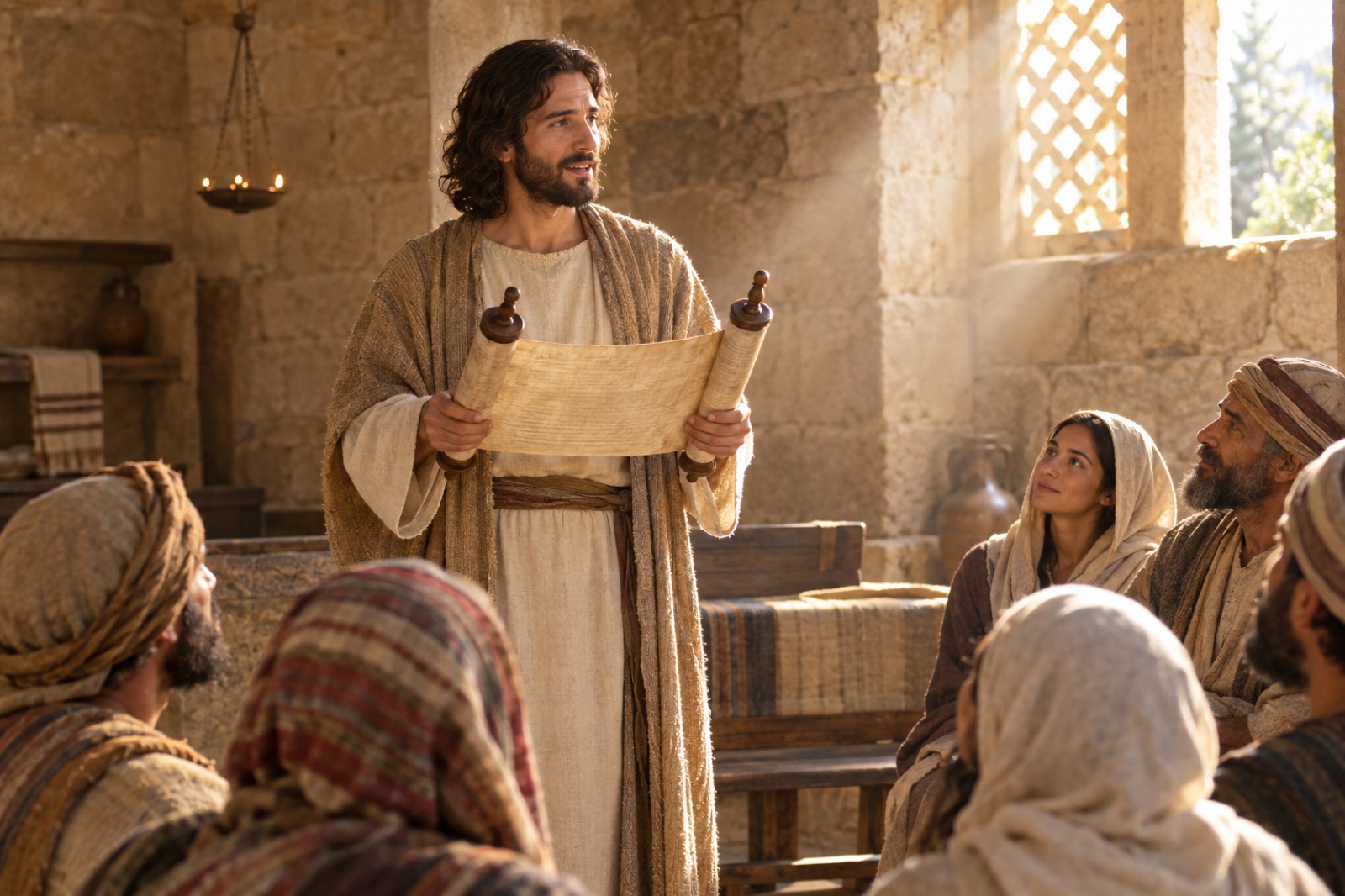
Luke 4 puts Him in Nazareth, the town where He grew up, on the sabbath. Luke writes: “And there was delivered unto him the book of the prophet Esaias. And when he had opened the book, he found the place where it was written.” Notice the verb. He found the place. Nobody assigned it, and He did not roll from the first column to the last.
Then He reads: “The Spirit of the Lord is upon me, because he hath anointed me to preach the gospel to the poor; he hath sent me to heal the brokenhearted, to preach deliverance to the captives, and recovering of sight to the blind, to set at liberty them that are bruised, To preach the acceptable year of the Lord.”
Next comes the part people read past: “And he closed the book, and he gave it again to the minister, and sat down.” The room goes still. Then: “This day is this scripture fulfilled in your ears.”
What That Tells a New Believer About Where to Start
A new believer bible study usually fails for one boring reason: it starts in the wrong place for a beginner. Genesis is a fine book. But if the whole library is about Jesus, then the pages where He walks and talks are the ones that make the rest of it make sense. In Luke 24, after the resurrection, Luke says that “beginning at Moses and all the prophets, he expounded unto them in all the scriptures the things concerning himself.” Jesus read the whole Bible as a book that points somewhere. And in John 5 He says of the scriptures, “they are they which testify of me.”
So a first study does not need to be complete. It needs to be pointed. Read the Gospels first, and let the rest of the Bible become the answer to questions you actually have.
A Detail Worth Checking Yourself
Here is something that was not in the plan I brought to this page: the words Luke records are close to Isaiah 61 but not identical. Isaiah 61:1 in the King James reads “to bind up the brokenhearted” and “the opening of the prison to them that are bound.” Luke’s version says “to heal the brokenhearted” and adds “recovering of sight to the blind,” a phrase that is not in Isaiah 61:1 in the KJV at all.
I won’t pretend to know exactly why, and you don’t have to settle it today. The point is smaller and more useful: you can open two pages side by side and notice things. That is a Bible study. You do not need a degree to do it, only a bookmark in Luke 4 and another in Isaiah 61.
Look at where the reading stops, too. Isaiah 61:2 goes on after “To proclaim the acceptable year of the LORD” with “and the day of vengeance of our God; to comfort all that mourn.” Luke’s record of the reading ends at “the acceptable year of the Lord,” and Jesus sits down. What He chose to read aloud, and where the reading ends, is itself something to sit with.
A First Week You Can Actually Keep
- Read one short scene, not a chapter. Ten verses is plenty. Luke 4:16-21 is six.
- Ask one question out loud: what is Jesus doing here, and who is He doing it for?
- Write one line. Not a summary. The one thing you noticed.
- Come back tomorrow to the next scene. Stopping on a good day is how a habit survives a bad one.
Picture the after. It is a Tuesday morning and the Bible is open before the coffee is cold. You are not behind. You know exactly which scene you’re in, and you are watching Jesus the way you’d watch someone new you want to understand. That is the difference between knowing about Him and starting to know Him, and it comes from a small daily rhythm far more than from a big plan.
If you want company on those first pages, these may help: a plan modeled on the very first believers, what to do with your questions, and what to say in a group when you don’t know.
Walk the Gospels One Day at a Time
That small rhythm is exactly what 30 Days Walking with Jesus is built around. It walks through the life of Jesus one day at a time, a beginner-friendly reading plan through the Gospels, in under 10 minutes a day. Each day has a short devotional video under 60 seconds and a full-chapter audio reading, and the whole thing comes with a PDF study guide with journal prompts and 5 quick-reference scripture guides.
It is free. No card, no upsell, no expiration, because the words of Jesus should not sit behind a paywall. You get instant access on any device, and it is yours forever.
Questions People Are Asking
Q: Where should a new believer start a Bible study?
A: In one of the Gospels, such as Luke or John, because they tell the life of Jesus directly. Read a short scene at a time, ten verses or fewer, so you can finish it and notice something before you move on.
Q: How long should a new believer bible study take each day?
A: Short enough to keep. Under ten minutes is a workable daily rhythm: read one scene, ask what Jesus is doing in it, and write one line about what you noticed.
Q: Do I need a study Bible or a commentary to begin?
A: No. A readable Bible and a pen are enough to start. Questions that come up can be written down and looked into later, and nothing about your first weeks depends on having every answer.
Q: Is it okay to skip around instead of reading the Bible from Genesis?
A: Yes. Many beginners find it easier to start in the Gospels, where Jesus is on the page, and then go back to the Old Testament with more context. Reading in order is one way to read the Bible, not the only one.
Q: Is 30 Days Walking with Jesus really free?
A: Yes. It costs nothing, needs no card, and has no upsell. It is a 30-day reading plan through the Gospels with short videos, audio readings, a PDF study guide with journal prompts, and 5 quick-reference scripture guides.