 0
0
 0
0
Some things in life are finished on paper long before they feel finished. The last payment on a loan clears, and you still flinch when the phone rings. The hospital says you’re clear, and you still check your body every morning. An apology is accepted, and you keep apologising anyway.
If you know that gap between done and feeling done, the tetelestai meaning is worth slowing down for. Tetelestai is the single Greek word behind Jesus’ words “It is finished” in John 19:30. Most people have heard that much. Far fewer have noticed that John uses the exact same word two verses earlier, and that the moment in between is a man asking for a drink.
Tetelestai Meaning: One Word, Three English Words
English needs three words, “it is finished.” Greek needs one: tetelestai (τετέλεσται). It comes from the verb teleō, which means to bring something to its end, to carry it all the way through, to complete it.
The form matters. Tetelestai is in the Greek perfect tense, and the perfect describes an action that was completed in the past and whose result still stands. So it isn’t only “it ended.” It’s closer to “it has been completed, and it stays completed.” It’s passive too, so the sentence doesn’t name who finished it. The work simply stands done.
Here is the whole moment in the King James Version:
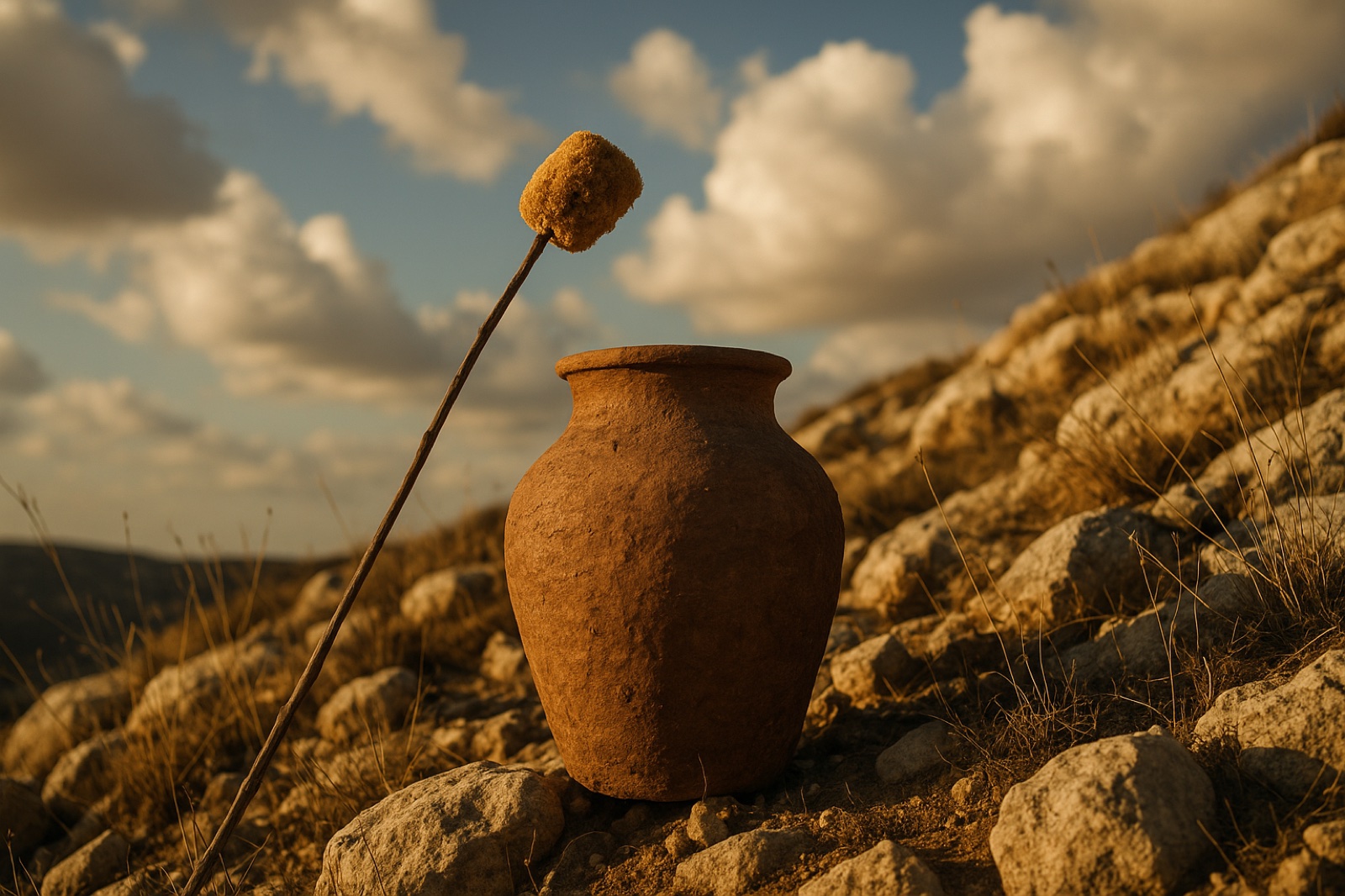
“After this, Jesus knowing that all things were now accomplished, that the scripture might be fulfilled, saith, I thirst. Now there was set a vessel full of vinegar: and they filled a spunge with vinegar, and put it upon hyssop, and put it to his mouth. When Jesus therefore had received the vinegar, he said, It is finished: and he bowed his head, and gave up the ghost.”
John 19:28-30 (KJV)
The Word John Wrote Twice
Look at verse 28 again: “Jesus knowing that all things were now accomplished.” In Greek, that word “accomplished” is tetelestai. Same word, same form. The King James translators rendered it “accomplished” in verse 28 and “finished” in verse 30, which is a perfectly good choice in English, but it hides the echo that a Greek reader would hear straight away.
So the order John gives us is this:
- Jesus knows it is finished (verse 28).
- Jesus says, “I thirst,” and receives a sponge of sour wine on a hyssop stalk (verses 28-29).
- Jesus says it is finished, and dies (verse 30).
In the middle of verse 28 there’s a third word from the same family. “That the scripture might be fulfilled” uses teleioō, a close relative of teleō. Most readers take it as pointing back to Psalm 69:21, “in my thirst they gave me vinegar to drink.” Even the thirst, John is saying, was part of the work being carried all the way to its end.
Here’s the part that’s easy to read past. Jesus already knew the work was complete, and he was still thirsty. Finished didn’t mean he stopped feeling anything. The completion was real before the body caught up with it, and he didn’t pretend otherwise. He said so out loud and asked for a drink.
Jesus Had Been Using This Word for a While
Tetelestai doesn’t come out of nowhere at the cross. On the road up to Jerusalem, Luke records Jesus taking the twelve aside and telling them, “all things that are written by the prophets concerning the Son of man shall be accomplished” (Luke 18:31). That “accomplished” is teleō again.
Then, on the night of his arrest: “this that is written must yet be accomplished in me, And he was reckoned among the transgressors: for the things concerning me have an end” (Luke 22:37). “Accomplished” is teleō, and “an end” is telos, the noun from the same root.
Put those beside John 19 and you can watch a sentence that was started on a dusty road get its full stop on a hill outside the city. “It shall be accomplished.” “It must yet be accomplished.” “It is finished.”
What About “Paid in Full”?
You may have heard that tetelestai was written on ancient receipts and meant “paid in full.” We’ve written about that angle before, and there is something real underneath it. It’s worth being exact about what that is.
The verb teleō really was the ordinary word for paying what you owed. You don’t need a museum to see that, because the New Testament uses it this way itself. When the tax collectors in Capernaum ask Peter, “Doth not your master pay tribute?” (Matthew 17:24), “pay” is teleō. When Paul writes, “For for this cause pay ye tribute also” (Romans 13:6), it’s teleō again. Ancient papyrus tax receipts use the same verb for dues that had been paid.
What’s less certain is the popular picture of the exact word tetelestai being stamped across every settled bill. That version gets told with more confidence than the evidence carries. The honest summary is that the debt meaning sits inside the word’s ordinary range, so a first-century listener could hear it, but John’s own context leans most heavily on something else, which is fulfilment. Scripture written, work given, work carried to its end.
Both meanings point the same way. Whether you hear “the debt is paid” or “the work is complete,” nothing is left hanging.
Finished Before It Feels Finished
This is where the double tetelestai reaches into a normal Tuesday. A lot of believers live as if their forgiveness is finished on paper but still being processed. They confess the same old failure for the fortieth time, just in case. They feel a pang of guilt and take it as proof that nothing was ever settled.
John’s order says something gentler. Jesus knew it was finished and was still thirsty. Feeling the thirst didn’t undo the finishing. In the same way, feeling the old guilt, the old fear, or the old ache doesn’t reopen what Jesus closed. The perfect tense is still true at 3am. It stays completed.
It also frees you to be honest. Jesus didn’t hide his thirst to look more finished. You don’t have to hide the ache to prove you believe. You can say “it is finished” and “I’m still hurting” in the same breath, because he did.
Paul uses a cousin of the same word for the work still going on in you: “he which hath begun a good work in you will perform it until the day of Jesus Christ” (Philippians 1:6). “Perform” there is epiteleō, to carry through to the end. The cross is finished. Your story is being finished. Neither one depends on how finished you feel today. If you want to sit with how the gap between knowing and feeling plays out in real life, this piece on spiritual bypassing shows why faith never asks you to skip the pain to prove the promise.
One more word from this family is worth knowing. When John writes that “perfect love casteth out fear,” “perfect” is teleios, love that has reached its end and purpose. Here’s what that changes about 1 John 4:18.
A good place to start: The Book of Matthew – Immersive Storytelling Format. Walk through the life of Jesus from his birth to the cross and the empty tomb, as if you were standing in the crowd. Get the free guide. Free.
Actions to Take
- Read John 19:28-30 and circle the two words. In whatever Bible or app you use, mark “accomplished” in verse 28 and “finished” in verse 30. Next to them, write “same word.” It takes one minute, and you’ll never read the passage the same way again.
- Name one thing you keep re-paying. Pick one failure, regret, or apology you keep going back to. Write it down in one line, and under it write “tetelestai – it stays finished.” Put it where you’ll see it tonight.
- Say both sentences out loud. The next time the old guilt or fear shows up, don’t argue with the feeling. Say, “It is finished,” then say honestly how you feel. Jesus did both on the same afternoon.
Journaling Prompts
- Where in your life do you know something is settled, but you still don’t feel it? Describe the gap.
- What do you tend to do when the feeling hasn’t caught up yet? Do you redo, re-confess, or hide it?
- If the thirst you feel isn’t evidence that anything is unfinished, what might it be instead?
A Prayer
God, I know the words “it is finished,” but some days I live like I’m still working off what I owe. Thank you that Jesus didn’t wait to feel finished before the work was done, and that he was honest about his thirst. Help me rest in what’s already complete, even when the old feelings come back. When I’m tired or afraid, remind me that what Jesus finished stays finished. Amen.
Discussion Question
Do you think the King James translators were right to use two different English words, “accomplished” and “finished,” for the same Greek word in John 19? Or would one word have helped readers see the connection? Tell us what you think in the comments.
Social Share Posts
Post 1:
I just learned that “accomplished” in John 19:28 and “finished” in John 19:30 are the same Greek word, tetelestai. Jesus knew it was finished, then said “I thirst.” Finished doesn’t mean you stop feeling.
Post 2:
Tetelestai is perfect tense, which means completed and still standing. It stays finished at 3am, even when I don’t feel it.
Post 3:
Something I needed today: Jesus didn’t hide his thirst to look more finished. I can say “it is finished” and “I’m still hurting” in the same breath.
Q&A
What does tetelestai mean?
Tetelestai is the Greek word translated “It is finished” in John 19:30, spoken by Jesus just before he died on the cross. It comes from the verb teleō, meaning to complete or carry something through to its end. It is in the Greek perfect tense, which describes an action completed in the past whose result still stands, so it means “it has been completed and remains completed.”
Does tetelestai appear more than once in John 19?
Yes. The same Greek word, tetelestai, appears in John 19:28, where the King James Version translates it “accomplished”: “Jesus knowing that all things were now accomplished.” Two verses later, in John 19:30, the King James Version translates the same word “finished.” Between the two, Jesus says “I thirst” and receives sour wine on a sponge.
Does tetelestai mean “paid in full”?
The verb behind tetelestai, teleō, was the ordinary Greek word for paying a tax or debt, and the New Testament uses it that way in Matthew 17:24 and Romans 13:6. So a debt meaning sits inside the word’s normal range. The popular claim that the exact form tetelestai was stamped on every settled receipt is stated more confidently than the evidence supports. In John 19, the surrounding context points mainly to fulfilment and completion.
How do you pronounce tetelestai?
Tetelestai is commonly pronounced “teh-TEL-eh-sty” in English, with the stress on the second syllable and the final syllable rhyming with “sky.” Pronunciation of ancient Greek varies between teaching traditions, so slight differences are normal.
What were Jesus’ last words on the cross?
The Gospels record different final words from Jesus on the cross. The Gospel of John records “It is finished” (tetelestai) in John 19:30. The Gospel of Luke records “Father, into thy hands I commend my spirit” in Luke 23:46. Many readers understand the two as different moments of the same final scene, each Gospel writer preserving a different saying.