 0
0
 0
0
Imagine ordering sunlight the way you order a taxi. You open an app, drop a pin on your street, and a few minutes after sunset a patch of soft light lands on your town from space.
That is the pitch. A California company called Reflect Orbital wants to put giant space mirrors in orbit and bounce the sun back down to Earth after dark. In July 2026, the United States government gave it permission to launch the first one.
Astronomers are not happy. Some say a full fleet of these mirrors would end the night sky as we know it. The company says most people will never even see the light.
Here is what is actually planned, what the numbers say, and one question nobody in the paperwork seems to be asking.
What the space mirrors actually are
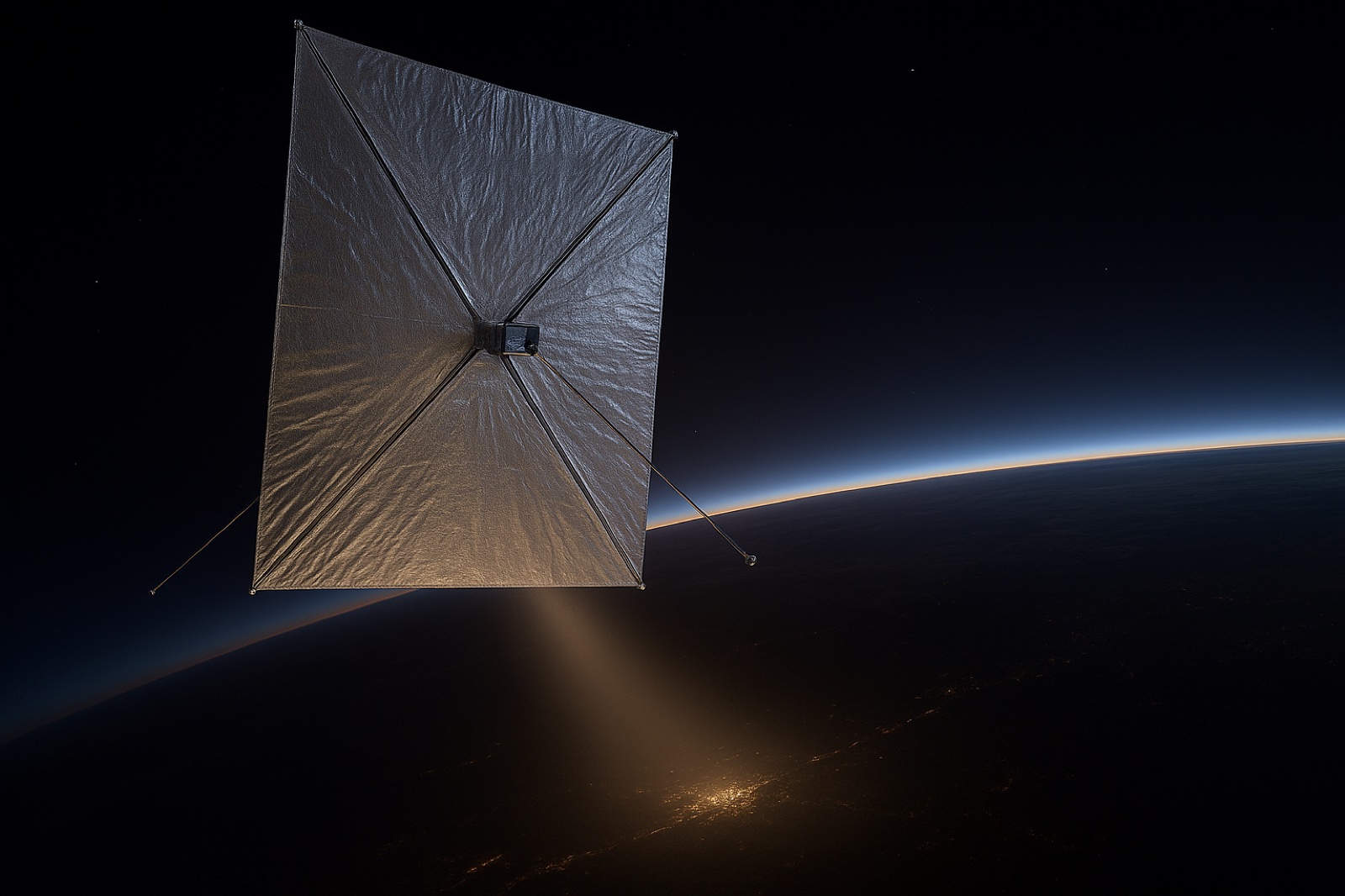
The first satellite is called Eärendil-1. It is small. The whole thing weighs about as much as two adults, and it launches folded up in a box about the size of a microwave oven.
Once it is in orbit, roughly 600 kilometres up, it unfolds a square sheet of thin, mirror-like plastic film coated in aluminium. Each side is about 18 metres. Picture a shiny square a bit wider than a tennis court is long, floating in space.
The satellite tilts that sheet so sunlight hits it and bounces down to one chosen spot on the ground. The lit patch is about 5 kilometres wide. The company’s goal is light about as bright as a full moon.
The US Federal Communications Commission approved the satellite on 9 July 2026. The launch is planned for later this year, riding along on a SpaceX rocket.
And this is just the test. The company has said it wants as many as 50,000 larger mirrors in orbit by 2035.
Who wants sunlight at night?
More people than you might guess. By the end of 2025 the company said it had received more than 260,000 requests for light through its website.
Its stated uses are real ones. Lighting a disaster zone so rescue crews can keep working after dark. Giving a search-and-rescue team a few more minutes to look. Lighting a construction site in a place with no power. And the big one: shining extra light on solar farms after sunset so they keep making electricity.
None of that is silly. A rescue team working under moonlight-bright sky instead of pitch black is a genuine good.
What astronomers say will happen
The worry is not really about one test satellite. It is about what happens when there are thousands.
A study led by Miroslav Kocifaj of the Slovak Academy of Sciences, accepted for publication in the Astrophysical Journal Letters, modelled the effect. Inside the 5-kilometre target zone, one mirror would look about 40 times brighter than the full moon. From 14 kilometres away, it would still look about as bright as the full moon. Four hundred mirrors working together could shine like 10,000 full moons, which is around 2.4 percent as bright as the sun. The glow could be seen from as far as 80 kilometres away.
A separate peer-reviewed study by Olivier Hainaut of the European Southern Observatory, published in July 2026, looked at the full 50,000-satellite plan. His estimate: the whole night sky, everywhere, would become three to four times brighter.
The quotes from scientists are blunt. Samantha Lawler of the University of Regina called the plan “incompatible with astronomy.” Scott Young, an astronomer at the Manitoba Museum planetarium, said it “will completely kill astronomy” and that one pass over a big telescope could “pretty much fry the camera.” Danielle Pahud, who runs a planetarium at the University of Manitoba, put it this way: “Nighttime as we know it will be gone.”
More than 1,800 public comments were filed against the plan. Groups that protect dark skies also raised a quieter concern: bright light at night confuses the body clocks of people and animals alike. Birds that migrate at night, insects, sea turtles finding the ocean, all steer by the dark.
If you want to feel the scale of that, step outside on the next full moon and notice how much you can see. Now imagine ten thousand of them.
The company’s answer
Reflect Orbital says the fears are overblown. Its points, in plain terms:
- The light is aimed. It goes to a chosen spot, not everywhere.
- Observatories and protected wildlife areas would get exclusion zones the mirrors steer away from.
- Any satellite can be switched off so it reflects nothing.
- The light cannot be focused tighter than ordinary sunlight, so it cannot start fires or hurt eyes.
- It has commissioned outside research on the environmental effects.
Its summary line: “most people and most places will never see this light.”
Both sides can be partly right. A single aimed mirror over a flood zone is a very different thing from fifty thousand of them lighting solar farms every night. The test is small. The plan is not.
Two numbers that don’t match
Here is the detail that gets lost in the headlines.
The company describes its satellite as looking about four times brighter than the full moon from inside the beam. The independent study says about forty times. That is a tenfold gap, and it has not been settled. Both numbers come from models. Nobody has watched one of these mirrors work from the ground yet. The first launch is partly about finding out who is closer to right.
And the second number, which almost nobody repeats: the light lasts about four minutes.
The satellite does not hover. It is moving fast, like every satellite in low orbit. It passes over your town, the beam sweeps through, and it is gone. “Sunlight on demand” from one mirror means roughly four minutes of moonlight-bright light, then dark again.
That is why the plan is 50,000 and not 50. To make light last, you need one mirror after another, each handing the spot to the next. The test satellite is a flashlight. The business is a chain of them.
The assumption underneath the whole idea
Read the pitch again and one idea sits underneath all of it. Night is wasted time. The sun clocks off, and for half of every day the planet is just waiting. Light it up and you get the hours back.
That is a very new way to think about the dark. For nearly all of human history, no one could do anything about night, so no one thought of it as a problem. It was simply the other half of the day.
There is an old story about how the world began, and it treats the dark differently from the way the pitch does. Light and dark get separated, and then each gets its own name. The night gets its own lesser light to rule it, the moon and the stars. And when it is all set out, the whole arrangement, dark half included, is called good. Later writers in the same tradition say the night is when the animals come out and people go home to rest, and that the night sky itself is saying something, if you are quiet enough to hear it.
In that way of seeing, the dark is not a gap God forgot to fill. It is a built-in stop. The half of the day where you are not supposed to be productive.
Which would mean the thing the mirrors are designed to remove is the thing we may need most.
What you can do tonight
None of this is up to you. The licence is granted, the rocket is booked. But a few things are.
- Go outside after dark this week. Find the moon, or a few stars, from wherever you are. Right now that view is free and unchanged. Notice it on purpose.
- Treat your own night like it has a job. The mirrors are an argument that dark hours should be useful. Try the opposite for one evening: dim the lights, put the phone down an hour early, let the day actually end.
- If sleep is the hard part, our free Why Can’t I Sleep? assessment takes two minutes and tells you which of the common causes is most likely yours.
Astronauts who have seen Earth from orbit often come home talking about the thin blue line of air and how fragile it looks. We wrote about that view and what it does to people. The dark side of the planet is part of that view too. From up there, the night is not empty. It is where the cities glow like embers and everything else rests.
Later this year, a mirror the size of a tennis court will unfold above it and try to send a little of the day back down. It may work. It may be the first of fifty thousand. Either way, tonight the dark is still there, doing what it has always done.
Maybe it was never a problem.
A good place to start:
Why Your Mind Won’t Slow Down at Night (Free)
A short guide to why your thoughts speed up the moment the house goes quiet, and the five-step order that lets your body and mind settle. Get the free guide. Free.
Discussion question
If you could order four minutes of moonlight-bright sky over your town tonight, would you? Or do you think the dark should be left alone? Tell us in the comments.
Share this
A startup got approval to beam sunlight down at night from space mirrors. Astronomers say a fleet could shine like 10,000 full moons. The detail nobody mentions: the light lasts about four minutes. https://bgodinspired.com/index.php/nature-and-creation/space-mirrors-sell-sunlight-at-night/
I thought “sunlight on demand” from space was a joke. It’s licensed and launching this year. The company says 4x a full moon. Scientists say 40x. Worth a read. https://bgodinspired.com/index.php/nature-and-creation/space-mirrors-sell-sunlight-at-night/
Every pitch for space mirrors assumes night is wasted time. Read this and tell me the dark isn’t doing something on purpose. https://bgodinspired.com/index.php/nature-and-creation/space-mirrors-sell-sunlight-at-night/
Questions and answers
What are space mirrors?
Space mirrors are satellites that unfold a large sheet of thin, reflective film in orbit and tilt it to bounce sunlight down to a chosen spot on Earth after sunset or before sunrise. The company Reflect Orbital plans to launch its first one, Eärendil-1, an 18-metre square mirror, in 2026. It is designed to light a patch about 5 kilometres wide for roughly four minutes per pass.
Did the FCC approve Reflect Orbital’s space mirror?
Yes. On 9 July 2026 the US Federal Communications Commission licensed Reflect Orbital to build, launch and operate its first demonstration satellite, Eärendil-1, with a two-year authorisation for its radio communications. The licence covers one test satellite. The company has separately applied to begin deploying a larger constellation from 2027, with a stated goal of up to 50,000 mirrors by 2035.
How bright would space mirrors be from the ground?
The numbers disagree. Reflect Orbital says one mirror would appear about four times brighter than the full moon from inside its beam. An independent study led by Miroslav Kocifaj of the Slovak Academy of Sciences estimates about 40 times brighter inside the 5-kilometre target zone, as bright as a full moon from 14 kilometres away, and a visible glow up to 80 kilometres away. Four hundred mirrors together could shine like 10,000 full moons.
Why do astronomers oppose space mirrors?
Astronomers say a large fleet of space mirrors would brighten the whole night sky. A peer-reviewed study by Olivier Hainaut of the European Southern Observatory estimated a full 50,000-satellite fleet would make the night sky three to four times brighter worldwide, and warned a single pass could ruin an exposure at a major observatory. More than 1,800 public comments were filed against the plan. Dark-sky groups also warn that light at night disrupts the body clocks of people and nocturnal wildlife.
How long does the light from a space mirror last?
About four minutes per pass over any one location. The satellite orbits Earth at low altitude and moves fast, so its beam sweeps across a spot and moves on. Continuous light would require many satellites handing the spot to one another, which is why Reflect Orbital’s long-term plan calls for tens of thousands of mirrors rather than a few.