 0
0
 0
0
A laser doesn’t have to be made of light. That sentence probably doesn’t parse right the first time you read it — lasers are light, aren’t they, the pointer on your desk, the scanner at the grocery store checkout, the beam Star Wars ruined for the rest of us. But a team of physicists in upstate New York just built one out of sound.
Not sound like a speaker makes. Sound at a scale so small you’d need instruments built for atoms to see it moving — and it turns out to be precise enough to detect the pull of gravity itself, more precisely than instruments built out of light or radio waves ever could.
What Is a Phonon Laser, Exactly?
You already know roughly what a normal laser does: it takes light and forces it into a tight, coherent beam, every photon moving in lockstep instead of scattering in every direction the way light from a lightbulb does. A phonon laser does the same trick, but with sound instead of light. Physicists call the smallest possible unit of sound or vibration a “phonon” — the acoustic cousin of a photon. Line enough phonons up, moving in the same precise rhythm, and you get something that behaves less like a stray vibration and more like a beam.
For decades, that idea stayed mostly theoretical. Controlling light precisely enough to build a laser was already hard. Controlling something as messy and heat-sensitive as vibration turned out to be harder. This year, two separate research teams each found a different way through.
The Lab That Turned a Sound Laser Into a Gravity Detector
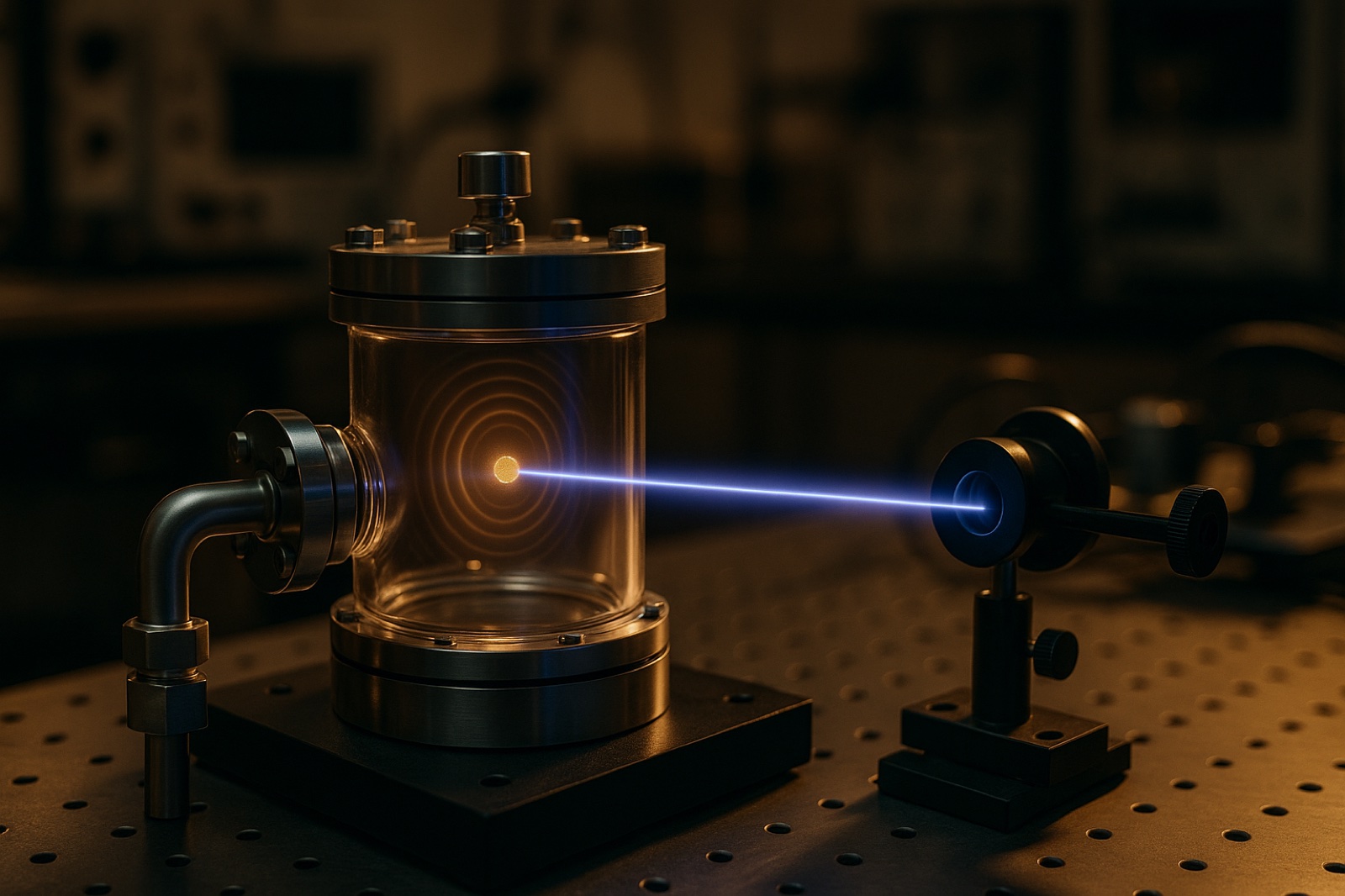
The first breakthrough came out of the University of Rochester, led by physicist Nick Vamivakas along with colleagues at the Rochester Institute of Technology, and published in the journal Nature Communications. Using optical tweezers to trap a nanoscale object inside a vacuum chamber, the team built what they’re calling a “squeezed phonon laser” — squeezed being a technique borrowed from quantum optics that reduces the random thermal jitter that normally limits how precisely you can measure anything this small.
“By pushing and pulling on a phonon laser with light in the right way, we can reduce that phonon laser fluctuation significantly,” Vamivakas explained. Less fluctuation means a far steadier signal — and a far steadier signal means the device can detect acceleration and gravitational forces with a precision that reportedly outperforms comparable light-based lasers or radio-frequency instruments.
That precision isn’t just a lab curiosity. The team believes it could lead to “quantum compasses” — navigation systems that don’t need satellites at all, sensing gravity and inertia directly instead of talking to GPS, which makes them, in theory, unjammable. It also opens a new, more sensitive window into quantum entanglement and some of physics’ oldest open questions about gravity itself.
Then a Second Lab Found a Completely Different Way to Control Sound
A few months later, in June 2026, a team at McGill University, working with the National Research Council of Canada and using crystal material synthesized at Princeton, built something aimed at a different problem entirely. Their device pushes an electric current through a crystal layer only a few atoms thick, cooled to just above absolute zero. Pushed hard enough, the trapped electrons release their energy as bursts of phonons — sound-like vibrations — in patterns the researchers can tune and predict.
Where Rochester’s device is built to feel gravity, McGill’s is built to talk through the places light and radio can’t reach. Sound moves through water, rock, and tissue in ways electromagnetic signals simply don’t. Researchers see a path toward communication in deep ocean environments and new options for medical diagnostics — places where a phone signal is useless but a well-controlled vibration might not be.
Why This Is a Bigger Deal Than It Sounds
Two different labs, two different countries, two completely different tools — but both are chasing the same underlying idea: sound, controlled with the same precision physicists have spent sixty years learning to apply to light. It’s part of a pattern quietly stacking up in physics labs this year. A separate team recently proved that light itself can now be reshaped in trillionths of a second, faster than anyone thought a device could manage. Around the same time, another group engineered a plastic that fully dissolves itself on command. The tools keep getting stranger. So does the level of control scientists are learning to exert over the basic materials of the physical world.
An Old Claim Buried in the Vibrations
There’s something almost funny about where all this lands, though. Physicists spent decades bending light to their will — lasers, fiber optics, the entire modern world runs on photons doing exactly what we tell them. And now the next frontier turns out to be sound: precise, controlled vibration, shaped carefully enough to measure gravity and carry information through walls nothing else can get through.
It’s an old idea, dressed up in new equipment. Long before anyone had a word for “phonon,” ancient texts described the world itself coming into being not through force or collision, but through voice — spoken into order, shaped by sound rather than built by hand. Whether or not you put any stock in that, it’s a strange thing to notice: the most precise tool physicists have found yet for touching the fabric of reality is, in its own quiet way, sound. Something got there first, saying it might work that way.
What’s Next
Humans have been trying to shape the world with whatever tool was closest at hand for longer than anyone can prove. The oldest confirmed tool of its kind in Europe is a 500,000-year-old bone hammer, shaped by hands trying to bend the world into something more useful. The tools have just gotten considerably more precise since then — from a chunk of elephant bone to a vacuum chamber that can hear gravity move.
None of this proves anything about how the universe began — it’s a lab instrument, not a philosophy. But the next time someone tells you a physics headline sounds cold and mechanical, this one’s worth a second look. Somewhere in a vacuum chamber in Rochester, a beam of pure, ordered sound is quietly measuring the pull of gravity — closer, some might say, to that old idea than anyone in the lab probably meant to get.
What Do You Think?
If it turns out that sound and vibration are just as fundamental to how the universe works as light is, does that change how you think about the old claim that the world was “spoken” into being — or is that reading too much into a coincidence? Tell us what you think in the comments.
Share This
- Scientists just built a laser out of pure sound instead of light — and used it to measure gravity itself. Physics keeps getting weirder in the best way.
- Two labs, two continents, one idea: sound can now be controlled precisely enough to feel gravity or carry a signal through solid rock. We’re only getting started with what “phonon lasers” can do.
- A “sound laser” precise enough to detect gravity, built the same year as a plastic that dissolves on command and a crystal that bends light in trillionths of a second. Something’s in the water in physics labs this year.
Questions People Are Asking
What is a phonon laser?
A phonon laser is a device that produces a coherent, amplified beam of sound-like vibrations, the same way a normal laser produces a coherent beam of light. “Phonon” is the physics term for the smallest possible unit of sound or vibration, similar to how a “photon” is the smallest unit of light.
How does a phonon laser measure gravity?
The University of Rochester’s “squeezed phonon laser” traps a nanoscale object with optical tweezers inside a vacuum chamber and uses a noise-reduction technique called squeezing to eliminate random thermal fluctuation. With that noise removed, the device can detect tiny changes in acceleration and gravitational pull with a precision that reportedly surpasses comparable light-based or radio-frequency instruments.
Who built the phonon laser that can measure gravity?
Physicist Nick Vamivakas of the University of Rochester led the research with colleagues at the Rochester Institute of Technology, publishing their findings in the journal Nature Communications.
What does the McGill quantum sound device do?
Announced in June 2026, the McGill University device pushes electrons through an ultra-thin crystal layer cooled near absolute zero, releasing controllable, tunable bursts of phonons. Rather than measuring gravity, it’s aimed at communication in environments like deep ocean water and medical diagnostics, where light and radio signals don’t travel well.
What could phonon lasers be used for in the future?
Researchers point to “quantum compasses” — satellite-free, unjammable navigation systems that sense gravity and inertia directly — along with new tools for probing quantum entanglement, deep-ocean and through-obstacle communication, and more sensitive tests of fundamental physics.