 0
0
 0
0
On July 31, 2026, a team of physicists announced something that sounds like science fiction: they built a material that can control light itself, reshaping its behavior in trillionths of a second — faster than any device has ever managed before.
It’s called a photonic time crystal, and it’s the first one ever built that works with visible-adjacent light in a real, working device. The research, published in the journal Nature, came from an international team at École Polytechnique, the Collège de France, and the Helmholtz-Zentrum Dresden-Rossendorf (HZDR) in Germany. And the applications — faster internet, sharper medical scans, a whole new class of lasers — are still just the opening chapter.
What Is a Photonic Time Crystal?
You already know what a normal crystal is, even if you’ve never thought about it that way. Salt, quartz, diamonds — they’re all built from atoms arranged in a pattern that repeats over and over in space. Look at one corner of the pattern, and you can predict what the next corner looks like.
A photonic time crystal takes that same idea and moves it from space into time. Instead of a pattern that repeats as you move across the material, it’s a pattern that repeats as time passes — the material’s optical properties flip back and forth on a fixed rhythm, over and over, without needing a fresh burst of energy every single cycle to keep the pattern alive.
Scientists have talked about time crystals as a theoretical idea for years. What’s new here is that this team actually built one that works with terahertz light — a fast, high-frequency type of radiation that sits between everyday radio waves and the light your eyes can see.
Why Terahertz Light Is So Hard to Control
Terahertz light already shows up in your life more than you’d guess — it’s used in airport security scanners, some medical imaging, and it’s considered one of the leading candidates for the next generation of wireless communication after 5G and 6G. The problem has always been control. Terahertz light moves and changes so fast that ordinary materials simply can’t switch their behavior quickly enough to keep up with it.
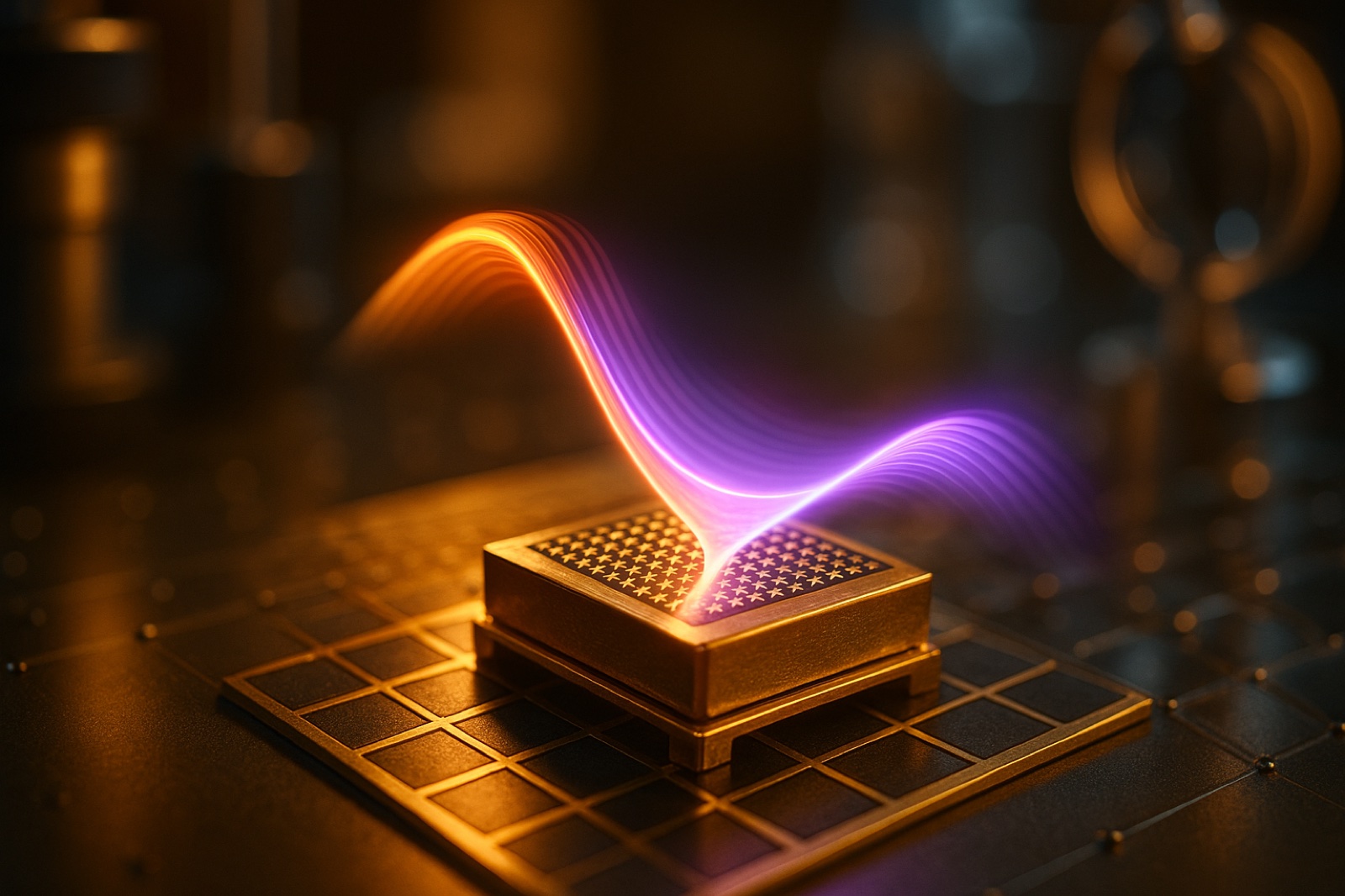
To solve that, the researchers built a metamaterial — a manufactured material engineered to do things natural materials can’t — out of gold and semiconductor components. They hit it with an ultra-intense terahertz laser pulse from a specialized facility in Germany, and the material’s optical properties began oscillating trillions of times per second, fast enough to actually keep pace with the light passing through it.
The early results are striking on their own: the device cut the energy loss of the trapped light roughly in half. That’s the kind of number that gets an entire field’s attention, because energy loss is the thing that’s been quietly limiting how fast and how far we can push light-based technology.
What This Could Actually Mean for You
Right now, this is still a laboratory device, not something in your phone. But the direction is clear. Researchers are already pointing to faster optical computers that move data at the speed of light instead of the speed of electricity, wireless networks that carry far more information with far less power loss, sharper and faster medical imaging, and an entirely new category of lasers that can be tuned to behave almost however an engineer wants, on demand.
It’s part of a pattern that keeps showing up in physics labs lately — researchers finding that the universe’s most basic building blocks behave far stranger, and far more precisely, than intuition suggests. It’s the same instinct behind the discovery that two entangled particles could stay perfectly connected even through one of the busiest fiber-optic cables in a major city, or the growing case for a hidden fifth dimension that might explain what’s actually holding the universe together. Reality keeps turning out to have more structure hiding inside it than we assumed.
An Old Claim About Light
There’s a strange footnote buried in all of this. Long before anyone could measure anything in trillionths of a second, one of the oldest texts human beings still read made an equally strange claim: that light came first. Not the sun. Not the stars. Not one single object in the universe for it to reflect off of or bounce against. Light itself, spoken into being before there was anything else there to hold it.
For most of history, that idea sounded almost backwards — how can there be light with nothing yet shining, nothing yet lit? But standing in a lab that just proved light behaves stranger, and more fundamentally, than intuition ever suggested, the old claim reads a little differently. Whatever wrote that first line seemed to understand something about light that it took the rest of us until this week to start catching up to.
It’s a small thing. It doesn’t ask you to believe anything. It’s just there, sitting quietly next to the physics — the same way NASA’s Psyche mission took the “long way” to a metal asteroid on purpose, exactly as planned. Sometimes the thing that looks like a detour, or a coincidence, turns out to have been the plan all along.
What’s Next
Labs around the world are already working on scaled-up, more efficient versions of this technology. It will likely be years before it shows up in a consumer device — but the foundational proof, the part that was genuinely uncertain until last week, is now done. Someone built a material that can reshape light faster than light itself seemed to allow.
And somewhere in that trillionths-of-a-second flicker, an old, strange claim about light being first — first before the sun, first before anything — just got a little harder to dismiss as poetry.
Discussion Question
Does knowing that scientists can now control light this precisely change how you think about something as ordinary as the light in the room around you right now? What’s the most “ordinary” thing you suspect is actually hiding something extraordinary? We’d love to hear your take in the comments.
Share This
- Scientists just built the first photonic time crystal — a material that controls light in trillionths of a second. Wild that we’re still discovering how strange light actually is.
- A new study out of France and Germany just proved you can reshape light itself faster than any device ever has before. And somehow, an ancient text got there first — just saying “light came first,” long before anyone could measure it.
- Terahertz light, a metamaterial made of gold, and an energy-loss cut in half. This new “photonic time crystal” breakthrough is one of those stories that makes the ordinary world feel a lot less ordinary.
Questions People Are Asking
What is a photonic time crystal?
A photonic time crystal is a material engineered to rapidly and repeatedly change its optical properties over time, instead of repeating a pattern in space the way a normal crystal’s atomic structure does. The first working version was built by an international research team and published in the journal Nature on July 31, 2026.
How fast can a photonic time crystal control light?
The device controls light in trillionths of a second — fast enough to reshape terahertz light behavior far beyond what any earlier optical device could manage.
What is terahertz light used for?
Terahertz light sits between microwaves and visible light on the electromagnetic spectrum. It’s already used in security scanners and some medical imaging, and it’s considered a leading candidate for future 6G-style wireless communication — though it has historically been very difficult to control and direct.
Who built the first photonic time crystal?
Researchers from École Polytechnique, the Collège de France, and the Helmholtz-Zentrum Dresden-Rossendorf (HZDR) in Germany built the device, using a gold-and-semiconductor metamaterial powered by an ultra-intense terahertz laser.
What could photonic time crystals be used for in the future?
Early results show the technology cuts energy loss of trapped light roughly in half. Researchers believe it could eventually lead to faster optical computers, more efficient wireless networks, sharper medical imaging, and a new generation of highly adjustable lasers.