 0
0
 0
0
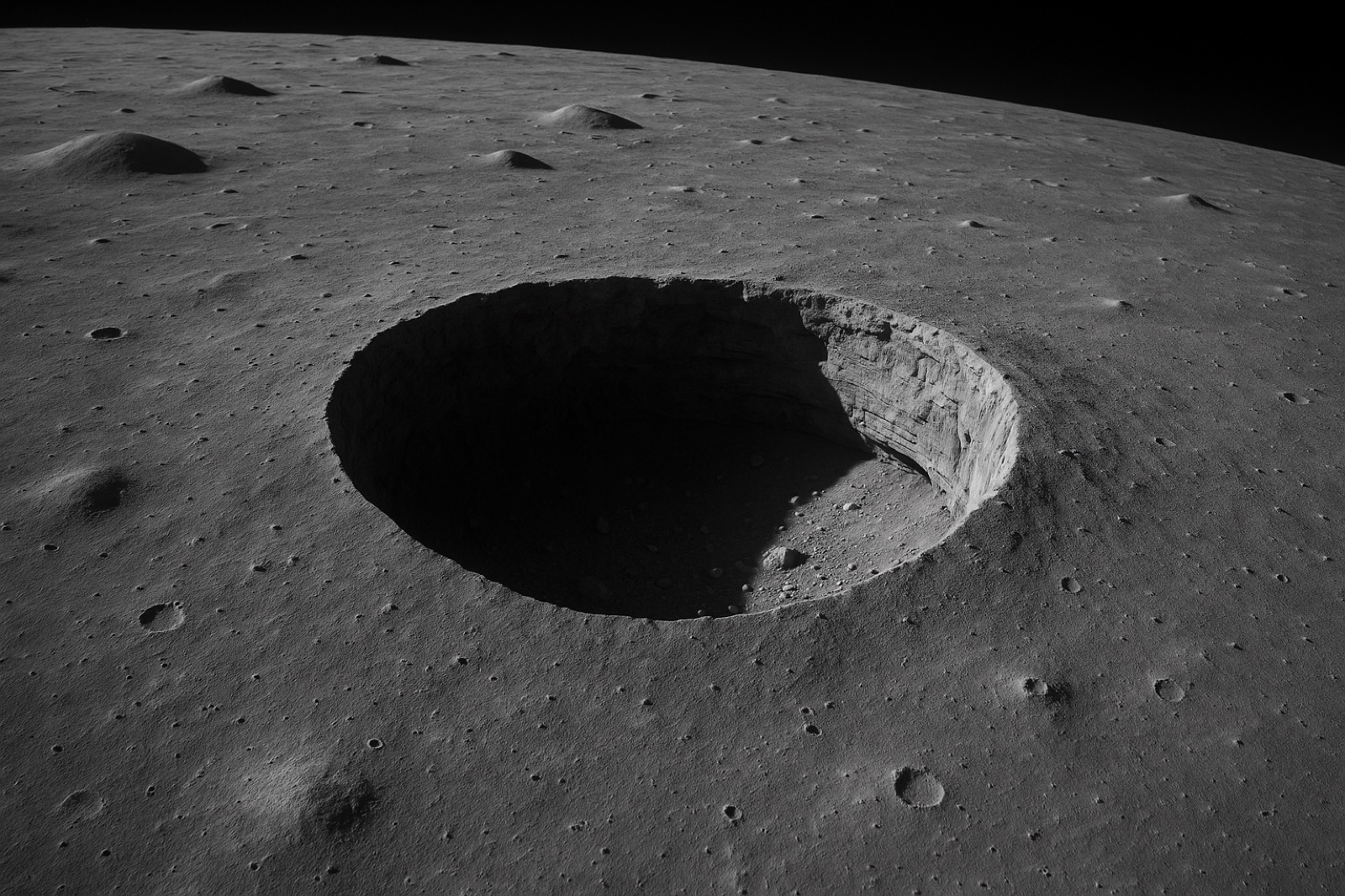
There is a hole on the Moon. It has been sitting in the photographs since 2009, and nobody is sure how deep it really goes.
The interesting question was never the hole itself. It was whether that hole is a skylight — an opening into a moon cave big enough to stand up in and walk around.
In the first days of October 2026, NASA picked a mission to go and find out.
Why a Moon Cave Is Suddenly Worth a Whole Mission
The hole is called the Marius Hills Pit. It sits in an old volcanic region on the side of the Moon that always faces us. Japan’s Kaguya spacecraft spotted it from orbit — a dark circle punched clean into grey ground.
Here is the first odd thing. Seventeen years later, the published measurements still do not agree with each other. Depending on which images you use and how you measure, you get somewhere between roughly 50 and 90 metres across, and somewhere between about 30 and 40 metres deep. That spread is not sloppiness. It is what happens when your only ruler is a camera a hundred kilometres up, looking down a shaft that is mostly shadow.
What everybody agrees on is that the pictures stop. The light goes in and does not come back out with an answer.
Then, in 2017, something else showed up. A team working with radar data from that same Kaguya spacecraft reported a strange echo near the pit: the signal dropped away sharply, then returned as a second strong peak from roughly 225 metres down. That is the pattern you would expect if the radar had passed through empty space. Their published wording was careful — possible evidence of an intact lava tube.
Possible. For nine years, that has been as far as anyone could get from orbit.
A good place to start: The Beginner’s Guide to Feeling God’s Presence Every Day. A short, simple guide to noticing God in ordinary moments — the commute, the kitchen, the waiting room — even when life feels loud. Get the free guide. Free.
How You Look for a Hollow You Cannot See
The new mission is called GIMLI — Geophysical Instruments for Marius Lunar pit Investigation. It is led by Than Putzig of the Planetary Science Institute, and funded through a NASA programme that buys rides to the lunar surface on commercial landers. Honeybee Robotics is building much of the hardware. The ground-penetrating radar is coming from the Norwegian Space Agency.
Radar, a gravity meter, cameras. That much you could have guessed.
The part nobody would have guessed is the seismic plan. GIMLI intends to make its own vibrations on the Moon and listen to how they come back. In the trade it is called an active-source seismic survey, and it is the oldest trick in field geology: hit the ground, time the echo, work out what is underneath. A hollow sounds different from solid rock.
According to Putzig, nobody has deliberately done that off Earth in half a century. His words: “It’s long been a desire of mine to reintroduce intentional active-source seismic methods to planetary science, as it has essentially not been done since the Apollo astronauts conducted the first seismic surveys on the Moon.”
Read that twice, because it is the detail the coverage skips. We have mapped the entire lunar surface. We have brought rocks home. We have pulled samples off the far side and found minerals in them that had never been seen on the Moon before. We are building satellites to park behind the Moon and listen for the universe before the first star. And yet the last time anyone stood on the Moon, made a bang on purpose and listened for what was under their feet, it was the Apollo crews.
Putzig is also plain about the downside, which is rarer than it ought to be. If the instruments find no cave, that is not a wasted trip — it still tells you how the pit formed and what the ground there is made of. A mission built so the disappointing answer is also a real answer is a well-built mission.
Why a Hole Is Worth This Much Trouble
Now the practical part, and this is where it stops being astronomy and starts being about shelter.
The surface of the Moon is a brutal place to keep a person alive. There is no air to even out the temperature and no magnetic field to turn away radiation. Across the Moon’s long day and long night, exposed ground swings from roughly 127°C down to about −173°C. Micrometeorites arrive at speed with no atmosphere to burn them up. Every one of those problems has to be solved by whatever you carried with you.
Unless you go inside.
In 2022, researchers at UCLA and the University of Colorado Boulder published something quietly remarkable in a peer-reviewed journal. Using the thermal camera aboard NASA’s Lunar Reconnaissance Orbiter, they measured the permanently shaded floor of a different lunar pit, this one in Mare Tranquillitatis.
The shaded part sits at about 17°C. Room temperature. Steady. While the ground a few dozen metres above it is cooking and then freezing, the shadow at the bottom of the hole simply holds.
No insulation. No power. No clever new material. Just rock, thick enough and old enough not to care what the Sun is doing.
That is why a cave is worth a mission. After everything we have learned about making materials, the best answer anyone has for radiation, for three hundred degrees of temperature swing, for things arriving at rifle speed, is still to get inside a rock and let the stone take it.
The Oldest Shelter Idea There Is
It is worth sitting with how old that answer is.
Long before anyone wrote an engineering proposal, people living in hot, dry, dangerous country did exactly this. They did not build shelter first. They found it. A cleft in a cliff face. An overhang. A cave mouth. The rock was already there, already cool, already older than every problem they had, and the entire skill was knowing where to get in.
And when those same people reached for a picture of what God was like, that is the one they used. Not a tower they built. Not a wall they manned. A rock. A hiding place in the stone. Something you did not make, cannot improve, and only have to climb inside of.
It is a strange thing to find that image again at the bottom of a mission proposal, written in the language of radar returns and seismic velocity.
What Happens Next
No launch date has been announced. GIMLI has been selected, not flown — the instruments still have to be built, and they still need a commercial lander and rover heading for the right patch of the Moon.
But at some point, if it all holds together, a small machine is going to sit beside a hole that has been photographed and argued over for nearly twenty years, and thump the ground, and listen.
Either the echo comes back hollow, or it does not.
Either way, a question that has been open since 2009 finally gets an answer. Not from a better picture. From knocking.
Something to Try Tonight
- Go find the neighbourhood. The pit itself is far too small to see from Earth, but the region around it is not hard to place. Look at the Moon and find the large dark plain on the western side of the face that points at us — that smooth grey area is old volcanic ground, and the Marius Hills sit inside it. You are looking at the right part of the Moon with nothing but your eyes.
- Watch it across a week. The Moon is lit from a different angle every night, and low sunlight throws long shadows that make hills and domes stand out. The same patch of ground looks like a different place from one night to the next. It costs nothing, and it works from anywhere on Earth. If you want a reason to start, the Hunter’s Moon on 26 October 2026 is as good a night as any.
One Question
If a cave really is down there — room temperature, shielded, already built by a volcano a few billion years ago — should the first long-term human base on the Moon go underground, or should we stay on the surface where we can see out?
Tell us what you’d choose in the comments. There is no expert answer to this one yet, which is exactly what makes it interesting.
Worth Passing On
- There’s a hole on the Moon nobody has been able to measure properly since 2009. NASA just picked a mission to go thump the ground next to it and listen for a cave. https://bgodinspired.com/index.php/bible-resources/bible-and-science/moon-cave-marius-hills-pit/
- Fun fact I did not expect: the last time anyone deliberately set off a seismic survey on the Moon, it was the Apollo astronauts. A new mission is bringing the technique back to find a cave. https://bgodinspired.com/index.php/bible-resources/bible-and-science/moon-cave-marius-hills-pit/
- The Moon’s surface swings from about 127°C to −173°C. The shaded floor of a lunar pit sits at a steady 17°C. After all our materials science, the best shelter plan is still: get inside a rock. https://bgodinspired.com/index.php/bible-resources/bible-and-science/moon-cave-marius-hills-pit/
Questions People Ask
Is there really a cave under the Moon’s surface?
It is strongly suspected but not confirmed. Radar data from Japan’s Kaguya spacecraft, analysed in a 2017 study, showed an echo pattern near the Marius Hills Pit consistent with an empty space roughly 225 metres below the surface, which researchers described as possible evidence of an intact lava tube. Nobody has measured one directly. NASA’s GIMLI mission was selected in October 2026 specifically to settle the question from the lunar surface.
What is the Marius Hills Pit?
The Marius Hills Pit is a roughly circular hole in an ancient volcanic region on the near side of the Moon, found in images from Japan’s Kaguya spacecraft in 2009. Published measurements vary with the method used, falling broadly between 50 and 90 metres across and 30 to 40 metres deep. It is thought to be a skylight — a place where the ceiling of an underground lava tube collapsed, leaving an opening.
What is the GIMLI mission?
GIMLI stands for Geophysical Instruments for Marius Lunar pit Investigation. It is a NASA-funded project led by Than Putzig of the Planetary Science Institute, selected in October 2026 through NASA’s PRISM programme, which sends instruments to the Moon aboard commercially provided landers. GIMLI will use ground-penetrating radar, seismic sensors, a gravity meter and cameras to look for an underground void beside the Marius Hills Pit. Honeybee Robotics is building much of the hardware and the Norwegian Space Agency is providing the radar. No launch date has been announced.
Why would astronauts live in a lunar cave?
Because the Moon has no atmosphere and no magnetic field, its exposed surface swings from roughly 127°C in sunlight to about −173°C at night, receives unfiltered radiation, and is struck by micrometeorites. A 2022 study by researchers at UCLA and the University of Colorado Boulder, using NASA’s Lunar Reconnaissance Orbiter, found that the permanently shaded floor of a lunar pit in Mare Tranquillitatis holds steady at about 17°C. Rock provides thermal stability and radiation shielding that no equipment carried from Earth can match for the same weight.
How deep is the Marius Hills Pit?
Estimates differ. Analyses of orbital imagery have put the depth of the Marius Hills Pit at roughly 30 to 40 metres, with the opening measuring somewhere between about 50 and 90 metres across depending on the images and measurement method used. The disagreement exists because the pit is measured from spacecraft about 100 kilometres overhead, looking down a shaft that is largely in shadow. Direct measurement from the surface has never been made.