 0
0
 0
0
Somewhere in your house right now, there’s a piece of plastic that will outlive you. Not metaphorically — literally. The toothbrush handle, the yogurt tub, the plastic fork from last week’s takeout. Depending on the type, it could still be sitting in a landfill or floating somewhere in the ocean 400 years from now, slowly shredding into smaller and smaller pieces that never actually disappear. That’s the quiet, uncomfortable math behind plastic pollution: almost everything we make is built to last far longer than we ever needed it to.
So when a team of scientists in Shenzhen announced they’d built a plastic that does the opposite — a material that works exactly like normal plastic until you tell it to stop existing, and then it’s gone within days — it sounded almost too convenient to be real.
A Plastic That Waits for a Signal
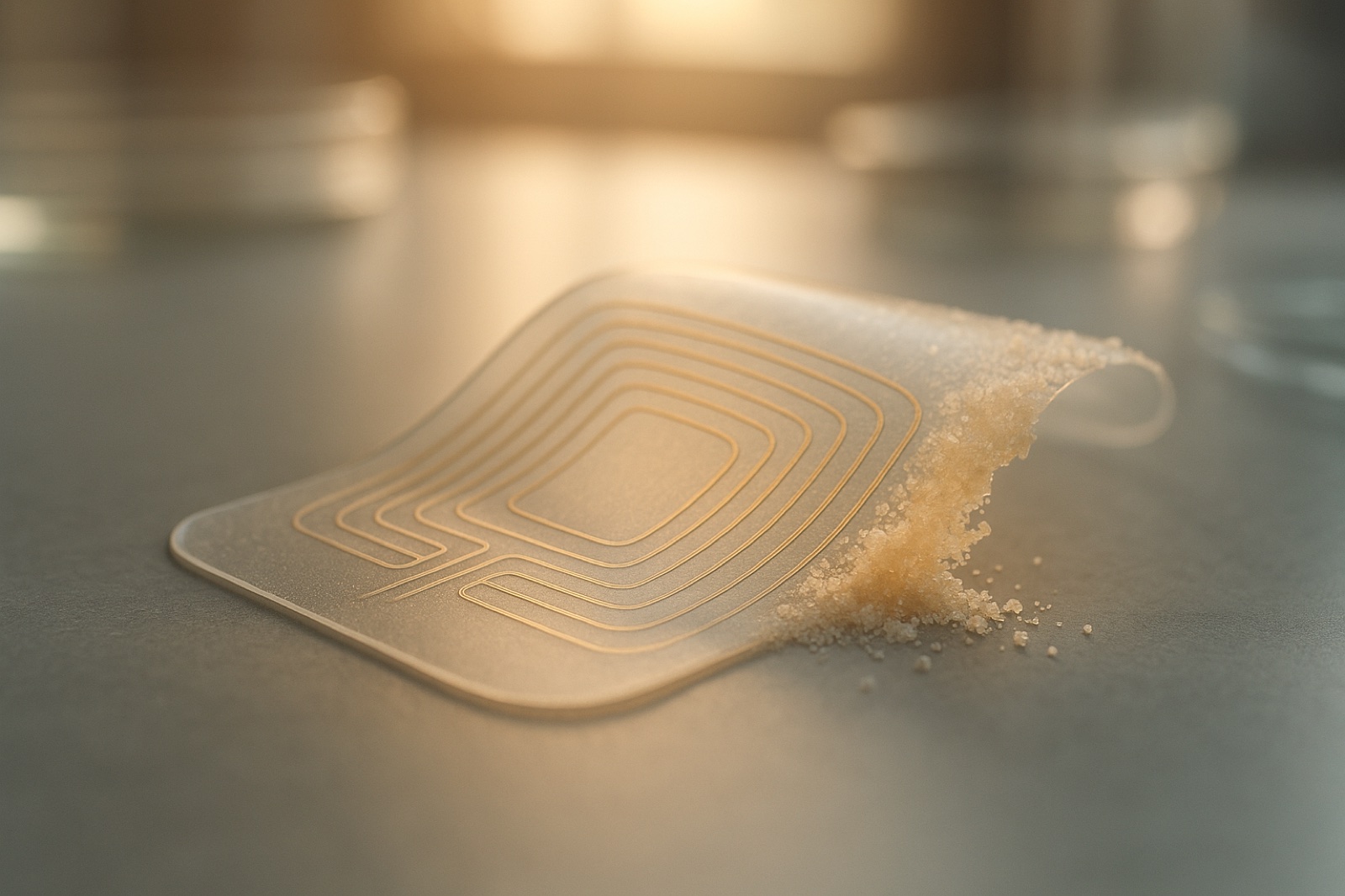
The material comes out of the Shenzhen Institute of Synthetic Biology, and it isn’t plastic with an additive sprinkled in to help it degrade a little faster. It’s something stranger: a living material. Researchers engineered two different strains of a common bacteria, Bacillus subtilis, and embedded them directly inside a plastic film in a dormant, spore-like state. As spores, they’re inert. The plastic behaves like any other piece of plastic — stable, durable, doing its job.
Then, on command, the bacteria wake up. One engineered strain acts like a random chopper, snipping the plastic’s long molecular chains into smaller fragments. The second strain follows behind it, working the fragments down from each end into their basic building blocks — small enough that they’re no longer plastic at all. In lab tests, the material fully broke down in just six days. Not fragmented into a cloud of microplastics, the way plastic normally “breaks down” when it’s left in the sun or in seawater. Fully broken down, into components with no plastic identity left.
To prove the material could actually function as a real product and not just a lab curiosity, the researchers built a wearable plastic electrode out of it — the kind of flexible sensor used in health monitoring — and ran it through real use. It performed the way a normal electrode would. Then, when its job was done, it degraded completely within two weeks, leaving nothing behind that needed to be collected, sorted, or shipped off to a landfill.
Why This Matters More Than It Sounds
The reason this isn’t just another feel-good lab headline: the material they chose to work with, polycaprolactone, is already used in real products — things like surgical sutures and certain 3D-printed medical devices. This isn’t a hypothetical plastic that might exist someday. It’s a familiar one, engineered to gain a new ability.
The researchers are already looking past the lab. Their next goal is figuring out how to trigger the same bacteria to activate in water — the environment where the vast majority of plastic pollution actually ends up, drifting in rivers and oceans long after anyone stopped paying attention to it. If that works, the same basic strategy could theoretically be adapted to other kinds of plastic, including the single-use packaging that makes up so much of what washes up on coastlines.
It’s not a fix for plastic pollution overnight. It’s one material, tested in a lab, with a long road between here and your grocery store. But it flips a question that’s usually asked backwards. For decades, the plastic problem has been “how do we get rid of something built to last forever?” This is the first serious attempt at the opposite question: what if we just stopped building things to last forever in the first place?
Something Older Than the Lab
There’s something quietly striking about a team of scientists spending years of research to give a material something every living thing already has by default: an ending. We tend to think of durability as the goal — stronger, longer-lasting, harder to destroy. But this plastic was engineered to do the opposite on purpose, and that turned out to be the harder, more sophisticated achievement.
It’s a pattern that shows up in some of the oldest writing human beings have ever produced — the idea that everything shaped from raw matter was always meant to eventually return to it, not as a flaw in the design, but as part of it. An ending, built in on purpose, isn’t a design failure. Sometimes it’s the whole point. Ancient wisdom got there first, just without a lab coat: something with a built-in end isn’t broken. It’s finished doing what it was made to do, and it lets go instead of lingering — a version of the same ache an ancient Hebrew word named for impermanence itself, long before anyone thought to ask a lab to engineer it on purpose.
Maybe that’s worth sitting with for a second the next time you’re the one wondering whether something in your own life — a season, a role, a version of who you used to be — was ever supposed to last forever in the first place.
What Happens Next
For now, the wearable electrode stays a proof of concept, and the ocean-ready version is still years away. But the direction is set: plastic that knows when its job is done, and doesn’t need convincing to move on. It’s the kind of story that keeps showing up in labs lately — scientists reaching for a name, a structure, or a pattern that already existed long before they got there, the same way an $800 million AI initiative recently borrowed a name that carried more weight than its founders may have realized. Whether or not this exact material ever makes it into your kitchen drawer, it’s already done something worth noticing — it proved an ending can be engineered as carefully, and as intentionally, as a beginning. It’s a small reminder that some of the most interesting science right now isn’t just discovering new things — it’s rediscovering old patterns in new places, one lab at a time.
What do you think?
If scientists could make every plastic product self-destruct safely once its job was done — no microplastics, no landfill, no centuries-long afterlife — would you actually want that for everything you own, or does something in you resist the idea of things being built to end? Tell us in the comments.
Share This
- Scientists just built a plastic that fully dissolves itself in 6 days — no microplastics left behind. We spent decades trying to destroy plastic. Turns out the answer was building it to know when to stop.
- A “living plastic” made with engineered bacteria breaks itself down completely on command. No landfill, no ocean debris, no forever. Wild where materials science is headed.
- Every plastic thing you own will outlive you by centuries. This one was built not to. Read about the self-destructing plastic that might change how we think about “durable.”
Questions People Are Asking
What is self-destructing “living plastic” made of?
It’s a plastic film called polycaprolactone (PCL) — already used in things like surgical sutures and 3D-printed materials — embedded with two engineered strains of the bacteria Bacillus subtilis in a dormant, spore-like state. When activated, the bacteria break the plastic down completely.
How long does it take for the living plastic to break down?
In lab testing at the Shenzhen Institute of Synthetic Biology, the material fully degraded in six days once activated. A wearable electrode built from the same material degraded completely within two weeks after use.
Does this plastic leave microplastics behind like regular plastic does?
No. Unlike plastic that breaks apart into smaller and smaller fragments in sunlight or seawater, this material is broken all the way down into its basic molecular building blocks by the two engineered bacteria strains — one that fragments the long polymer chains, and one that digests those fragments from each end.
Could this technology be used to clean up ocean plastic pollution?
That’s the researchers’ next goal. They’re working on triggering the bacteria to activate in water, since that’s where most plastic pollution ends up. If successful, the same approach could potentially be adapted to other plastics, including single-use packaging.
Is this the same as biodegradable plastic already on the market?
No. Most “biodegradable” plastics on the market today still break down slowly and often incompletely, sometimes leaving microplastics behind. This material is engineered to fully decompose into non-plastic components on command, in days rather than years.