 0
0
 0
0
In the early 1990s, archaeologists digging at a quarry called Boxgrove in southern England pulled a broken, fist-sized sliver of bone out of the mud. It went into storage with thousands of other fragments from the site — a routine find at a location already famous for some of Europe’s oldest human remains. It sat there for decades, unremarkable, unread.
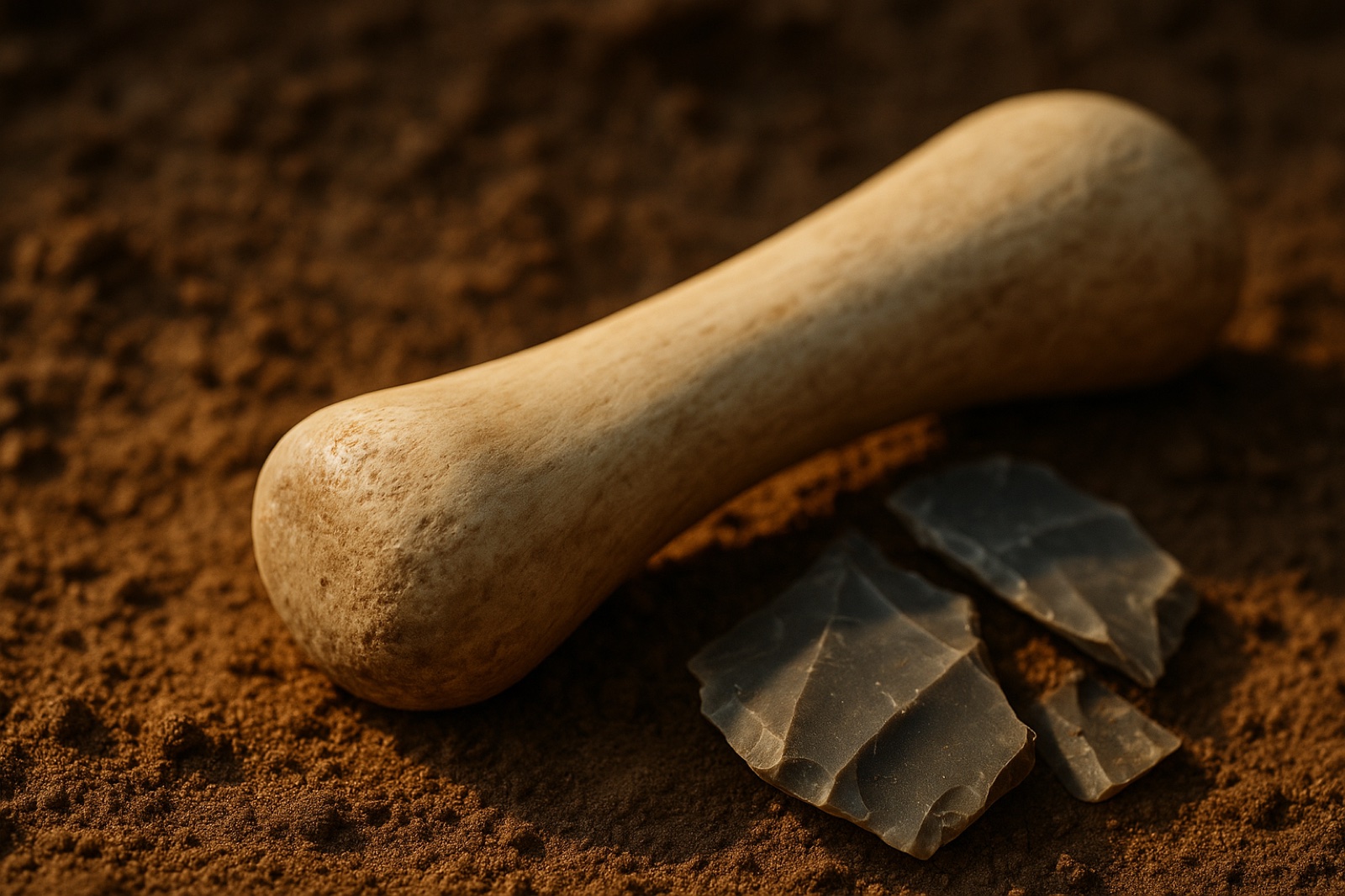
Then a team from University College London and the Natural History Museum took a second look. What they found rewrote a small but significant piece of human history: the fragment wasn’t debris. It was a tool. Specifically, a hammer — carved and shaped from the leg bone of an elephant, and used roughly 500,000 years ago by some of the earliest humans to ever set foot in Britain.
The Oldest Tool of Its Kind in Europe
The bone came from Palaeoloxodon antiquus, the massive straight-tusked elephant that once roamed the marshes and grasslands of ancient Britain, standing taller at the shoulder than today’s African elephants. Whoever made this tool didn’t use just any bone lying around — they chose elephant bone specifically, and researchers now understand why. Elephant bone is unusually dense and thick, which means it can absorb repeated, controlled impact without splintering or shattering the way smaller animal bones do.
That mattered, because this tool had a very particular job. Scientists call it a “retoucher” — a hand-held hammer used to resharpen and reshape stone hand-axes once their edges had dulled from use. Instead of throwing away a worn-out flint tool and starting over, early humans at Boxgrove picked up this bone hammer, applied precise, controlled taps to the stone’s edge, and knocked off tiny flakes to restore a working point. The elephant bone hammer wasn’t a weapon or a one-time-use object. It was maintenance equipment — built for reuse, over and over, on tools that themselves were built to last.
Published in the journal Science Advances, the discovery makes this the earliest confirmed elephant-bone tool ever found in Europe. Researchers believe it was likely made and used by Neanderthals or an earlier related species, Homo heidelbergensis — long before Homo sapiens arrived on the continent.
What a Half-Million-Year-Old Hammer Actually Proves
It’s easy to read a headline like this and picture something crude — a caveman banging rocks together. That’s not what the evidence shows. Choosing a specific material for its precise physical properties, shaping it for a specialized repeated function, and using it consistently over time to maintain other tools is a level of planning that researchers didn’t expect to find this far back in the human story.
This wasn’t survival by accident. It was foresight. Someone at Boxgrove understood that their stone tools would dull, planned for that ahead of time, and built something specifically to fix the problem before it became urgent. They weren’t just making things. They were maintaining things — investing effort now so that something else would keep working later. It’s the same instinct that, five hundred millennia on, still shows up whenever we name something we’re building after the idea of a beginning — even a modern AI research initiative recently named “the Genesis Mission” — as if some part of us keeps reaching for the same starting point.
The Instinct Older Than Any of Us
There’s something worth sitting with in that. Long before written language, before agriculture, before anything resembling a city or a book or a written law, humans were already doing something remarkably specific: building tools to build and repair other tools. Not just surviving the next hour, but investing in the next season. Not just making — but making things that keep on working. It echoes another recent find — cave paintings recently dated to the exact decade they were made, created in total darkness, with no practical use at all. Humans, it turns out, have never just been surviving. We’ve been building and making meaning at the same time, from the very beginning.
That instinct hasn’t gone anywhere. It’s in a mechanic keeping an old engine running instead of replacing it. It’s in a parent quietly fixing a child’s broken toy at midnight instead of tossing it out. It’s in anyone who has ever picked up a tool — literal or otherwise — to repair something rather than let it stay broken. Ancient wisdom has always held that the drive to build, mend, and create isn’t just a clever survival trick evolution stumbled into. It’s described as something closer to an echo — a trace, in the human hand, of a Maker who builds and repairs first, and who wired that same instinct into everything made in His likeness. It’s the same instinct people have quietly noticed in the old phrase “made in God’s image” — an idea a lot older than the argument over it.
Whoever shaped that bone half a million years ago never imagined it would end up cleaned, labeled, and studied under museum lighting five hundred millennia later. They were just solving a problem in front of them, the best way they knew how. And maybe that’s the quieter discovery hiding inside this one: something made with real care has a way of outlasting the moment it was made for — and outlasting the person who made it, too.
Frequently Asked Questions
What did archaeologists discover at Boxgrove, England?
Archaeologists confirmed that a bone fragment excavated at the Boxgrove site in southern England in the early 1990s is actually a deliberately shaped hammer made from elephant bone, used approximately 500,000 years ago to resharpen stone hand-axes. It is the oldest confirmed elephant-bone tool ever found in Europe.
Why did early humans use elephant bone instead of other materials?
Elephant bone is unusually thick and dense, allowing it to withstand repeated, controlled impact without splintering. This made it ideal for use as a “retoucher” — a hammer-like tool used to knock small flakes off a stone hand-axe to restore its sharp edge.
Who made the Boxgrove elephant bone hammer?
Researchers believe the tool was likely made and used by Neanderthals or by Homo heidelbergensis, an earlier human relative, since Homo sapiens had not yet arrived in Europe 500,000 years ago.
Why is this discovery significant?
The tool shows evidence of planning and specialized, repeated use rather than a single-use or accidental object. It suggests early humans were deliberately selecting materials for specific physical properties and maintaining their tools over time — a more sophisticated level of foresight than is often assumed for this period.
Where was the research published?
The findings were published in the journal Science Advances by researchers from University College London (UCL) and the Natural History Museum, London.
What Do You Think?
If a tool built half a million years ago still shows this much intention behind it, what does that say about the things you’re building, fixing, or maintaining today — are they built to last, or built to be replaced? Share your take in the comments below.
Share This
- “A hammer made from elephant bone just became the oldest tool of its kind ever found in Europe — and it’s half a million years old. What it reveals about the human drive to build is wilder than the age itself.”
- “Long before writing, before cities, before anything we’d call civilization — humans were already making tools to fix other tools. That instinct never left us.”
- “500,000 years old, and still recognizable as an act of care: someone planned ahead, built something to last, and kept it working. Some things really don’t change.”