 0
0
 0
0
You’ve had the flu. Everyone has. That week where your whole body aches, your head feels stuffed with wet cotton, and even lifting a glass of water feels like a chore. You probably blamed the virus and left it at that.
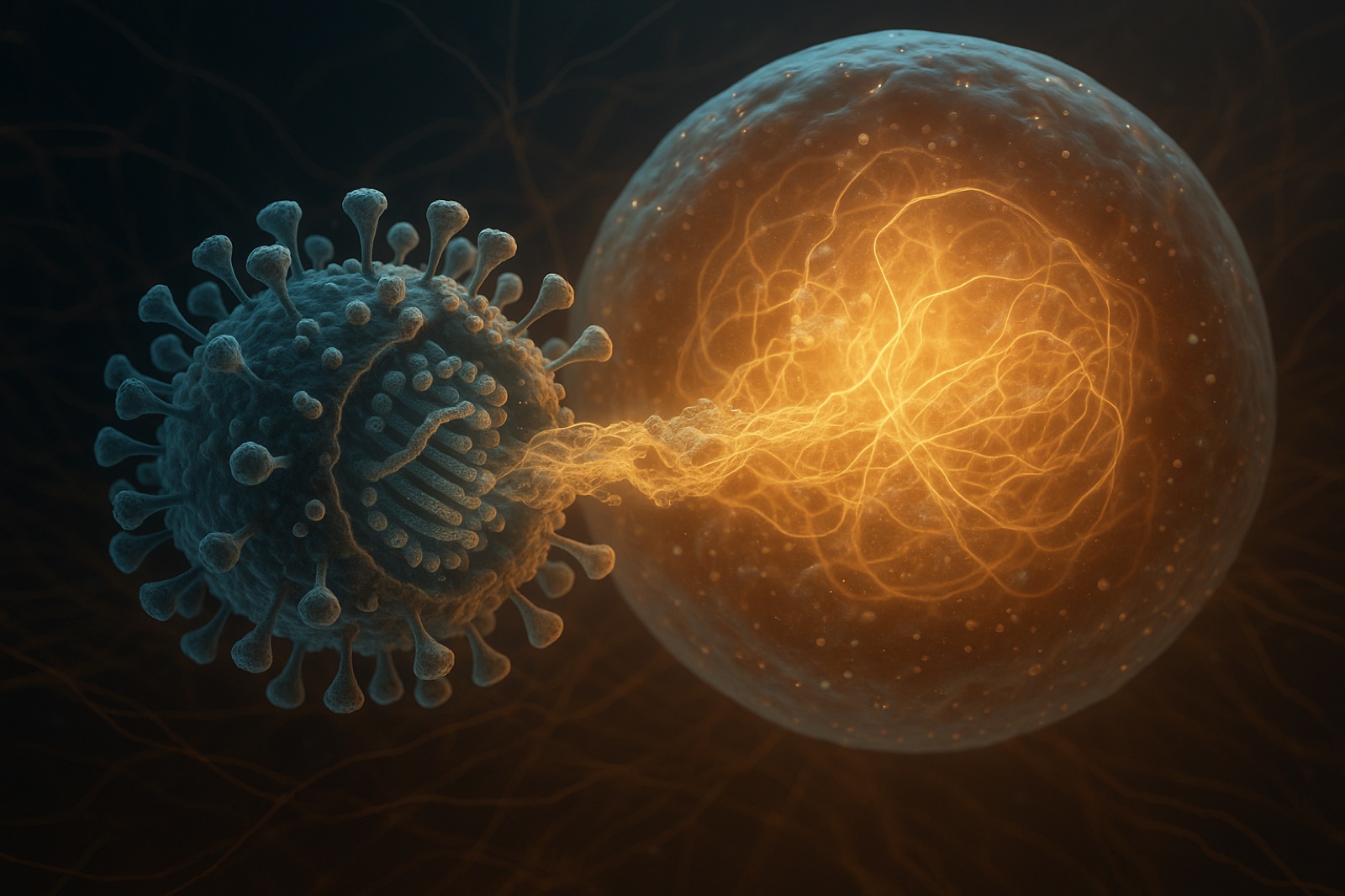
But this week, a team of scientists at EMBL Hamburg published something that answers a much stranger question: what is the flu virus actually doing inside your cells while you feel that way? Using advanced imaging, they mapped the process in more detail than anyone has managed before — and the answer isn’t what most people would guess. It’s the kind of finding that joins a growing pile of research where scientists finally map, in molecular detail, something that older wisdom seemed to already sense long before anyone had a microscope.
The Virus Shows Up Nearly Empty-Handed
Here’s the part that surprises people: the influenza A virus doesn’t arrive with much of its own equipment. It can’t build a cell. It can’t manufacture the raw materials it needs to make more of itself. In a very literal sense, it shows up with almost nothing.
What it can do is take apart what’s already there and use the pieces.
The new research, published in Nature Microbiology, tracked the virus targeting something most people have never heard of: paraspeckles. These are small, dense clusters of RNA and protein that sit inside the nucleus of your cells, quietly helping manage which genetic instructions get used and when. They’re not flashy. They’re maintenance structures — the kind of cellular housekeeping that keeps everything running in the background.
Within hours of infection, the virus dissolves them. Not damages — dissolves, deliberately, piece by piece. Then it repurposes the freed-up material to build more copies of itself.
Nothing New, Only Rearranged
Watch that process closely enough, as this team did, and a pattern becomes impossible to miss: the virus never creates. It only unbuilds. Every single thing it accomplishes — replicating, spreading, making you feel awful — depends entirely on dismantling order that already existed before it ever arrived.
This tracks with something virologists have said for decades, in a more clinical way: viruses aren’t fully considered “alive” by most biological definitions, precisely because they can’t do this on their own. No independent metabolism. No self-directed reproduction. Just a set of instructions that hijacks a working system and turns it against itself.
It’s a strange kind of vandal — one that can’t so much as light a match without first taking apart a house to find the matches.
Why This Matters Beyond Flu Season
This isn’t just a curiosity. Understanding exactly which structures the virus dismantles — and how — opens a new door for treatment. Instead of only targeting the virus’s replication machinery directly (which mutates and adapts quickly, which is why flu shots need updating every year), researchers can now look at protecting the structures being cannibalized in the first place. Shore up the house, in other words, rather than only chasing the vandal room to room.
It’s early. But it’s the kind of foundational mapping that tends to lead somewhere real a few years down the line — the way a similar 3D map of how the cold sore virus hijacks the human genome gave researchers their first real look at that virus’s actual weak spot.
There’s something almost humbling in it, too. All that misery from a case of the flu, and the virus behind it can’t originate a single new thing. It only knows how to unravel what your body already built.
An Old Idea, Confirmed at the Molecular Level
There’s an idea about the nature of corruption that predates microscopes by a few thousand years: that a destructive force never actually creates anything of its own. It only unravels what was already good. Ancient wisdom described this exact shape of harm long before anyone could see a single cell — that whatever tears things down is never original. It’s parasitic on something that came first, something whole.
And the same wisdom tends to point past the damage, toward what happens next: not just resistance, but restoration. Something bigger than the immediate threat, putting broken structures back together — not merely defending the walls, but rebuilding them, often stronger than before. That same ache for renewal shows up all over the natural world, in far bigger places than a single infected cell.
What Your Body Does That the Virus Can’t
Here’s the part worth sitting with the next time you’re on the couch, achy and miserable: your immune system doesn’t just get chipped away at while the virus does its work. It notices the intrusion, mobilizes a response, clears out the wreckage, and rebuilds what was lost. Then it does something the virus never could — it creates something new. Antibodies. Memory cells. A defense that didn’t exist before, tailored specifically to this exact threat, ready the next time it shows up.
The virus can only take apart. Your body’s response is the one actually building something. That’s not a small distinction. It might be the whole story.
Discussion Question
Where else have you noticed this same pattern — something that only tears down and never actually creates anything new? A habit, a rumor, a bad influence, an old grudge? Does naming it that way change how you deal with it?
Share This
- “Scientists just mapped how the flu virus works inside your cells. Turns out it can’t build anything — it only takes apart what your body already made. Wild.”
- “The flu virus shows up with basically nothing. It can only dismantle what’s already there and reuse the pieces. New study out of EMBL Hamburg mapped the whole process.”
- “Every virus is basically a vandal that can’t light a match without tearing apart a house first to find one. New research on how flu actually hijacks your cells.”
Questions People Are Asking
What did scientists actually discover about how the flu virus works?
Researchers at EMBL Hamburg used advanced imaging to map, in detail, how the influenza A virus dismantles specific structures called paraspeckles inside an infected cell’s nucleus, then repurposes the freed material to replicate itself. The findings were published in Nature Microbiology in July 2026.
What are paraspeckles?
Paraspeckles are small clusters of RNA and protein inside a cell’s nucleus that help regulate which genetic instructions get used. They’re a normal part of everyday cell maintenance, not something related to illness on their own.
Can a virus create anything on its own?
No. Viruses lack the independent machinery to build new biological material or reproduce by themselves. This is a major reason many biologists don’t classify viruses as fully “alive” — they depend entirely on hijacking a host cell’s existing systems.
Why does this discovery matter for future flu treatment?
Most current antiviral approaches target the virus’s replication process directly, which mutates quickly. Understanding exactly which host structures get dismantled opens the door to treatments that protect those structures instead, potentially making treatments more durable against new strains.
Is there a bigger lesson in how a virus behaves this way?
Many people find it striking that something so destructive is, at its core, incapable of originality — it can only take apart what already exists. It’s a pattern that shows up well beyond biology, in habits, relationships, and old wounds, and many find it clarifying to name it that way.