 0
 0
Hebrew Word for Disciple: What Does “Limmud” Really Mean?
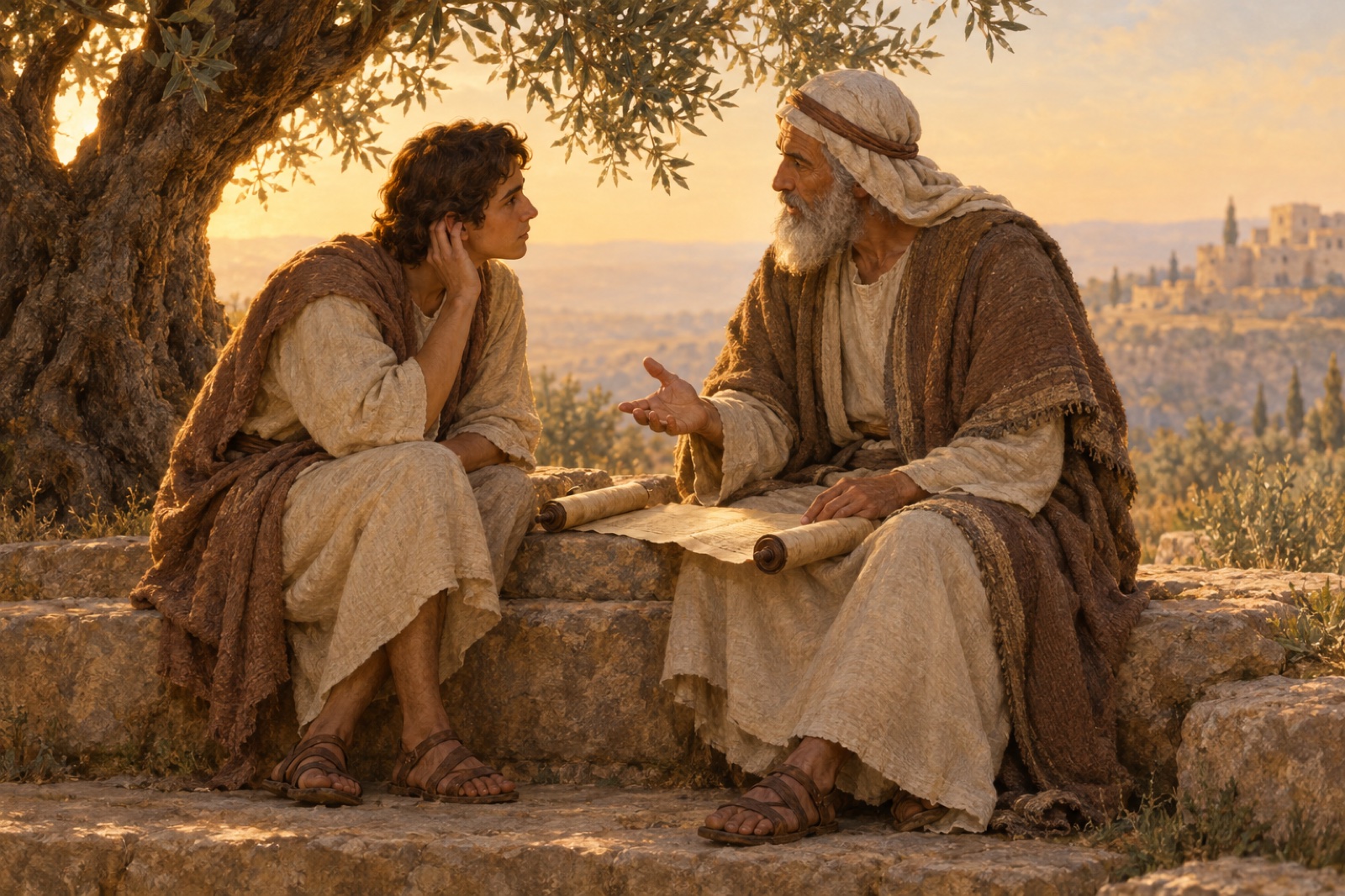
Quick answer: The Hebrew word for disciple is limmud (לִמּוּד, pronounced “lim-MOOD”), Strong’s H3928. It is built on the verb lamad, “to learn” or “to teach,” and it literally means “a taught one,” someone whose habits have been formed by instruction. It appears only six times in the Old Testament, all in Isaiah and Jeremiah, and the King James Version translates it five different ways: “disciples,” “learned,” “taught,” “used to,” and “accustomed.” That spread is the whole lesson. In Hebrew, a disciple is not someone who has signed up to follow. It is someone who has been trained until the teaching has become second nature.
Word Study: Where It Comes From
Limmud comes from the root lamad (לָמַד, H3925), the ordinary Hebrew verb for learning and teaching. The same verb does both jobs. In the simple form it means “to learn”; in the intensive form it means “to teach.” Hebrew does not treat those as two different activities so much as two ends of one transaction. Moses uses the root twice in a single breath in Deuteronomy 4:10: “that they may learn to fear me all the days that they shall live upon the earth, and that they may teach their children.” The learner is expected to become the teacher. That is what the word is for.
The root has a sharper picture behind it. The Hebrew word for an ox goad, the pointed stick a farmer used to steer and prod an animal along the furrow, is malmad (מַלְמָד, H4451), the same three letters with a prefix. It appears once in the Bible, in Judges 3:31, where Shamgar “slew of the Philistines six hundred men with an ox goad.” Many scholars also connect the name of the Hebrew letter lamed (ל) to this root, since its oldest shape resembles a staff or goad. Whatever the exact history, the family of words is clear enough: to learn, in Hebrew, is to be goaded. It is training, with a point to it, repeated until the animal goes where it should without being told.
That is why limmud can describe a wild donkey as easily as a prophet. In Jeremiah 2:24 the word is used of “a wild ass used to the wilderness,” an animal so accustomed to the open desert that nothing can turn it. In Jeremiah 13:23 it is used of people “accustomed to do evil,” who can no more change than a leopard can change its spots. In both verses the King James translators reached for “used to” and “accustomed” rather than “disciple,” but it is the same word. A limmud is simply someone, or something, whose training has gone all the way down. The question the word asks is never “are you a disciple?” It is “a disciple of what?”
When Isaiah uses it, the training comes from God. The word limmud is much older and much rarer than the word most people expect here. The familiar rabbinic word for a disciple, talmid, the one behind “Talmud,” appears exactly once in the whole Old Testament, in 1 Chronicles 25:8, where the King James renders it “scholar.” It is Isaiah’s limmud, not talmid, that carries the idea of discipleship in the prophets. And when Jesus later says “learn of me,” the Greek verb manthano and its noun mathetes are translating exactly this Hebrew picture of a learner in training, which is why we unpacked the yoke that goes with it in our Greek word for yoke study.
If You Are Christian, You Are To Follow Christ. Here’s How.
A limmud is formed by daily instruction, not a single decision. The free 3-day sample of 30 Days Walking with Jesus is a place to start that kind of training: short, easy-to-read devotionals that bring His words, actions, and love to life, built for new Christians learning how to begin and for longtime believers wanting to rekindle the connection.
Where This Word Appears in the Bible
Limmud occurs six times in five verses, and this table is the complete list. Watch how the King James Version translates it differently each time. The English readers of these verses have no way of knowing they are looking at one word.
| Reference | KJV text | How the KJV renders limmud |
|---|---|---|
| Isaiah 8:16 | “Bind up the testimony, seal the law among my disciples.” | “disciples” |
| Isaiah 50:4 | “The Lord GOD hath given me the tongue of the learned, that I should know how to speak a word in season to him that is weary: he wakeneth morning by morning, he wakeneth mine ear to hear as the learned.” | “the learned” (twice) |
| Isaiah 54:13 | “And all thy children shall be taught of the LORD; and great shall be the peace of thy children.” | “taught” |
| Jeremiah 2:24 | “A wild ass used to the wilderness, that snuffeth up the wind at her pleasure; in her occasion who can turn her away?” | “used to” |
| Jeremiah 13:23 | “Can the Ethiopian change his skin, or the leopard his spots? then may ye also do good, that are accustomed to do evil.” | “accustomed” |
Read the third column as a sentence and the word explains itself. Disciples. Learned. Taught. Used to. Accustomed. A disciple, in Hebrew, is a person who has been taught until they are used to it.
Verse Deep Dive: The Tongue of a Disciple (Isaiah 50:4-5)
Isaiah 50 is the third of the four “Servant songs,” the passages Christians have always read as portraits of the Messiah. The chapter goes on to describe the Servant giving His back to the smiters and His cheeks to those who pluck out the hair, which is why it is read every Holy Week. But it opens with something quieter, and the King James hides the key word twice in one verse.
“The Lord GOD hath given me the tongue of the learned,” the Servant says. The Hebrew is leshon limmudim, “the tongue of disciples.” Then, at the end of the same verse: “he wakeneth mine ear to hear as the learned,” kallimmudim, “as disciples do.” The English word “learned” suggests a scholar, someone with credentials. The Hebrew says the opposite. The Servant does not speak with the tongue of a professor. He speaks with the tongue of a pupil.
Notice the order of the verse. The tongue is mentioned first, but the ear is where the work happens. “Morning by morning” God wakens the Servant’s ear, and only because the ear has been opened does the tongue know “how to speak a word in season to him that is weary.” The ability to say the right thing to a tired person is not a gift of eloquence. It is the fruit of being taught every morning. Verse 5 closes the loop: “The Lord GOD hath opened mine ear, and I was not rebellious, neither turned away back.” That is the exact opposite of the wild donkey of Jeremiah 2:24, who is limmud to the wilderness and whom no one can turn. Same word, opposite training.
This is the heart of what the Hebrew adds to the Gospels. When Jesus says “learn of me,” He is not asking for admirers. He is describing what He Himself did: woke each morning, had His ear opened, and became so accustomed to the Father’s voice that He could speak a word in season to the weary. Four chapters later Isaiah promises the same training to everyone: “all thy children shall be taught of the LORD,” limmudei YHWH, disciples of the LORD. Jesus quotes that very line in John 6:45, “they shall be all taught of God,” and then adds the application: “Every man therefore that hath heard, and hath learned of the Father, cometh unto me.” Hearing, then learning, then coming. The order of Isaiah 50:4, in Jesus’ own mouth.
Not All “Disciple” Is the Same
Several Hebrew and Greek words sit behind the English “disciple,” “learn,” and “teach,” and they are worth keeping apart.
- Lamad (לָמַד, H3925) is the verb: to learn, and in its intensive form, to teach. It is the engine of the whole family, used around 85 times in the Old Testament, from Deuteronomy’s “teach them thy sons” to the Psalmist’s “teach me thy statutes.”
- Limmud (לִמּוּד, H3928) is the result: a taught one, someone whose habits have been trained in. It is Isaiah’s word for the disciples of the LORD, and Jeremiah’s word for people and animals accustomed to something else.
- Malmad (מַלְמָד, H4451) is the instrument: the ox goad of Judges 3:31. It only occurs once, but it tells you what Hebrew thought learning felt like.
- Talmid (תַּלְמִיד, H8527) is the later word for a student, the one that gave Judaism the “Talmud” and that Jewish readers in Jesus’ day would have used for the twelve. In the Bible itself it appears just once, in 1 Chronicles 25:8, for a “scholar” among the temple musicians.
- Mathetes (μαθητής, G3101) is the Greek New Testament’s word, used well over 250 times for the followers of Jesus. It comes from manthano, “to learn,” and carries the same idea as limmud: a disciple is first of all a learner, not a joiner.
The thread through every one of these is learning, not membership. None of them means “follower” in the sense of someone who has merely chosen a side. All of them describe a person in the middle of being changed by instruction.
Why the Original Word Changes the Meaning
In English, “disciple” tends to describe a status. You are one or you are not, the way you are a member of a club. The Hebrew word describes a process, and it is brutally honest about where that process leads. Limmud is used of the people of God in Isaiah and of a leopard-spotted sinner in Jeremiah, and it means the same thing in both: a creature formed by what it has been repeatedly exposed to. Everyone is a limmud. The only question is who, or what, has been doing the teaching.
That reframes a question many believers quietly carry: “Am I really a disciple?” The Hebrew would answer: look at what you are accustomed to. What do you reach for when you are weary, or when someone else is? What do you do without being told, because it has been goaded into you over years? Those habits are your training, and your training is your discipleship. Isaiah’s hope is not that you will decide to be a disciple. It is that God will take over the teaching, morning by morning, until the right responses are as automatic as the wrong ones used to be.
And the promise in Isaiah 54:13 is that this is exactly what God intends: “all thy children shall be taught of the LORD.” Not the clever ones, not the credentialed ones. All of them. The tongue that can speak a word in season to the weary is not reserved for the Servant. It is the ordinary equipment of anyone whose ear God has been waking.
Living It Out
Take Isaiah 50:4 literally for one week. Before your phone, before the news, before the first task, give God the first five minutes of the morning: read a short passage aloud and ask one question, “What are You teaching me today?” Write down a single sentence in answer. The point is not the five minutes. The point is that limmud is made by repetition, and after seven mornings you will have begun to be accustomed to listening. That is what a disciple is.
Journal Prompts
- Jeremiah 13:23 uses the word limmud for people “accustomed to do evil.” What are you most accustomed to, good or bad, that you never actually decided on? Who or what trained it into you?
- Isaiah 50:4 puts the opened ear before the skilled tongue. When you last tried to say the right thing to a weary person, had you listened to God first that day? What would change if the ear came before the mouth?
- Isaiah 54:13 promises that “all thy children shall be taught of the LORD,” and Jesus quoted it in John 6:45. Where in your life have you been waiting for someone else to teach you what God has already offered to teach you directly?
Prayer
Lord, I have called myself Your disciple, and today I see what that word was always supposed to mean. I am a limmud, a taught one, and I have been taught by many things that were not You. Waken my ear morning by morning, as You did for Your Servant. Make me accustomed to Your voice until listening is the first thing I do and not the last. Give me the tongue of a learner, so that I know how to speak a word in season to someone who is weary. Teach me, Lord, and let me not turn away. Amen.
Share This
- The Hebrew word for disciple, “limmud,” literally means “a taught one,” and it is also the word for a wild donkey “used to” the desert and for people “accustomed” to doing evil. Everyone is a disciple of something. The question is what has been training you. [Post URL]
- In Isaiah 50:4 the Messiah speaks with “the tongue of the learned.” The Hebrew actually says “the tongue of disciples,” and the ear comes before the mouth. A quick Hebrew word study of “limmud”: [Post URL]
FAQ
What is the Hebrew word for disciple?
The Old Testament word is limmud (לִמּוּד), Strong’s H3928, from the verb lamad, “to learn” or “to teach.” It means “a taught one” or “one accustomed to something.” The King James Version translates it “disciples” in Isaiah 8:16, “learned” in Isaiah 50:4, and “taught” in Isaiah 54:13.
Is “talmid” the Hebrew word for disciple in the Bible?
Talmid (תַּלְמִיד) is the common rabbinic Hebrew word for a student, and it is the word behind “Talmud,” but it appears only once in the Old Testament, in 1 Chronicles 25:8, where the King James renders it “scholar.” The word the prophets use for disciples of the LORD is limmud.
How many times does limmud appear in the Old Testament?
Six times in five verses: Isaiah 8:16, Isaiah 50:4 (twice), Isaiah 54:13, Jeremiah 2:24, and Jeremiah 13:23. Three of the six describe people taught by God; the other three describe a wild donkey accustomed to the wilderness and people accustomed to doing evil.
Does limmud only mean a follower of God?
No. The word is neutral about who does the teaching. Jeremiah uses it for a donkey trained by the desert and for people trained by their own sin. It means a creature shaped by repeated instruction, which is why Isaiah’s phrase “taught of the LORD” matters: it names the teacher.
What does Isaiah 54:13 “taught of the LORD” mean?
The Hebrew is limmudei YHWH, “disciples of the LORD.” It promises a day when every child of God is taught by God directly, not only by human teachers. Jesus quoted this verse in John 6:45, “they shall be all taught of God,” and applied it to everyone who hears and learns from the Father and comes to Him.
If You Are Christian, You Are To Follow Christ. Here’s How.
Isaiah’s disciples were made “morning by morning.” The free 3-day sample of 30 Days Walking with Jesus gives you a simple way to start that rhythm: short daily devotionals that bring His words, actions, and love to life.