 0
 0
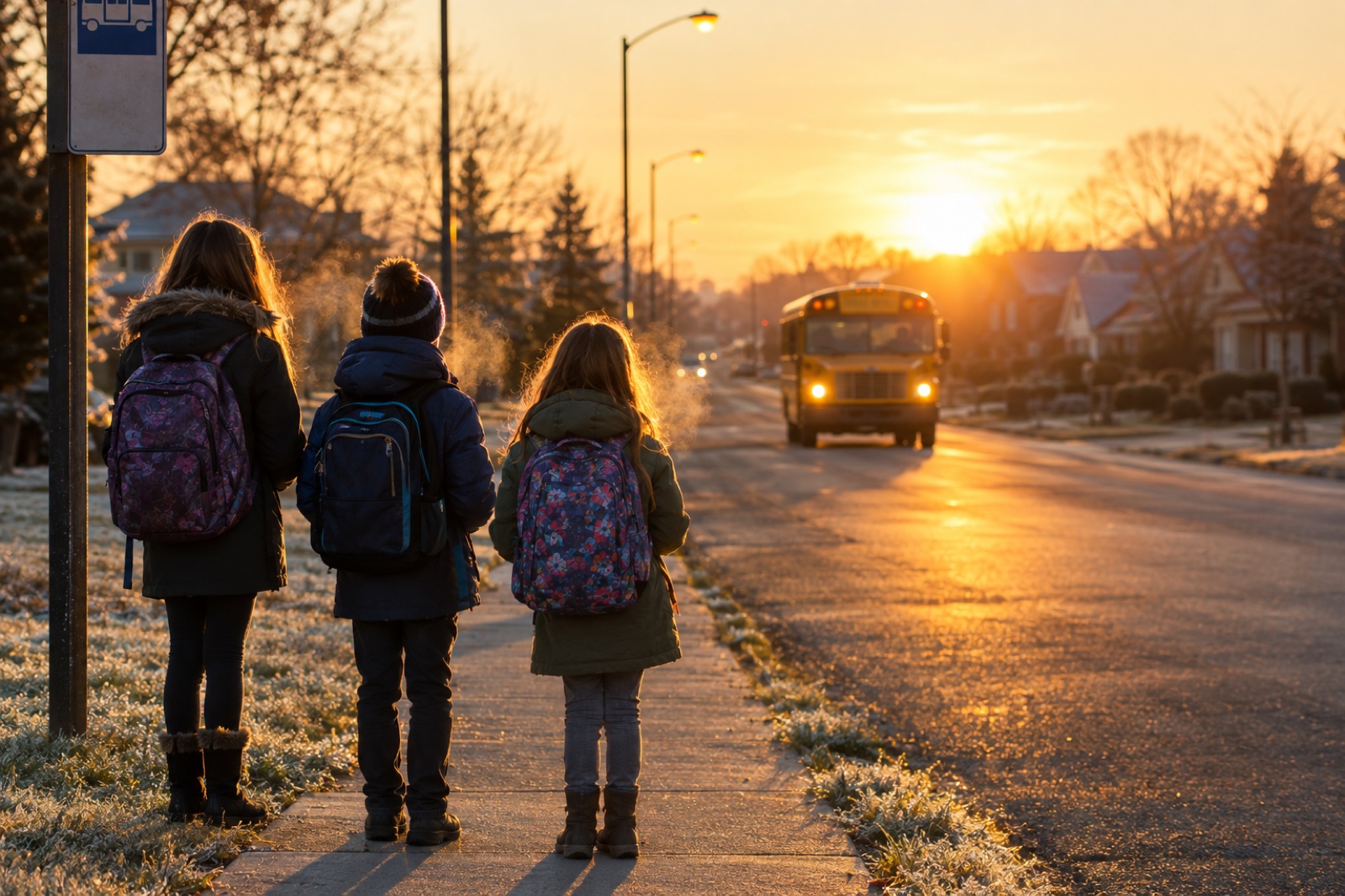
If you have ever stood at a bus stop with a child in winter, you know the feeling. It is a quarter past seven. The street lights are still on. Your kid’s breath hangs in the air, and the cars coming round the corner are two headlights and a guess. You find yourself stepping half a pace in front of them without deciding to.
That moment is what a new study is about. Researchers at the University of Washington asked a plain question: if the United States stopped changing its clocks and stayed on permanent daylight saving time all year, how many more school mornings would start in the dark? Their answer, published in the journal Current Biology at the end of October 2026, is more than 2 billion extra dark-morning trips to school every year.
That number is big enough to feel abstract. So here is what it actually means, where it comes from, what the same country learned the last time it tried this, and what you can do about your own family’s mornings whichever way the vote goes.
What Permanent Daylight Saving Time Would Do to School Mornings
Start with the part everyone forgets. Changing the clock does not change the sun. The day is exactly as long as it was going to be. All a clock law does is decide which end of your day gets the light.
Daylight saving time pushes the clock an hour ahead of the sun. In summer that is pleasant, because sunrise is early anyway and the extra evening light is free. In winter it is not free. Sunrise is already late, and moving the clock forward makes it later still on paper. A school that opens at 8:00 does not change its bell. The sun simply has not arrived yet when the bell rings. As Horacio de la Iglesia, the biologist who led the research team, explained, permanent daylight saving time would move the school day earlier relative to the sun without changing a single bell schedule.
The team looked at 14 of the 19 states that have already passed laws saying they will switch to year-round daylight saving time if the federal government ever allows it. They matched real school start times and school locations against real sunrise times, then counted how many trips to school would happen before the sun came up. In those 14 states alone, the answer was roughly 356 million more dark-morning trips a year than under the current system. Scaled up to the whole country, the estimate passes 2 billion.
Some states would feel it far more than others. Georgia came out worst, with about 71 million extra dark commutes a year. Washington state would add close to 35 million. Mississippi and Alabama, where schools tend to start before 8:00, would each go from around 2 million dark trips a year now to more than 20 million.
Why the Dark Matters: The Crash Numbers
A dark morning is not just unpleasant. The researchers went through United States traffic collision records and found that fatal crashes involving school-aged pedestrians were roughly twice as likely during dark mornings as after sunrise.
Two honest caveats belong next to that figure. First, it is an association. The records show that dark mornings and child pedestrian deaths go together; they cannot by themselves prove that every extra dark morning causes a set number of extra crashes. Second, the study models a hypothetical. Nobody has observed 2 billion dark commutes. The team estimated them from enrolment numbers, bell times and the position of the sun.
But the direction of the risk is not in doubt, and the researchers think their number is low rather than high. For the national estimate they had to assume children leave home at about 8:00 in the morning, because better data did not exist. “That’s pretty late, so our calculation is likely an underestimation of the real number,” said Guadalupe Rodríguez Ferrante, the study’s lead author. Many children leave earlier. Some arrive early for breakfast at school. Every one of those earlier departures is a darker one.
The Country Already Tried This Once
Here is the piece of this story that rarely makes the headlines. The United States has lived under year-round daylight saving time before, and it lasted about ten months.
In the winter of 1973 the country was in a fuel crisis, and Congress reached for the clock as a way to save energy. On 6 January 1974 most of the nation went onto daylight saving time and stayed there through the winter. In December 1973, before it started, one national survey found roughly four in five Americans in favour. By February 1974, after a few weeks of dark school mornings, support had fallen to well under half.
Part of what changed minds was children. Reports came in of school-aged children killed on dark roads, including a cluster in Florida in the first weeks, and parents across the country found themselves sending their kids out before dawn and not liking it. Later analysis could not pin the rise in deaths on the clock alone, but the mood had turned. Congress repealed the experiment, and President Gerald Ford signed the repeal on 5 October 1974. Standard time came back for the winter.
The researchers behind the new study know this history. Their point is not that the 1970s settles anything. It is that the trade-off has not changed. In winter, the light has to come from somewhere, and when you give it to the evening you take it from the morning, which is where children happen to be outside.
Where the Law Stands Right Now
On 14 July 2026 the US House of Representatives passed the Sunshine Protection Act by 308 votes to 117. The bill would put the whole country on permanent daylight saving time. It then went to the Senate, where it has sat in committee since. No law has changed, and the clocks went back as usual on 1 November 2026. If you want the longer story of why the clocks change at all, we covered that in Daylight Saving Time: The Only Clock the Bible Turned Back.
The new study lands in the middle of that pause, and it comes with a quiet twist. The researchers do not argue for keeping the twice-yearly switch. They argue that if the country wants to stop changing clocks, the better choice is the other one: permanent standard time, the setting that matches the sun. Their modelling found that permanent standard time would roughly halve the number of dark school mornings compared with today. De la Iglesia noted that pushing school start times later would not fix the problem under permanent daylight saving time, because work and everything else would shift later too, until daily life lined up with the sun again. “That, by definition, is Standard Time,” he said.
If you live outside the United States, most of this will sound strange. Most of the world does not change its clocks at all, and near the equator the length of the day barely moves across the year. But the underlying question is the same anywhere winter mornings are dark, from Scotland to northern Japan: when the bell rings before sunrise, who is standing outside?
What This Means for Your Own Family’s Mornings
You cannot vote in a Senate committee. You can do something about the mornings you already have.
- Light up the walk, not just the child. Reflective strips on a bag, a small clip-on light, or simply crossing at the lit corner instead of the dark one cost almost nothing, and on a dark morning they are the biggest thing a parent can change.
- Get the morning light the moment it arrives. Even ten minutes outside after sunrise tells a child’s body clock, and yours, what time it really is. On the darkest mornings, opening the curtains and eating breakfast by the window does some of the same work.
- Protect bedtime harder in winter. Teenagers’ body clocks run late by design, which is why so many of them are wrecked by an 8:00 bell. A dark morning makes it worse, because there is no sunlight to pull them awake. The fix is not a lecture about discipline. It is a consistent lights-out and screens out of the bedroom. If you are curious whether your own body clock runs early or late, our free What Is My Sleep Chronotype? quiz takes two minutes.
- Watch your own mood in the first dark weeks. Fewer bright mornings can pull adults down too. If November already feels heavy, we looked at what the research actually says about why, and most of what helps is free.
Nobody Can Make a Morning
The sentence from this study that stayed with me was not a number. It was something de la Iglesia said: “No clock policy adds a single minute of daylight. It only changes when that daylight is available.”
Think about how much effort sits on either side of that sentence. Votes in Congress. Nineteen state laws waiting for permission. A research team counting bell schedules against sunrises, school by school. All of it to decide where to put a light none of us made and none of us can add to.
There is an old line at the very start of the Bible that counts each day of creation the same way, and the order is easy to miss: “the evening and the morning.” Dark first. Then light. Whoever wrote that was not setting a clock. They were describing a day as a thing that is given, dark to light, before anyone has done anything to earn it. The morning arrives. We do not produce it. We can only decide to be awake for it, and to make sure the small people we love are standing somewhere safe when it comes.
That is a strangely restful thought in the middle of a political fight. The sun will come up tomorrow at the time it was always going to. The only part we actually control is what we do in the hour before it does.
What Happens Next
The Senate may act on the Sunshine Protection Act, or it may not. If it passes as written, winter mornings across most of the United States will get an hour darker, and the number in this study becomes something to measure instead of estimate. If it stalls again, the clocks will spring forward in March as they always have.
Either way, there will be a child at a bus stop tomorrow morning, and an adult standing half a pace in front of them. Whatever the clock says, the sun is on its way. Hold the hand, watch the corner, and look east.
Discussion Question
If a country has to choose between permanent daylight saving time and permanent standard time, which should it pick: brighter winter evenings for adults, or brighter school mornings for children? Tell us which way you would vote in the comments below.
Share This
- “Permanent daylight saving time would add more than 2 billion dark school mornings a year, a new study estimates. The US tried it in 1974 and repealed it in ten months. Worth knowing before the Senate votes. https://bgodinspired.com”
- “‘No clock policy adds a single minute of daylight. It only changes when that daylight is available.’ That line from a sleep scientist reframed the whole clock debate for me.”
- “Fatal crashes involving school kids on foot are about twice as likely in dark mornings as after sunrise. Permanent DST pushes sunrise later all winter. I did not know that was the trade.”
Questions About Permanent Daylight Saving Time
What did the new study on permanent daylight saving time find?
A University of Washington study published in Current Biology on 29 October 2026 estimated that permanent daylight saving time would add more than 2 billion dark-morning trips to school across the United States every year. In the 14 states the team modelled in detail, the increase was about 356 million trips a year. The study also found that fatal crashes involving school-aged pedestrians were roughly twice as likely during dark mornings as after sunrise.
Why would permanent daylight saving time make school mornings darker?
Daylight saving time sets the clock one hour ahead of the sun. In winter, when sunrise is already late, that makes sunrise fall an hour later on the clock while school start times stay the same. A school that opens at 8:00 would, on many winter mornings, be opening before the sun is up. The total amount of daylight does not change; it is shifted from the morning into the evening.
Has the United States tried permanent daylight saving time before?
Yes. During the fuel crisis, most of the United States went onto year-round daylight saving time on 6 January 1974. Public support fell sharply within weeks, partly because children were travelling to school in the dark, and Congress repealed the experiment. President Gerald Ford signed the repeal on 5 October 1974, about ten months after it began.
Is the Sunshine Protection Act law yet?
No. The US House of Representatives passed the Sunshine Protection Act, H.R. 139, on 14 July 2026 by a vote of 308 to 117. The bill would make daylight saving time permanent nationwide. As of early November 2026 it was in the Senate Committee on Commerce, Science, and Transportation with no vote scheduled, and clocks in the United States went back to standard time as usual on 1 November 2026.
Would permanent standard time be better for children?
The researchers behind the 2026 Current Biology study say yes for school mornings. Their modelling found that permanent standard time, which keeps clocks matched to the sun all year, would roughly halve the number of dark school commutes compared with the current system of changing clocks twice a year, while permanent daylight saving time would add more than 2 billion dark commutes a year. Permanent standard time also lines up better with the natural body clocks of children and teenagers.