 0
0
 0
0
Somewhere out there, a galaxy is still shining because of something it stopped doing before anyone existed to notice.
The engine went quiet. The light kept going.
That is not a poetic flourish. It is a measurement. A team of astronomers has just put careful numbers on a set of dying radio galaxies – galaxies still glowing millions of years after the jets that lit them switched off. They examined fourteen of them. What came back was smaller than expected, and stranger than the headline suggests.
What a dying radio galaxy actually is
Start with the engine.
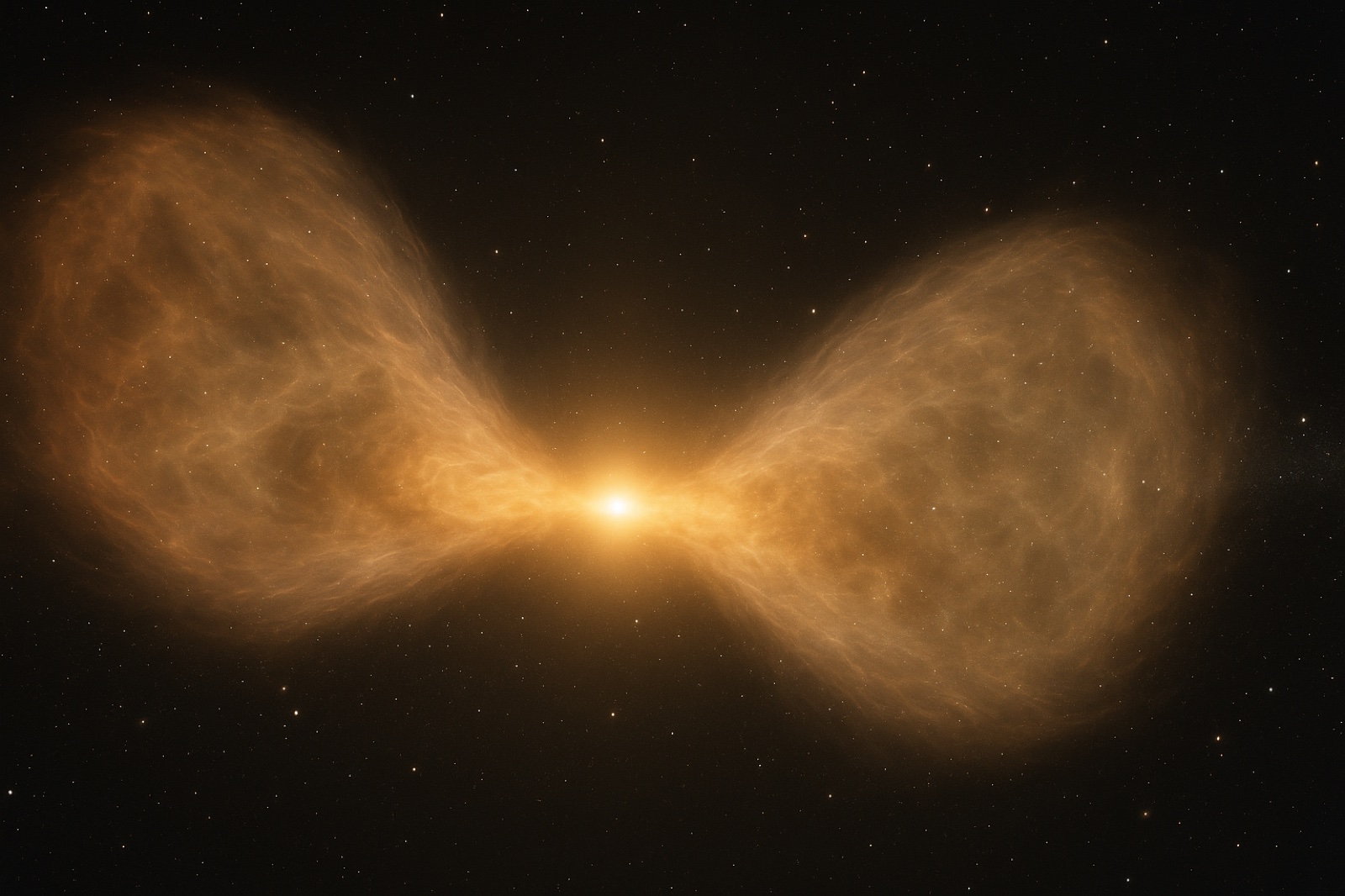
At the centre of a large galaxy sits a supermassive black hole. When material falls toward it, the black hole can fire two narrow jets of charged particles outward at close to the speed of light, in opposite directions.
Those jets do not stay narrow. They ram into the thin gas outside the galaxy and inflate two enormous balloons of glowing plasma, one on each side. These are the lobes, and they are often far bigger than the galaxy that made them. They shine in radio waves, which is why we call the whole arrangement a radio galaxy.
Then the feeding stops. The black hole goes quiet. The jets shut off.
And the lobes just keep glowing. Nothing is refilling them. They are running on the energy already inside them, like a room that stays warm after the fire is out. Astronomers call that a remnant – or, more bluntly, a dying radio galaxy.
How do you date something that has no clock?
This is the clever part, and it is worth understanding, because everything else rests on it.
Inside the lobes are electrons moving at enormous speed. The fastest, highest-energy ones lose their energy first. So once the supply of fresh particles is cut off, the lobes do not simply dim evenly – they change colour, in the radio sense. The high-frequency end of the glow drains away first, and the spectrum bends.
The shape of that bend is the clock. It is closer to judging how long ago a fire went out by the colour of the embers than by looking at a watch.
To read the bend, you need to see the whole curve, which means observing the same object across a wide span of radio frequencies. The team combined data from 144 megahertz up to 1.5 gigahertz, pulling in MeerKAT in South Africa, the upgraded GMRT in India, and observations from LOFAR, GMRT and the Jansky Very Large Array.
Here is the first thing the brief on this study will not tell you: two of the fourteen candidates were not dead at all. Once the full spectrum was in view, they were reclassified as still active. They had only looked finished. The researchers made a point of it – without sensitive coverage across many frequencies, you will mistake living things for dead ones.
Twelve were confirmed as genuine remnants.
The ages came back short
For those twelve, the spectral ages ran from roughly 8 to 42 million years, with a median near 12 million. Mapping the lobes pixel by pixel instead of treating each source as a single blob gave a broadly similar spread.
Twelve million years is young for this kind of object – which is the only sense in which the word “young” belongs anywhere near it. It is still vastly longer than humans have existed. The point is not that these things are brief. The point is that they are briefer than this population was expected to be.
There is a second number in the paper that is easy to read past, and it is the most interesting one in the whole study. The researchers worked out, for each source, how much of its total measured lifetime had been spent in the silent phase – glowing with the engine already off.
That fraction ranged from about 4% at one end of the sample to about 83% at the other.
Sit with the high end of that. For at least one of these objects, the quiet afterglow was not a footnote to its life. It was most of its life. The visible, jetted, obviously active phase was the short part.
It is a reminder that in astronomy, as elsewhere, we tend to define things by their loudest period. This is the same habit that made a dormant black hole invisible for 30,000 years until it finally ate something and gave itself away.
The oldest light in the universe is what rubs them out
So why do these particular remnants seem to fade faster than expected?
The explanation the researchers put forward is the part that genuinely stops you.
Space is not empty of light. The entire universe is soaked in a faint background glow left over from its earliest era – the light released when the cosmos first became transparent. It is everywhere, and it has never gone out.
When a fast electron in one of those lobes runs into that background light, it hands over some of its energy. Do that endlessly, everywhere, and the lobes drain.
And that background glow was denser and more energetic in the past. These galaxies are far away, which means we are seeing them as they were long ago – their light left them at redshifts from about 0.35 out to 2.85. The further out you look, the more crowded that ancient light was, and the harder it worked on the lobes.
Which lands on this: the light left over from the beginning of the universe is what erases the light left over from these galaxies. The oldest thing there is quietly rubbing out the newer thing. (If you have never looked at just how old that background light is, our free How Old Is the Universe? explorer lays the timeline out in plain numbers.)
Two honest caveats, because the paper is careful and the coverage sometimes is not. First, the researchers list this as the likely cause, alongside a second possibility – that the lobes expanded quickly into unusually thin surroundings. It is a strong explanation, not a settled one.
Second, and more important: because every one of these objects is distant, this sample may be catching the slice of the population where fading happens fastest. That would mean our window for spotting them is short, which is not quite the same claim as every afterglow everywhere being short. Both readings are still alive in the data. It is a similar kind of care to the one that reframed why star formation across the universe is declining – the obvious explanation was not the one the measurements supported.
What twelve fading galaxies leave you with
Strip away the telescopes and the shape of this is very ordinary.
Something ran for a while. Then it stopped. And the effect of it went on travelling – unfed, unwitnessed, nobody tending it – for a stretch that in some cases was longer than the run itself.
People were saying something close to that long before anyone could measure a radio lobe. That what you send out keeps moving after you have stopped. That a life is not really weighed by how long the engine ran. That nothing given away is wasted, including the parts nobody stayed around to see. Some people file that under ancient wisdom. Some people call it God. Either way, twelve galaxies are currently demonstrating it in radio waves.
None of which changes your afternoon.
But the next time you find yourself assuming that something you started years ago stopped mattering the moment you stopped doing it – that is not how the universe seems to handle it. The lobes are still out there, still bright, still spreading.
Whether anyone happens to be looking or not.
Questions people ask about dying radio galaxies
What is a dying radio galaxy?
A dying radio galaxy, also called a remnant radio galaxy, is a galaxy whose central supermassive black hole has stopped launching jets, but whose two huge lobes of charged particles are still glowing in radio waves. Nothing is refilling the lobes, so they run on stored energy and fade over millions of years.
How do astronomers know a radio galaxy has switched off?
They read the shape of its radio spectrum. The highest-energy electrons lose energy fastest, so once fresh particles stop arriving, the spectrum bends and steepens in a characteristic way. In the 2026 SuperMIGHTEE study of 14 candidates in the XMM-LSS field, that test confirmed 12 as genuine remnants and reclassified two as still active.
How long do the lobes keep glowing after the jets stop?
In the 12 confirmed remnants of the SuperMIGHTEE sample, spectral ages ran from roughly 8 to 42 million years, with a median near 12 million years. Measured as a share of each object’s total lifetime, the silent phase ranged from about 4% at one end of the sample to about 83% at the other.
Why would distant dying radio galaxies fade faster?
The likely reason the researchers give is inverse-Compton losses. The universe is filled with faint background light left over from its earliest era, and that light was denser and more energetic in the past. Fast-moving electrons in the lobes collide with it and surrender energy, so a more distant remnant is likely drained more quickly. The team also raised rapid expansion into low-density surroundings as a possible contributing factor.
Who carried out this study?
The work was led by Sushant Dutta with colleagues at the University of Cape Town and the Inter-University Institute for Data Intensive Astronomy, and published in Monthly Notices of the Royal Astronomical Society in 2026. It combined MeerKAT MIGHTEE and uGMRT superMIGHTEE survey data with LOFAR, GMRT and Jansky Very Large Array observations across 144 megahertz to 1.5 gigahertz. The full paper is available here.
Over to you
Here is the question worth arguing about. If something you set in motion keeps having an effect long after you stopped and forgot about it, does that effect still belong to you – or has it become its own thing entirely, nothing to do with you anymore?
There is no correct answer, and people split hard on this one. Tell us where you land in the comments.
Share this
Astronomers confirmed 12 galaxies still glowing millions of years after their black holes switched off. In one of them, the quiet phase after the engine stopped was about 83% of its entire measured life. The loud part was the short part. https://bgodinspired.com/index.php/bible-resources/bible-and-science/dying-radio-galaxies-still-glow-after-jets-stop/
Just learned that the light left over from the beginning of the universe is what slowly erases the light left over from dying galaxies. The oldest thing there is rubbing out the newer thing, everywhere, all the time. https://bgodinspired.com/index.php/bible-resources/bible-and-science/dying-radio-galaxies-still-glow-after-jets-stop/
Fourteen galaxies were thought to be dead. Two turned out to be alive – they had only looked finished. I cannot stop thinking about that. https://bgodinspired.com/index.php/bible-resources/bible-and-science/dying-radio-galaxies-still-glow-after-jets-stop/