 0
 0
For about a hundred years, the strongest physical evidence for ancient Egypt human sacrifice sat in a drawer in Cambridge, and nobody read it properly.
The drawer holds 46 skulls. They came out of the sand at Abydos, in southern Egypt, dug up by the British archaeologist Flinders Petrie in the 1920s. They belonged to people buried in small, plain graves, packed in neat rows around the burial monuments of Egypt’s first kings, roughly 5,000 years ago.
Petrie reported no injuries on them at all.
Dr Roselyn Campbell of Purdue University has now gone back to those same skulls with modern forensic methods. Eighteen of the 46 carry fractures that happened around the time the person died. That is about 39% of them.
The Evidence for Ancient Egypt Human Sacrifice, in 46 Skulls
Abydos was where Egypt’s earliest rulers were buried, at the very start of the First Dynasty. Around their tombs and their separate funerary enclosures, archaeologists found hundreds of much smaller graves. The people in them are usually called “retainers” — the staff of a royal household, buried at the edges of their ruler’s monument.
For more than a century, Egyptologists have argued about why. The uncomfortable explanation has always been on the table: that these people were killed so they could go into the ground with the ruler they served. The habit seems to fade out by the start of the Second Dynasty, which suggests it was a practice that began, peaked, and was abandoned.
What was missing was evidence in the bone. That is what the new study, published in Frontiers in Environmental Archaeology, went looking for.
The 46 skulls that survive come from the graves around the enclosures of three First Dynasty rulers: Djer, Djet, and Merneith, who was a woman. They are only a small slice of the original burials — somewhere around 5% to 15% of the people buried at each enclosure. Almost everything else was reburied a century ago.
The injuries Campbell found are mostly linear fractures running across the parietal bones, the broad plates that make up the sides and top of the skull. “The injuries on the preserved crania are generally linear fractures,” she said. One individual also has a sharp-force injury, a chopping blow to the eye.
Nobody Noticed for a Hundred Years — and That Part Is Not an Accident
Here is the detail that makes this study genuinely strange. Petrie did not fail to find these fractures because the skulls were hidden from him. He had them in his hands.
Campbell’s argument is that he saw the cracks and read them as ordinary damage — the kind of breakage that happens to any bone left in the ground for 5,000 years. The evidence that he looked right at them is almost physical: during conservation, he applied paraffin wax directly around the fractured areas. He was treating the damage. He simply did not have the training to recognise what kind of damage it was. Forensic bioarchaeology barely existed yet.
That wax is now part of the problem. It sits on the bone surface and obscures the colour of the fracture edges, which is one of the main clues used to tell an injury that happened around the time of death from one that happened long after.
The rest of what happened to these people afterwards is worth saying plainly. Petrie measured about 80 skulls and sent 60 of them to the Eugenics Department at University College. The ones that ended up at Cambridge were later studied by researchers whose main interest was sorting them by “race” through the measurement of skulls — a field that has since been discarded entirely. For most of the last century, these individuals were not studied as people who died. They were studied as data about something that turned out not to be real.
What the Fractures Do and Do Not Prove
This is where the study is careful, and where most retellings of it will not be.
Campbell does not claim to have proved that 18 people were executed. Her conclusion is hedged on purpose: the long-standing idea that this was retainer sacrifice may well be correct, and there is now physical evidence consistent with it for the first time. That is a real step. It is not the same as a verdict.
The honest list of limits is long:
- There is no way to prove these injuries are what killed the people who had them.
- Accidental falls cannot be completely ruled out — though a fall hard enough to crack a skull would usually leave other damage on the skeleton, and Petrie’s records do not describe any. The rest of the skeletons are gone, so they cannot be checked.
- The fractures do not match what a mace usually leaves behind. A mace tends to make a depressed fracture, a dent. These are mostly straight breaks.
- The cause of death for the other 28 is unknown. Some may have died naturally. Some may have been killed in ways that leave no mark on bone at all, such as suffocation.
- Whether anyone went willingly is not a question bone can answer. Campbell says as much about a comparable case elsewhere: willingness is simply unknowable in the archaeological record.
So the finding is not “ancient Egyptians murdered their servants.” The finding is that the evidence has been sitting in a drawer for a hundred years, it points one way, and the first person to look at it with the right training said so.
Some of Them Have Names
This is the part that changed how the whole thing reads for me, and it is not in any of the headlines.
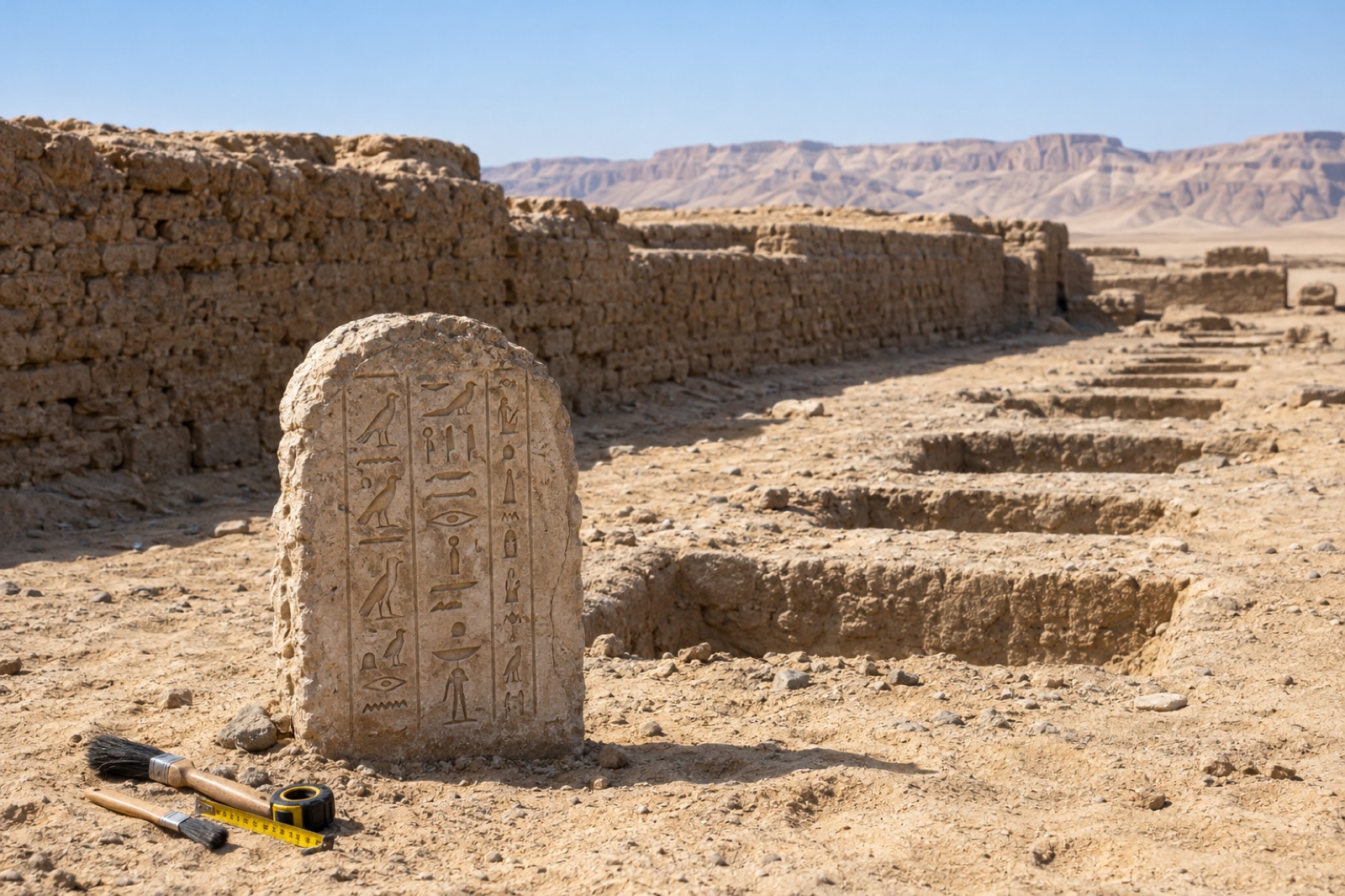
Not every one of those small graves was anonymous. Some had a stela — a small upright slab of stone — carved with the name of the person inside. They are not common. But they exist.
And the titles on them are ordinary. Seal-bearers. Inspectors. Artisans. Working people, the middle of a household rather than the top of it. Some of the words are not job titles at all, but descriptions of a relationship: physician, and one often translated “mistress,” which may be closer to “lady.” One of them is simply friend.
What is missing from those stones is just as telling. No wife of the king. No vizier. No king’s children. The powerful were not in these graves. The staff were.
The group itself fits that picture: men and women, no children, very few older adults. People in their working years. People, in other words, who were there because of what they did.
Five thousand years later, you can still read one of those stones and learn that somebody was a doctor, or an inspector, or a friend. We have no idea who ordered those stelae carved, or why some got one and most did not. But somebody decided a name was worth the stone.
It is the same small shock as the oldest surviving dress in the world, which still has creases at the elbows from the person who wore it. The grand monument tells you about the ruler. The tiny detail at the edge of it tells you a person was there.
The Oldest Idea About Power, and the One That Runs Backwards
Strip away the sand and the hieroglyphs and the arrangement at Abydos is not exotic at all. It is the oldest version of a very familiar idea: the people around someone powerful exist in order to be useful to them. Useful enough, in this case, that the usefulness was expected to continue after death. Fill the grave.
Egypt was not unusual in this. The same logic turns up in a 4,000-year-old walled city in northern China, among people who had never heard of Egypt. Order costs something, and the cost gets paid by whoever is least able to refuse.
Which is what makes one later story so odd when you put it next to this one. The man at the centre of the most copied book in human history spent his life being called a king and then said, plainly, that the whole point of being great is to serve the people beneath you rather than to be served by them. He said the measure of love is giving your life for your friends — the same word that somebody carved onto a small stone at Abydos. And the single most famous thing about his tomb is that it was empty. Nobody was taken along.
Same instinct about power, read exactly the other way round. Make of that what you like.
What the Skulls Are Actually Asking
Campbell’s own interest in these people is not really forensic. What she wants to know is who they were, and how they understood their own place in the life and death of the person they served. Those are not questions a fracture can answer.
But they are good questions to carry around, because the quiet modern version of this is everywhere. Being treated as a role rather than a person. Being described by what you produce. The low, persistent worry that if you stopped being useful, the relationship would stop too.
If that is a thing you think about, it is also worth noticing which side of it you are on — most of us are somebody’s boss, parent, or team lead, and how you lead when nobody is checking is a more answerable question than anything at Abydos.
Because that is what survived here, in the end. Not the kings — we had their names already. What came through 5,000 years of sand was a seal-bearer, an inspector, a physician, and somebody’s friend.
The study is published in Frontiers in Environmental Archaeology (Campbell, 2026).
A question worth arguing about
If a society bothers to carve someone’s name and job onto a grave marker, does that make it more humane — or just better organised? There is a real case either way. Drop your take in the comments.
Share This
- “46 skulls from the graves around Egypt’s first kings sat in a Cambridge drawer for a hundred years. Someone finally looked properly: 18 of them have fractures from around the moment of death. https://bgodinspired.com/index.php/bible-resources/bible-history/ancient-egypt-human-sacrifice-abydos/”
- “The archaeologist who dug these up in the 1920s reported no injuries. He had painted conservation wax directly over the cracks. He just didn’t know what he was looking at. https://bgodinspired.com/index.php/bible-resources/bible-history/ancient-egypt-human-sacrifice-abydos/”
- “Some of the people buried around Egypt’s first kings got a small carved stone with their name on it. Seal-bearer. Inspector. Physician. Friend. 5,000 years later you can still read it. https://bgodinspired.com/index.php/bible-resources/bible-history/ancient-egypt-human-sacrifice-abydos/”
Frequently Asked Questions
What did the new study of the Abydos skulls find?
A 2026 study by Dr Roselyn Campbell of Purdue University, published in Frontiers in Environmental Archaeology, re-examined 46 skulls recovered from the small graves surrounding the First Dynasty funerary enclosures at Abydos in southern Egypt. Eighteen of the 46, about 39%, show perimortem cranial trauma — fractures that occurred around the time of death. Most are linear fractures across the parietal bones, and one individual also shows a sharp-force chopping injury to the eye. The original excavator, Flinders Petrie, had reported no cranial injuries at all.
Did ancient Egypt practise human sacrifice?
The evidence points that way for a brief period at the very beginning of Egyptian history, around 3000 BCE, but it is not proven. Egypt’s first kings were buried with hundreds of smaller “subsidiary” graves around their tombs and enclosures, and the practice appears to fade out by the start of the Second Dynasty. The 2026 forensic study of 46 surviving skulls found that 39% carry injuries consistent with deliberate killing, which supports the long-standing retainer-sacrifice hypothesis. The researcher is careful to state that there is no way to prove these injuries caused death, and the cause of death for the other individuals remains unknown.
Who were the people buried around Egypt’s first kings?
They appear to have been household staff rather than royalty. A small number of the subsidiary graves at Abydos had carved stone stelae naming the person buried there, and the titles recorded are low- to mid-level: seal-bearers, inspectors and artisans, along with relationship terms including physician, “mistress” (possibly better translated “lady”), and friend. High-status titles such as wife of the king, vizier, or king’s child are absent. The surviving sample includes both men and women, no children, and few older adults.
Why did the original excavator miss the injuries?
Flinders Petrie excavated the Abydos graves in the 1920s and recorded no cranial trauma, but Campbell argues he almost certainly saw the fractures and interpreted them as ordinary post-burial damage from thousands of years in the ground. The evidence that he examined them closely is that he applied paraffin conservation wax directly around the fractured areas. Forensic bioarchaeology as a discipline did not yet exist, so he lacked the training to distinguish an injury sustained around the time of death from later breakage. That same wax now obscures the fracture surfaces and makes modern analysis harder.
Can archaeologists tell whether these people went willingly?
No. Willingness leaves no trace in the skeleton, and Campbell states directly that it is unknowable in the archaeological record. Bone can show that an injury happened around the time of death; it cannot show consent, coercion, belief, or fear. It is also difficult to prove whether anyone was buried alive, and some individuals may have died by methods that leave no mark on bone at all, such as suffocation. The circumstances of these deaths remain genuinely unresolved.