 0
0
 0
0
You are standing in front of two packets of chewing gum. One has sugar. One says sugar-free. You take the sugar-free one, because that is the sensible thing to do, and you never think about it again.
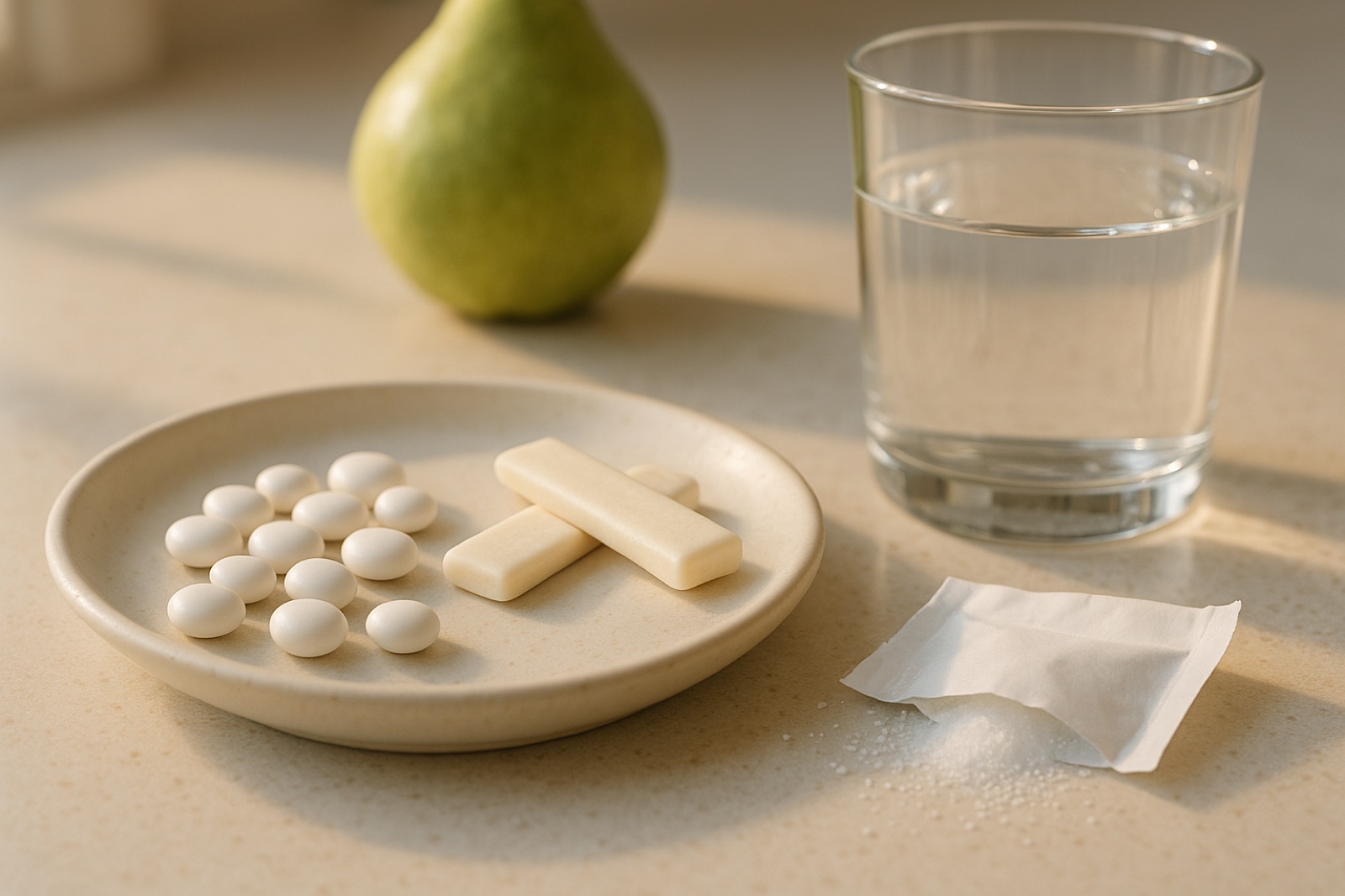
The word on the back of that packet is often sorbitol. It turns up in sugar-free gum and mints, in some cough syrups and medicines, in foods labelled “no sugar added,” and naturally in fruit like pears, apples and prunes. It tastes sweet. It carries fewer calories than sugar. That is the whole pitch, and for years it was the whole story.
So is sorbitol bad for you? Researchers at Washington University in St. Louis went looking, and what they found does not really sit on the packet at all.
Is Sorbitol Bad for You? The Short Answer First
For most people, in the amounts found in food, sorbitol’s best-known effect is dull and temporary. Eat a lot of it and it can upset your stomach. That has been on labels for a long time and it is not news.
The newer question is about the liver. And the finding underneath it is the part almost nobody repeats: your own body makes sorbitol. According to this work, enzymes in your intestine turn ordinary glucose — plain sugar, from ordinary food — into sorbitol after a meal.
You do not have to buy a single sugar-free product for sorbitol to show up inside you. You just have to eat.
What the Study Actually Found
The paper is titled “Intestine-derived sorbitol drives steatotic liver disease in the absence of gut bacteria,” and it was published in the journal Science Signaling. Read that title slowly, because the important phrase is the last one.
Working with zebrafish, the team traced where sorbitol goes. In a normal gut, certain bacteria — a group called Aeromonas — eat sorbitol and break it down. It gets handled locally. Nothing happens.
Strip those bacteria out, and the sorbitol has nowhere to go. It travels on to the liver. There it is converted into a fructose compound, and fat begins to build up in the liver — the condition doctors call steatotic liver disease, or fatty liver. When the researchers put the sorbitol-eating bacteria back, the effect eased.
Gary Patti, the senior researcher on the work, put the whole thing in one sentence in the university’s announcement of the study:
“It can be produced in the body at significant levels. But if you have the right bacteria, turns out, it doesn’t matter.”
That is a strange and rather beautiful result. The compound is not the villain. The compound is normal. What decides whether it becomes a problem is whether something else is living in you and doing its job.
Why This Is Not the Story You Would Expect
Almost every headline about sweeteners follows the same shape: the thing you swapped in is secretly worse than the thing you swapped out. Swap sugar for a substitute, discover the substitute is a trap, feel briefly betrayed, move on.
This one does not fit that shape, and it is worth being precise about why.
- The sorbitol in this study is mostly the sorbitol your intestine makes, not the sorbitol in a packet.
- The harm required the bacteria to be missing. With the bacteria present, the researchers describe the sorbitol as handled.
- The fix that worked in the study was not removing something from the diet. It was putting the bacteria back.
Which quietly moves the question. It is less “what did I eat” and more “what is living in me, and is it still there.” Gut bacteria keep turning up as the hidden variable in places nobody expected them — they have even been linked to how strong an older person’s grip is. And the things that thin them out are ordinary: illness, a poor stretch of eating, and medicines, which can leave a mark on the gut long after the last dose.
What This Does Not Mean
Here is where most coverage of a study like this goes wrong, so let us be careful and honest.
This work was done in zebrafish. That is a real and useful model, but a fish is not a person. The authors said so themselves: more research is needed to understand how gut bacteria regulate sorbitol, and whether the same thing happens in humans. That caveat is theirs, not a hedge added here.
It is also not new. The study was published in November 2025. It circulated again almost a year later, which is how a great many “scientists just discovered” headlines are actually made — the same thing happened with the sea squirt anti-aging story, where the research everyone was sharing was years old and had only ever run in mice.
And it does not mean sugar-free gum gives you fatty liver. Nobody has shown that. The university’s announcement notes that fatty liver affects roughly 30% of adults worldwide, which is why any thread leading toward it gets attention — but attention is not evidence.
What is fair to say is narrower, and more interesting: a compound your own body produces can be either harmless or harmful depending on what else is present, and researchers now have a specific mechanism to go looking for in people.
The Part That Stays With You
There is an old idea, far older than any laboratory, that what really shapes a person does not come from what they eat. It comes from inside them. People have argued about that line for centuries, almost always as a moral claim about food rules and clean hands.
It is odd to run into the same shape in a liver study. The compound is not sneaking in from outside. It is being made in there, quietly, out of ordinary food, by you. And the thing that keeps it from doing damage is not something you swallow either — it is something already living inside you, doing a job you never asked it to do, that you would only notice if it stopped.
Whether you call that luck, or design, or something you were given, almost nobody thinks about it while it is working.
So What Do You Actually Do?
Honestly: nothing dramatic, and be suspicious of anyone selling you the dramatic version off the back of a fish study.
You can keep chewing the gum. You can keep eating pears. The practical takeaway is not a new rule about sweeteners — it is a slightly different way of reading the next health headline you see. Ask who it was done in. Ask when it was published. Ask what the researchers themselves said they still do not know.
And maybe, next time you eat something perfectly ordinary, spare a thought for the invisible crowd doing quiet work in the dark so that it stays ordinary.
Questions People Are Asking
Is sorbitol bad for you?
In the amounts found in food, sorbitol’s main known effect in people is digestive — large amounts can cause stomach upset, which is why sugar-free products carry a warning. A study published in Science Signaling in November 2025 by researchers at Washington University in St. Louis found that in zebrafish, sorbitol reaching the liver could drive fat build-up, but only when sorbitol-degrading gut bacteria were absent. That research has not been shown to apply to humans, and the authors said further study is needed.
Does the human body produce sorbitol on its own?
Yes. In the Washington University in St. Louis research, enzymes in the intestine convert glucose from ordinary food into sorbitol after meals. This means sorbitol is present in the body regardless of whether a person eats sugar-free products containing it.
What are Aeromonas bacteria and what do they do with sorbitol?
Aeromonas are a group of gut bacteria that can break down sorbitol. In the zebrafish study, when these sorbitol-degrading bacteria were present, sorbitol was handled in the gut. When gut bacteria were depleted, sorbitol travelled to the liver and was converted into a fructose compound, and fat accumulated there. Reintroducing the bacteria reduced the effect.
What is steatotic liver disease?
Steatotic liver disease, commonly called fatty liver, is a build-up of fat in liver cells. Washington University in St. Louis noted in announcing this research that it affects roughly 30% of adults worldwide. The zebrafish study describes one possible mechanism involving sorbitol; it does not establish that mechanism in people.
Should I stop eating sugar-free products that contain sorbitol?
This research does not support that conclusion. The study was conducted in zebrafish, it focused largely on sorbitol produced inside the body rather than sorbitol eaten in food, and the harmful effect required gut bacteria to be missing. Anyone with a specific concern about their liver or digestion should raise it with a doctor rather than acting on an animal study.
One Question Worth Answering
When you read a headline that says a food is secretly harming you, what makes you believe it — or not believe it? Is it the source, the wording, or just whether it matches something you already suspected? Tell us in the comments; the answers to this one are always more interesting than the headline was.
Share This
“Turns out your intestine makes its own sorbitol from ordinary sugar. Whether it ever bothers your liver comes down to which bacteria are living in you. Wild. https://bgodinspired.com/index.php/health-and-wellness/is-sorbitol-bad-for-you/”
“Reminder that ‘scientists just discovered’ usually means ‘a study from last year is going around again.’ Good breakdown of one, including what the researchers themselves said they still don’t know: https://bgodinspired.com/index.php/health-and-wellness/is-sorbitol-bad-for-you/”
“I clicked expecting another ‘sweeteners are evil’ article and got something much stranger — the compound isn’t the problem, the missing bacteria are. https://bgodinspired.com/index.php/health-and-wellness/is-sorbitol-bad-for-you/”
Source: the study “Intestine-derived sorbitol drives steatotic liver disease in the absence of gut bacteria,” published in Science Signaling, as announced by Washington University in St. Louis.