 0
0
 0
0
Astronomers have a problem that’s bugged them for decades: supermassive black holes eat so violently that they should, in theory, starve themselves out. The radiation and jets they blast into their surroundings are so intense they ought to push away the very gas the black hole needs to keep growing. And yet these things sit at the center of galaxies for billions of years, somehow never running out of fuel.
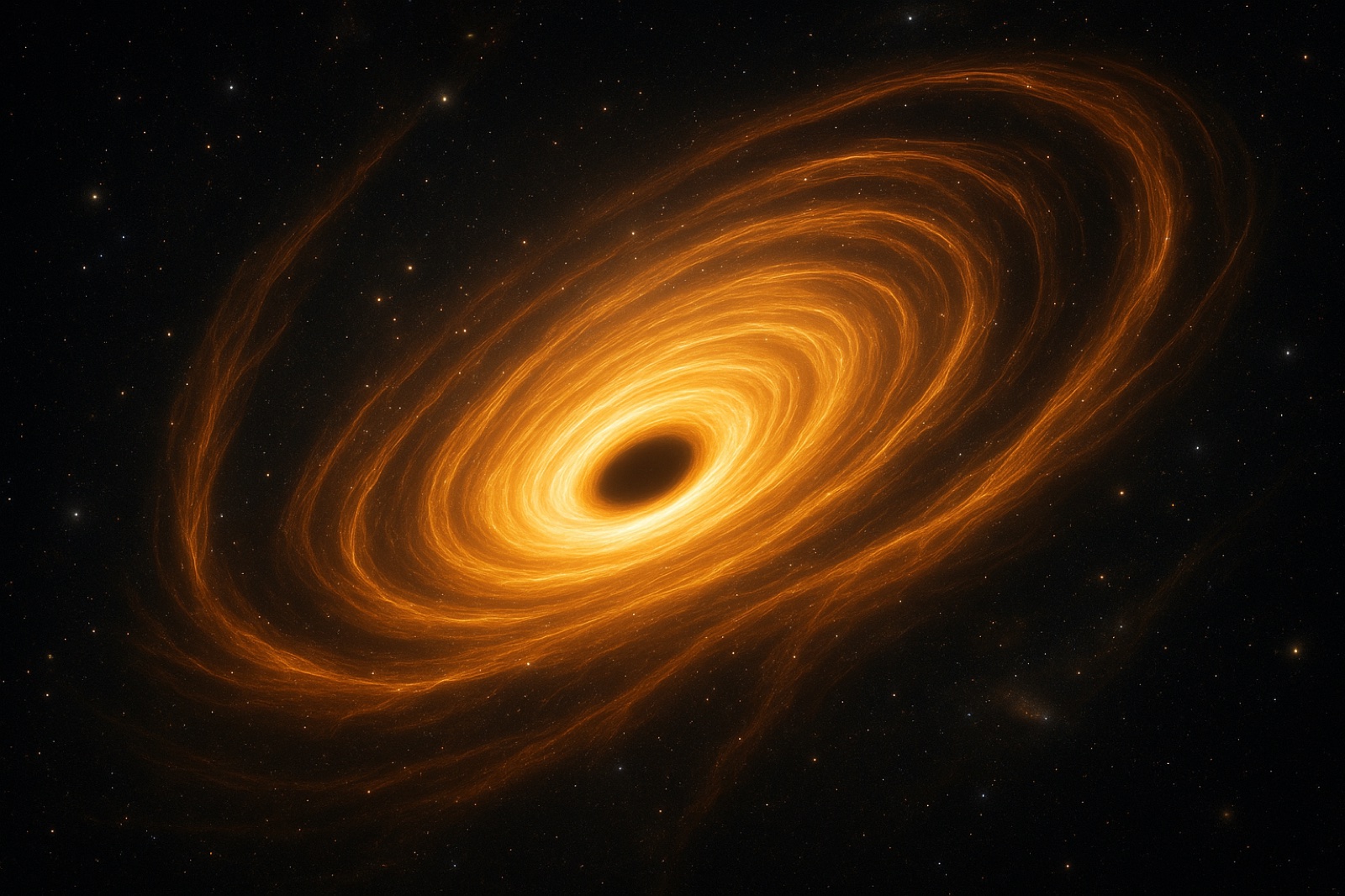
Now, thanks to nearly eight hours of staring through the James Webb Space Telescope, a team of astronomers thinks they’ve caught the answer in the act. The black hole isn’t just eating. It’s recycling.
A Black Hole That Shouldn’t Be Able to Keep Eating
The black hole in question sits at the center of a galaxy called NGC 4696, roughly 145 million light-years away, in the middle of the Centaurus Cluster. It’s not a small one. Supermassive black holes like this one can weigh as much as billions of suns — a stark contrast to the tiny 4.5-solar-mass black hole astronomers recently spotted in a much older star cluster. And the energy this one releases while feeding is enormous — enough, physicists have long assumed, to blow nearby gas clear out of reach.
That’s the puzzle. If a black hole heats and scatters its own food supply every time it eats, where does the next meal come from? For years, the honest answer was: we don’t fully know.
How Scientists Caught It Recycling Its Own Fuel
An international team, led by researchers at the Université de Montréal, pointed Webb’s NIRSpec instrument at NGC 4696 and mapped the motion of gas deep inside the black hole’s zone of influence — in enough detail to pick out structures only about 30 light-years across, which is remarkably sharp for something this far away.
What they found was a vast filament of gas, cooled and threading its way inward, funneling material into a spinning disk about 800 light-years wide. Inside that disk, gas races around the black hole at speeds up to 600 kilometers per second.
Here’s the part that solves the puzzle: that disk isn’t just falling in and disappearing. The black hole’s own jets heat some of the surrounding gas and fling it outward — but instead of that gas escaping for good, it eventually cools, condenses into thin filaments, and drifts right back down toward the center. The black hole heats its fuel, sends it out, lets it cool, and pulls it back in to eat again.
It’s a closed loop. A supermassive black hole, feeding itself for billions of years, using the very heat that should have been its undoing as part of the system that keeps it fed.
Why This Finding Matters
This isn’t a small detail for astronomers. It reshapes how they think about galaxy evolution itself. Black holes like this one sit at the center of galaxy clusters and regulate how those galaxies grow — too much unchecked feeding and a galaxy’s star formation shuts down; too little and the whole system behaves differently than what we actually observe in the universe. A self-sustaining feedback loop, the kind just mapped in NGC 4696, is the missing mechanism that makes the math finally work.
The findings were published July 14, 2026, in The Astrophysical Journal Letters, and researchers are already treating it as a likely explanation for how black holes across the universe manage to keep functioning for eons without ever fully going dark or fully consuming everything around them. It’s the same instinct that drove astronomers to spend 33 straight days listening to a distant exoplanet for signs of something, and the kind of question behind why quasars far older than they should be keep turning up in deep space: the universe keeps surprising the people who study it closest. A system billions of years old, recycling itself, staying balanced — without anyone or anything managing it moment to moment.
Something Is Holding It All Together
There’s something almost unsettling about that phrase — a system that holds itself together, balances itself, keeps itself fed, across a scale so vast that light takes 145 million years just to reach us from it. No engineer designed that feedback loop. No one is out there adjusting the dials. And yet it works, has worked, and will keep working long after every person reading this is gone.
It’s the kind of thing that shows up again and again once you start looking — order where you’d expect chaos, balance where you’d expect collapse. Long before anyone could see a black hole, ancient wisdom already had a name for whatever it is that holds all things together, quietly, at every scale, without needing to be watched. Maybe that’s worth sitting with for a second before you close the tab: something that vast, staying that steady, isn’t nothing.
A Question Worth Sitting With
If a black hole 145 million light-years away can run on a self-sustaining balance nobody built and nobody manages — what does that tell you about the odds of everything else in the universe just happening to hold together too? We’d love to hear where you land on that. Drop your take in the comments.
Share This
- A black hole 145 million light-years away has been quietly feeding itself for billions of years, heating its own fuel, cooling it, and pulling it back in. No one’s managing it. It still works. #JWST #BlackHole
- Scientists finally caught a supermassive black hole recycling its own fuel supply on camera (well, JWST camera). The loop has apparently been running for billions of years, untouched.
- Wild thought from today’s science reading: the universe has self-sustaining systems running at scales we can barely picture, and they don’t need anyone watching them to keep working.
Common Questions About This Discovery
What did the James Webb Space Telescope actually discover?
JWST observed a supermassive black hole at the center of the galaxy NGC 4696, in the Centaurus Cluster, and found direct evidence of a self-sustaining feeding cycle: the black hole heats surrounding gas, that gas cools and falls back inward, and the black hole feeds on it again.
Where is NGC 4696 located?
NGC 4696 is the central galaxy of the Centaurus Cluster, located roughly 145 million light-years from Earth.
How did scientists observe this feeding cycle?
A team led by researchers at the Université de Montréal used Webb’s NIRSpec instrument, gathering nearly eight hours of observation time to map gas motion in detail sharp enough to resolve structures about 30 light-years across.
Why does a black hole need to recycle its own fuel?
The intense energy and jets a black hole releases while feeding can push gas away, which should eventually starve it. Recycling that gas — letting it cool and fall back in — solves the long-standing question of how black holes keep feeding for billions of years without running out of material.
When was this research published?
The findings were published July 14, 2026, in The Astrophysical Journal Letters.