 0
0
 0
0
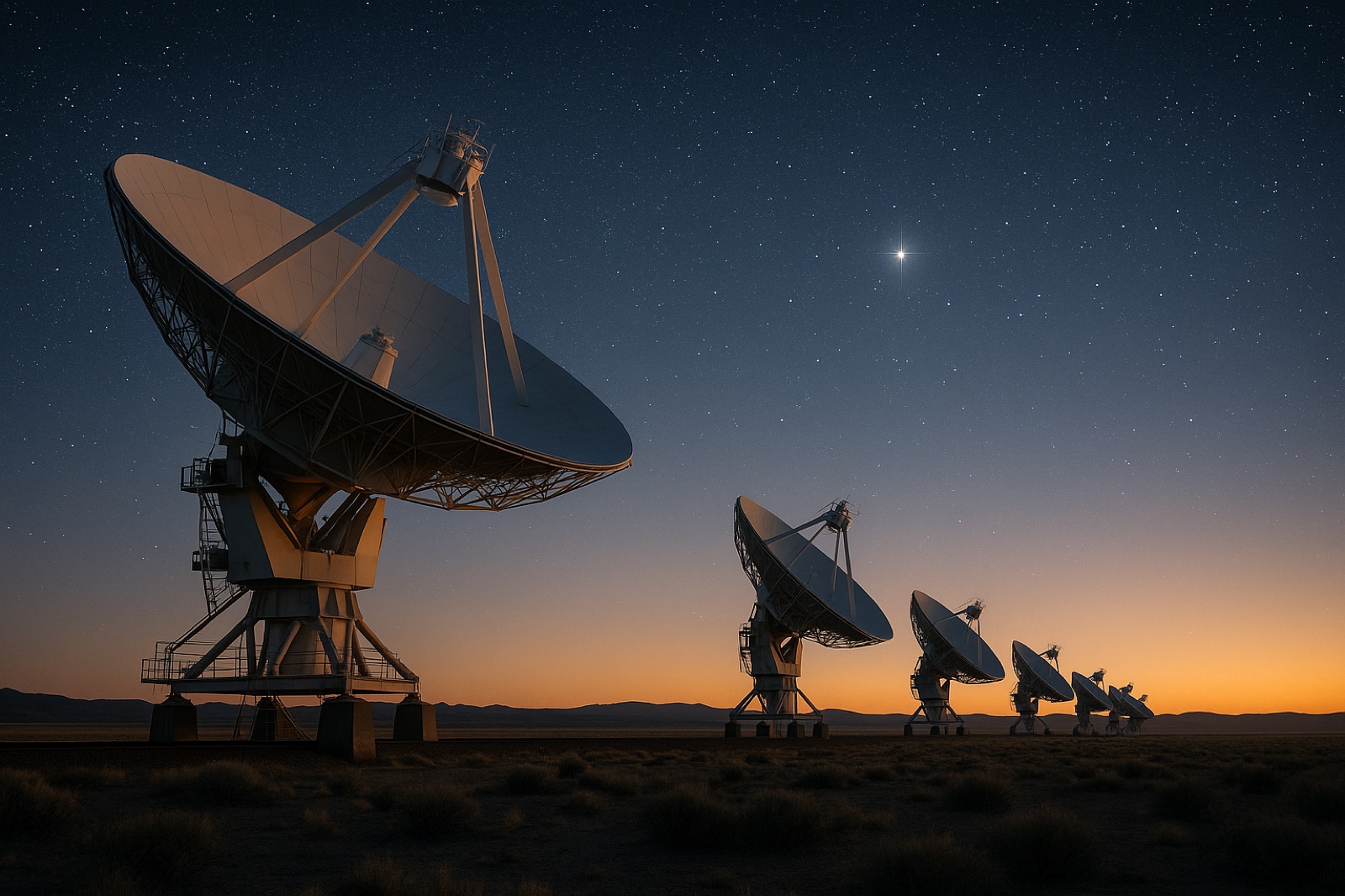
For 33 straight days this summer, two of the most sensitive radio telescope arrays on Earth were pointed at a single spot in the sky that the naked eye can’t even find. The target was K2-18b, a planet 124 light-years away that keeps showing up in headlines because it might be one of the best real candidates we have for a world that could support life. Using the Karl G. Jansky Very Large Array in New Mexico and the MeerKAT array in South Africa, astronomers spent that entire month scanning nearly every radio frequency a signal could plausibly travel on, listening for one specific thing: a transmission that looked artificial. Something that couldn’t be explained by stars, storms, or static. Something built.
Thirty-three days wasn’t a random length. It’s exactly how long one full year lasts on K2-18b — long enough, the researchers reasoned, to catch a signal if anyone there were broadcasting on any kind of regular schedule, the way we do. The search covered a frequency range roughly six times wider than any previous scan of this planet, at a sensitivity capable of detecting a transmitter a thousand times fainter than earlier searches could catch. Across that entire window, there were millions of individual signals technically detectable.
When the 33 days ended and the data was finally combed through, the answer came back the same at every frequency: nothing. No transmission. No pattern. No signal that couldn’t be explained by ordinary interference. Silence, from one end of the search to the other.
Why K2-18b Keeps Showing Up in the Search for Life
K2-18b isn’t just another distant rock. It orbits its star in the habitable zone — the narrow band of distance where temperatures could allow liquid water — and earlier observations from the James Webb Space Telescope picked up signs of methane and carbon dioxide in its atmosphere, along with a disputed but tantalizing hint of a molecule that, on Earth, is only produced by living organisms. Scientists classify it as a possible “hycean” world: a planet that could be covered by a deep, warm ocean underneath a hydrogen-rich atmosphere. It’s the kind of place that makes the question “is anyone out there” feel less like science fiction and more like an open research problem.
That’s exactly why this particular search mattered. Most searches for extraterrestrial signals — the field is called SETI, short for the Search for Extraterrestrial Intelligence — have historically scanned wide swaths of sky without much reason to think any one target was more promising than another. K2-18b gave researchers a specific, defensible reason to point everything they had at one coordinate for an extended stretch of time, rather than skimming the whole sky thinly. For this survey, the VLA used a system called COMICS, and MeerKAT relied on the Breakthrough Listen project’s BLUSE equipment, both built to sift enormous volumes of radio data and flag anything that didn’t look natural. It’s not a small undertaking. It’s the most sensitive, most sustained listening effort this specific planet has ever received.
Thirty-Three Days of Total Silence
The researchers were careful about what the null result does and doesn’t mean. Finding no artificial radio signal doesn’t rule out life on K2-18b. It only rules out one very specific thing: broadcasting, at a power level comparable to human technology, in the frequencies this survey covered, during this particular window of time. There could be life there that never developed radio technology at all. There could be a civilization broadcasting on a frequency, at a power level, or on a schedule this search didn’t happen to catch. Or there could simply be nothing there to find. The silence doesn’t answer the question. It narrows it.
What the astronomers gained instead was a method — a faster, more sensitive way to run this kind of search that can now be pointed at the next target, and the one after that. Discoveries like this tend to work that way — the value isn’t only in what gets found, it’s in what gets built along the way toward finding it.
What Silence Might Actually Mean
There’s an old story — the kind that’s been retold and copied down for thousands of years — about a man who went looking for God in the loudest possible way. He was exhausted, certain he’d been left alone, and desperate enough for an answer that he went looking for it in the biggest signals he could think of: a windstorm strong enough to split rock, then an earthquake, then a fire. None of it was where God turned out to be. The story says he finally found what he was looking for in something almost embarrassingly quiet — a voice so soft he had to go completely still and lean in just to catch it. Not louder proof. Quieter presence.
Maybe the loudest possible search — every frequency, every angle, thirty-three straight days of listening with the most sensitive instruments available — was never going to be how anyone catches something that simply doesn’t announce itself that way. Silence on the instruments doesn’t necessarily mean nothing is there. Sometimes it means whatever’s there was never going to show up as noise in the first place.
It’s a strange kind of comfort, if you let it be one. Feeling like you’re shouting into silence — waiting on a diagnosis, a decision, an answer that hasn’t come — is its own kind of exhausting search. The absence of a dramatic sign isn’t proof that nothing’s there. It might just mean you’re listening for the wrong kind of signal.
Still Listening
The K2-18b data is still being studied by teams around the world, and more targeted searches are already being planned using the same refined method. Whether or not a future scan ever catches something, the astronomers who ran this one weren’t wasting thirty-three days. They built a sharper tool, tightened the sensitivity, and now know precisely what near-silence looks like when you measure it carefully enough to describe it with confidence. There’s something worth borrowing from that, even on the nights when your own listening doesn’t turn up an answer either. Sometimes the value isn’t in getting the signal back right away. It’s in becoming someone who knows how to listen well, long before the answer ever shows up.
Two Small Things Worth Trying
- Tonight, go quiet on purpose. Put your phone in another room for ten minutes and sit in whatever silence you can find — no podcast, no scrolling, nothing filling the space. Notice what’s actually still there once the noise stops.
- The next time you’re waiting on an answer that hasn’t come — a text back, test results, a decision someone else is sitting on — try not treating the silence as the final word. Give it room to still be open.
A Question Worth Sitting With
If a signal from another world finally showed up in the data tomorrow, would you want to know immediately — or does some part of you actually prefer the mystery, the not-knowing, the sense that the universe still has something left to find? What do you think the silence actually means? Tell us in the comments.
If This Found You Today
- Scientists just spent 33 days listening to an entire planet for a single signal. They heard nothing. And somehow, that’s not actually the end of the story.
- K2-18b might be our best real shot at finding life outside Earth. Astronomers just ran the most sensitive search yet — six times the frequency range, a thousand times more sensitive than before. Total silence. Here’s why that might not be bad news at all.
- The most powerful alien-signal search ever pointed at K2-18b came back completely empty. An old story about a man listening for God in a windstorm says maybe that’s exactly how it’s supposed to go.
Common Questions About the K2-18b Signal Search
What is K2-18b, and why do scientists think it might support life?
K2-18b is an exoplanet about 124 light-years from Earth that orbits its star inside the habitable zone, where temperatures could allow liquid water to exist. Earlier observations from the James Webb Space Telescope detected methane and carbon dioxide in its atmosphere and a disputed hint of a molecule that, on Earth, is only produced by living things. Scientists consider it a leading candidate for a “hycean” world — a planet covered by a deep ocean beneath a hydrogen-rich atmosphere.
What did the 33-day radio survey of K2-18b actually search for?
It searched for artificial radio signals — transmissions that couldn’t be explained by natural causes like stars or interference — using the Very Large Array and MeerKAT telescope arrays. The survey covered a much wider range of frequencies and far greater sensitivity than any previous search of this specific planet.
Did astronomers find any signs of alien life on K2-18b?
No artificial signals were detected during the 33-day search. That result doesn’t rule out life on K2-18b — it only rules out one specific possibility: a detectable radio broadcast, at human-comparable power, on the frequencies and during the window this survey covered.
What telescopes were used to search K2-18b for radio signals?
The search used the Karl G. Jansky Very Large Array in New Mexico and the MeerKAT array in South Africa, running specialized data-processing systems (COMICS and Breakthrough Listen’s BLUSE) built to filter enormous volumes of radio data for anything that looks artificial.
Why does the 33-day length of the search matter?
Thirty-three days is the length of one full year on K2-18b. Researchers chose that window because it’s long enough to catch a signal if any transmission were being sent on a regular, year-based schedule, similar to how human broadcasts often repeat.