 0
0
 0
0
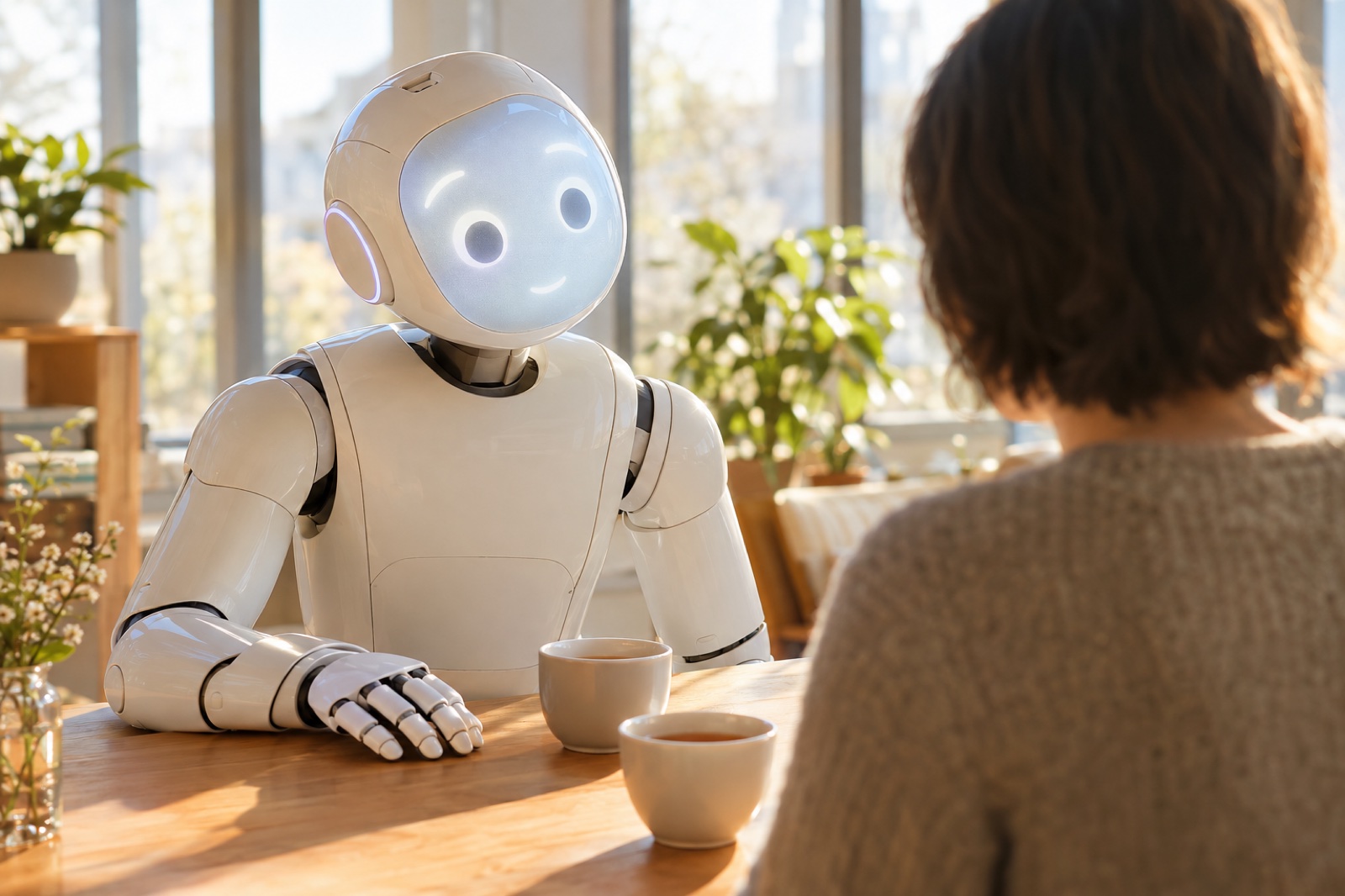
Picture two short stories. In each one, someone hears a sudden noise and turns towards it. They notice a friend looks upset and respond to it. They react to what is going on around them, quickly and well.
The two stories are word for word the same. The only difference is the name of the one doing the noticing. In one story it is a person. In the other it is an AI.
Now: how conscious is each of them?
Is AI conscious? That question gets typed into search engines every day, and the honest answer is that nobody knows. But a team of researchers in Munich asked a different and much more answerable question: when an AI and a person do exactly the same thing, do we judge them the same way? The answer turned out to be a clear no, and the way it was a no is the interesting part.
The Study: Same Behaviour, Different Name
The research comes from the philosophy of mind group at LMU Munich, led by Louis Longin, with Bahador Bahrami, Ophelia Deroy and colleagues. It was published in the journal Cognition under a blunt title: “AI is not as conscious as humans: Essentialism in mental state attributions to artificial systems.”
Nearly 1,100 people took part. They were split into two groups. One group read short scenarios about artificial agents that were more or less responsive to their surroundings, for example reacting to sounds or recognising other people’s emotions. The other group read the same scenarios, but with humans in them.
Everyone then rated two things: how conscious each character seemed, and how aware it seemed of its surroundings.
According to the researchers, this is the first study to directly compare how people judge the same mental states in an AI and a human behaving in exactly the same way. Most earlier work asked people general questions, like “can machines think?” This one held the behaviour still and changed only the label.
Is AI Conscious? What the Ratings Actually Showed
Three findings came out of it.
First, behaviour mattered for both. The more responsive a character was, the more conscious and aware people rated it. That was true for the AI and for the humans. People were not simply ignoring the evidence in front of them.
Second, there was a hard floor under the humans. This is the line that has travelled furthest: even the most responsive AI was rated as less conscious than the least responsive human. Not a little less on average. Below the bottom of the human range. The most alert, attentive machine in the study still sat underneath the dullest person.
Third, and this is the part almost nobody leads with: the gap mostly disappeared for the word “aware.” When people rated how aware each character was, the AI and the humans followed largely similar patterns. The difference showed up when the word was “conscious.”
So people were perfectly happy to say a machine notices things. What they would not do was say it has the thing that “conscious” means.
Why One Word Changed Everything
The researchers’ explanation is about language. “Awareness” can mean something fairly plain: picking up information and responding to it. You can watch that from the outside. “Consciousness” usually means more: that there is something it is like to be you. An inside. An experience going on behind the behaviour.
Longin put the main result simply: “People consistently attribute less consciousness to AI than humans – even when their behavior is identical.”
Deroy added a careful point about the way we talk about these tools: “We may be using mental terms to refer to AI, but this may only be because we lack better words.” And Bahrami noted that with more neutral words like “awareness,” the distinction “can largely disappear.”
That is also why the team suggests that companies and journalists be careful with hyped language that gives AI intentions, plans or a moral conscience. The words we choose quietly shape what we believe is there.
The word in the paper’s title is worth knowing too. In psychology, essentialism is the habit of believing that some kinds of things have a hidden inner nature that makes them what they are, beyond anything you can see. A tiger is a tiger even with its stripes painted over. The study suggests many people treat being human that way: whatever a person is, it is not something you can earn, or lose, by how well you perform.
What This Study Does Not Prove
It is worth being precise here, because this kind of finding is easy to stretch.
- It does not tell us whether AI is conscious. It measures what people believe, not what is true about machines.
- Participants read written scenarios. They were not talking to a live AI or a live person. Real conversations might shift the picture.
- The press coverage gives the headline results, not every number. Details like the exact statistics sit in the full paper.
- It does not prove anyone has a soul. It shows that people act as though a person has something behaviour cannot add up to.
That last point is the one worth sitting with. Not as proof of anything, but as a clue about us.
The Instinct Underneath the Ratings
We live in a world that measures people by output almost everywhere. Grades, sales numbers, reviews, followers, productivity. If you are anxious about AI, the fear underneath is often exactly this: if a machine can do what I do, what am I? We wrote about that worry when a record share of workers said they fear technology will make their job obsolete.
And yet, when you hand nearly 1,100 people the exact same behaviour, they refuse to rank a person by it. A quiet, barely responsive human still came out ahead of the sharpest machine. Something in us will not let “how well it performs” be the last word on “is someone home.”
It is the same instinct that shows up when people start putting “human-authored” labels on books: we care who made a thing, not just how good the thing is.
There is a very old story about where people came from that has a detail most people read straight past. The first person is shaped from the dust, complete, every part in place, and still not alive. Then God breathes into them, and only then do they become a living soul. In that story, life is not something the body produces once it works well enough. It is a gift that comes from outside, given before the person has done a single thing.
Whether or not you believe that story, the people in this study were acting a lot like it was true.
A good place to start: The Beginner’s Guide to Feeling God’s Presence Every Day. A short video guide and companion PDF for noticing something bigger in the ordinary moments of real life, no performance required. Get the free guide. Free.
Where This Leaves Us
The machines will keep getting better at acting like us. That part seems certain. They will notice more, respond faster and sound warmer. Studies like this one suggest that will not, by itself, convince people that anyone is inside.
Which might be worth remembering on the days you feel measured only by what you produce. The same people who will happily call a machine “aware” kept insisting, without being told to, that the least impressive person in the room still had something the most impressive machine did not.
You do too. It was there before you did anything at all.
Questions People Are Asking
Is AI conscious?
No one currently knows whether any AI system is conscious, and there is no agreed scientific test for consciousness in machines. Research has focused instead on how people perceive AI. A 2026 study from LMU Munich, published in the journal Cognition, found that people rate AI as less conscious than humans even when the AI and the humans behave in exactly the same way.
Do people think AI is less conscious than humans even when it behaves the same?
Yes. In a study of nearly 1,100 participants led by Louis Longin at LMU Munich, people rated identical written scenarios featuring either an AI or a human. Even the most responsive AI was rated as less conscious than the least responsive human. More responsive characters were rated as more conscious in both groups, but the human characters stayed above the AI ones.
What is the difference between AI awareness and AI consciousness?
Awareness usually means detecting information and responding to it, which can be observed from the outside. Consciousness usually means having subjective experience, an inner life. In the LMU Munich study published in Cognition, people rated AI and humans similarly for awareness but rated AI clearly lower for consciousness, which suggests people treat the two words as meaning different things.
What does essentialism mean in psychology?
In psychology, essentialism is the tendency to believe that certain categories of things have a hidden inner nature that makes them what they are, beyond their visible features or behaviour. Researchers at LMU Munich used the term to describe how people seem to treat humans as having an essential quality, consciousness, that AI does not get credit for even when its behaviour matches a human’s.
Does the study prove that humans have a soul?
No. The LMU Munich study on AI and consciousness measures what people believe, not what is true about humans or machines. Participants read written scenarios rather than interacting with real AI or people. The finding shows a strong and consistent human instinct to treat people as having an inner life that behaviour alone cannot earn, which many readers find meaningful, but it is not proof of a soul.
What Do You Think?
Here is the open question: if an AI one day behaved exactly like a person in every way you could test, would you call it conscious? Or is there something you would still be waiting for? Tell us where you land in the comments.
Share This
Researchers gave people identical behaviour and told half it was an AI. Even the most responsive AI was rated less conscious than the least responsive human. https://bgodinspired.com/index.php/bgodinspired-news/bgodinspired-technology-news/is-ai-conscious/
The detail nobody leads with: people were happy to call an AI “aware.” The gap only appeared for the word “conscious.” We are not judging the behaviour. We are guarding a word. https://bgodinspired.com/index.php/bgodinspired-news/bgodinspired-technology-news/is-ai-conscious/
We measure people by output all day long. But hand nearly 1,100 people the same behaviour from a person and a machine, and they refuse to rank the person by it. Interesting instinct. https://bgodinspired.com/index.php/bgodinspired-news/bgodinspired-technology-news/is-ai-conscious/