 0
 0
A small dog’s skull came out of the sand on the northern coast of Peru with its ears still attached.
Somebody had painted it red.
It had been in the ground for more than a thousand years. The coastal desert there is so dry that skin and ears can survive when everything else gives up. The red was cinnabar — a bright mineral pigment those people used on their dead. Not on rubbish. Not on animals they had finished with. On their dead.
That is the detail that pulled a lot of people into this story. But it is not the most interesting thing the bones say.
What the archaeologists actually found
The place is El Castillo de Huarmey, a walled tomb complex roughly 180 miles north of Lima, by National Geographic‘s account of the research. It belonged to the Wari, who ran the first great empire of the Andes somewhere between AD 600 and 1050 — centuries before anyone had heard of the Inca.
A Polish-led team, working alongside researchers from Dartmouth College and the University of Pittsburgh, has been excavating there since 2010. Under the sand they found a royal mausoleum: dozens of high-status women buried together, a handful of men, and smaller graves set off to the sides.
And dogs. More than 340 dog bones, from at least twenty animals. Puppies only weeks old. Full-grown adults. Some were loose bones. Some had mummified on their own in the dry ground.
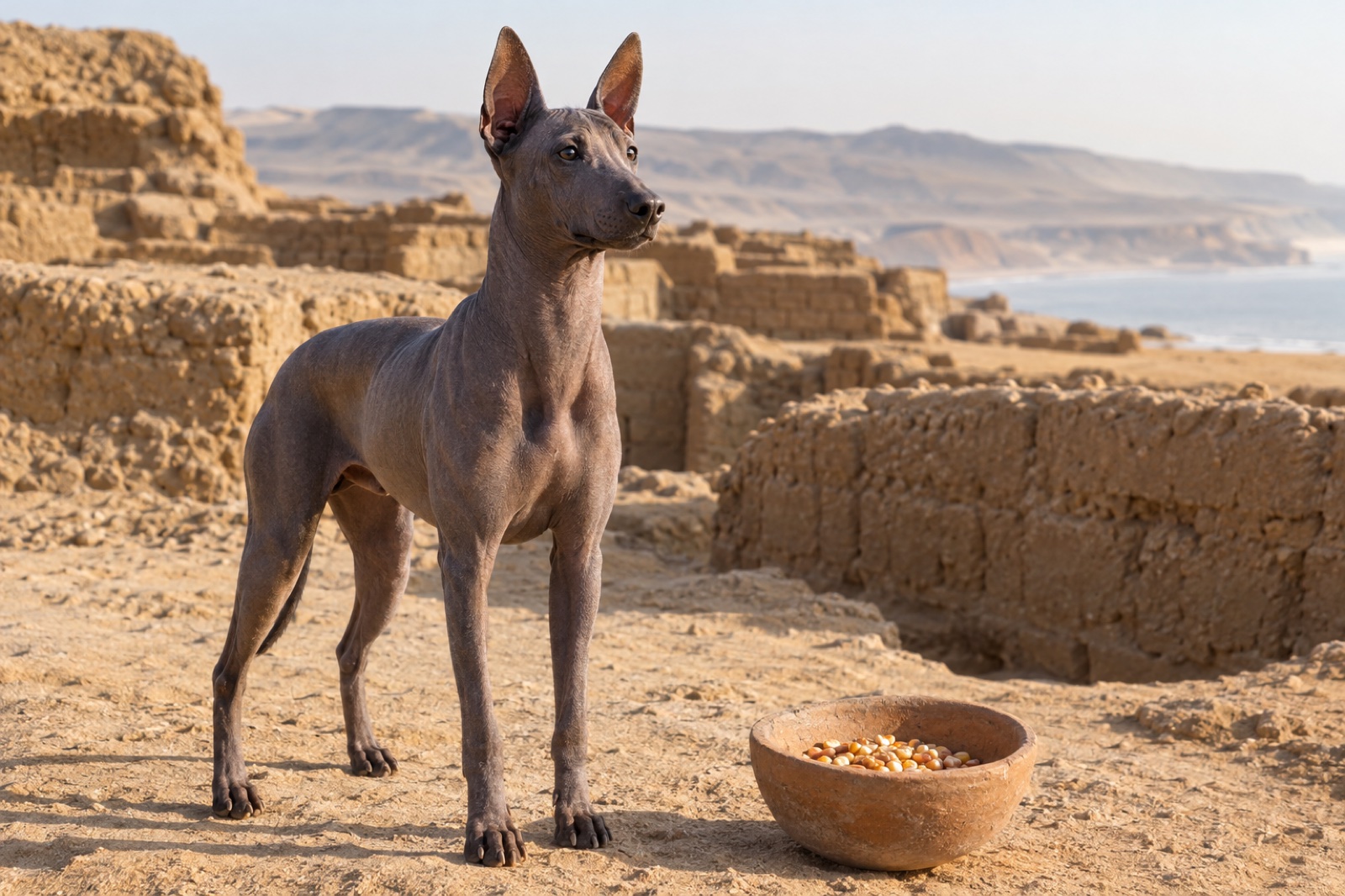
Three sets of remains came from Peruvian hairless dogs — the same long-legged, smooth-skinned breed you can still meet on a street in Lima today. Working out that they were hairless took some care, because hairlessness does not leave a skeleton. The team used the teeth. Many of the dogs were missing molars and premolars, and crucially those teeth had not fallen out.
“Some teeth, especially first premolars and sometimes last molars, had just never erupted,” said Weronika Tomczyk of Dartmouth, who led the study, published in the Journal of Anthropological Archaeology.
The same genetic change that makes these dogs hairless also leaves them short a few teeth. A missing tooth that was never there is a fingerprint. A handheld microscope on a scrap of preserved skin confirmed the rest.
The dogs were eating what the children were eating
Here is the part that did not make the headlines, and it is the part I keep thinking about.
The team ran isotope analysis on the remains — a chemistry test that reads what an animal ate out of its own bone. Most of the dogs had been living on maize, which was the staple of the Wari diet. In other words, they ate what people ate.
The puppies went further than that. Their chemical signature looked like the signature of Wari children.
Not scraps. Not whatever was left. The same food, in the same proportions, as the small humans in the household.
One dog was the exception, and it is a lovely exception: its diet looked like a llama’s. That dog had probably spent its life out on the road with herds or trading caravans, eating what the animals around it ate. Others looked like they had scavenged near settlements. Some of these dogs were family. Some were working animals. Some were probably neither.
Tomczyk is careful about how far this can be pushed. “We do not know if the dogs were intentionally fed maize,” she said — it is possible they simply ate what was lying about in a maize-centred world. The researchers raise organised breeding as a possibility, not a finding.
Still: something about that food result lands. We spend a lot of effort now proving what dog owners have assumed forever — that the bond is real and runs both ways. Recent work has found that dogs’ brains split our speech into words in much the way ours do. A thousand years ago, on a desert coast, somebody was already feeding a puppy out of the same pot as their child.
Who they were buried with
The placement of the animals is what made the team sit up.
A puppy was laid beside a man who appears to have guarded the mausoleum, just outside the main chamber. An adult dog was put in a side room with a teenager. Another was found with a craftsman the Wari clearly held in high regard. The researchers have said the positioning of the animals in these burials was unlikely to have been accidental.
People have been packing for the journey out for a very long time. A 3,000-year-old tomb near Luxor has a full meal painted on its wall so the man inside would never run out. Different continent, different millennium, same reflex: do not send them out with nothing.
What the find can’t prove
You will see this story told as proof that the Wari sent dogs along to guide the dead into the next world. That reading has real roots — in Andean tradition, dogs, and black dogs especially, were understood as guides between the world of the living and the world of the dead. Tomczyk has pointed to that belief herself when discussing the possible symbolic and ritual role of the animals.
But it is an interpretation, not a measurement, and the researchers say so. Dogs in a grave prove dogs were in a grave. What those people believed as they put them there is not recoverable from bone chemistry.
There is a harder problem too, and it is worth knowing about. El Castillo de Huarmey was looted heavily for decades before archaeologists got to it. A lot of the original context — what lay next to what, and in what order — is simply gone. An outside specialist, Susan deFrance, who was not part of the study, has called it very sound zooarchaeological research while noting that similar beliefs about dogs as underworld guides turn up elsewhere in the Americas. Tomczyk’s own summary of the bond is deliberately modest: if dogs are buried in close association with humans, there must have been some kind of bond.
And in her franker moments she allows that these animals could have been pets to some people and pests to others. Both at once. Which is exactly how dogs have always lived among us.
So the strongest evidence in this tomb is not the red paint. It is the food. The paint tells you what someone hoped was true about death. The food tells you what was already true about life.
A good place to start: The Beginner’s Guide to Feeling God’s Presence Every Day. A simple way to notice God in ordinary moments — the walk, the kitchen, the drive — instead of waiting for a dramatic one. Get the free guide. Free.
Nobody wants anyone to walk out alone
Strip away the empire, the cinnabar and the thousand years, and what is left at Huarmey is a very small, very recognisable instinct.
Somebody could not stand the thought of a person they loved going into the dark unaccompanied. So they sent a companion. They painted it red so it would be unmistakable. They did the only thing they could think of to do.
Every culture has built something like this. A guide, a boatman, a dog, a lamp left burning. The particulars change wildly and the impulse never does, which is usually a sign that the impulse is telling the truth about us even when the particulars are guesswork.
There is an old shepherd’s song, sung in a different desert a long way from Peru, that takes the same valley seriously and answers it differently. It does not tell you to find someone to send with you. It says the one who made you is already in there, walking it beside you, and has been the whole time. The companion is not something you arrange in advance. It is the point.
You can see how durable that image turned out to be: when archaeologists near Nicaea uncovered one of the oldest known paintings of Jesus, He was not on a throne. He was carrying a sheep home on His shoulders.
Back in the sand
The skull with the ears is the thing I cannot shake.
Somebody knelt down in that dry coastal sand with a pot of red pigment and took the time to paint a small dog. We do not know their name. We do not know what they thought happened next, and the looters took most of the clues. But we know it mattered to them that the dog went too.
Twenty dogs. Three hundred and forty bones. Puppies fed like children.
Whatever else this find turns out to mean, that is the oldest thing in the tomb — older than the empire that built it. Someone did not want anyone to go alone.
Questions People Ask
What were the mummified Peruvian hairless dogs found in Peru?
They are the remains of three Peruvian hairless dogs recovered from El Castillo de Huarmey, a Wari tomb complex on Peru’s northern coast around 180 miles north of Lima. They were part of a larger assemblage of more than 340 dog bones from at least twenty animals. Some remains had mummified naturally in the dry coastal desert, including a skull with its ears still preserved and painted with cinnabar, a red mineral pigment used on the dead. The research, led by Weronika Tomczyk of Dartmouth College, was published in the Journal of Anthropological Archaeology.
How old are the Peruvian hairless dog remains from Castillo de Huarmey?
The oldest hairless dog remains at the site date to between AD 688 and 870. That places them inside the Wari period, which ran roughly from AD 600 to 1050 — several centuries before the Inca empire. El Castillo de Huarmey itself was excavated from 2010 onward by a Polish-led team working with Dartmouth College and the University of Pittsburgh.
How did archaeologists know the dogs were hairless if hair does not survive?
They used the teeth. The genetic change that makes a Peruvian hairless dog hairless also leaves it missing certain teeth, usually first premolars and sometimes the last molars. Crucially, those teeth had never erupted at all rather than being lost during life, which is a different and recognisable pattern in the jaw. Researchers then examined preserved skin from one naturally mummified dog under a handheld microscope and confirmed it carried very little hair.
Were the Wari dogs really guides to the afterlife?
That is an interpretation, not an established finding, and the researchers present it as a possibility. It draws on Andean tradition, in which dogs — black dogs in particular — were understood as guides between the world of the living and the world of the dead. The evidence that supports it is the placement of the animals: a puppy beside a man who appears to have guarded the mausoleum, an adult dog with a teenager, another near a high-status craftsman. Researchers have said that positioning was unlikely to be accidental. But the site was heavily looted for decades before excavation, so much of the original burial context is missing, and bone chemistry cannot recover what people believed.
What did the Wari dogs eat?
Isotope analysis of the bones showed most of the dogs lived mainly on maize, the staple of the Wari diet, with nitrogen levels suggesting animal protein as well. The puppies’ chemical signature closely resembled that of Wari children, meaning they were eating much the same food as the youngest people in the household. One dog was an outlier whose diet matched that of llamas and alpacas, suggesting it travelled with herds or trade caravans. Some others appear to have scavenged near settlements. The lead researcher has cautioned that it is not known whether the dogs were deliberately fed maize or simply ate what was available.
What do you think?
Every culture seems to build a companion for the road out — a guide, a boatman, a dog, a light left on. Do you think that says something true about how people are made, or is it just a story we tell ourselves because the alternative is unbearable? Tell me how you read it in the comments.
If this was worth your time, pass it on
A thousand years ago in Peru, somebody fed their puppy the same food they fed their child — and then buried it beside them. We’re still proving what they already knew. https://bgodinspired.com/index.php/articles/mummified-peruvian-hairless-dogs-wari/
Archaeologists found a mummified dog skull in Peru with its ears still attached, painted red. But the detail that got me wasn’t the paint. It was the bone chemistry: these dogs were eating what the children were eating. https://bgodinspired.com/index.php/articles/mummified-peruvian-hairless-dogs-wari/
Twenty dogs. Three hundred and forty bones. One small skull with its ears intact. Somebody could not stand the thought of a person they loved going out of this world alone — so they sent a friend. https://bgodinspired.com/index.php/articles/mummified-peruvian-hairless-dogs-wari/