 0
0
 0
0
Between July 2021 and April 2023, the ice covering Antarctica got heavier. Not a little heavier. About 695 billion tonnes heavier.
It is the largest short-term Antarctica ice gain that satellites have ever measured. And the reason, according to a study published in the journal Nature on 19 August 2026, was not in Antarctica at all. It was in a patch of warm ocean thousands of kilometres to the north. Nobody standing on the ice could have seen it.
You may have seen this story shared two opposite ways. Some people posted it as proof the ice is fine. Others waved it away. The study itself says something more interesting than either.
What Actually Happened to Antarctica’s Ice
Scientists weigh Antarctica from space. Satellites circle the Earth and measure tiny changes in gravity underneath them. More mass on the ground pulls a little harder. Less mass pulls a little less. Over the years, that tells researchers whether the ice sheet is getting heavier or lighter.
For about two decades, the answer has mostly been lighter. On average, Antarctica has been losing roughly 140 billion tonnes of ice a year.
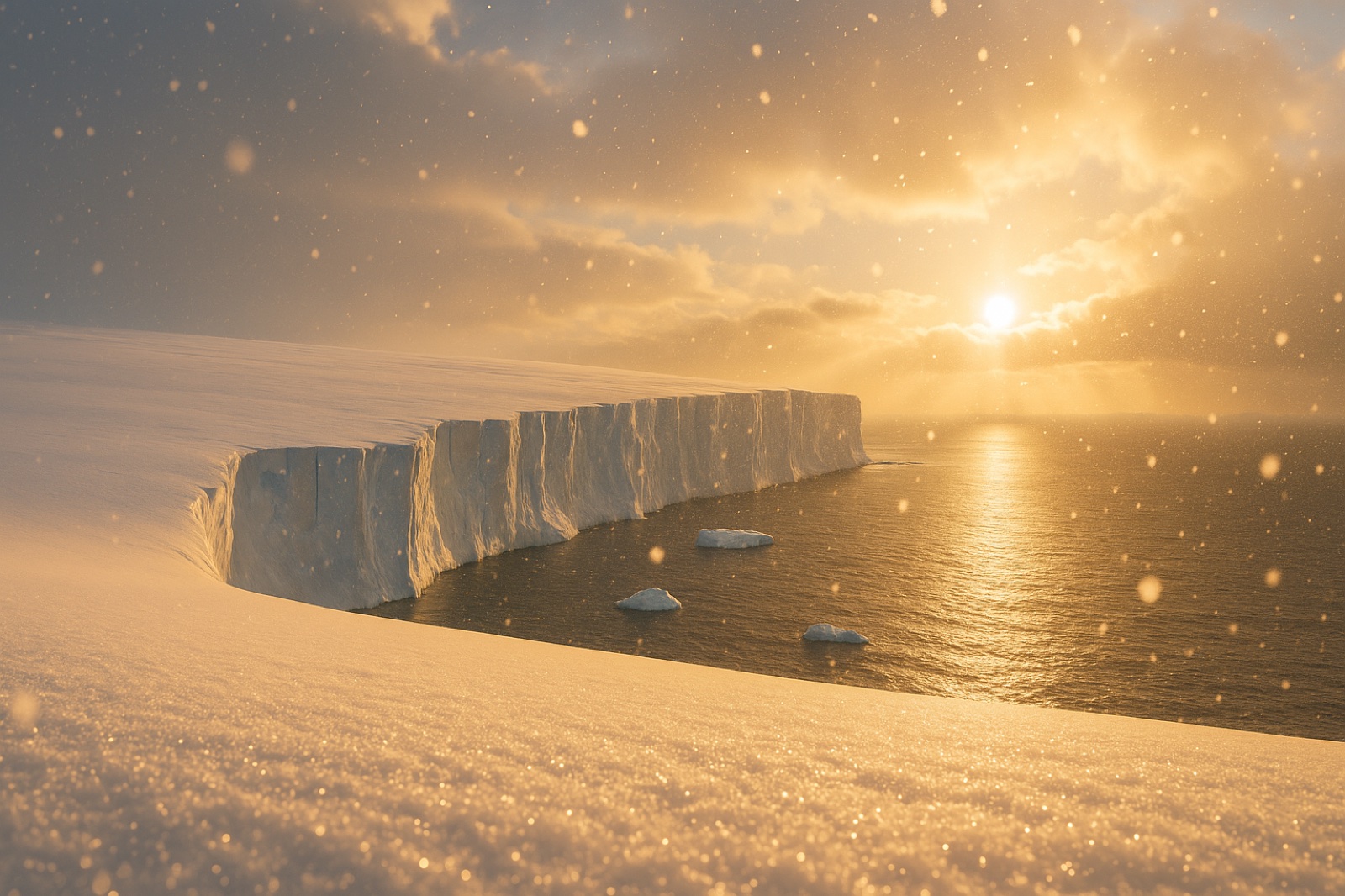
Then, for 22 months, it went the other way. The ice sheet gained about 695 billion tonnes, the largest increase of that length in the satellite record. The gain came from snow: unusually heavy snowfall along one stretch of East Antarctica, the coast of Queen Mary Land and Wilkes Land.
To give that a sense of scale: 695 billion tonnes is roughly five years’ worth of the ice Antarctica loses in an average year. It piled up in less than two.
Why the Antarctica Ice Gain Happened: A Warm Ocean Far Away
The research team, led by Yunhe Wang at the Institute of Oceanology of the Chinese Academy of Sciences, went looking for why so much snow fell in one place at one time.
They traced it north. A long way north.
Around Indonesia, where the western Pacific meets the eastern Indian Ocean, sits one of the warmest stretches of ocean on Earth. Scientists call it the tropical warm pool. From 2021 to 2023, it stayed unusually warm for an unusually long time.
Warm water heats the air above it. And heating the air in one place can set off a kind of wave in the atmosphere. Not a wave you could see, but a long chain of giant bends in the way air flows around the globe. Scientists call it a Rossby wave train. This one travelled south, toward the pole.
When it arrived, it set up two weather systems side by side: low pressure south of Australia, and high pressure along the East Antarctic coast. Between them, the winds were steered into a channel. That channel pulled long, narrow bands of moist air, called atmospheric rivers, off the Indian Ocean and pushed them onto the ice.
The moisture met the cold. It fell as snow. And it kept falling.
Wang described what the team found as a “previously underrecognized” link between the tropical warm pool and the East Antarctic ice sheet. In plain words: nobody had properly connected these two places before. (The research institute’s summary is available here.)
Antarctica has a habit of hiding its signals in plain sight. A separate study recently found hundreds of iceberg earthquakes that no catalogue had recorded, because the instruments were tuned to notice a different kind of event.
What the Study Does Not Say
This is the part that got lost in a lot of the sharing.
It was temporary. The researchers state plainly that the gain does not reverse the long-term decline of the Antarctic ice sheet. West Antarctica is still losing ice. And some of East Antarctica’s big outlet glaciers still face warm ocean water melting them from underneath.
Most of it was natural variation. This is the surprising one. When the team ran atmospheric model experiments, only about 9% of the extra snowfall could be attributed to human-caused warming. The main driver was the natural rise and fall of the tropical ocean. Co-author Eric Steig has described the event as primarily climate variability, the ordinary ups and downs of a restless system, while noting that fully separating human influence from natural variation is still difficult.
It will probably happen again. Long warm spells in the tropical warm pool come around roughly once a decade, according to the study. So a snowy gain like this is less a turning point than a recurring interruption. A pause in a long story, not a new chapter.
Both things are true at the same time. Antarctica had two record-breaking years of gain. And the long-run pattern is still loss. Anyone who uses one of those facts to hide the other is telling you less than the scientists did.
Weather That Starts Where You Can’t See
Here is the idea that stays with me.
If you had been standing on the ice in Wilkes Land during those months, you would have seen snow. Week after week of it. You might have guessed at a reason. It’s cold, it’s Antarctica, it snows.
You would never have guessed the real one. The cause of that snow was warm water near the equator, thousands of kilometres out of view. From where you stood, it was simply invisible. It took satellites, computer models and years of data to connect the two.
Hardly anyone is there to see it anyway. Antarctica is the one continent with no permanent population, only small research crews who come and go. (A study of one of those crews found that the hardest part of the long winter was not the isolation most people would expect.)
A lot of the weather in a life works the same way. A hard season lands on you, and the cause, if there is one you could even name, is usually somewhere you cannot see from where you are standing.
There is a very old story about exactly this. A man loses almost everything in a short space of time: his children, his livelihood, his health. His friends arrive and insist he must have done something to deserve it. He refuses their answer. He says he wants to hear the reason from God directly.
And the strange thing is, he gets an answer. It comes out of a whirlwind, a storm. But it is not an explanation. It is a long string of questions about the weather. Had he ever been inside the storehouse where the snow is kept? Who sends rain to the wilderness, where no one lives at all? Where does the ice come from? Who brings the frost into being, and turns the surface of the deep as hard as stone?
The reader of that story knows something the man never learns. Its opening pages show a reason for his suffering that happens entirely out of his sight. He is never told it, not even at the end. What he is given instead is a tour of how much is being held together beyond the edge of his view: snow on lands nobody visits, rain for places nobody lives, whole seas frozen in the dark.
Somehow, that is enough for him. Before, he says, he had only heard about God. Now he has seen for himself.
Rain in places where no one lives. That old line reads differently after this study. Two years of record snow fell on an empty continent, driven by warmth that nobody on the ice could see, and it was still part of one system reaching all the way around the world.
The Ice Keeps Its Own Long Story
None of this changes the long story of the ice. It adds a chapter: two unusual years, now measured, explained and written down. If the pattern holds, the tropics will warm again sometime in the coming decade. The air will bend again. And snow will fall somewhere far from the thing that caused it.
Seasons work like that, in the atmosphere and in people. They arrive, they stay a while, and they turn, whether or not we ever find out why.
So if the weather where you are has been heavy lately, it might help to remember the snow in Wilkes Land. What is falling on you is real. The reason may simply be a very long way from where you are standing. And further out than you can see, the whole of it is still being held.
Discussion Question
When a hopeful fact turns up inside a mostly worrying story, like a record ice gain in a shrinking ice sheet, do you think the honest thing is to celebrate it, or to keep it firmly in context? I’d genuinely like to know which way you lean. Leave a comment and tell me.
Share This
Short version:
Antarctica gained a record 695 billion tonnes of ice in 22 months. The cause? A warm patch of ocean near Indonesia, thousands of km away. Nobody on the ice could have seen it coming. https://bgodinspired.com/index.php/nature-and-creation/antarctica-record-ice-gain-warm-ocean/
The bit that stayed with me:
Everyone argued about whether Antarctica’s record ice gain was good news or bad news. The study itself says: temporary, mostly natural, likely to come around again in a decade, and the long-term trend is still loss. Both facts at once. https://bgodinspired.com/index.php/nature-and-creation/antarctica-record-ice-gain-warm-ocean/
For the weather people:
Warm tropical warm pool, then a Rossby wave train, then low pressure south of Australia and high pressure on the East Antarctic coast, steering atmospheric rivers onto Queen Mary Land and Wilkes Land. Record Antarctic snowfall, made in the tropics. https://bgodinspired.com/index.php/nature-and-creation/antarctica-record-ice-gain-warm-ocean/
Questions People Ask
Did Antarctica really gain ice recently?
Yes. Between July 2021 and April 2023, the Antarctic ice sheet gained about 695 billion tonnes of mass, the largest 22-month increase in the satellite-gravity record. The finding was published in the journal Nature on 19 August 2026 by a team led by Yunhe Wang of the Institute of Oceanology, Chinese Academy of Sciences. The gain came mainly from exceptionally heavy snowfall in East Antarctica, along Queen Mary Land and Wilkes Land.
Why did Antarctica gain so much ice in 2021 to 2023?
Antarctica gained ice in 2021 to 2023 because the tropical warm pool, a region of very warm ocean in the western Pacific and eastern Indian Ocean, stayed unusually warm for a long period. That warmth set off a Rossby wave train, a chain of large bends in atmospheric circulation, which travelled toward Antarctica. It produced low pressure south of Australia and high pressure along the East Antarctic coast, steering moist atmospheric rivers from the Indian Ocean onto East Antarctica, where they fell as heavy snow.
Does the Antarctic ice gain mean the ice sheet has stopped shrinking?
No. The researchers behind the Nature study state that the 2021 to 2023 ice gain was temporary and does not reverse the long-term decline of the Antarctic ice sheet. Over roughly the past two decades, Antarctica has lost about 140 billion tonnes of ice per year on average. West Antarctica continues to lose ice, and some East Antarctic outlet glaciers remain exposed to warm ocean water melting them from below.
Was the record Antarctic snowfall caused by climate change?
Mostly not, according to the study. In atmospheric model experiments, the research team attributed only about 9% of the extra snowfall during 2021 to 2023 to human-caused forcing. The main driver was natural variability in the tropical warm pool. Co-author Eric Steig has described the event as primarily climate variability, while noting that fully separating human influence from natural tropical variation remains difficult.
How often do events like this happen?
According to the study, sustained warm spells in the tropical warm pool of the western Pacific and eastern Indian Ocean occur roughly once a decade. That suggests short periods of unusually heavy East Antarctic snowfall and temporary ice gain may recur, but the researchers do not treat them as a lasting change to Antarctica’s long-term pattern of ice loss.