 0
0
 0
0
For thirteen years, something kept shaking the far edge of Antarctica. The seismometers recorded it. Nobody wrote it down.
A study in the journal Geophysical Research Letters went back through data from 2010 to 2023 and pulled out 362 seismic events that were largely missing from earthquake catalogues. Most of them — 245 — happened at the ocean end of a single glacier. These hidden earthquakes in Antarctica were not too small to detect.
They were the wrong shape.
That is the part worth sitting with. The instruments were working the whole time. The data was there the whole time. It was simply being read by tools built to notice a different kind of event.
What Was Actually Shaking
The glacier is Thwaites, in West Antarctica. You may have seen it called the “Doomsday Glacier” in headlines. That nickname is press shorthand, not a scientific term, and it does the actual science no favours.
What happens at the edge of Thwaites is simpler than the nickname suggests, and stranger.
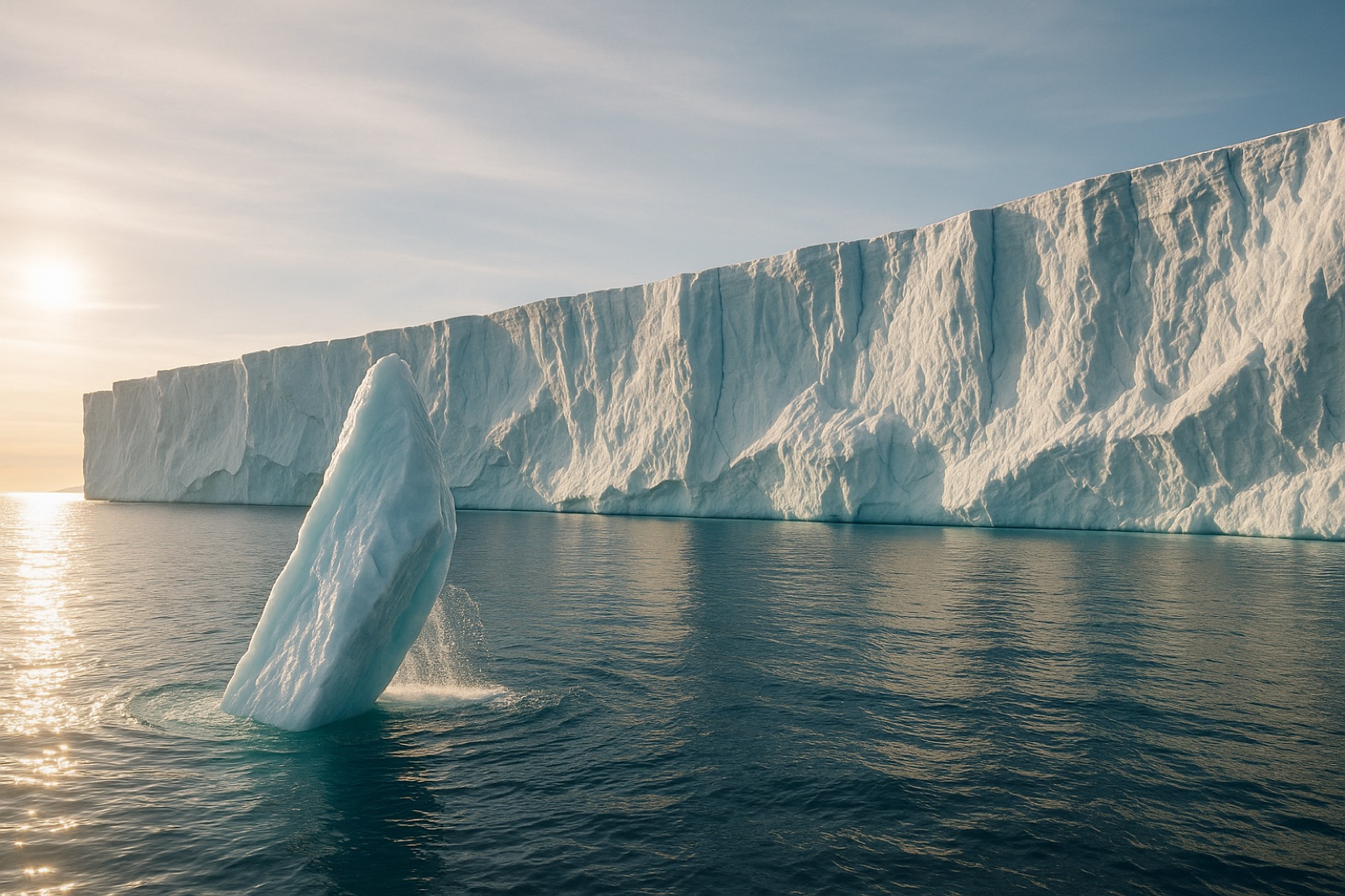
Thwaites ends in the sea. Where it ends, pieces of ice break off. Some of those pieces are tall and thin — taller than they are wide. A tall, thin block of ice floating in water is unstable, in the same way a tall, thin box standing on its end is unstable.
So it tips over.
An iceberg the size of a building rolling onto its side shoves an enormous volume of water out of the way. It also shoves back against the glacier it just left. That push travels through the ground as a seismic wave. Scientists call the result a glacial earthquake.
Nothing is cracking. No fault is slipping. It is ice, falling and turning.
Why the Hidden Earthquakes in Antarctica Went Unrecorded
Here is what makes this study interesting rather than just tidy.
A normal earthquake is a snap. Rock that was stuck comes unstuck, fast. Fast movement makes high-frequency waves — a sharp arrival that shows up on a seismogram as a clean, obvious spike. Automatic detection systems are built to hunt for exactly that spike. They watch for the sudden onset, and they time it.
Ice tipping over is not a snap. It is a slow roll. And slow movement makes slow waves.
Glacial earthquakes have been recognised as their own class of event for around two decades, and they live in a part of the seismic spectrum most of us never think about. The waves have periods measured in tens of seconds. Not tens of waves per second — tens of seconds per wave. A single ripple can take longer to pass than it takes you to read this sentence out loud.
To a detector tuned for a sharp crack, a wave that slow does not look like a weak signal. It does not look like a signal at all. There is no onset to pick. There is nothing to time. It falls below the threshold not because it is faint, but because it is the wrong shape for the filter.
We are not built to feel timescales like that. It is the same reason the age of the universe stays an abstract number no matter how many times you read it — you can hold the figure, but you cannot feel it. (If that particular problem interests you, we built a free How Old Is the Universe? explorer that tries to make the scale land.)
What the Researchers Did Differently
The team, led by Thanh-Son Pham at the Australian National University, changed two things.
First, they used seismometers sitting inside Antarctica rather than leaning on the global network. Closer instruments catch smaller events.
Second, they stopped looking for a spike. They looked for agreement.
Their method checks whether the same slow ripple — a type called a Rayleigh wave — turns up across a scatter of stations in a pattern that lines up. One station registering a slow wobble means nothing at all. Several stations registering the same wobble, in the order and with the timing you would expect if it had spread outward from one point, means something happened at that point.
That is the whole trick. Instead of asking “is this loud enough to count,” they asked “do these all agree.” The result was a catalogue of 362 events of magnitude 2 to 3, spread across thirteen years, most of which no existing catalogue held. The study’s lead author wrote up the findings here.
The Part Most Coverage Skipped
Two details in this study deserve more attention than they got.
The first is a timing match. The events near Thwaites did not arrive at a steady rate. They surged between 2018 and 2020 — and that surge lines up with a stretch when the glacier’s floating front sped up towards the sea. Faster ice at the front, more ice breaking off, more icebergs rolling. The seismic record and the ice record tell the same story from two completely different directions, which is the kind of thing that makes researchers trust a result.
The second detail is that not all of it fits.
The Thwaites events sit exactly where you would expect ice to be breaking off — right at the water. But a second cluster, near the neighbouring Pine Island Glacier, was consistently located 60 to 80 kilometres inland from the water’s edge. Too far from the sea to be capsizing icebergs. Something is happening there, repeatedly, and the researchers say plainly that it remains puzzling and needs follow-up work.
An honest “we don’t know yet” inside a published paper is worth more than a confident answer. It is also the part that almost never survives into the headline. The same thing happens in ocean science all the time — orcas were recently filmed doing something nobody can explain, after decades of people watching them closely.
Listening on the Wrong Frequency
Once you have the idea, it is hard to stop seeing it.
Slow change is nearly invisible to any system built to notice sudden change. That is true of a seismic network and it is true of a person. We are wired to register the spike — the argument, the diagnosis, the phone call at a strange hour. Anything that arrives gradually enough can pass straight through us and register as nothing at all.
Which means “nothing is happening” and “nothing is happening fast enough for me to notice” feel exactly the same from the inside. They are not the same thing. Antarctica has a habit of exposing that gap — a long study of a crew wintering on the ice found the hardest part of the year was not the thing everyone assumed it would be either.
There is a very old story that is strange for a religious text, because most of it is about what did not happen. A man goes out to a mountain, exhausted and convinced he has been abandoned, waiting for God to show up. A great wind tears through the place. Then an earthquake. Then fire. And in each one — nothing. What he was actually waiting for arrived afterwards, in something so quiet it barely counted as a sound. He nearly missed it, and the story does not pretend otherwise.
Whoever first told that story had no seismometers. But they had already worked out the thing a detection algorithm had to be rebuilt to handle: the wind and the earthquake and the fire are the easy things to notice, and they were not the point. The point arrived on a frequency the man was not set up to hear.
Thirteen Years of Something
Thwaites is still there. So are the instruments — the same ones that recorded all 362 of those events while they sat uncatalogued, doing nothing differently, waiting for someone to read them another way.
Nothing about the ice changed when the study came out. The icebergs had been breaking off and rolling over the entire time, thirteen years of them, whether or not anyone had a name for it. The only thing that changed was the listening.
That is usually how it goes. The event is rarely the thing that was missing.
Discussion Question
Which do you think we are worse at noticing — a change that happens too fast to process, or one that happens too slowly to register? I would genuinely like to know which way you lean. Leave a comment and tell me.
Share This
Short version:
362 earthquakes in Antarctica went uncatalogued for 13 years. Not because they were too small — because they were too slow. The detectors were built to hear a crack. This was a roll. https://bgodinspired.com/index.php/bible-resources/bible-and-science/hidden-earthquakes-antarctica-wrong-frequency/
The bit that stayed with me:
A study just found 362 seismic events at the edge of Antarctica that no catalogue held. The instruments recorded every one of them. They were filtered out for being the wrong shape, not for being too faint. Which makes me wonder what else is sitting in plain sight, filed under “nothing.” https://bgodinspired.com/index.php/bible-resources/bible-and-science/hidden-earthquakes-antarctica-wrong-frequency/
For the science people:
Standard quake detection hunts for high-frequency arrivals. Icebergs capsizing produce waves with periods measured in tens of seconds — no sharp onset to pick, so nothing to trigger on. Change the method, and 362 events appear in data you already had.
Questions People Ask
What are the hidden earthquakes found in Antarctica?
They are 362 seismic events recorded between 2010 and 2023 that were largely absent from earthquake catalogues. A study published in Geophysical Research Letters, led by Thanh-Son Pham of the Australian National University, identified them using seismometers located in Antarctica itself. About 245 of them occurred at the ocean end of Thwaites Glacier in West Antarctica, and they measured magnitude 2 to 3.
What causes a glacial earthquake?
A glacial earthquake happens when a tall, thin iceberg breaks off the end of a glacier and capsizes in the water. The rolling iceberg pushes against the water and back against the glacier behind it, and that force travels through the ground as a seismic wave. No rock breaks and no fault slips, which is what separates a glacial earthquake from an ordinary one.
Why were these Antarctic earthquakes missed for so long?
Standard earthquake detection looks for high-frequency seismic waves — the sharp, sudden arrival produced when rock snaps under stress. An iceberg capsizing is a slow movement, so it produces slow, long-period waves with no sharp onset for an automatic detector to pick out and time. The events were not too faint to record. They were the wrong shape for the filters in use, so they were never flagged.
Is Thwaites Glacier really the “Doomsday Glacier”?
“Doomsday Glacier” is a media nickname for Thwaites Glacier in West Antarctica, not a scientific classification. It reflects real research interest in how the glacier interacts with the ocean where it meets the sea, and in the large uncertainty around long-term sea-level projections. It is not a prediction of a specific event or a date, and the glacial-earthquake study did not put a timeline on anything.
What is still unexplained about the study?
A cluster of the detected events sits near Pine Island Glacier, 60 to 80 kilometres inland from the water’s edge — too far from the sea to have been caused by capsizing icebergs. The researchers state that these events remain puzzling and require follow-up research. No confirmed cause for them has been published.