 0
0
 0
0
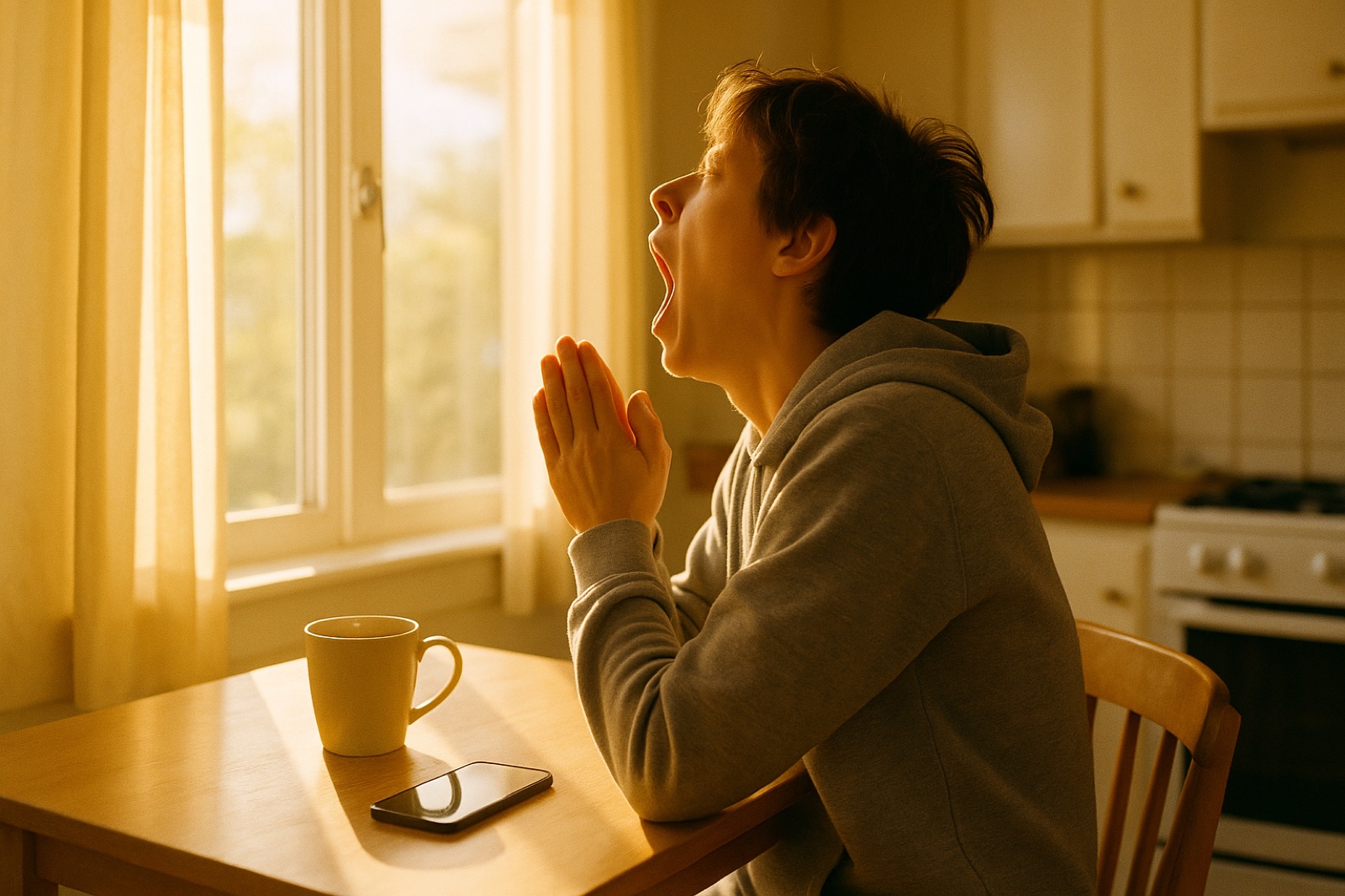
You finally sit down to pray. The house is quiet. Maybe it is early and the kettle has not boiled yet, or it is late and everyone else is asleep. You close your eyes, you get three words in — and your jaw stretches wide in a huge yawn.
Then another one. Then a third, with watery eyes.
So you look it up. Why do I yawn when I pray? And some of what comes back is frightening. Spirits leaving the body. Something dark being pushed out. A sign of a battle you did not know you were in.
If that is what brought you here, take a breath. The people who teach that usually love God and mean it kindly. But you deserve to know what the Bible actually says about this — and what it says is gentler, and more surprising, than you might expect.
Why Do I Yawn When I Pray? Start With Your Body
Here is something most people never hear: scientists still do not fully agree on why anyone yawns. The researchers who study it say openly that there is still no agreement about what yawning is for, partly because so many different things set it off. So anyone who tells you with total certainty what your yawn means is claiming more than the scientists will claim.
What they do know rules a few things out. For a long time people assumed a yawn was your body grabbing extra oxygen. In the late 1980s, the psychologist Robert Provine and his colleagues tested that. Breathing air with more oxygen, or more carbon dioxide, did not change how often people yawned. Exercise hard enough to double how fast they were breathing did not change it either.
So what does make us yawn? Two ideas have the most support. One is that yawns cluster around changes of state — waking up, winding down, sliding from busy to still, or from drowsy to alert. The other, tested by the researcher Andrew Gallup and others, is that a deep yawn helps cool the brain and keep it working well.
And here is the detail most people have never heard. Yawning is not only about boredom or sleepiness. Researchers have noticed people yawning more right before stressful moments — paratroopers before their first free-fall jump, musicians waiting to go on stage, athletes about to compete (a 2022 review in the journal Animal Behaviour gathers these examples). Nobody yawns before jumping out of a plane because they are bored.
Now think about what prayer is for most of us. It is one of the few moments in the day when we actually stop. We go from rushing to still. We often pray at the edges of the day, when we are tired anyway. And we usually bring the heaviest things we are carrying. That is a change of state, a tired body and a stressed heart, all at once. A yawn is about the most ordinary thing that could happen.
None of this can tell you exactly why your yawn happened this morning. But nothing in it needs a spirit to explain it.
If your yawns come mostly because you are running on too little sleep — lying awake at night with a mind that will not switch off — we made a free guide for exactly that: why the mind will not slow down at night, and the five-step order that changes it.
The Bible Never Mentions Yawning. Not Once.
Search the whole King James Bible for the word yawn and you will find nothing. Not yawn, not yawning, not yawned. There is no verse that says a yawn in prayer is a spirit leaving, and no verse that says it is anything else either. Whatever you have been told about it, that part did not come from Scripture.
But the Bible does describe something very close. There is a night when the people closest to Jesus tried to pray with Him and could not keep their eyes open. And the way Jesus responded tells you a great deal about how God sees a tired body at prayer.
The Night Jesus Found His Friends Asleep
It was the night before the cross. After supper, Jesus walked with His disciples to a garden called Gethsemane, at the foot of the Mount of Olives. He took Peter, James and John further in, and He did not hide how He felt:
“My soul is exceeding sorrowful, even unto death: tarry ye here, and watch with me.” (Matthew 26:38)
He went a little further and prayed. When He came back, all three were asleep. And yes, He was disappointed — Scripture does not hide that either: “What, could ye not watch with me one hour?” (Matthew 26:40).
But listen to what He said next, because it is the sentence people usually quote as a telling-off:
“Watch and pray, that ye enter not into temptation: the spirit indeed is willing, but the flesh is weak.” (Matthew 26:41)
Read it slowly. Jesus gives two diagnoses, and neither one is a dark spirit. The first is about their hearts: the spirit indeed is willing. Jesus is saying they meant it. They wanted to be there with Him. The second is about their bodies: the flesh is weak. Their bodies had simply run out.
That is the whole explanation Jesus offers. Not an attack. Not something inside them that needed to come out. A willing heart in a worn-out body.
Mark’s Gospel adds a small detail that anyone who has nodded off mid-prayer will recognise:
“And when he returned, he found them asleep again, (for their eyes were heavy,) neither wist they what to answer him.” (Mark 14:40)
They did not know what to say. They were embarrassed. It is the same feeling you get when you jolt awake halfway through a prayer and wonder what that says about you.
Luke Says They Were “Sleeping for Sorrow”
Matthew and Mark tell us the disciples slept. Luke is the one who tells us why:
“And when he rose up from prayer, and was come to his disciples, he found them sleeping for sorrow,” (Luke 22:45)
Sleeping for sorrow. Not from laziness. Not because something had got into them. They were grieving.
Think about the evening they had just had. At that same supper, Jesus had told them that one of them would betray Him and that Peter would deny Him. Anyone who has sat through a night like that knows what grief does to a body. It makes it heavy. It makes it want to shut down.
There is one more detail worth knowing. The man traditionally named as the writer of this Gospel was a doctor — Paul calls him “Luke, the beloved physician” (Colossians 4:14). We cannot know for sure whether his training shaped how he told this story. But it is fitting that the Gospel linked to a physician is the one that stops to give the reason: sorrow.
Luke also records what Jesus said to them: “Why sleep ye? rise and pray, lest ye enter into temptation.” (Luke 22:46). He woke them up and invited them back in. He did not treat their sleep as a sign they were lost.
Jesus Knew What a Tired Body Was
Jesus did not talk about weak flesh from a distance. The Gospels show Him tired too. Once, in a storm so bad His friends thought they would drown, He was “in the hinder part of the ship, asleep on a pillow” (Mark 4:38). His body needed sleep, and it slept.
And look at how the night in the garden ends. The third time Jesus came back and found them sleeping, Matthew records Him saying, “Sleep on now, and take your rest” (Matthew 26:45). Readers take those words in different ways — some modern translations turn them into a question, asking whether they are still sleeping. Either way, the next thing He says is “Rise, let us be going” (Matthew 26:46). Let us. He takes the same sleepy friends with Him into the hardest hour of His life.
It is the same way God treated Elijah. When the prophet collapsed under a tree, worn out and ready to give up, the first thing that came was not a lecture. It was sleep, a meal and water — twice — “because the journey is too great for thee” (1 Kings 19:7). We looked more closely at what God did when Elijah cracked, if that story is where you are right now.
Your Body May Be Setting Something Down
So here is a different way to see the yawn.
Most of us spend the whole day braced. Braced for the next message, the next bill, the next hard conversation, the next thing that goes wrong. Our bodies hold that all day long. Then we finally sit down with God — maybe the first moment all day we have not been bracing — and the body notices. It shifts gears. It yawns.
That is not something dark leaving you. It is you, finally stopping. For a lot of people, the yawn is the first honest thing their body has said all day: I am tired. I have been carrying a lot.
And the Bible has a verse for exactly that person. It is not about yawning, but it is about the stretched-thin, up-early, up-late life that makes us yawn:
“It is vain for you to rise up early, to sit up late, to eat the bread of sorrows: for so he giveth his beloved sleep.” (Psalm 127:2)
In that psalm, sleep is not the enemy of faith. It is a gift God gives to the people God loves. And the English words line up in a way worth noticing: the disciples were sleeping for sorrow, and the psalm describes people eating the bread of sorrows. Different books, different languages, the same heavy human experience — and the answer the Bible gives it is not a fight. It is rest.
A yawn in prayer isn’t something leaving you. It’s you, finally setting something down.
It works a lot like a mind that drifts during prayer. The drift is not a verdict on your faith — where your mind wanders when you pray is often just an honest map of what you are carrying. The yawn may be your body’s version of the same thing.
When a Yawn Is Worth a Closer Look
One honest caveat. If you are yawning heavily all day — at work, while travelling, in the middle of conversations, not just in prayer — and you feel worn out no matter how much you rest, that is worth mentioning to a doctor, nurse or clinic if you can reach one. Constant tiredness has ordinary causes, and some of them are easy to help. Getting checked is not a lack of faith. Luke was a physician, after all.
And if you suspect you are simply not getting enough sleep, our free How Much Sleep Do I Need? calculator takes about a minute and shows you what your body is actually asking for.
What to Do the Next Time You Yawn Mid-Prayer
You do not need a new routine for this. You need a new reaction.
Actions to Take
- Let the yawn happen, then name it. Next time a yawn comes during prayer, do not fight it or panic. When it passes, say one honest line: “God, I’m tired.” That is a real prayer, and it takes three seconds.
- Notice what you have been bracing against. Right after the yawn, check where your body is tight — your jaw, your shoulders, your hands. Let that spot loosen, and tell God the one thing that has been making you hold it.
- Move one prayer to a more awake moment. If you only ever pray when you are already exhausted, try one short prayer tomorrow at a time you are more alert — while walking, washing up or waiting for the kettle. See whether the yawning follows you there.
Journaling Prompts
- When you first heard that yawning in prayer might mean something dark, what did you feel about yourself — and what did that fear reveal about how you think God sees you?
- What have you been carrying so long that your body only lets go of it when you finally stop?
- If Jesus looked at you mid-yawn and said “the spirit indeed is willing,” which part of that would you find hardest to believe about yourself?
A Prayer for When You Are Tired
God, I sat down to talk to You and my body just kept yawning, and I got scared about what it meant. I think I am more tired than I have let myself admit. You saw the disciples asleep in the garden and still called their spirit willing — please see me that way too. Take what I have been carrying all day, and give me the rest You promised to the people You love. Amen.
A Question Worth Sitting With
When Jesus said “the spirit indeed is willing, but the flesh is weak,” do you hear it more as a warning or as kindness? Tell us how you read it in the comments — we read every one.
Share This
- The word “yawn” does not appear anywhere in the Bible. Not once. But the night Jesus found His friends too drowsy to pray, Luke says they were “sleeping for sorrow.”
- I used to worry that yawning while I prayed meant something spiritual was wrong. Then I read Matthew 26:41. Jesus called the disciples’ spirit willing and their flesh weak. Tired, not lost.
- Paratroopers yawn before their first jump. Musicians yawn before they go on stage. Maybe my yawn in prayer is not boredom or a spirit. Maybe it is just me, finally stopping.
Questions People Ask
Why do I yawn when I pray?
Yawning during prayer is very common and usually has ordinary physical causes. Researchers link yawning to changes of state, such as moving from busy to still or from drowsy to alert, and to keeping the brain cool, and people also yawn more before stressful moments. Prayer often combines all of these: a tired body, sudden stillness, and heavy concerns brought to God. Scientists still do not fully agree on what yawning is for.
Is yawning during prayer a sign of evil spirits leaving?
The Bible does not teach this. The word “yawn” does not appear anywhere in the King James Bible, and no verse links yawning to spirits. When Jesus found His disciples too drowsy to pray in Gethsemane, He explained it as “the spirit indeed is willing, but the flesh is weak” (Matthew 26:41), naming tired bodies rather than a spiritual attack.
What does “the spirit indeed is willing, but the flesh is weak” mean?
Jesus said these words in Matthew 26:41 after finding Peter, James and John asleep while He prayed in Gethsemane the night before the crucifixion. The saying credits the disciples with a willing heart while recognising that their bodies were exhausted. Mark 14:38 records the same saying as “The spirit truly is ready, but the flesh is weak.”
Why were the disciples sleeping in the Garden of Gethsemane?
Luke 22:45 says Jesus “found them sleeping for sorrow,” meaning grief had worn the disciples out. Earlier that same evening, Jesus had told them that one of them would betray Him and that Peter would deny Him. Matthew 26:43 and Mark 14:40 add that “their eyes were heavy.”
What does the Bible say about sleep and rest?
Psalm 127:2 says, “It is vain for you to rise up early, to sit up late, to eat the bread of sorrows: for so he giveth his beloved sleep,” presenting sleep as a gift from God rather than a failure. In 1 Kings 19, when the prophet Elijah collapsed from exhaustion, the first help he received was sleep, food and water, “because the journey is too great for thee.”