 0
0
 0
0
You have an accent. You almost certainly cannot hear it. Neither, it turns out, can a chimpanzee — and chimpanzee accents have now been measured.
That is the strange part. Other people can place you in seconds — a country, a region, sometimes a single town — while you sound completely normal to yourself. You did not choose it. It arrived while you were busy doing something else.
In a study published on 3 September 2026 in the journal PLOS ONE, researchers listened to 11,225 calls from young chimpanzees living in two different countries, and could usually tell which group a young chimp had grown up in from the sound alone.
But the finding worth sitting with is not that one. It is which sound picked up the local accent first — and which sound had not picked one up at all.
What Chimpanzee Accents Actually Are
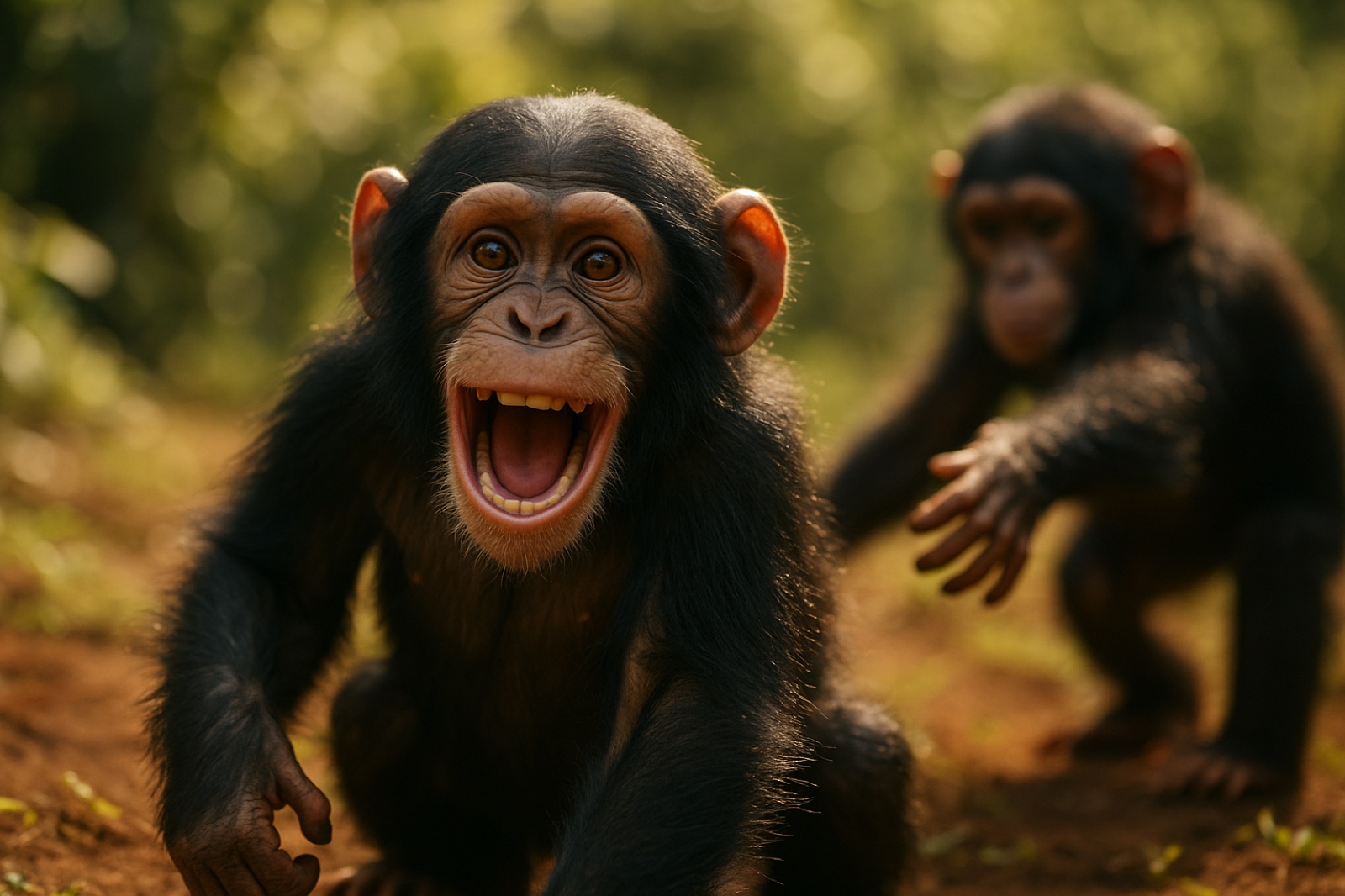
The work was led by Kassandra Giragosian at Queen Mary University of London, with colleagues at the University of Portsmouth. The recordings came from two places: Chimfunshi Wildlife Orphanage in Zambia, where the chimps live semi-wild in open miombo woodland, and Gombe National Park in Tanzania, where they live wild in thick tropical rainforest.
They studied three sounds young chimps make constantly:
- Laughs — the panting sound of play. 4,733 of them.
- Grunts — the everyday social sound, often around food. 3,694 of them.
- Whimpers — the distress sound. The chimp version of crying. 2,798 of them.
Then they ran the sounds through a statistical test that asks one simple question: given only the sound, can you guess which site it came from?
For the older youngsters — the 10 juveniles — the answer was yes, and not by a little. Their laughs were matched to the correct home site 96.70% of the time. Their grunts, 90.58%. Their whimpers, 87.89%.
That is not a species sound. That is a neighbourhood sound. (If you have ever wondered why chimps laugh at all, and what that has to do with us, we followed where human laughter came from a while back.)
The Call That Had No Accent Yet
Now the part most write-ups skipped.
The team also looked at the 21 infants — the youngest chimps in the study. Their laughs already carried a local accent: 93.17% correctly matched. Their grunts, less strongly, but clearly there: 78.25%.
Their whimpers did not.
Infant whimpers came out at 71.81%, and the result was not statistically significant (p = 0.123). In plain language, the researchers could not rule out that they were looking at noise rather than a real difference. Of every sound tested at every age tested, the babies’ crying was the one that had not yet learned where it was from.
Read that again slowly, because it is genuinely lovely. Belonging reached their play before it reached their pain.
It makes a kind of sense. A young chimp’s laugh is a social act. It happens with someone. It needs a partner, and it is learned in the middle of a group. Distress works the other way round: it comes out of the body first and asks for company second. So the sound made with others picks up the local flavour early, and the sound made when you need others is the last one to be shaped by them.
It does get shaped eventually. By the juvenile years the whimper carries an accent too, rising from that unconvincing 71.81% to a solid 87.89%. Even the crying learns, in the end, where it came from.
What the Researchers Are Careful to Say
This is where good science gets interesting, and where a lot of coverage stops.
The recordings were not gathered for this study. They came from earlier work, made at different times, with different equipment and different methods. The researchers say so plainly — and then give their reason for trusting the result anyway. If the gear were creating the difference, you would expect that difference to show up evenly across every kind of call. It did not. It showed up in some calls and not others, and it strengthened with age. Equipment does not do that.
They are equally careful about why the accents exist. They do not claim the chimps are deliberately copying one another. They also note that genetics alone is an awkward explanation: if the two groups simply sounded different because they were related differently, you would not expect the difference to depend so heavily on which call type you examined.
What they raise instead is quieter, and in a way more interesting. The two forests are not the same shape. Sound travels differently through dense rainforest than through open woodland, so some of what we are calling an accent may be the landscape itself — pressing on a voice, year after year, until the voice fits the place.
Giragosian summed up the main finding this way: chimpanzee vocalisations “are not simply fixed from birth but continue to develop as young animals interact with their social and ecological environments.”
Humans Do This Too — And We Use It Against Each Other
Any honest article about accents and belonging has to deal with the other half of this.
The same marker that says “here is where I am from” is one of the oldest tools people have for deciding who does not belong. The linguist John Baugh gave the practice a name — linguistic profiling — after running a simple test. He phoned landlords about advertised housing, said the same sentence every time, and changed only his accent. With one accent he was invited to come and view the place. With another he was told it had already gone.
Nothing about him had changed. Only the sound.
Accent has been used to sort people in job interviews, in courtrooms, in classrooms, and in exactly those housing calls. It is not a neutral signal and it never has been. A mark of belonging is also, in the wrong hands, a mark of not belonging — and plenty of people have spent years quietly sanding theirs down just to be let through a door. If you have ever felt like the one who does not fit the room you were born into, we wrote about being the odd one out in your own family.
What an Accent Is Actually For
Here is what this study is really describing. An accent is not a skill. It is a record.
It is the sound of every hour you spent near particular people, laid down in your voice without your permission, keeping a more honest account of your life than your memory does. You can move away. You can change your clothes, your work, even your name. Your vowels will still tell on you.
There is a very old story about a man standing by a fire in a courtyard, insisting to the people around him that he did not know the man everyone was talking about — that he had never been part of that group, had never even met him. And someone in the crowd looked at him and said, more or less: your accent gives you away.
He had spent years with those people. It had got into his voice. And the reason that story has lasted two thousand years is not the exposure. It is what came afterwards. He was not thrown out for it. He was found again, on a beach, called by his own name, and given work to do.
Which is an odd thing to set beside a paper about chimpanzee laughter. But it is the same observation. Belonging marks you, and the mark is not the punishment. It is the evidence that you were with someone — and the reason you can be found again.
Whatever you have belonged to has left something in you that you cannot hear. The old idea is that God can hear it, and does not need you to explain yourself first.
The Voice You Cannot Hear
You will not fix your accent by listening for it. That is not how it works. The whole point is that it lives below the level where you can watch it happening.
But you can notice the thing underneath it. Those chimps did not choose their sound. They got it from proximity — from who was near them, for how many hours, doing what. That part is not a mystery, and it is not fixed. Whoever you spend your hours with is, right now, quietly setting the tone of the sound you will be making in ten years.
You cannot hear it happening. It is happening anyway.
(If you enjoy this sort of thing, we also built a free What Animal Am I? quiz — same curiosity, less statistics.)
What Do You Think?
Some people work hard to lose their accent. Others would never give theirs up for anything. Which side are you on — is an accent something worth holding on to, or something that mostly gets in the way? Tell us in the comments.
Share This
- Baby chimps pick up a local accent in their laughter before they pick one up in their crying. Belonging reaches your play before it reaches your pain. https://bgodinspired.com/index.php/nature-and-creation/chimpanzee-accents-laughter-first/
- 11,225 chimp calls, two countries. Researchers could tell where a young chimp grew up just from the sound of its laugh — 96.7% of the time. The one sound that had not learned an accent yet: the crying. https://bgodinspired.com/index.php/nature-and-creation/chimpanzee-accents-laughter-first/
- You have an accent you cannot hear. So do chimpanzees, and they grow into it exactly the way we do — from whoever happens to be nearby. https://bgodinspired.com/index.php/nature-and-creation/chimpanzee-accents-laughter-first/
Questions People Ask
Do chimpanzees have accents?
Yes. A study published in PLOS ONE in September 2026 analysed 11,225 calls from young chimpanzees at Chimfunshi Wildlife Orphanage in Zambia and Gombe National Park in Tanzania. Working from the sound alone, researchers correctly matched juvenile chimpanzees’ laughs to their home site 96.70% of the time, their grunts 90.58% of the time, and their whimpers 87.89% of the time — evidence of population-specific vocal patterns, sometimes called dialects.
Do baby chimpanzees have accents?
Only partly. In the 2026 PLOS ONE study, infant chimpanzees’ laughs were correctly matched to their home site 93.17% of the time and their grunts 78.25% of the time. Infant whimpers — the distress call — reached only 71.81% and were not statistically significant (p = 0.123), meaning no reliable local accent was detected in infant crying. By the juvenile years, whimpers did carry a site-specific accent, at 87.89%.
Why do chimpanzees from different places sound different?
The researchers behind the 2026 PLOS ONE study point to social and ecological environment rather than genetics alone. They note that if genetic difference between the populations were the main driver, the variation would not be expected to depend so strongly on which call type was examined. They also raise habitat: Gombe National Park is dense tropical rainforest and Chimfunshi is more open miombo woodland, and sound travels differently through each, so habitat-related differences in sound transmission may contribute to the divergence.
What is linguistic profiling?
Linguistic profiling is the practice of identifying a person’s social characteristics — such as race or region of origin — from auditory cues like accent and dialect, and then treating that person differently on that basis. The term was coined by the linguist John Baugh, who tested it by telephoning landlords about advertised housing using identical wording in different accents and recording which calls resulted in an invitation to view the property.
Can a person lose their accent?
An accent can shift considerably with long exposure to a new speech community, and many people deliberately modify theirs, but accents are typically acquired without conscious effort in childhood and are not fully under conscious control. Research on chimpanzees published in PLOS ONE in 2026 found a comparable pattern of gradual, environment-shaped vocal development, with population-specific differences strengthening from infancy into the juvenile years.