 0
0
 0
0
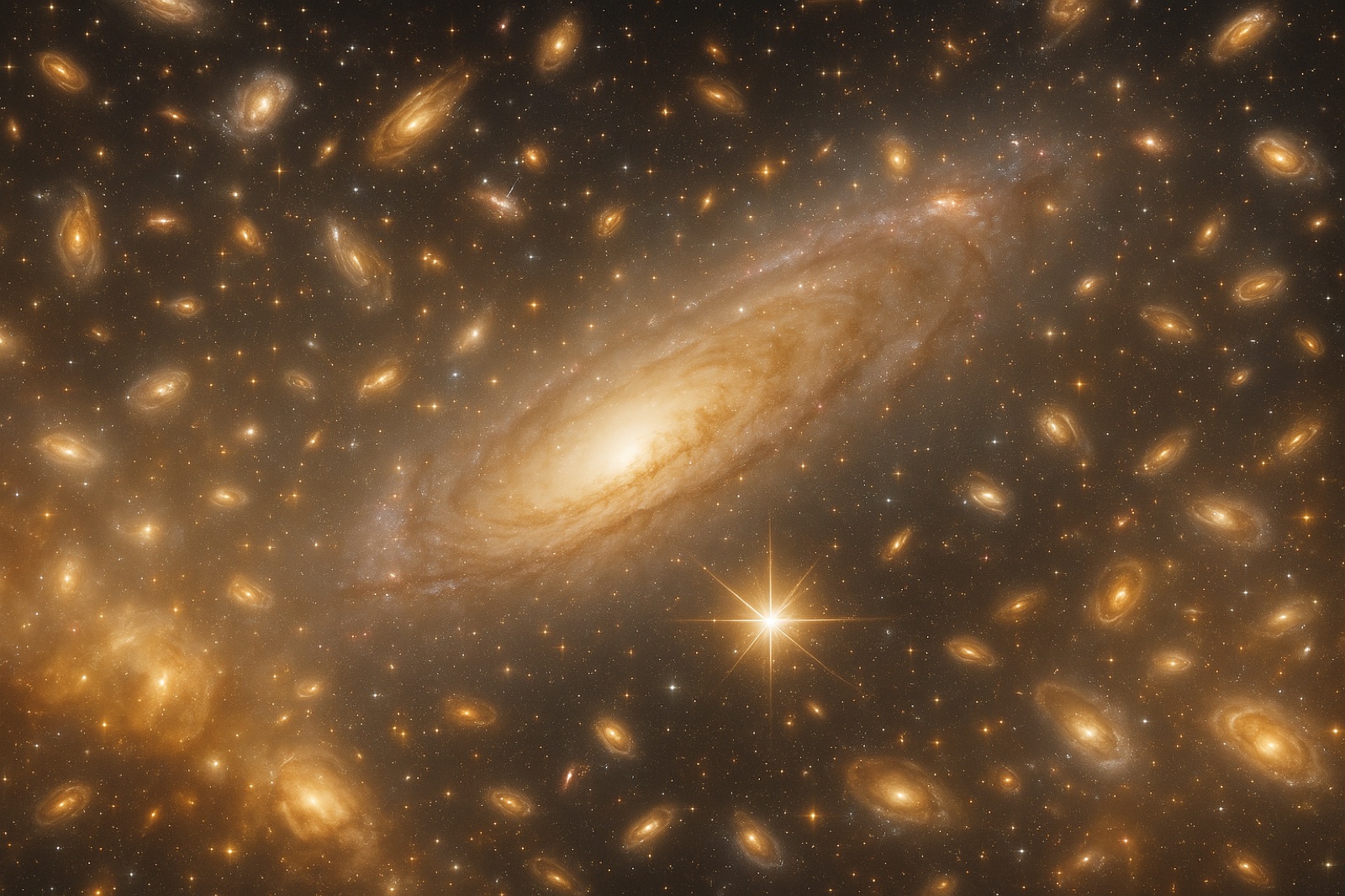
You have probably seen it somewhere. A church slide, a study-Bible footnote, a picture of deep space shared by a friend. Underneath the stars sits a line from Isaiah about God, who “stretcheth out the heavens as a curtain.” The caption says the Bible knew the universe was expanding thousands of years before scientists did.
This week a very different headline has been going around. It asks whether dark energy — the mystery force said to be pushing the universe apart faster and faster — has been debunked. A study of more than 1,700 exploding stars, published earlier this year, suggests the universe may be slowing down instead.
If you are a believer, there is a small, honest jolt in that moment. Wait. Does this hurt the Bible?
It doesn’t. But the reason why is better than you might expect. It was sitting in the same chapter the whole time — fourteen verses before the one everybody quotes.
Is the Universe Slowing Down? What the Study Actually Found
First, the backstory. In 1998, two separate teams of astronomers were studying a special kind of exploding star called a Type Ia supernova. These explosions are useful because they all shine at close to the same brightness. So how bright one looks tells you roughly how far away it is — the way you can judge the distance of a streetlight by how dim it looks.
The faraway ones looked dimmer than expected. The simplest explanation was that the universe’s growth is speeding up. Something seemed to be pushing space apart harder over time. Scientists called that something dark energy. In the standard picture of the universe, it makes up roughly 70 percent of everything there is. In 2011, three of the astronomers behind the discovery — Saul Perlmutter, Brian Schmidt and Adam Riess — won the Nobel Prize in Physics for it.
Now the new study. Three physicists — Animesh Sah and Mohamed Rameez of the Tata Institute of Fundamental Research in Mumbai, and Subir Sarkar of the University of Oxford — went back to a big catalogue of more than 1,700 of these supernovae, called Pantheon+. They added one correction. There is growing evidence that these explosions are not quite as identical as everyone assumed. How bright they shine may depend on how old their parent stars were.
“If this effect is not accounted for,” Sarkar said, “it can lead to the erroneous conclusion that the expansion rate is accelerating.”
With the correction in place, their numbers no longer showed a universe that is speeding up. They pointed to one that is slowing down. The paper appeared in 2026 in the Monthly Notices of the Royal Astronomical Society, under a blunt title: “Pantheon supernovae corrected for progenitor age indicate the universe is decelerating.”
They made a second, stranger point too. Our galaxy is moving through space, and the faint leftover glow from the early universe looks very slightly warmer in the direction we are heading. The team says the apparent speed-up is strongest in that same direction, and fades the further out you look. Real dark energy, they argue, should push the same way everywhere. Something that follows our own direction of travel looks more like an effect of where we happen to be standing.
One thing is worth saying clearly, because the headlines blur it. Nobody in this argument thinks the universe has stopped growing. The only question is whether that growth is speeding up or slowing down.
Dark Energy Isn’t Dead Yet: The Other Paper in the Same Issue
Here is the detail most of the coverage skipped. The same issue of the same journal carries a paper that reaches the opposite conclusion about the age correction.
Its title is “Still accelerating”, and seventeen astronomers wrote it. Their case is that the age problem is already mostly handled. Astronomers routinely adjust supernova brightness for the size of the galaxy each one sits in. In their analysis, once that standard adjustment is made, the age of the host galaxy stops mattering. They also point to nearby supernovae, where explosions in young, busy galaxies and in old, quiet ones of the same size look almost equally bright.
Look down the author list and two names jump out: Adam Riess and Brian Schmidt. Two of the three people who won the Nobel Prize for discovering the speed-up are among the scientists defending it.
That is not a scandal. The people who know a subject best are often the right people to defend it, and they may well be right. Sarkar is not a newcomer, either. He has argued since at least 2016 that the supernova evidence for acceleration is weaker than it looks. What all this means is simple: you are watching a live argument between serious people. Not a verdict.
It is the same careful spirit physicists showed recently when a dark matter detector caught one event it couldn’t explain and still refused to call it a discovery. Big claims need more than one witness. The next major test will likely come from the Vera C. Rubin Observatory in Chile, whose sky survey is expected to catch far more supernovae than today’s catalogues hold. Until then, the honest answer to “Is dark energy real?” is this: the standard model still includes it, a serious group of researchers disputes it, and the question is open.
We should be honest about something here. A few weeks ago, this site published a piece on Einstein’s “biggest blunder” that treated the speeding-up universe as solid ground and built an argument on top of it. It may still turn out to be solid ground. But this new fight shows how quickly the ground under a science-and-faith argument can move. That is not a reason to stop reading science. It is a reason to be careful what we lean on.
Isaiah 40:22 and the “Expanding Universe” Verse
Now back to the verse on the church slide. Here it is in full, in the King James Version:
It is he that sitteth upon the circle of the earth, and the inhabitants thereof are as grasshoppers; that stretcheth out the heavens as a curtain, and spreadeth them out as a tent to dwell in:
— Isaiah 40:22 (KJV)
Isaiah loves this picture. The prophet comes back to God stretching out the heavens several more times, with Isaiah 42:5 and 44:24 among them. Some Bible teachers and study notes read it as a hint of the expanding universe. Others say we should read it the way Isaiah’s first listeners would have heard it: as poetry about the greatness of God, not a physics claim.
But look closely at one word, because it may be the most interesting thing in the whole verse.
The word translated “curtain” is the Hebrew word doq. It appears here and nowhere else in the entire Hebrew Bible. It means something thin and fine. Not a heavy stage curtain. More like gauze, or a light veil.
Then Isaiah finishes the picture: “as a tent to dwell in.” Put those two together and the image is not a speedometer. It is someone pulling a thin cloth overhead to make a shelter for people to live under. It is a picture of home.
Could the verse also hold a hint of something Isaiah could not have known? Maybe. The text does not say, and it would be overclaiming to insist that it does. What it plainly says is that the sky above you was spread out as a covering for people to live under. That is true whether the universe is speeding up, slowing down, or doing something nobody has thought of yet.
Fourteen Verses Earlier: “The Grass Withereth”
Here is the part that never makes it onto the slide. If you read Isaiah 40 from the top, you reach this long before you get to the heavens and the tent:
The voice said, Cry. And he said, What shall I cry? All flesh is grass, and all the goodliness thereof is as the flower of the field: The grass withereth, the flower fadeth: because the spirit of the LORD bloweth upon it: surely the people is grass. The grass withereth, the flower fadeth: but the word of our God shall stand for ever.
— Isaiah 40:6-8 (KJV)
“All the goodliness thereof” means the very best that people can make. Our finest work. Our cleverest ideas. Isaiah is not insulting any of it. Grass is alive and green and good. It just doesn’t last. It has a season.
Scientific models are part of that goodliness. They are some of the finest things human minds have ever made. And they have seasons too. In barely more than a century, our best picture of the universe has changed again and again. Einstein first pictured a universe that stood still. Then Edwin Hubble showed it was growing. Then, in 1998, it seemed to be growing faster. Now a serious team says it may be slowing. Each picture was the best anyone had at the time. Each one bloomed.
Notice the order. Isaiah put the humility before the cosmic verse. By the time you reach the heavens stretched out like a thin cloth, the chapter has already taught you how to hold that picture: gratefully, and loosely. Our understanding of the sky is grass. The word of God is the thing that stands.
That means a believer does not need this supernova fight to go one way or the other. If your faith were built on “the Bible predicted a speeding-up universe,” a study like this would feel like a crack in the foundation. But faith was never meant to be built there. It was built on the word that outlasts every model — including the one we are using right now.
There is one more line, a few verses later, that belongs in this story:
Lift up your eyes on high, and behold who hath created these things, that bringeth out their host by number: he calleth them all by names by the greatness of his might, for that he is strong in power; not one faileth.
— Isaiah 40:26 (KJV)
Astronomers are doing something very close to the first half of that verse. They lift up their eyes and count the stars by number. Pantheon+ is, quite literally, a numbered list of exploding stars. What Isaiah adds is the other half: a Maker who knows every one of them by name. And notice the question Isaiah asks. Not “how fast?” but “who?”
What This Means for Your Faith Today
You don’t have to become an astronomer to take something from this. You only have to notice what you are leaning on.
A lot of us carry a few “proof” arguments around. A verse that science seemed to confirm. A fact that felt like it settled things. They can be wonderful. But if they are holding up the whole building, the next headline will shake you. The ground Isaiah offers is steadier: not a model, but a Maker who knows every star by name, and a word that is still standing when the grass is gone.
If you want to feel the size of all this for yourself, our free How Old Is the Universe? Explorer walks through how the universe’s age is actually measured, in plain language.
Try This Today
- Read Isaiah 40 in one sitting. It is 31 verses and takes about five minutes. Count how many times the chapter points you toward what lasts.
- Before you share the next “science proves the Bible” (or “science disproves the Bible”) post, ask one question: is this a finding, or a fight? A two-minute search for the other side keeps your words honest.
- Write down one thing your faith has been leaning on that is really grass — an argument, a favourite teacher, a feeling you had once. Then write Isaiah 40:8 underneath it. Keep both. The grass can be good. It just isn’t the foundation.
A Prayer for When the Headlines Shift
God, I’ll admit I like it when science seems to back me up, and I get uneasy when a headline seems to go the other way. Help me hold what we know about the universe with gratitude and a loose grip, because it is grass, and it is still beautiful. Let my faith rest on your word that stands, not on whichever model is winning this year. And when I look up at night, remind me that you know every star by name — and that you know mine too. Amen.
Discussion Question
Should Christians use scientific discoveries as evidence for the Bible at all — or does that set faith up to be shaken every time the science changes? Tell us where you land in the comments.
Share This
- The Bible never said how fast the universe is expanding. It said all our best ideas are grass, and God’s word stands. Isaiah 40 puts that 14 verses BEFORE the verse everyone quotes. https://bgodinspired.com/index.php/bible-resources/bible-and-science/is-the-universe-slowing-down-dark-energy-isaiah-40/
- Two of the Nobel winners who discovered the “speeding up” universe co-wrote a 2026 paper defending it, while another team says it may be slowing down. Real science is a live argument. My faith doesn’t have to pick a side. Read it here
- The Hebrew word for “curtain” in Isaiah 40:22 appears only once in the whole Bible. It means thin gauze. The picture isn’t a speedometer. It’s a tent to live in. bgodinspired.com
Questions People Are Asking
Is the universe slowing down?
A 2026 study in the Monthly Notices of the Royal Astronomical Society, by Animesh Sah and Mohamed Rameez of the Tata Institute of Fundamental Research in Mumbai and Subir Sarkar of the University of Oxford, re-analysed more than 1,700 Type Ia supernovae from the Pantheon+ catalogue with a correction for the age of the stars that produce them. It concluded that the universe’s expansion may be slowing down rather than speeding up. A separate paper in the same journal issue, whose seventeen authors include Nobel laureates Adam Riess and Brian Schmidt, argues that the evidence for acceleration remains robust. As of September 2026 the question is unresolved. In both views, the universe is still expanding.
Has dark energy been debunked?
No. Dark energy, the name for whatever appears to be speeding up the expansion of the universe, has been challenged but not disproven. A 2026 re-analysis of supernova data argued that the apparent acceleration disappears once the age of the parent stars is taken into account. Another 2026 study concluded that standard corrections already handle that effect and that acceleration still holds. Future data, including from the Vera C. Rubin Observatory in Chile, is expected to help settle the question.
Does the Bible say the universe is expanding?
Isaiah 40:22 in the King James Version describes God as the one “that stretcheth out the heavens as a curtain, and spreadeth them out as a tent to dwell in.” Some readers see a hint of cosmic expansion in that line, while others read it as ancient poetry about the greatness of God rather than a statement about physics. The Hebrew word translated “curtain,” doq, occurs only in this verse and means something thin and fine, like gauze. The verse pictures the sky as a shelter for people to live under and does not describe any rate of expansion.
What does “all flesh is grass” mean in Isaiah 40?
In Isaiah 40:6-8 (KJV), a voice declares that “all flesh is grass, and all the goodliness thereof is as the flower of the field,” and that “the grass withereth, the flower fadeth: but the word of our God shall stand for ever.” The passage contrasts the short life of every human achievement with the permanence of the word of God. Human work is pictured as good but seasonal, like grass, while the word of God is described as the one thing that lasts forever.
Who won the Nobel Prize for discovering the accelerating universe?
The 2011 Nobel Prize in Physics went to Saul Perlmutter, Brian Schmidt and Adam Riess for discovering, through observations of distant supernovae, that the expansion of the universe is accelerating. Their teams published the finding in 1998. The discovery led to the idea of dark energy, which in the standard model of cosmology makes up roughly 70 percent of the universe.
Sources: Sah, Rameez and Sarkar, “Pantheon supernovae corrected for progenitor age indicate the universe is decelerating,” Monthly Notices of the Royal Astronomical Society 549 (2026); Wiseman et al., “Still accelerating: type Ia supernova cosmology is robust to host galaxy age evolution,” Monthly Notices of the Royal Astronomical Society 549 (2026); reporting from Phys.org.