 0
0
 0
0
There is a small museum in London that keeps a linen shirt in a case.
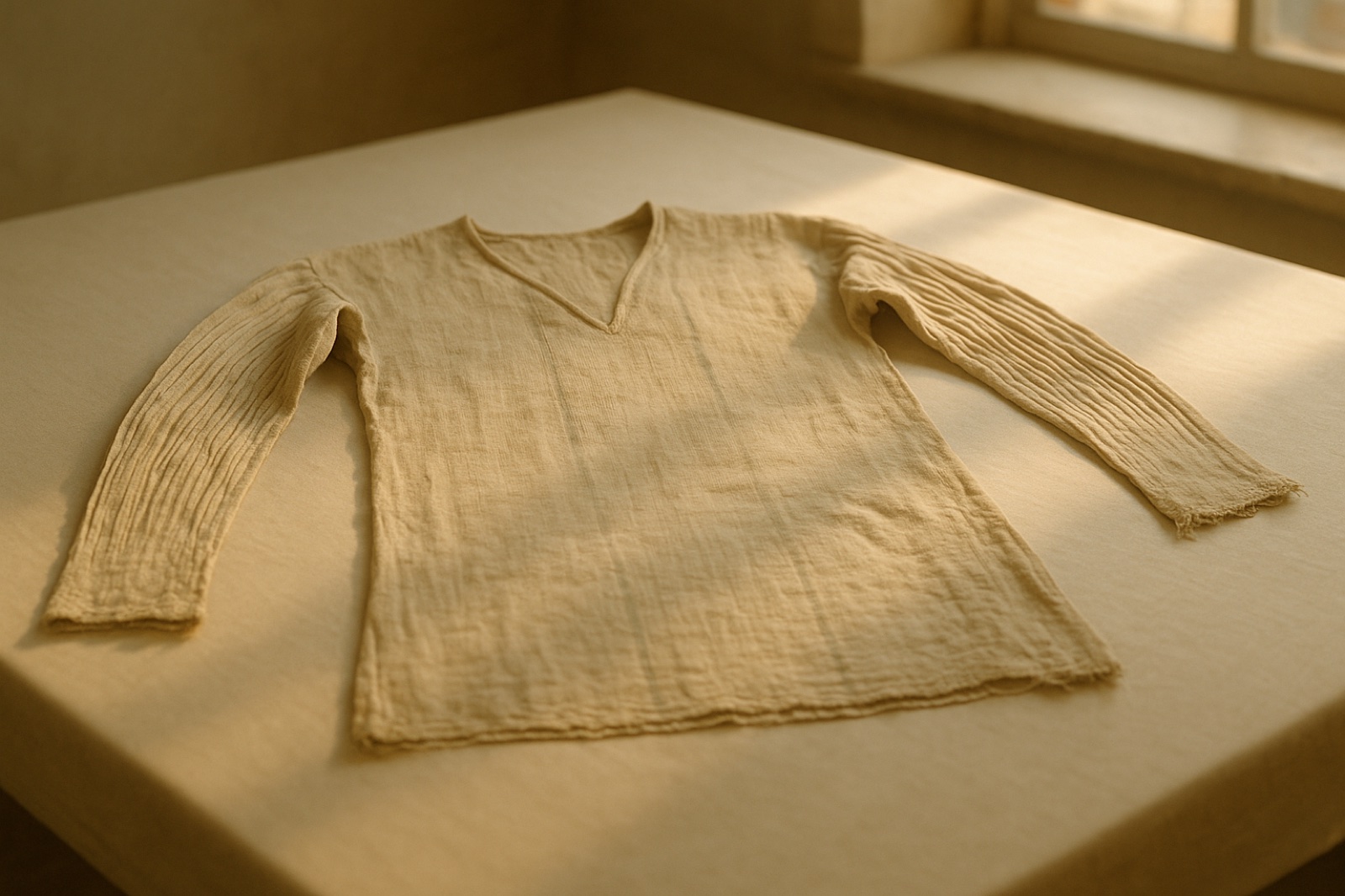
It is pale, roughly the colour of milky tea. The sleeves are narrow and finely pleated. The neck is a simple V. If it were hanging in a market stall you might not look twice, except to notice that somebody made it by hand.
It is more than five thousand years old.
And there are creases in the elbows.
That last detail is the entire reason this shirt matters. Almost everything that survives from that far back survives because it was precious — gold, stone, things buried on purpose to last. This is a piece of clothing that somebody put on, moved around in, and took off again. The creases are where the arms bent.
A Shirt Nobody Was Looking For
It came out of the ground in 1913, at a burial ground called Tarkhan, south of Cairo. The dig was run by Flinders Petrie, and the shirt came from the area of a tomb catalogued as mastaba 2050.
Here is the first odd thing. That tomb had already been robbed. Completely. The people who came for the valuables took the valuables, and what they left behind was a heap of dirty linen lying outside — the sort of thing that gets written down as funerary rags and packed away without much ceremony.
So the oldest surviving woven garment on earth was saved by being worthless. Nobody stole it because nobody wanted it. Then it was crated up, shipped to London, and forgotten for sixty-four years.
How the Oldest Dress in the World Was Nearly Lost Twice
In 1977 the Textile Conservation Workshop at the Victoria and Albert Museum was working through that old pile of linen — cleaning it, flattening it, sorting scraps from scraps.
Somebody realised one of the bundles was not a scrap at all. It had been cut. It had been sewn. It had sleeves.
It had also been turned inside out, which is exactly what happens to a shirt when you drag it off over your head in a hurry.
This is a pattern worth noticing, because it keeps happening in archaeology: the thing that changes the story is often already in the store room. It happened again with the 80,000-year-old arrowheads from a cave in Uzbekistan, which sat unnoticed in material that had already been excavated, simply because they were broken and small. Digging is only half of it. Somebody still has to look.
The Date Was Wrong for Nearly Forty Years
Once the garment was identified, it was tested. A radiocarbon test in 1978 came back with a date of roughly 2362 BC.
That is old. It is also wrong by more than a thousand years — and being wrong in that direction meant the shirt stayed interesting rather than extraordinary. For most of the time it has been in a museum, the oldest woven garment we know of was filed as a fairly old one.
The problem was that testing it properly used to mean destroying a meaningful piece of it. Radiocarbon dating needed more material than anyone was willing to give up.
By the 2010s it needed far less. Researchers took a sample weighing 2.24 milligrams — a speck — and ran it at the University of Oxford’s radiocarbon unit. Alice Stevenson and Michael Dee published the result in the journal Antiquity in early 2016.
The garment dates to between 3482 and 3102 BC, with 95% probability. Narrow the confidence to 68% and the window tightens to 3366–3120 BC.
The researchers were careful about their own number, which is worth repeating because it rarely gets repeated. They noted the result is less precise than is now routinely possible, both because the sample was so small and because radiocarbon dates from that particular stretch of the fourth millennium BC are genuinely awkward to calibrate. They also pointed out that the tomb itself had been rifled, so there was no secure context to check the date against — which is why the age had been argued over in the first place.
That is what an honest finding sounds like. A range, not a number, and a note about why the range is as wide as it is.
What the Cloth Itself Tells You
The shirt is made from three pieces of sturdy hand-woven linen, with a natural pale grey stripe running through the weave. The sleeves and the bodice are knife-pleated. The main body piece is about 76 centimetres wide. The weave runs at roughly 22 to 23 threads per centimetre in one direction and 13 to 14 in the other, which is not crude work by any standard.
The hem is gone. That means nobody can say how long it originally was, or where on the body it ended. From what remains, the sizing suggests it fitted a young teenager or a slim adult.
And then the creasing — around the elbows and under the arms. That, together with the fact that it was found inside out, is why researchers describe it as showing signs of wear indicating it was used in life, rather than made new for a burial.
It is a strangely intimate kind of evidence. Not a name, not a face, not a possession. Just the shape a body pressed into cloth by doing nothing in particular. There is a similar feeling to the Anglo-Saxon graves in Suffolk that contained no bodies at all — only the outlines left in sand after the bone had dissolved. Sometimes the last thing left of a person is the space they took up.
It Is Not the Oldest Clothing Ever Found
This gets repeated carelessly, so it is worth being precise.
People were working with fibre long, long before this. Flax fibres from Dzudzuana Cave in Georgia have been dated to tens of thousands of years ago, and they had been spun, knotted, cut, and even dyed. Ancient footwear has turned up that is older than the pyramids too.
What makes the Tarkhan shirt different is not age alone. It is that this is a garment — woven, cut, and sewn to fit a specific human shape, with sleeves that assume arms and a neck that assumes a head. Older cloth exists. This is the oldest known thing that was made to be worn by a particular body.
The Part That Stays With You
Here is what I keep turning over.
The oldest thing anyone ever made to fit a human being was not a weapon, or a tool, or an ornament. It was a covering.
And if you go looking for the oldest stories people tell about clothing — not the oldest cloth, the oldest stories — you find something that does not match how we usually think about this. Those stories rarely begin with fashion, or status, or even modesty as a rule to be followed. Several of them begin with two people who suddenly feel exposed, and with God making them something to wear.
That is a gentler idea than the one most of us carry. Most of us treat covering up as something you do for yourself, fast, before anyone notices — hiding, basically, and a little bit ashamed of the hiding. The old story has somebody else doing the covering. On purpose. With care. For people who had just got everything wrong. It is not a telling-off. It is a sewing.
Five Thousand Years, and a Fold in the Sleeve
The shirt is still in London, at the Petrie Museum of Egyptian Archaeology. You can go and stand in front of it.
What you would be looking at is not a treasure. It is a Tuesday. Somebody roughly your size, probably younger than you, pushed their arms into those sleeves and bent them, over and over, doing whatever the day required — and the day was so unremarkable that the only surviving record of it is a fold in the cloth.
Their name is not written anywhere. The tomb near where they were found was emptied by robbers. The museum that owned them lost track of them for sixty-four years. And they are still here, five thousand years later, because of the way they moved their arms.
Deep time is almost impossible to feel as a number. It gets easier when you shrink it to something you can hold — the days you have personally been alive, for instance, which you can work out in about ten seconds with our free How Many Days Have I Been Alive? counter. It is a smaller number than most people expect. That is rather the point.
Whoever wore that shirt had a number too. They used it up on ordinary mornings. And an ordinary morning turned out to be the thing that lasted.
Questions People Ask About the Oldest Dress in the World
What is the oldest dress in the world?
The oldest known woven garment in the world is the Tarkhan dress, a linen shirt with pleated sleeves and a V-shaped neckline, excavated in 1913 from the Tarkhan burial ground south of Cairo, Egypt. It is held at the Petrie Museum of Egyptian Archaeology in London.
How old is the Tarkhan dress?
Radiocarbon testing at the University of Oxford, published in the journal Antiquity in early 2016, dated the Tarkhan dress to between 3482 and 3102 BC with 95% probability. That makes it more than 5,000 years old. An earlier test in 1978 had given a much younger date of around 2362 BC.
How do we know the Tarkhan dress was actually worn?
The Tarkhan dress shows creasing around the elbows and under the arms, and it was found turned inside out — the state a shirt ends up in when it is pulled off over the head. Researchers describe these as signs of wear indicating the garment was used during the wearer’s life, rather than made new for a burial.
Where was the Tarkhan dress found, and how was it nearly lost?
It was excavated in 1913 by Flinders Petrie’s expedition at Tarkhan, Egypt, from the area of a tomb catalogued as mastaba 2050 that had already been robbed. It was collected as part of a pile of undistinguished funerary linen and went unrecognised for 64 years, until conservators at the Victoria and Albert Museum in London identified it as a made garment in 1977.
Is the Tarkhan dress the oldest clothing ever found?
No. It is the oldest known woven garment — meaning cloth that was cut and sewn into a shape made to fit a body. Much older worked fibres exist, including spun and dyed flax fibres from Dzudzuana Cave in Georgia dating back tens of thousands of years, and older examples of ancient footwear have also been found.
A Question to Sit With
Suppose everything you own disappeared except one object, and a stranger dug it up five thousand years from now.
Which of your things would tell them the truest thing about you? Not the most impressive thing — the truest one. And would the giveaway be the object itself, or the wear on it?
Tell us in the comments. The answers to this one are always better than people expect.
Share This
- The oldest surviving woven garment on earth is a 5,000-year-old linen shirt from Egypt — and it has creases in the elbows, because somebody actually wore it. It survived because grave robbers thought it was dirty laundry. https://bgodinspired.com/index.php/bible-resources/bible-history/oldest-dress-in-the-world-tarkhan/
- For nearly 40 years the world’s oldest dress was dated more than a thousand years too young, because testing it properly would have destroyed part of it. Then the test got small enough to need a 2.24mg speck. https://bgodinspired.com/index.php/bible-resources/bible-history/oldest-dress-in-the-world-tarkhan/
- The first thing humans ever made to fit a body wasn’t a weapon or a tool. It was something to wear. This 5,000-year-old shirt is still creased where the elbows bent, and I have not stopped thinking about it: https://bgodinspired.com/index.php/bible-resources/bible-history/oldest-dress-in-the-world-tarkhan/