 0
0
 0
0
You have probably seen the phrase on a wall somewhere. On a poster in a break room. In a performance review. In a job advert looking for someone who will “go the extra mile.”
Ask anyone for the go the extra mile meaning and you will get some version of the same answer: do a bit more than you were asked. Stay a little later. Be the one who tries harder.
It is a nice phrase. Soft. A little tired.
That is not what it was.
When Jesus said it, He was speaking to people living under military occupation. The first mile was not something anyone volunteered for. It was something a soldier could take from you on the road, without asking, on any ordinary day of your life.
The Go the Extra Mile Meaning Most People Never Hear
Here is the line, in the King James wording:
“And whosoever shall compel thee to go a mile, go with him twain.” — Matthew 5:41
“Twain” is an old word for two. Go one mile. Then go a second one.
On its own it sounds like advice about being helpful. Read where it actually sits, and it is something else entirely.
It comes in the middle of the Sermon on the Mount, inside a short run of three examples. Someone strikes your face. Someone takes you to court over your coat. Someone makes you carry a load. Jesus answers all three the same way — and the third one is the only example where the person doing the taking had the whole weight of an empire behind him.
The Word Underneath “Compel”
The Greek word behind “compel” is angareuo. It is not a general word for pressure or persuasion. It is a technical term — and it did not even start out in Greek.
It came from Persia. The Persian kings ran a royal courier network, and their messengers carried the authority to seize whatever kept the post moving: horses, boats, and people. The couriers were called angaroi. The word for what they did to you travelled along with them.
Rome took over the practice and kept the word. By the time Jesus used it, angareuo meant one specific thing — the power of an occupying force to requisition a local person’s labour on the spot. You can see the word and every place it appears catalogued here.
So the person in Jesus’s example is not being asked. There is no request anywhere in the sentence. A soldier steps onto the road, and your afternoon stops belonging to you.
Why It Was a Mile
A Roman mile was a thousand paces — about 1.45 kilometres, slightly shorter than the mile most people picture today.
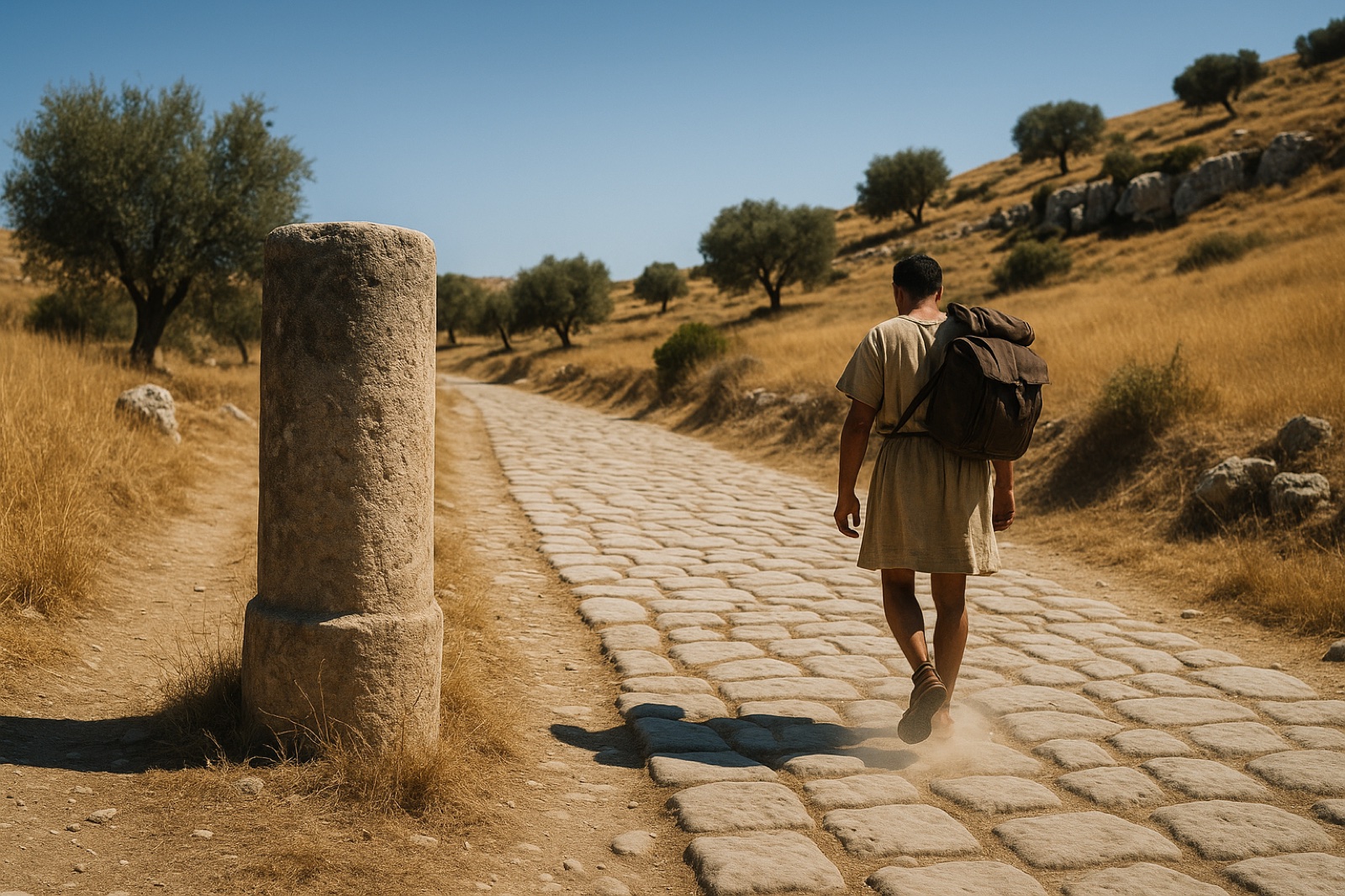
And it was not an idea. It was marked. Roman roads carried stone markers set at every mile, and those stones are what made the limit real. A soldier could make you carry his pack from one marker to the next. At the next stone, it was finished.
Here it is worth separating what is known from what is repeated. That Rome could requisition civilian labour is not in doubt — the word Jesus chose is the technical term for exactly that. The tighter detail, that the limit was precisely one mile and fixed by law, is described consistently by commentators and historians, and the roadside milestones make it a very natural boundary. But it rests on that tradition rather than on a surviving statute anyone can hand you and read aloud. Call it a well-attested practice rather than a quotable law.
Nothing in the passage depends on the difference. What matters is that there was a point on the road where the obligation ended — and you could see it coming.
The Answer Everybody Expected
This was a live political argument, not a thought experiment.
There was a resistance movement in Judea that treated refusing this kind of forced labour as a matter of principle. Carrying a soldier’s pack was collaboration. The honourable answer was no, whatever it cost you. That refusal was part of the resentment that eventually boiled over into open war with Rome.
So when Jesus opened His mouth on this exact subject, everyone listening already knew the two available answers. Comply, and swallow it. Or refuse, and pay for it.
He gave a third one that was on nobody’s list.
Where the Second Mile Actually Begins
Look at where the sentence puts the change.
Jesus does not say don’t be angry. He does not say the soldier is right, or that the occupation is fine, or that you ought to feel grateful. He says nothing at all about the first mile. The first mile is simply conceded. It was taken. There was never a version of that day where you kept it.
He points at the stone.
At that marker the pack becomes yours to put down. And the person who has spent an hour being someone else’s property picks it up again — for reasons that belong entirely to them. Nobody ordered the second mile. Nobody could. It is, quite literally, the first free act of the day.
The first mile belonged to Rome. The second mile belonged to you.
That is what is buried inside a phrase we now use for staying late at work. Jesus was not asking a worn-down person to be extra nice to the boot on their neck. He was showing them the exact spot on the road where their freedom was still intact — and telling them it was bigger than they thought.
Because the moment you walk a second mile, something has quietly turned over. The soldier is still walking. But he is no longer the one deciding. You are.
The Same Word Turns Up One More Time
Here is the part that is easy to walk straight past.
Angareuo is a rare word. It appears three times in the whole New Testament. Once here, in Matthew 5:41. And then twice more — both of them describing the same single moment, told by two different writers:
“And as they came out, they found a man of Cyrene, Simon by name: him they compelled to bear his cross.” — Matthew 27:32
Same word. A soldier on a road, pulling a stranger out of a crowd, making him carry a load he never agreed to.
Only this time the load is Jesus’s cross. And Jesus is walking the road beside him.
Matthew’s Gospel introduces Jesus teaching about the person who gets compelled to carry something. It ends with Jesus walking next to one. Whatever else that is, it is not a teacher asking of other people something he kept himself clear of.
What This Looks Like Where You Live
Most of us are not stopped on a road by soldiers. But almost everyone has a first mile.
A shift you cannot refuse. A relative who assumes. A landlord, a supervisor, a sick parent, a queue you have no power to shorten. Something that is genuinely not a choice, that eats hours you will never get back, and that you spend the whole day arguing with inside your own head.
Jesus is oddly practical about this. Stop fighting the first mile. It is gone. It was gone before you woke up.
Then find the second one — and make it small enough to be real. Not a grand gesture. The extra bag carried to the door. A name said out loud instead of nothing. A message sent to someone who cannot pay you back. One thing in the day that nobody demanded and nobody can take credit for.
It will not change your circumstances. It was never going to. But it changes who is holding the pen.
This same quiet reversal runs underneath a lot of what Jesus taught about being owed. It is why the Bible’s answer to karma turns out not to be about the other person at all, and why the servant in Matthew 18 who was forgiven an unpayable debt is measured not by what he suffered but by what he chose next. And if your own first mile has a face attached to it, our free “Am I Ready to Forgive?” assessment is a gentle place to work out where you honestly stand — because a second mile is very hard to walk while you are still keeping score.
Actions to Take Today
- Name your first mile. Write down the one thing today you genuinely cannot refuse. Two minutes. Naming it as compulsory is what stops you fighting it for the next eight hours.
- Find your marker. In that same situation, work out where the obligation actually ends — the exact point where you have done what was required of you. Most of us have never once located it.
- Walk fifty steps past it. One small unrequested thing, today, in that same situation. Choose it before you feel like it, because you will not feel like it.
Journaling Prompts
- Where does your first mile end? Write the exact moment in your day when the obligation is over — and what you usually do with the ten minutes after it.
- Think of a time someone walked a second mile with you when nothing required them to. What did it change in how you saw them? Have you ever told them?
- When you picture giving something extra to a person who holds power over you, what rises first — freedom, or humiliation? Stay with whichever one came, and ask where you learned it.
A Prayer for the Second Mile
God, there is someone in my life who can make demands of me, and we both know I cannot say no. I am tired of feeling like the whole day belongs to somebody else. Help me stop fighting the mile that was never mine to keep. Show me the small thing today that is still mine to give — and let me give it on purpose, not out of fear. Amen.
Let’s Talk About It
Is choosing to give more to someone who holds power over you a form of strength, or a form of surrender? Tell us how you see it in the comments — we read every one.
Share This
- “Go the extra mile” is a workplace phrase now. Jesus said it under military occupation, where a soldier could take the first mile from you on the road. The second mile was the only part of that day nobody could make you walk.
- The Greek word for “compel” in Matthew 5:41 appears only three times in the New Testament. Once when Jesus teaches it — and twice when soldiers pull Simon of Cyrene out of a crowd and make him carry the cross. Same word. Jesus ended up walking beside the man He had described.
- I stopped arguing with the part of my day I cannot change, and started looking for the fifty steps past it that nobody asked for. Turns out that is where the freedom was the whole time.
Questions People Ask
What is the “go the extra mile” meaning in the Bible?
“Go the extra mile” comes from Matthew 5:41, where Jesus says, “And whosoever shall compel thee to go a mile, go with him twain” (KJV). “Twain” means two. Jesus was speaking to people living under Roman occupation, where a soldier could require a local person to carry his pack for one Roman mile. The first mile was forced; the second was voluntary. In the Bible the phrase is not about working hard — it is about choosing to give something in a situation where you had no choice at all.
What does the Greek word angareuo mean?
Angareuo is the Greek verb translated “compel” in Matthew 5:41. It is a loan word from Persian, where royal couriers called angaroi could seize horses, boats and people to keep the king’s post moving. Rome adopted the practice, and the word came to mean the power of an occupying force to requisition a civilian’s labour on the spot. It appears three times in the New Testament: Matthew 5:41, Matthew 27:32 and Mark 15:21.
How long was a Roman mile?
A Roman mile was one thousand paces, roughly 1.45 kilometres — slightly shorter than the modern mile. Roman roads were marked with stone milestones set at each mile, which is what made a one-mile limit on forced labour something a traveller could actually see coming.
Who was Simon of Cyrene?
Simon of Cyrene was a passer-by whom Roman soldiers pulled from the crowd and forced to carry Jesus’s cross on the way to the crucifixion. Matthew 27:32 records it: “And as they came out, they found a man of Cyrene, Simon by name: him they compelled to bear his cross.” The verb translated “compelled” there is the same rare Greek word Jesus used in Matthew 5:41.
Does Matthew 5:41 mean Christians should never resist injustice?
Matthew 5:41 does not say the occupation was just, and it does not tell anyone to pretend a wrong is right. Jesus says nothing about whether the soldier should hold that power — He addresses only what the person carrying the pack does with the stretch of road that is still theirs. Read alongside the two examples immediately before it, the passage is about refusing to let another person’s power decide who you are, rather than about approving of that power.