 0
0
 0
0
Most families have a branch that stopped getting invited.
Nobody announced it. There was no meeting. There was a disagreement two generations back — over a house, a will, a wedding, a word said at a funeral — and then there was silence, and the silence hardened into a fact. Now there are cousins you would not recognise standing behind you in a queue at the market. Same surname. Same grandparents. Same face shape, if anyone looked.
If you have ever lived on either side of that line, you already understand the Samaritans better than most sermons will let you.
Because the word has been sanded smooth. “Good Samaritan” now means a kind stranger who stops at a roadside. Hospitals are named after it. Laws are named after it. And that is exactly why the stories have stopped landing — a first-century listener heard something close to the opposite of what we hear.
Who Were the Samaritans? Not Foreigners — Relatives
Start with the account the Bible itself gives, in 2 Kings 17. After Assyria carried off the northern kingdom of Israel, the text says the king of Assyria “brought men from Babylon, and from Cuthah, and from Ava, and from Hamath, and from Sepharvaim, and placed them in the cities of Samaria instead of the children of Israel” (2 Kings 17:24).
The chapter then describes a religion that never fully committed: “They feared the LORD, and served their own gods, after the manner of the nations whom they carried away from thence” (2 Kings 17:33).
That is one account. It is also worth saying plainly that it was written from Jerusalem’s side of the argument, and it is not the only version there has ever been.
The Samaritans have never described themselves that way. Their own tradition holds that they descend from Ephraim and Manasseh — Joseph’s sons — and stayed on the land while others were carried away. In their telling the split happened much earlier and ran the other direction entirely: the priest Eli abandoned the true sanctuary and set up a rival one at Shiloh, and Jerusalem is the branch that wandered off, not them.
Historians still argue about how the community actually formed, and an honest article says so rather than picking the tidier story. But one thing is not in dispute at all, and it is the thing that changes how the Gospels read.
They kept the Torah. Their own version of the five books of Moses — the Samaritan Pentateuch — was their entire scripture. Same Abraham. Same Jacob. Same Moses. Same commandments. This was not a foreign religion shipped in from another empire. It was the same first five books, read carefully, arriving at a different address for the temple: Mount Gerizim, not Jerusalem.
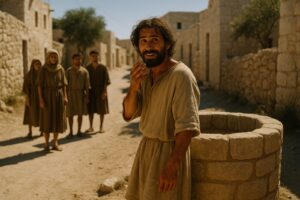
And the family claim was not made quietly. When the woman at the well pushes back at Jesus, she does it exactly the way a relative would: “Art thou greater than our father Jacob, which gave us the well, and drank thereof himself, and his children, and his cattle?” (John 4:12).
Our father Jacob. Said to a Jewish man. At Jacob’s well. As a challenge. And Jesus does not correct the genealogy.
Then comes the part that turns a disagreement into a wound. Around 110 BC, a Judean ruler named John Hyrcanus destroyed the Samaritan temple on Mount Gerizim. Not a foreign empire. The other half of the family, with an army.
So when John’s Gospel drops its famous aside — “for the Jews have no dealings with the Samaritans” (John 4:9) — that is not the polite distance between strangers. That is the distance between people who know exactly where the other one lives.
The Word Was Used as an Insult — Against Jesus
There is a verse most people never connect to any of this. In an argument in the temple, Jesus’ opponents reach for the worst thing they can say to him:
“Then answered the Jews, and said unto him, Say we not well that thou art a Samaritan, and hast a devil?” (John 8:48)
Look at how the word is being used. It is not an argument. It is a slur, and they pair it with the accusation of being possessed to make sure it stings.
Nobody reaches for a word like that about a distant nation they have never met. That kind of contempt is reserved for people close enough to embarrass you.
The Word Jesus Used That Almost Nobody Notices
Ten men with a skin disease stand at a distance from Jesus and shout for mercy. He tells them to go and show themselves to the priests, and while they are walking, they are healed. Only one of them turns around.
“And fell down on his face at his feet, giving him thanks: and he was a Samaritan.” (Luke 17:16)
Luke holds the identification back to the last three words of the sentence, the way you would deliver a line you know is going to land.
Then Jesus says something that carries far more weight in Greek than it does in English:
“There are not found that returned to give glory to God, save this stranger.” — Luke 17:18
“Stranger” is doing enormous work there. The Greek word behind it is allogenes, and it appears exactly once in the entire New Testament — right here, in this sentence, about this man.
It is not rare because nobody needed it. It is rare because of where it normally appeared. In 1871, the archaeologist Charles Clermont-Ganneau found a stone slab in Jerusalem: one of the warning notices that stood on the barrier around the Second Temple courts. Its Greek text forbids any allogenes from passing beyond that barrier, and warns that anyone caught doing so will have only himself to blame for the death that follows. The complete stone sits in the Istanbul Archaeology Museums today; a fragment of another was found in 1936 and is held in the Israel Museum.
That was the barrier word. The word on the sign at the line you do not cross.
We cannot know whether Jesus had that particular stone in mind — nothing in the text says so, and it would be dishonest to claim otherwise. What we can say is what the word carried, and who it lands on here. The only man in the story who came back is the exact man that word existed to keep out. Jesus does not use it to fence him off. He uses it, and then tells him: “Arise, go thy way: thy faith hath made thee whole” (Luke 17:19).
If it is the gratitude in that scene that catches you, we followed that thread further in what the ten lepers still teach us about gratitude.
The Lawyer Who Could Not Say the Word
The most famous Samaritan story starts with a man trying to draw a boundary. A lawyer asks Jesus, “And who is my neighbour?” (Luke 10:29) — a question built to find the edge of the obligation, not to widen it.
You know the shape of the answer. A man is beaten and left half dead on the road. A priest passes by on the other side. A Levite looks at him and passes by on the other side. Then: “But a certain Samaritan, as he journeyed, came where he was: and when he saw him, he had compassion on him” (Luke 10:33).
Here is the detail almost every retelling skips. Jesus turns the question around and asks which of the three was a neighbour to the injured man. The lawyer had a one-word answer available to him. He did not use it.
“He that shewed mercy on him.” (Luke 10:37)
He found a longer way around the word. Luke does not tell us why, and we should not invent a reason. But the sentence is the sentence, and it is hard to read it out loud without hearing something catch in the man’s throat.
Why It Shocked People That Jesus Kept Choosing Them
Here is what we usually carry away from these stories: be kind to outsiders. It is a good lesson. It is also not what made the original audience flinch — which is why the stories can feel a little toothless now.
Kindness to a foreigner is not especially costly. Foreigners are far away. It is easy to be generous about people you will never have to sit across a table from.
What Jesus kept doing was harder to swallow than that. He kept handing the moral high ground to the estranged half of the family.
The priest and the Levite are the insiders. Right address, right scriptures, right building. They walk past. The cousin nobody claims stops, lifts the man onto his own animal, pays the innkeeper and promises to come back and pay more. Ten men are healed and the only one who returns to give glory to God is the one from the wrong hill. And the longest theological conversation Jesus has about worship in the whole of John’s Gospel is not with a scholar in Jerusalem. It is with a woman at a well in Samaria who has had five husbands.
God kept crossing a family line everyone else had agreed not to cross.
What makes this land is that Jesus does not do it by pretending the disagreement was nothing. He tells the woman plainly, “Ye worship ye know not what: we know what we worship: for salvation is of the Jews” (John 4:22). That is not a man flattening every difference to keep the peace. He is not saying the argument never mattered.
He is saying something more unsettling than that: “the hour cometh, when ye shall neither in this mountain, nor yet at Jerusalem, worship the Father” (John 4:21). The mountain is about to stop being the question. Not because truth stopped mattering, but because God was never willing to let a family argument decide who gets pursued.
That is the shock. Not tolerance. Pursuit.
What That Costs You in an Ordinary Week
There is almost certainly a name attached to this for you. Not a nation. Not a group. A person — the one you have quietly stopped counting. The sibling. The in-law. The friend who took a side. The one whose name changes the temperature of a room.
Notice what the Samaritan on the road actually did, because it is smaller than we remember. He did not heal the schism. He did not win the argument about the mountain. He did not have a conversation about any of it. He bandaged, lifted, paid, and said he would come back.
He did one physical thing for one specific person, and it cost him money and a day.
That is the size of the move available to you today. Not reconciliation. A message. A transfer. A pot of soup left at a door. Something that costs you a little and does not require the other person to admit anything first.
And if you are reading this from the other side — if you are the branch that stopped getting invited — that is worth sitting with too. Being the one written out is usually a role you were handed rather than a flaw you earned. In all three of these stories, the person on the outside is the one Jesus makes the point with. Not the one he tolerates. The one he holds up.
Three Things You Can Do Today
- Say the name out loud. Just once, to yourself, in the room you are in. Naming the person you have quietly written off is uncomfortable in a way that thinking about them vaguely never is — and that discomfort is the whole point.
- Send eight words, not eighty. “I was thinking about you today. No agenda.” Nothing about the argument. Nothing that asks them to explain themselves. A short message is a bandage, not a settlement, and a bandage is what the Samaritan actually offered.
- Do the costly small thing. Pay for something they need, drop food at the door, cover a bill, take the child for an afternoon. Practical help travels across a silence that words cannot cross yet.
If the second and third steps feel impossible right now, that is honest information rather than a failure. Our free Am I Ready to Forgive? walk-through is built for exactly that gap between wanting to move and being able to.
Journaling Prompts
- Who is the person whose name you skipped over while reading this? What made your mind move past them so quickly?
- The lawyer answered “he that shewed mercy” rather than saying “the Samaritan.” Which word is hard for you to say out loud, and what would it cost you to say it?
- If God has been pursuing the person you find hardest to claim, with the same patience shown to you — what does that ask of you, and what does it not ask of you?
A Prayer for When You Are the One Nobody Claimed
God, I know what it is to be the one left off the list. I have felt what it is to be talked about instead of talked to, and I have done it to someone else too. I do not know how to fix the silence, and I am tired of pretending I do. Show me the one small thing that is actually mine to do this week, and give me enough courage to do it before I talk myself out of it. And where I am the one on the outside — remind me that You have never once needed me to be claimed by anybody else before You came looking.
A Question Worth Talking About
Why do you think “Good Samaritan” became a compliment for kind strangers, when the original point was about someone the audience actively looked down on? Tell us what you think in the comments — we read every one.
Share This
- “Good Samaritan” is now a compliment. To the first people who heard the story, it was almost a contradiction in terms. That’s the part we lost.
- The Samaritans weren’t foreigners. They kept the same five books of Moses and claimed the same grandfather. It was a family fight — which is exactly why it hurt.
- Ten men were healed. One came back. Luke waits until the last three words of the sentence to tell you which side of the family he was from.
Questions People Ask About the Samaritans
Who were the Samaritans in the Bible?
The Samaritans were a community living in the region of Samaria, between Galilee and Judea, who kept their own version of the five books of Moses (the Samaritan Pentateuch) and worshipped at a temple on Mount Gerizim rather than in Jerusalem. Second Kings 17 describes populations resettled in Samaria by Assyria after the fall of the northern kingdom of Israel; Samaritan tradition instead traces the community’s descent from the Israelite tribes of Ephraim and Manasseh. Both accounts agree on the essential point that made the Gospel encounters so charged: this was a dispute inside the family of Israel, not an encounter with a foreign religion.
Were the Samaritans Jewish?
Samaritans and Jews shared the Torah, the patriarchs Abraham and Jacob, and the law of Moses, but they were separate communities with separate priesthoods, separate sanctuaries and, by the first century, deep mutual hostility. First-century Jews did not regard Samaritans as fellow Jews, and Samaritans did not regard Jerusalem as the legitimate place of worship. The closest modern description is two branches of one family tree that stopped recognising each other.
Why did Jews and Samaritans hate each other?
The hostility had both a religious and a political history. The two communities disagreed over which mountain God had chosen for worship — Gerizim or Jerusalem — and over which priesthood was legitimate. That disagreement turned violent when the Judean ruler John Hyrcanus destroyed the Samaritan temple on Mount Gerizim around 110 BC. By the time of Jesus, the split was old, bitter and personal, which is why the Gospel of John notes simply that “the Jews have no dealings with the Samaritans” (John 4:9).
What does “Good Samaritan” actually mean in the Bible?
In Jesus’ parable in Luke 10:25-37, a priest and a Levite — both religious insiders — walk past a man who has been beaten and left half dead, and a Samaritan stops to help him. The phrase now means any kind stranger, but the original force came from who the helper was: a member of the despised, estranged branch of the family, held up as the moral example in front of an audience that looked down on him. Notably, when Jesus asks which man acted as a neighbour, the questioner answers “He that shewed mercy on him” rather than naming the Samaritan at all.
Do Samaritans still exist today?
Yes. A small Samaritan community still exists, numbering in the hundreds rather than the thousands, living mainly near Mount Gerizim in the Nablus area and in Holon in Israel. They continue to use the Samaritan Pentateuch as their scripture and still observe Passover on Mount Gerizim, which makes them one of the smallest and oldest continuously surviving religious communities in the world.