 0
0
 0
0
Someone cuts in the queue. A cousin brings up politics at dinner. The group chat will not stop pinging. And somebody says it, with a tired little laugh:
“Hell is other people.”
It gets a laugh because it feels true. It sounds clever, because a French philosopher said it. And it seems to promise a quiet kind of permission: the problem is not you. It is them.
Here is the strange part. The man who says that line in the play is in hell, and he is there for a reason. The door of his room opens before the end, and he does not walk out. And twenty years later, the man who wrote the line went on record to say people had it backwards.
What “Hell Is Other People” Really Means
Here is our reading, and we will argue for it below. “Hell is other people” is not a line about disliking people. It is a line about what happens when the only mirror you have left is somebody else’s eyes, and those eyes are unkind.
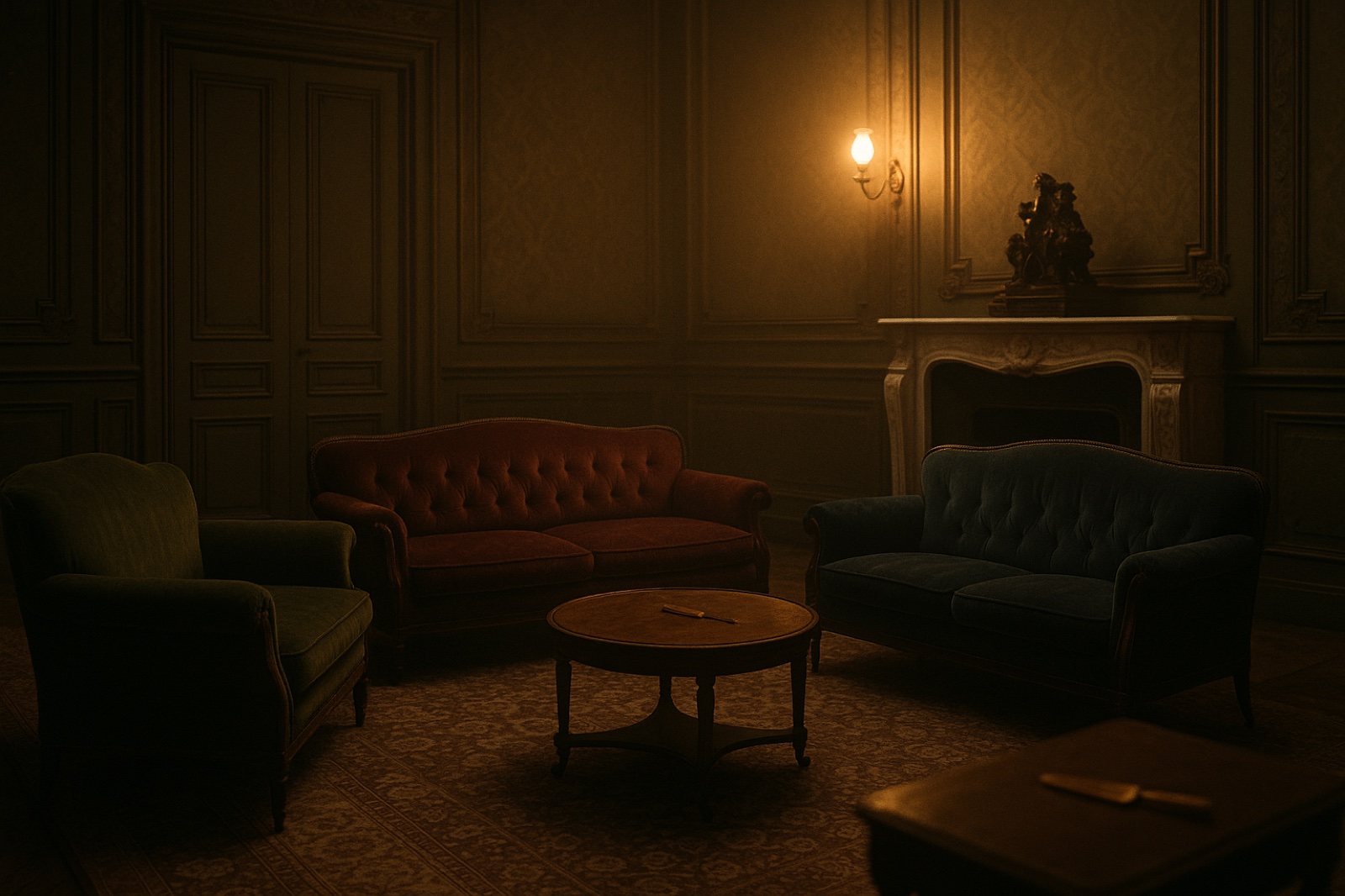
Look at the room Jean-Paul Sartre built for his three damned characters. There are no mirrors. The characters notice this early, and one of them says everything that looked like a glass has been taken away. There is no night. There are no eyelids, so nobody can ever blink or sleep. The only way any of them can find out what they look like, or who they are, is by reading it off the two other faces in the room.
That is the claim. Not “people are awful.” Rather: you cannot know yourself without other people, and when you let their verdict replace your own, you are at their mercy. For ever, if the room is hell.
Notice what the line assumes. It assumes we build our picture of ourselves out of borrowed pieces. Sartre thought this was simply true of all of us, and most people, if they are honest, would agree. Notice too what the line leaves out. It does not say how you get out. The play does, though. The door opens. Nobody leaves.
Where the Line Comes From: Three Friends, a Locked Room, and Occupied Paris
“Hell is other people” comes from a one-act play Sartre wrote in late 1943 and early 1944, in Paris, while the city was under German occupation. In French it is Huis clos, a legal term for a hearing held behind closed doors. In English it is usually called No Exit, and sometimes In Camera.
It started as a casting problem
Most people picture a famous line like this being born out of deep thought. Sartre himself told a humbler story. In a spoken introduction recorded for a 1965 record release of the play, he explained that when he wrote it he had three friends, and he wanted to write them a play without favouring any one of them. That meant none of them could leave the stage, because whoever went off would think the other two had the better part.
So the problem was practical: how do you keep three people on stage together, right to the end, as if for eternity? And that, he said, is where the idea came to him of putting them in hell and making each one the torturer of the other two. The printer Marc Barbezat had asked for a play his wife Olga and another actress could tour with: three actors, no scene changes. The eternal locked room was, first of all, a way to meet a brief.
The play almost had a different title, and a different Garcin
The play first appeared in print under a different name. It was published as Les Autres, “The Others,” in a small literary review called L’Arbalète, before it became Huis clos. The title that got dropped is the one that gives the famous line away: the whole play was named for other people before it was named for the locked door.
And the man first lined up to direct it, and to play Garcin, the character who says the line, was Albert Camus. Rehearsals began in December 1943 in Simone de Beauvoir’s hotel room. Camus stepped aside, saying he did not feel qualified to direct professional actors or perform on a Paris stage, and a planned production fell through after Olga Barbezat was arrested. In the end the Théâtre du Vieux-Colombier took the play, Raymond Rouleau directed, and Michel Vitold played Garcin.
Opening night, ten days before D-Day
It opened on 27 May 1944, in an occupied city, ten days before the Allied landings in Normandy. The run was cut short that summer by the fighting that drove the Germans out of Paris, and the play was back on stage that September in a freed city. So the first audiences to hear “hell is other people” were people who had spent four years being watched, reported on, and judged by their neighbours, and who were about to find out who had informed on whom.
Reviews were divided, and they have stayed divided. The American critic Clive Barnes later called the play “an intellectual phony from start to finish.” It is still Sartre’s most performed work.
Who Says It, and Why That Changes Everything
This is the fact that most people repeating the line do not know. Sartre does not say “hell is other people.” A character does, and the character is not a hero.
His name is Joseph Garcin. He was a journalist who called himself a pacifist, and he was shot for deserting. He also, by his own account, treated his wife cruelly for years. What he wants, more than anything, is for someone to tell him he was not a coward. He spends the play fishing for that verdict from the two women locked in with him, and one of them, Inès, will not give it.
Near the end, Garcin stands at the mantelpiece, looks at the bronze ornament, and says he finally understands where he is. He had been told hell would be fire and torture chambers. Old wives’ tales, he says. No need for the red-hot pokers. In French: “L’enfer, c’est les autres.” Hell is other people.
And then comes the moment the posters leave out. The door flies open. Inès tells him he is free to go. He stays. He says he is staying because of her, because she is the one who knows what cowardice is, and he cannot leave until she believes he is not one. He has handed his verdict to the one person in the room who will never give it. That is his hell, and the open door shows he chose it.
What Sartre Said Twenty Years Later
Sartre knew exactly how the line was being used, and he did not like it. In that same recorded introduction from the mid-1960s (most sources date it 1965, some 1964), he said “hell is other people” had always been misunderstood. The English version in the collection Sartre on Theater (1976) runs like this: “It has been thought that what I meant by that was that our relations with other people are always poisoned, that they are invariably hellish relations. But what I really mean is something totally different. I mean that if relations with someone else are twisted, vitiated, then that other person can only be hell.”
Why? Because, he went on, other people are the most important thing we have for knowing ourselves. We judge ourselves with tools other people gave us. Whatever I say about myself, someone else’s judgment is already inside it. “If my relations are bad, I am situating myself in a total dependence on someone else. And then I am indeed in hell.”
Then he said the sentence that, for our money, is the real quote. In our own translation from the French: there are a great many people in the world who are in hell because they depend too much on the judgment of others. And he added that this does not at all mean we cannot have other kinds of relationships. It simply marks “the capital importance of all other people for each one of us.”
He also said something about the open door. Whatever circle of hell we live in, he said, we are free to break it, and if people do not break it, they stay in it freely. So the writer most often quoted to say that other people are the problem actually said something harder: the lock is on the inside.
If that lands close to home, we wrote a plain guide to how to stop caring what people think, which turns out to be less about caring less and more about who gets a vote.
The Honest Objection
Not everyone accepts Sartre’s clean-up. Some readers point out that the line belongs to a damned man dodging the blame, and that the play’s three characters all say “the others” are the problem while refusing to own what they did. On that reading, the famous sentence is not Sartre’s verdict at all. It is a coward’s excuse, placed in a coward’s mouth on purpose.
We think that objection is fair, and that it does not actually contradict Sartre. His own words agree with it: people stay in hell freely. Garcin’s excuse and Sartre’s explanation are two halves of one idea. Other people become your hell when you give them the keys, and you are the one who gave them.
There is also a quieter objection worth hearing. Sartre did not believe in God, and his way out of the room is pure willpower: you are free, so break the circle. Anyone who has tried to stop caring what a parent, an ex, or a boss thinks of them by sheer will knows how far that gets you. The diagnosis is brilliant. The cure is thin.
A Proverb That Named the Same Trap
Sartre’s “total dependence on someone else” is a twentieth-century description of something a Hebrew proverb had already named in a single line, well over two thousand years earlier:
“The fear of man bringeth a snare: but whoso putteth his trust in the LORD shall be safe.”
– Proverbs 29:25 (KJV)
“The fear of man” in that old English does not mean being scared of people. It means living under their verdict: the dread of what they think, the need for their approval. And the proverb’s word for it is a snare, a trap you walk into, not a cage someone locks you in. That is Garcin exactly. That is the open door.
We are not claiming Sartre had this proverb in mind. There is no evidence he did, and he would probably have been annoyed at the comparison. What is striking is the convergence. A French atheist writing in an occupied city, and an ancient wisdom teacher, both looked at the same human trap and described it the same way: handing your verdict to other people is a kind of hell, and you walk into it yourself.
Where they part is the exit. Sartre says: be free, and break it. The proverb does not say you can stop needing a judge. It says you can change who the judge is. Trust the One whose verdict is not twisted, not unkind, and not for sale, and the other verdicts lose their grip. One cure asks you to need nobody. The other says you were built to need someone, and names who. We will leave that tension standing, because it is real, and it is the whole question.
We saw the same shape when we looked at what Aristotle meant by eudaimonia: a great thinker gets the diagnosis right, and the oldest texts keep arriving at the part he left out.
Looking at the Line Again
So the next time someone says “hell is other people” across a dinner table, you might hear it a little differently. It was never really about the people across the table. It was about which pair of eyes you have handed your verdict to.
Garcin had a door. It opened. He stayed, because he needed the cruellest person in the room to tell him he was good. Most of us have done a smaller version of that, with a smaller room. The question the line leaves you with is not “how do I get away from people.” It is “whose judgment am I living in, and is it a kind one.”
If you are not sure how much of your own picture of yourself is borrowed, our free How Healthy Is My Self-Esteem? assessment is a quiet place to find out.
Let’s Talk
Whose opinion of you has the most power over you right now, and did they earn it? And which famous quote have you repeated for years without knowing who actually said it, or where? Tell us in the comments.
Questions People Ask About “Hell Is Other People”
Who said “hell is other people”?
Jean-Paul Sartre wrote “hell is other people,” but in the play it is spoken by a character, not by Sartre in his own voice. The line comes near the end of his one-act play Huis clos (No Exit), first staged in Paris on 27 May 1944. The character who says it is Joseph Garcin, a journalist shot for deserting, who is locked in a room in hell with two women. In French the line is “L’enfer, c’est les autres.”
What did Sartre mean by “hell is other people”?
Sartre meant that “hell is other people” describes what happens when our relationships are twisted and we depend completely on other people’s judgment of us, not that people are bad or that relationships are always hellish. In a spoken introduction recorded for a 1965 release of the play, he said the line had always been misunderstood. He explained that we know ourselves largely through other people, so if those relationships are spoiled, we are “in a total dependence on someone else,” and that is hell. He added that this simply shows the capital importance of other people for each of us.
What play is “hell is other people” from?
“Hell is other people” is from Jean-Paul Sartre’s one-act play Huis clos, known in English as No Exit or In Camera. Three dead people, Garcin, Inès and Estelle, are shown into a Second Empire drawing room with no mirrors, no windows and no night, and slowly realise they are each other’s torturers. The play was written in occupied Paris in 1943 and early 1944, was first published under the title Les Autres (“The Others”), and opened at the Théâtre du Vieux-Colombier on 27 May 1944.
Is “hell is other people” in the Bible?
No. “Hell is other people” is not in the Bible. It comes from Jean-Paul Sartre’s 1944 play Huis clos (No Exit). The closest biblical idea is Proverbs 29:25, which says, “The fear of man bringeth a snare: but whoso putteth his trust in the LORD shall be safe.” Both describe living under other people’s judgment as a trap, but the proverb points to trusting God as the way out, while Sartre pointed to human freedom.
Did Sartre hate people when he wrote “hell is other people”?
No. Sartre said directly that “hell is other people” does not mean we cannot have good relationships with others. He said the line is about bad, twisted relationships, where we depend too much on another person’s judgment, and he said many people live in that kind of hell. He also said that the play was written for three friends he wanted to keep on stage together, which is where the idea of a locked room in hell came from. Garcin, the character who says the line, stays in the room by choice when the door opens, because he needs another person’s approval too much to leave.
Share This
- I had no idea “Hell is other people” is said by a coward in hell, and that Sartre went on record 20 years later to say people had it backwards. He meant: hell is depending on someone else’s verdict of you.
- Just learned Sartre’s locked room in hell started as a casting problem. He had three friends, wanted none of them to leave the stage, and thought: where do three people stay together for ever? Hell. That’s the whole origin.
- The poster version: other people are the problem. The play version: the door opens, and he stays, because he needs the cruellest person in the room to call him brave. Proverbs called that a snare 2,000 years earlier.