 0
 0
Greek Word for Bread: What Does ‘Artos’ Really Mean?
Quick answer: The Greek word for bread is ἄρτος (artos), pronounced AR-toss — Strong’s G740. It appears 97 times in the New Testament and means a loaf: specifically the round wheat loaf of an ordinary first-century table, about as thick as your thumb and as wide as a plate. It is the plainest possible word. The surprise is not in artos at all — it is in the single adjective the Gospels set beside it in the Lord’s Prayer, a word that appears nowhere else in surviving Greek and that nobody has ever confidently translated.
Word Study: Where “Artos” Comes From
Where does artos come from? Honestly: nobody is sure, and it is worth saying that out loud rather than papering over it. Strong’s derives it from αἴρω (airō), “to lift or raise” — bread as the stuff that rises. Thayer’s reaches instead for an older root ἄρω, “to fit or join together,” and then immediately flags its own suggestion as doubtful. The NAS lexicon gives up cleanly and lists the word as “of uncertain origin.” For a noun this common that is genuinely striking: artos is so old and so ordinary that Greek itself had forgotten where it came from.
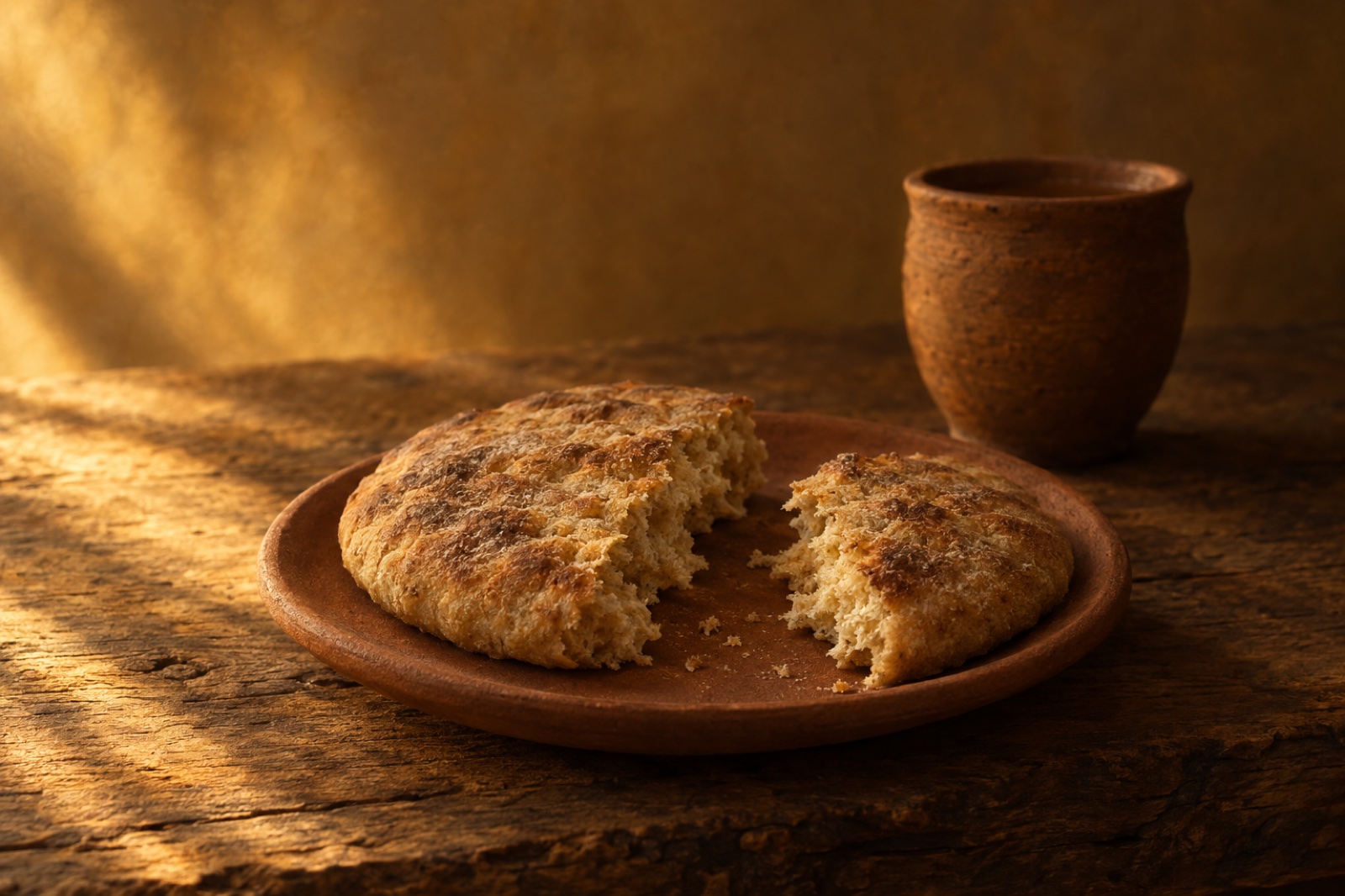
What the lexicons do agree on is the shape of the thing, and the shape turns out to matter. Thayer describes the Israelite loaf as a flat cake, round or oblong, roughly the thickness of a thumb and the width of a platter — and then adds the consequence in six words: hence, it was not cut, but broken.
You cannot slice a loaf like that. You tear it. Which is why the early church’s name for its central meal is not “the cutting of bread” but ἡ κλάσις τοῦ ἄρτου (hē klasis tou artou), “the breaking of the loaf” (Acts 2:42). A physical fact about baking became the name of a sacrament.
Two more things are worth knowing about this word:
- Artos is the default bread, and the default is wheat. Classical Greek distinguished artos from μᾶζα (maza), the barley cake that poorer people ate. So when John tells us what the boy in the crowd actually had, the Greek has to add a qualifier: πέντε ἄρτους κριθίνους, “five barley loaves” (John 6:9). One adjective quietly tells you the economics of that hillside before the miracle even starts.
- It stretches far past baking. Like the Hebrew word it was used to translate, artos widens out to mean food in general, a meal, a living. “To eat bread on the sabbath day” (Luke 14:1) just means to go to dinner. “Eat their own bread” (2 Thessalonians 3:12) means earn your own keep. Greek picked up that breadth from Hebrew: the Septuagint used artos to render לֶחֶם (lechem), and the idiom came across with the word. If you want that side of the story, there is a companion study on the Hebrew word for bread.
If “daily bread” is meant to be a daily thing, it helps to have somewhere to put the day. 30 Days Walking with Jesus is a free 3-day sample of a 30-day devotional that walks through what Jesus actually said and did — built both for people starting out and for people wanting to rekindle a connection that has gone quiet.
Where This Word Appears in the Bible
Artos turns up at almost every hinge in the Gospels — a temptation, a prayer, a hillside, a claim, and a supper that changed everything:
| Reference | Text (KJV) | What’s happening |
|---|---|---|
| Matthew 4:4 | “…Man shall not live by bread alone, but by every word that proceedeth out of the mouth of God.” | Jesus, genuinely starving, calls bread real and insufficient in the same breath |
| Matthew 6:11 | “Give us this day our daily bread.” | Artos with the strangest adjective in the New Testament attached to it |
| John 6:9 | “There is a lad here, which hath five barley loaves, and two small fishes: but what are they among so many?” | Artos qualified as barley — the poor man’s grain, and all there was |
| John 6:35 | “I am the bread of life: he that cometh to me shall never hunger; and he that believeth on me shall never thirst.” | Jesus takes the most ordinary noun available and puts it after “I am” |
| Luke 24:35 | “…how he was known of them in breaking of bread.” | The resurrection recognised at the tearing of a loaf, not during the sermon |
Verse Deep Dive: Matthew 6:11 — The Word Next to “Bread” That Nobody Can Translate
“Give us this day our daily bread” is probably the most-prayed sentence in human history. In Greek it runs: Τὸν ἄρτον ἡμῶν τὸν ἐπιούσιον δὸς ἡμῖν σήμερον.
Artos is easy. ἐπιούσιος (epiousios), Strong’s G1967 — the word your Bible renders “daily” — is not. It occurs exactly twice in the entire New Testament: here, and in Luke’s version of the same prayer (Luke 11:3). Outside those two verses it is essentially unattested in ancient Greek literature. Origen, writing on prayer in the third century as a native Greek speaker with a library most of us can only envy, said plainly that the word was not in ordinary use and concluded that the Gospel writers appear to have coined it themselves.
So the most familiar line in Christian prayer contains a word that may have been invented for it. Three readings have real support:
- “For the coming day.” Greek already had ἡ ἐπιοῦσα (hē epiousa) for “the next day,” and Acts uses it that way repeatedly — “and the next day he shewed himself unto them” (Acts 7:26) is τῇ ἐπιούσῃ ἡμέρᾳ. On this reading you ask in the morning for today’s bread, and in the evening for tomorrow’s. Either way, one day at a time.
- “Needful for existence.” From ἐπί plus a form of οὐσία (ousia), “being, substance” — bread sufficient to keep a body alive. Not comfort, not surplus: the amount that means you are still here tomorrow.
- “Supersubstantial.” The same construction taken at full theological strength: bread that is more than bread, provision that belongs to a different order than the loaf on the table.
Here is the detail that makes this impossible to wave away. Jerome translated the whole Bible into Latin, and he met this one word twice. At Matthew 6:11 he wrote panem nostrum supersubstantialem da nobis hodie. At Luke 11:3 — the same Greek word, in the same prayer, in the same Bible — he wrote panem nostrum quotidianum da nobis hodie: “our daily bread.”
One translator. One word. Two different answers, side by side in a single Bible, for sixteen centuries. The English “daily” that hundreds of millions of people say every morning came down the Luke road. The Matthew road was never really taken. Jerome also recorded, in his commentary on Matthew, that a Hebrew gospel he had seen read mahar at this point — “tomorrow’s.”
And that unresolved ambiguity is not a defect to be fixed. Notice where every candidate lands. Bread for the coming day. Bread enough to exist. Bread that is more than bread. Not one of them means enough for the year. Whatever epiousios turns out to mean, the prayer refuses to ask for the stockpile. It asks for the next stretch of road and stops.
Not All “Bread” Is the Same
Artos is the general word, but the New Testament reaches for several others, and each one is doing a job:
- ἄρτος (artos, G740) — the everyday loaf, and by extension food, a meal, a livelihood. The default word.
- ἄζυμος (azymos, G106) — “unleavened,” built from a– (“without”) and ζύμη (zymē), “yeast.” In the plural, ta azyma, it stops being an adjective and becomes the name of a week: the Feast of Unleavened Bread. Paul then turns the baking term into a description of a cleaned-out life in 1 Corinthians 5:7–8.
- κλάσμα (klasma, G2801) — not a loaf at all but a piece torn off, from the verb “to break.” It is the word for what was left over after the feeding of the five thousand: “they took up of the fragments that remained twelve baskets full” (Matthew 14:20). The leftovers of the miracle are named for the breaking, not the baking.
- ἄρτοι τῆς προθέσεως (artoi tēs protheseōs) — literally “loaves of the setting-out,” the shewbread of Matthew 12:4. Bread placed before God rather than eaten at a table — the one kind of bread in Scripture whose purpose is not to be food.
Why the Original Word Changes the Meaning
On the afternoon of the resurrection, two people walk seven miles to a village called Emmaus with the risen Jesus beside them, and do not recognise him. He explains the whole of the Hebrew Scriptures to them as they go. It does not work. Their eyes stay shut through what must have been the finest sermon ever preached.
Then they sit down to eat.
“And it came to pass, as he sat at meat with them, he took bread, and blessed it, and brake, and gave to them. And their eyes were opened, and they knew him.” (Luke 24:30–31)
Four verbs, in order: took, blessed, brake, gave. Luke had written those same four verbs in that same order two chapters earlier, in an upper room: “And he took bread, and gave thanks, and brake it, and gave unto them” (Luke 22:19). Same word for the loaf. Same sequence. Same hands.
And when those two get back to Jerusalem and try to say what happened to them, the sentence they reach for is not about the teaching on the road. It is ἐγνώσθη αὐτοῖς ἐν τῇ κλάσει τοῦ ἄρτου — “he was known of them in breaking of bread” (Luke 24:35).
That is what the sheer plainness of artos is for. The word carries no religious weight of its own; it is the least impressive noun on the table. So when Jesus says “I am the bread of life” (John 6:35), he is not reaching for a lofty image. He is reaching for the most repeatable thing in the room — the thing you will need again tomorrow no matter how much of it you had today. Gold you can keep. Bread you finish, and then it is morning again.
Which is also why the recognition happens where it happens. God did not become visible to those two during the explanation. It happened at supper, over a torn loaf, after the walking was done.
Living It Out
Two things follow from this word, and they pull gently in opposite directions.
The first is that your prayer is allowed to be small. Whatever epiousios means, it does not mean “enough for the year,” and most of our anxiety is about the year. Try praying Matthew 6:11 this week with nothing added — no stockpile, no contingency, nothing past tomorrow — and notice how hard it is to stop the sentence there.
The second is that you may be waiting in the wrong place. The Emmaus pair wanted an explanation and were given one, and it did not open their eyes; the ordinary meal did. If you have been holding out for God to explain something before you’ll sit down again, the pattern in Luke 24 suggests doing it the other way round. Set the table first. Recognition tends to arrive over bread.
Journal Prompts
- Write out “give us this day our daily bread,” then write down what you were actually asking for the last time you prayed it. How far past today did the request reach? What would genuinely change this week if you asked only for the coming day’s portion?
- Jerome gave the same Greek word two different translations: “supersubstantial” in Matthew, “daily” in Luke. Which of those do you need right now — the bread that simply keeps you alive, or the bread that is more than bread? Be honest about which one you would rather have, and why.
- The two on the Emmaus road recognised Jesus at a table, not during the explanation. Where have you been waiting for an explanation before you’ll move? What is the ordinary, unimpressive thing in front of you that you could sit down to instead?
Prayer
Lord, give me this day my daily bread — artos, the plain loaf, enough for today. I keep asking for the year, and what you keep offering is the day; forgive me for treating that as the smaller gift. Where I have been waiting for an explanation before I will move, give me the grace to sit down at the table instead. Open my eyes in the breaking of bread, the way you did on the road to Emmaus, and let what arrives today be enough — because of who it came from. In Jesus’ name, amen.
Share This
“Give us this day our daily bread” contains a word that appears nowhere else in Greek — Origen thought the Gospel writers invented it. Jerome then translated it two different ways in the same Bible: “daily” in Luke, “supersubstantial” in Matthew. Nobody has settled it since. [Post URL]
First-century bread was a flat round loaf about as thick as your thumb. You couldn’t slice it — you tore it. Which is why the church’s oldest name for its central meal is the breaking of bread, and why two disciples recognised the risen Jesus the moment a loaf came apart in his hands. [Post URL]
FAQ
What does artos mean in Greek?
ἄρτος (artos, Strong’s G740) is the ordinary Greek word for bread — a round wheat loaf. It appears 97 times in the New Testament. Like the Hebrew lechem it translates, it often widens out to mean food in general or a person’s livelihood: “to eat bread” (Luke 14:1) simply means to have a meal.
What does “epiousios” mean in the Lord’s Prayer?
Honestly, no one is certain. ἐπιούσιος (G1967) occurs only in Matthew 6:11 and Luke 11:3 and is essentially unattested elsewhere in Greek; Origen said it was not a word people actually used. The three main candidates are “for the coming day,” “needful for existence,” and “supersubstantial.” English Bibles settle on “daily,” which is a reasonable choice rather than a certain one.
Is “I am the bread of life” the same Greek word as “daily bread”?
Yes. John 6:35 and Matthew 6:11 both use artos — the plain, everyday loaf. That is the force of the claim: Jesus did not pick an exalted image, he picked the most ordinary and most repeatedly necessary thing on the table.
Does artos mean leavened bread specifically?
Not strictly. Artos is the general word for a loaf, and when the New Testament needs to specify unleavened bread it uses azymos (G106) instead. But artos is still used for the loaf at a Passover meal, where the bread would have been unleavened — as in Luke 22:19. The word names the loaf, not the recipe.
One day’s portion is easier to receive when there’s a place to put it. 30 Days Walking with Jesus is a free 3-day sample of a 30-day devotional that brings the words and actions of Jesus to life — made for new Christians working out how to start, and for long-time ones wanting to rekindle the connection.