 0
0
 0
0
Some words are big enough to hold a whole life. Eudaimonia is one of them.
If you have looked up the eudaimonia meaning, you have probably seen it translated as “happiness.” That is close, but it is not quite right. Happiness sounds like a mood. It comes and goes, like sun on a cloudy day. Eudaimonia is bigger than a mood. It means a whole life that has gone well. A life that flourished.
The word comes from ancient Greece, and it is still quietly running a lot of modern thinking. Here is what it really means, what Aristotle said it takes, and the one sentence in his writing that most people read straight past.
What Is the Eudaimonia Meaning, in Plain Words?
Eudaimonia (you say it you-die-MOH-nee-uh) is made of two Greek parts. Eu means “good” or “well.” Daimon means a spirit, a kind of guiding power over a person’s life. So the old picture inside the word is something like “having a good spirit watching over you.” Put simply: being well-off in the deepest sense.
Most people today use it to mean “human flourishing.” Not feeling good for an afternoon, but being good at being alive, across years. A plant that is flourishing is not just green today. It is rooted, growing, and doing what a plant is meant to do. That is the idea.
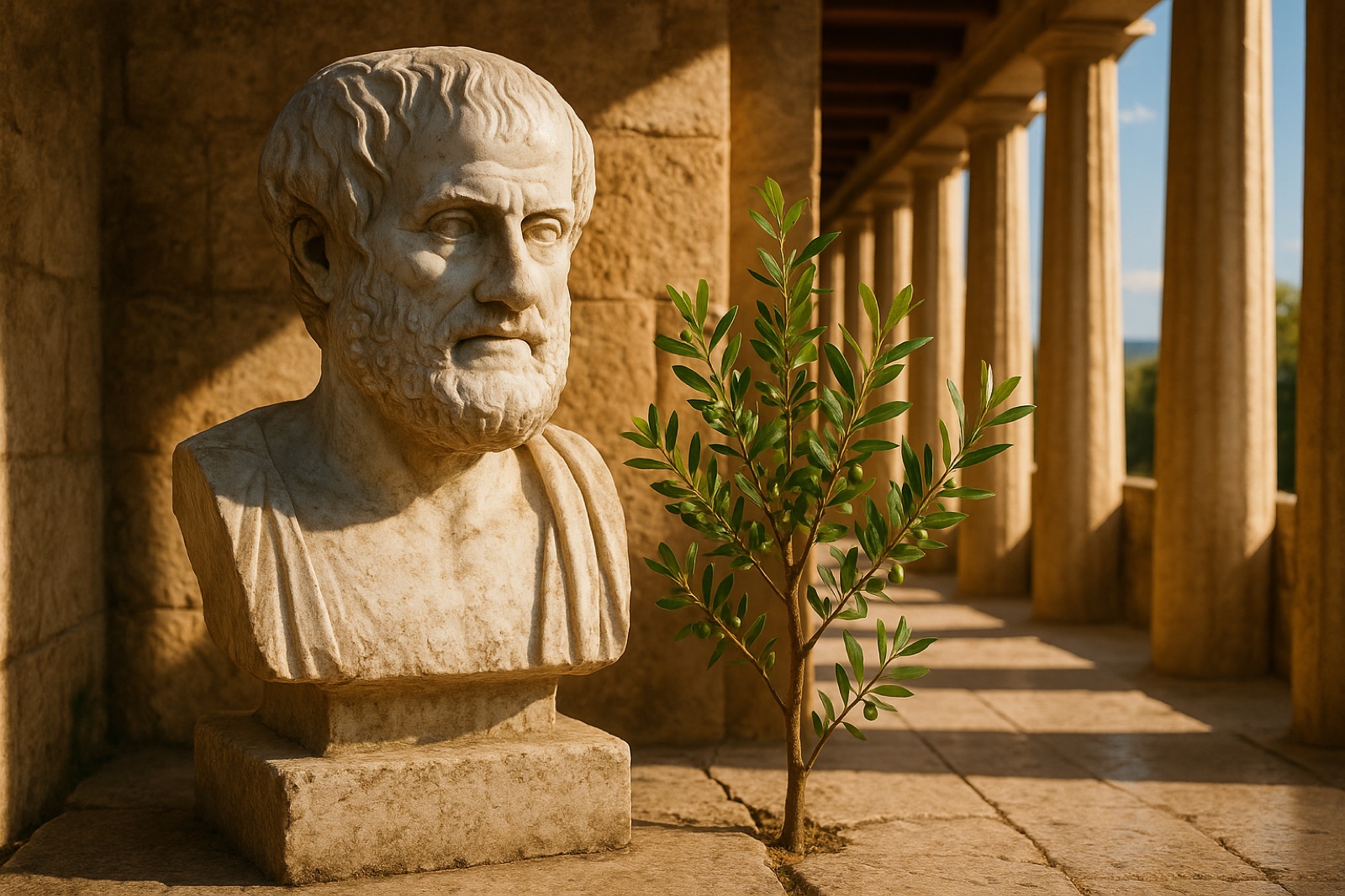
The word was used by many Greek thinkers, but one man shaped how we understand it more than anyone else: Aristotle, who taught in Athens more than 2,300 years ago. His book the Nicomachean Ethics is really one long answer to a single question: what makes a human life go well?
What Aristotle Said Eudaimonia Takes
Aristotle’s answer has three parts, and each one is worth sitting with.
1. It is something you do, not something you feel. In the classic W. D. Ross translation, Aristotle says the human good “turns out to be activity of soul in accordance with virtue.” In other words, flourishing is living well: being brave, fair, honest, kind and wise, over and over, until it becomes who you are. You cannot feel your way into it. You practise your way into it.
2. It takes a whole life. This is where his most famous line comes from. “One swallow does not make a summer, nor does one day; and so too one day, or a short time, does not make a man blessed and happy.” One good week does not make a flourishing life. You judge a life by its whole shape.
3. It needs some luck. This is the part people skip, and Aristotle was honest about it. He wrote that happiness “needs the external goods as well; for it is impossible, or not easy, to do noble acts without the proper equipment.” Then he got specific. He said a person who is “very ugly in appearance or ill-born or solitary and childless is not very likely to be happy,” and even less so if they have “lost good children or friends by death.”
Read that again slowly. Friends, money, a good family name, children, even good looks. Aristotle believed you could do everything right and still miss out on a fully flourishing life, simply because of what happened to you.
Who Eudaimonia Quietly Left Out
Aristotle was not being cruel. He was being realistic about how the world looked from where he stood. But when you follow his idea to its edges, you notice who ends up outside it.
Children. He said a boy is not yet happy, because he is too young to live a life of virtue. When people call a child happy, he wrote, they are really praising “the hopes we have for them.”
Slaves. Near the end of the book, he wrote that “no one assigns to a slave a share in happiness.” In his world, a slave did not have the freedom to live the kind of life that flourishing required.
The grieving. This is the part that stopped me. Aristotle tells the story of Priam, the old king of Troy in the Greek legends, who lived a good life and then lost his sons, his city and everything else in his old age. Aristotle says that no one calls a man like that happy.
To be fair, Aristotle softens this. He says a good person who suffers terribly will not become truly miserable, and that their “nobility shines through” when they bear great pain well. But then comes the line almost everyone reads past. The good man, he says, “can never become miserable; though he will not reach blessedness, if he meet with fortunes like those of Priam.”
Not blessedness. The Greek word Aristotle used right there is makarios. It was the word for the very top of the good life, the fullest kind of happiness. In old Greek poetry, it was the word used for the gods themselves: “the blessed ones,” who lived far above pain. And Aristotle’s point was clear. Great grief closes that door. You might still be a good person. But the highest blessing is for people whose lives have not been broken.
Why Eudaimonia Still Matters Today
You might think this is dusty history. It is not. A lot of today’s thinking about the good life runs on Aristotle’s engine, even when nobody says his name.
Psychologists who study “well-being” often split it into two kinds. One is feeling good (pleasure, comfort, a good mood). The other is living well (meaning, growth, being true to your values). That second kind is often called “eudaimonic” well-being, borrowed straight from Aristotle’s word.
And much of the self-improvement world carries his whole recipe with it. Build good habits. Become your best self. Find your purpose. It is close cousins with ideas like ikigai, the Japanese idea of a life worth living, and with the Stoics, who argued about the same questions in the same streets (we wrote about what Stoicism actually taught here).
There is real wisdom in all of it. Virtue matters. Habits matter. A whole life matters more than one good day.
But there is also a quiet weight in it. If flourishing is something you build, then a life that falls apart is a life you failed to build. If you are poor, or grieving, or stuck in a body or a place you did not choose, the message underneath can feel like this: the good life is for other people.
If you have ever felt that, you are not being dramatic. You have understood Aristotle correctly.
The Same Word, Turned Upside Down
Here is the strange thing. A few hundred years after Aristotle, the most famous list of “blessed” people ever spoken used the very same word he had closed the door with.
When Jesus sat on a hillside in Galilee and described the flourishing life, the Greek text of that sermon does not use eudaimon at all. (In fact, that word does not appear anywhere in the New Testament.) It uses makarios. The word for the gods’ own untouchable happiness. The word Aristotle said grief would keep you from.
And then it pronounces that word over exactly the people Aristotle’s plan left out. Blessed are the poor. Blessed are those who mourn. Blessed are the hungry. Not “blessed will you be once you fix this.” Blessed, now, in the middle of it.
Aristotle’s flourishing was a prize, earned by the fortunate and the virtuous. This was something else: a flourishing handed out as a gift, starting with the people who had nothing to show for themselves. It is the kind of idea that only makes sense if the good life does not finally depend on you holding it together.
What to Take From Eudaimonia
You do not have to choose between these. Aristotle was right that how you live matters. Habits shape you. Courage and kindness are worth practising. A good life is a long game.
But if your life right now looks more like Priam’s than like a flourishing garden, it may help to know that the oldest word for the highest kind of happiness was once taken out of the hands of the lucky and given to the grieving. Flourishing might not be only something you build. It might also be something you are given.
If you are not sure what your own life is for right now, our free What Is My Purpose? assessment is a gentle place to start. And if you want to keep exploring where real meaning shows up in ordinary days, the free guide below was made for exactly that.
Questions People Ask About Eudaimonia
What does eudaimonia mean in simple terms?
Eudaimonia is an ancient Greek word usually translated as “flourishing” or “a life that goes well.” It comes from “eu” (good) and “daimon” (spirit). Unlike happiness as a passing mood, eudaimonia describes the overall quality of a whole life lived well, especially through good character and wise choices.
What is the difference between eudaimonia and happiness?
Happiness today usually means a good feeling that comes and goes. Eudaimonia means a whole life that is flourishing. Aristotle taught that eudaimonia is an activity, living with virtue over many years, rather than a feeling. A person can feel sad on a given day and still be living a flourishing life in Aristotle’s sense.
Did Aristotle think anyone could achieve eudaimonia?
No. In the Nicomachean Ethics, Aristotle wrote that eudaimonia needs “external goods” such as friends, wealth and good birth, and he said children and slaves could not have it in the full sense. He also said a good person struck by great misfortune, like King Priam of Troy, would not reach “blessedness,” the highest level of the good life.
Is the word eudaimonia in the Bible?
No. The word eudaimonia and the related word eudaimon do not appear in the Greek New Testament. When Jesus lists who is blessed in the Sermon on the Mount, the Greek text uses “makarios,” a word that ancient Greek writers, including Aristotle, used for the highest kind of blessedness.
What does makarios mean?
Makarios is an ancient Greek word usually translated “blessed” or “happy.” In early Greek poetry it described the gods, who lived beyond suffering. Aristotle used it for the fullest level of a good life. It is also the word used in the Beatitudes, the list of people Jesus called blessed.
Let’s Talk About It
Aristotle believed a truly flourishing life needs some good luck, like friends, health and enough money. Do you think he was right, or can a person flourish even when life takes almost everything away? Tell us what you think in the comments.
Share This
“Aristotle said grief keeps you from the highest blessing. A few centuries later, the same Greek word was spoken over people who mourn. I did not know this.” https://bgodinspired.com/?p=117341
“Eudaimonia isn’t happiness. It’s a whole life that flourishes. Here’s what Aristotle actually said it takes, and who it quietly left out.” https://bgodinspired.com/?p=117341
“One swallow doesn’t make a summer. Found this really good read on eudaimonia, the ancient word for a flourishing life. Worth your five minutes.” https://bgodinspired.com/?p=117341