 0
0
 0
0
Somewhere between 1,200 and 2,000 meters down — deeper than sunlight has ever reached, deeper than most submarines are rated to go — something has been swimming in total darkness for roughly 125 million years. Until a few years ago, no human being had ever seen it alive.
Not once.
Every photograph, every specimen, every scrap of what we thought we knew about the goblin shark came from a dead or dying body pulled up in a fishing net, blinking in sunlight it was never built for. Scientists had bones, skin, stomach contents. What they didn’t have — what nobody on Earth had — was footage of a goblin shark simply being a goblin shark, doing whatever it is goblin sharks do when nobody’s watching.
That changed. And a study published this month is finally telling the full story.
Meet the Goblin Shark
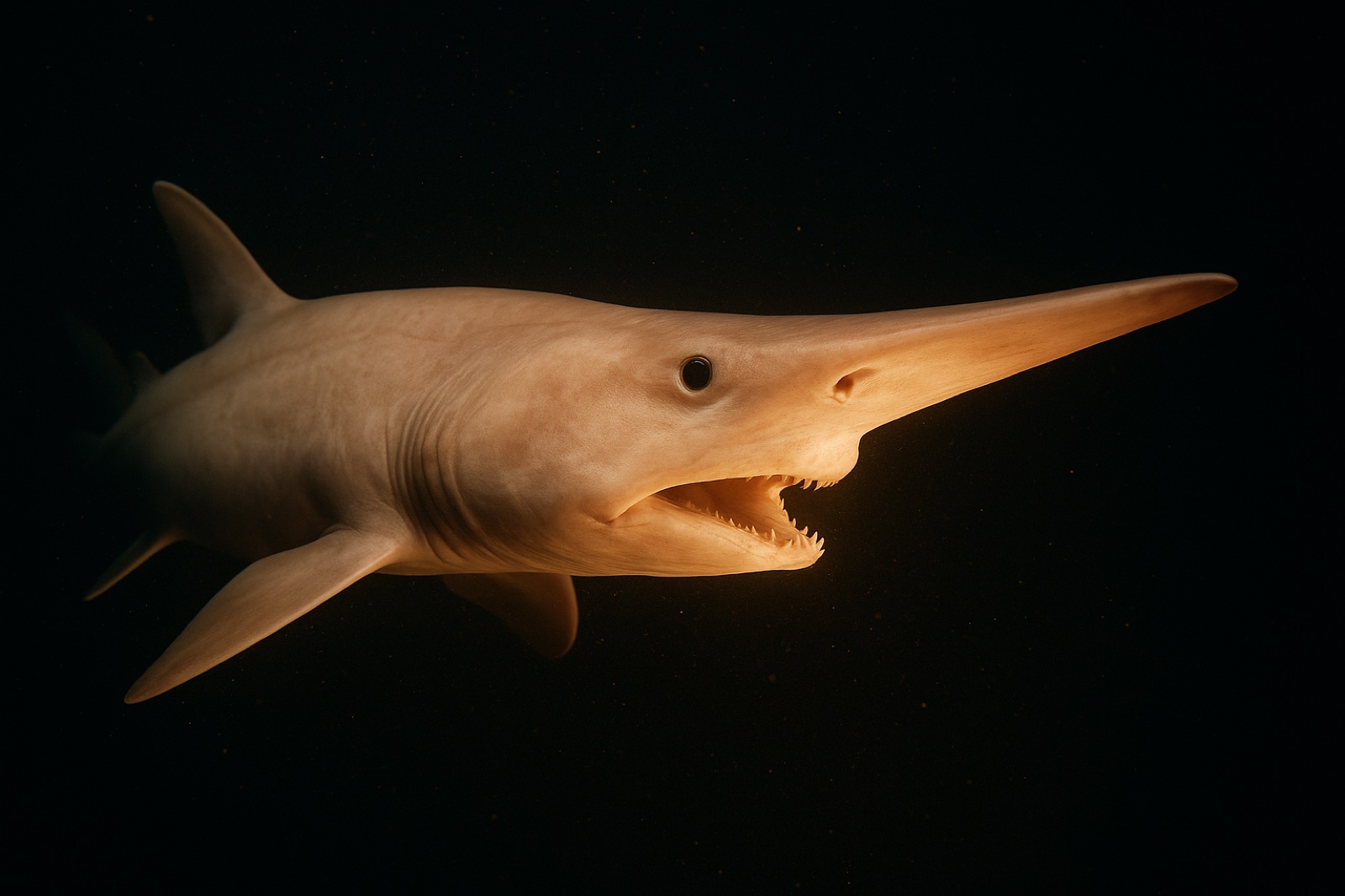
Mitsukurina owstoni looks like it wandered out of a monster movie and decided to stay in the one place no camera could follow it. It has a long, flattened snout studded with electroreceptor organs — sensors so fine they can detect the faint electrical pulse of a fish’s heartbeat in pitch-black water. Its skin is pale, almost translucent pink, because thin blood vessels show straight through it. It never evolved dark pigment, because there’s nothing down there to hide from and no light to hide in.
Then there’s the jaw. Most of the time it sits tucked flush against the shark’s face, almost dainty. But the instant prey drifts into range, it launches forward on elastic ligaments in a fraction of a second — one of the fastest strikes recorded in any shark, a kind of slingshot bite that snaps shut around whatever swam too close.
It’s not a new species. The goblin shark is the last living member of a shark family that traces back more than 100 million years — a “living fossil” that has outlasted nearly every relative it ever had. What’s new is that we’ve finally watched it do any of this alive.
Why It Took This Long
The deep sea is still one of the least-explored places on the planet — more people have walked on the moon than have ever laid eyes on some of its deepest trenches. Goblin sharks typically live between about 100 and 1,300 meters down, far below scuba range and beyond where most research submersibles ever bother to look. So for as long as scientists have known the species existed, “known” meant “known from corpses.”
That’s what makes 2019 significant. A remotely operated vehicle working near Jarvis Island in the Pacific caught a live goblin shark on camera at 1,237 meters — the first confirmed video of the species behaving naturally in its own habitat, not thrashing on a boat deck. It’s a moment that echoes another ocean-first this year, when orcas were filmed doing something researchers had never documented before — proof the ocean is still capable of surprising the people who study it for a living.
Then, in 2024, a baited camera rig recorded a second goblin shark in the Tonga Trench at nearly 1,997 meters — about 700 meters deeper than the species had ever been confirmed. Researchers from the Minderoo-UWA Deep Sea Research Centre analyzed both encounters and published their findings this month in the Journal of Fish Biology, giving scientists their first real look at how this animal actually moves, rather than guessing from a specimen on ice.
It’s a fitting companion to the news that the ocean is still changing in ways researchers are only now measuring — a reminder that the water covering most of this planet still keeps most of its business to itself.
Unseen Was Never the Same as Unreal
Here’s what stays with me about this story. That shark wasn’t “discovered” in July. It didn’t come into existence the moment a camera finally caught it. For something like 125 million years, it was already there — fully formed, perfectly adapted, doing exactly what it was built to do, long before the first human eye ever confirmed it was real.
It’s not so different from a giant planet that sat in plain sight for eleven years before anyone noticed it was there. The planet didn’t wait for a telescope’s permission to exist. It just existed, exactly as it was, the whole time.
There’s an old idea, older than marine biology, that says the same is true of a life — that it can be complete, intentional, and fully formed long before anyone else notices it, validates it, or films it as proof. Something bigger than us doesn’t wait for an audience to make a thing real. It just makes it, exactly as designed, and lets it exist — seen or not.
Still Down There Tonight
Maybe that’s worth sitting with the next time it feels like nobody’s paying attention to the season you’re in. The goblin shark didn’t need a camera crew to be a goblin shark. It just kept being exactly what it was built to be, a mile under the surface, for longer than there have been mountains where you’re standing right now.
Somewhere down there tonight, it’s still doing it. Unseen. Undiminished. Exactly as designed.
Discussion Question
If a creature can exist perfectly formed for 125 million years without a single human witness, what does that say about the difference between being unseen and being unreal? Tell us in the comments.
Share This
- A shark that’s been alive and thriving for 125 million years just got filmed for the very first time. It didn’t need us to notice it to be real. Neither do you.
- Scientists just filmed a goblin shark alive for the first time in human history — nearly 2,000 meters down, in complete darkness. It’s been living exactly like this the whole time. We just never saw it.
- Wild thought from this goblin shark story: something can be fully formed and functioning for millions of years without anyone ever seeing it. Unseen isn’t the same as unreal.
Questions People Are Asking
What is a goblin shark?
The goblin shark (Mitsukurina owstoni) is a rare deep-sea shark known for its long, flattened snout and a jaw that can shoot forward to catch prey. It’s the only living member of a shark family that dates back more than 100 million years, making it what scientists call a “living fossil.”
Has a goblin shark ever been filmed alive?
Yes. The first confirmed video of a living goblin shark in its natural habitat was captured in 2019 by a remotely operated vehicle near Jarvis Island in the Pacific Ocean, at a depth of 1,237 meters. A second, even deeper sighting was recorded in 2024 in the Tonga Trench at nearly 2,000 meters.
Why had nobody seen a live goblin shark before?
Goblin sharks live far below the range of scuba divers and most submersibles, typically between 100 and 1,300 meters down, sometimes deeper. Before these recent sightings, everything scientists knew about the species came from dead specimens accidentally caught in fishing nets and pulled to the surface.
How deep do goblin sharks live?
Goblin sharks are usually found between about 100 and 1,300 meters deep, but the 2024 Tonga Trench sighting confirmed one living at nearly 2,000 meters — roughly 700 meters deeper than the species had ever been recorded before.
Why is the goblin shark pink?
Its pale, pinkish color comes from thin, translucent skin that lets its blood vessels show through. Because it lives in total darkness, it never needed the camouflage pigment that shallow-water sharks rely on.