 0
0
 0
0
Somewhere in your muscles right now, a set of cells is sitting completely still — not damaged, not dying, just waiting. These are your body’s built-in repair cells, and until an injury calls for them, they can stay dormant for years. Scientists in Japan just discovered the exact molecule that wakes them up, and what they found is reshaping how researchers think about aging, injury, and the body’s own hidden capacity to heal itself.
If you’ve ever wondered why a pulled muscle heals fast at twenty and slow at sixty, this is the missing piece. It’s not that your body forgot how to repair itself. It’s that the wake-up call got weaker.
The Cells That Were Already There
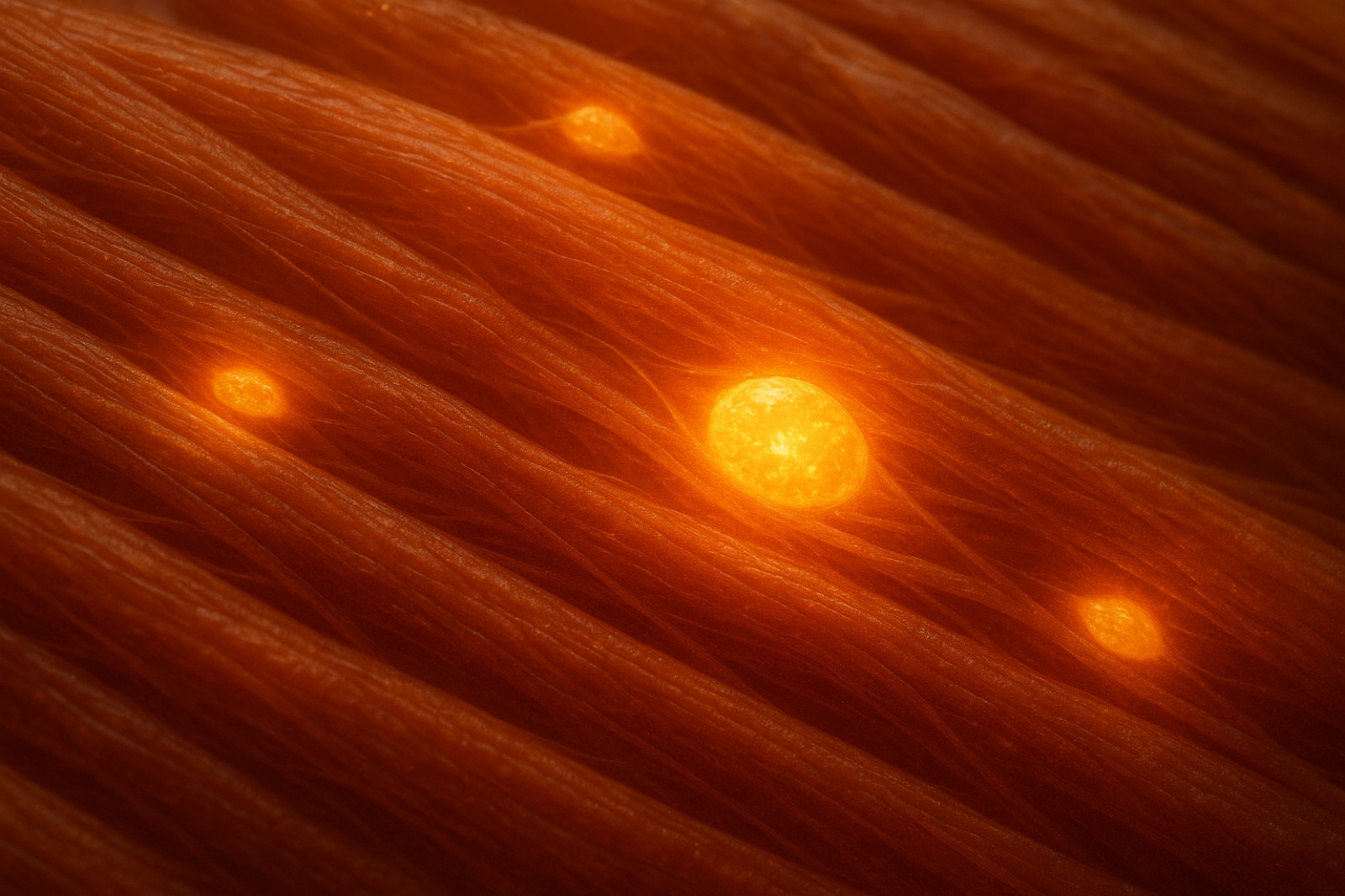
Buried inside your muscle fibers are cells called satellite cells — a type of stem cell that has been sitting there since long before you ever pulled a hamstring or lifted anything heavy. They don’t do anything most of the time. They just wait, tucked against the muscle fiber, doing nothing until something goes wrong.
When an injury happens, these cells switch on. They multiply, migrate to the damaged spot, and rebuild the tissue from the inside out. It’s an emergency repair crew your body installed before it ever needed one — standard equipment, not an upgrade.
The Signal That Fades With Age
The problem isn’t that the repair cells disappear as we get older. They’re still there. The problem is the message that wakes them up.
That message comes largely from a protein called HGF — hepatocyte growth factor. Think of it as the alarm that tells satellite cells “you’re needed, go.” But HGF is fragile. It breaks down quickly once it’s released, and in older or more damaged tissue, it often degrades before it finishes delivering the message. The repair crew is on standby. The alarm just isn’t loud enough, or long enough, to reach them.
Turning HGF Into “Super HGF”
This is where the new discovery comes in. Researchers at Kyushu University, led by Professor Ryuichi Tatsumi, identified a molecule called LASSS — short for lipoic acid trisulfide — that protects HGF from breaking down. Instead of fading fast, the signal holds. Scientists are calling the protected version “Super HGF,” and in early testing, it kept the wake-up call to satellite cells active far longer than normal.
The findings, first reported by ScienceDaily and published in the journal Scientific Reports on July 24, 2026, point toward a specific target: sarcopenia, the medical term for the age-related muscle loss that quietly steals strength from millions of people as they get older. It’s not a treatment yet. It’s a mechanism — but it’s the kind of mechanism that new treatments get built on.
Why This Could Matter for Millions
Age-related muscle loss isn’t just about strength at the gym. It’s tied to falls, frailty, and independence in later life — the difference between carrying your own groceries at 75 and not being able to. If a therapy eventually grows out of this discovery, the target wouldn’t be building new repair cells from scratch. It would simply be making sure the cells already there get the message loud and clear.
It’s also not the only piece of this puzzle to surface recently. A separate study out of UCLA found the exact protein that acts like a brake on aging muscle — when researchers switched it off, old cells started repairing like young ones again. And another recent study traced the molecular switch behind why exercise keeps muscles young in the first place. Different labs, different molecules, same underlying story: the repair system was never missing. It was just waiting for the right key.
What This Means for You Right Now
Human therapies built on LASSS and Super HGF are still years away — this is early-stage research, not a prescription. But there’s real, practical value in understanding how this system already works in your favor:
- Resistance and strength training is one of the few things proven to naturally boost the body’s own HGF signaling and keep satellite cells active, at any age.
- Protein intake gives your body the raw material those activated repair cells actually need to rebuild tissue.
- Sleep is when a large share of muscle repair signaling happens — skimping on it mutes the wake-up call even further.
- Patience with a slower-healing body is fair. The repair crew is still there. It’s the signal, not the capacity, that weakens with age.
There’s something almost startling about how this repair system works. It wasn’t built after the injury happened. It was built in, ahead of time — installed and waiting, long before anyone knew it would ever be needed. Ancient wisdom has always described restoration this way, too. Not as something manufactured out of nothing once things break, but as something already present, quietly waiting for the right call to bring it back to life. The capacity was there the whole time. It just needed to be woken up.
Maybe that’s worth sitting with the next time something in your own life feels finished — a body that’s slowing down, a situation that looks too far gone to come back from. Somewhere inside it, the repair crew might still be waiting. Sometimes the only thing missing is the signal. If that idea resonates, this piece on what restoration can look like when something seems too far gone is worth a read.
What Do You Think?
If your body already has a hidden repair crew waiting for the right signal, what do you think has been dormant in your own life — not broken, just waiting for the right call to wake it back up? Tell us in the comments.
Share This
Scientists just found the molecule that wakes up your body’s own repair cells — cells that were built in and waiting the whole time. Wild. https://bgodinspired.com/index.php/health-and-wellness/molecule-wakes-muscles-own-repair-cells/
Your body has a repair crew already installed, just waiting for the right signal. New research shows exactly which molecule wakes it up, and why it matters more as we get older. https://bgodinspired.com/index.php/health-and-wellness/molecule-wakes-muscles-own-repair-cells/
Not broken. Just waiting for the right signal. That’s literally how muscle repair works, and maybe more than muscle. https://bgodinspired.com/index.php/health-and-wellness/molecule-wakes-muscles-own-repair-cells/
Questions People Are Asking
What is LASSS and how does it help muscle repair?
LASSS stands for lipoic acid trisulfide, a molecule discovered by researchers at Kyushu University that protects a growth factor called HGF from breaking down in the body. By stabilizing HGF into what researchers call “Super HGF,” LASSS helps keep the signal that wakes up dormant muscle stem cells, known as satellite cells, active for longer, giving the body a stronger call to begin repairing damaged tissue.
What are satellite cells?
Satellite cells are a type of stem cell that live inside muscle tissue in a dormant, inactive state. They stay quiet until an injury or damage signal calls them into action, at which point they multiply and help rebuild damaged muscle fibers.
Why does muscle healing slow down with age?
One reason is that the signals that activate repair cells, like HGF, break down faster than the body can use them, especially in older tissue. The wake-up call to satellite cells gets weaker over time, even though the repair cells themselves are still present and capable.
Could this discovery help with sarcopenia, or age-related muscle loss?
That’s the hope behind the research. Because LASSS helps protect and prolong the HGF signal that activates dormant repair cells, scientists see it as a potential foundation for future therapies targeting sarcopenia and other forms of age-related muscle loss, though human treatments are still years away.
Is this treatment available now?
No. The findings, published in Scientific Reports on July 24, 2026, come from early-stage research led by Professor Ryuichi Tatsumi at Kyushu University. Turning this into an actual therapy for humans will require significant additional research and clinical trials.