 0
 0
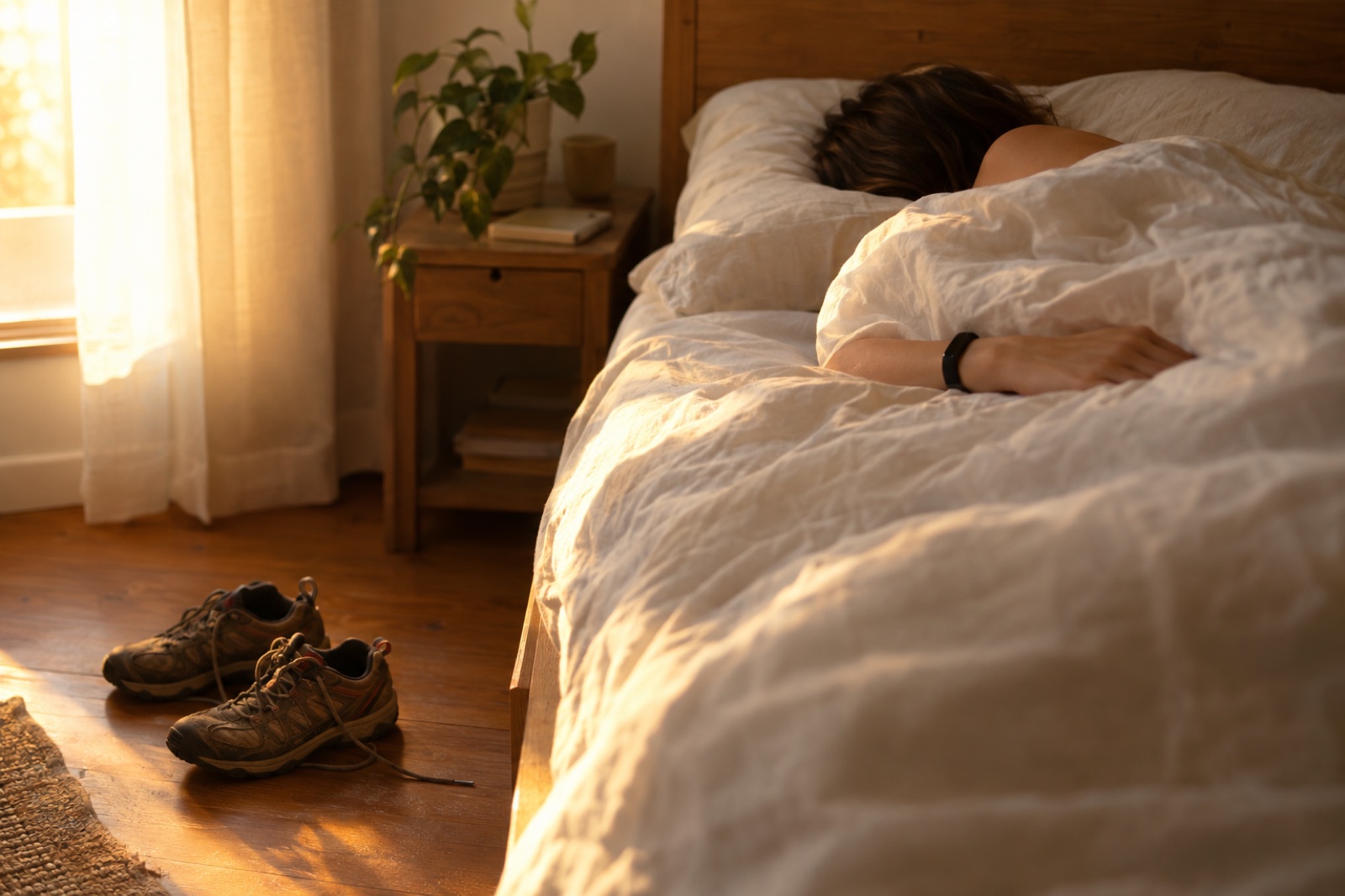
You lie down tired. Properly tired, the kind where your eyes ache. You sleep the whole night. And you still wake up feeling like you never really went under.
If that is you, you have probably asked the question at 3am: what is actually wrong with me?
Here is one answer worth knowing about, because it is cheap, it is small, and most people have it the wrong way round. When it comes to exercise and deep sleep, a study that followed students wearing Fitbits for months found that how often you move seemed to matter more than how long you move. And the amount that showed a difference was small: about ten minutes a day.
What the Fitbit Study Found About Exercise and Deep Sleep
Researchers at the University of Texas at Austin looked at Fitbit data from university students who wore the trackers for several months. The work was published in the Journal of Physical Activity & Health and reported by the university in July 2025.
Most older sleep research was done in a lab, often measuring a single night after a single workout. This study did something different. It watched ordinary life, night after night, and asked a simple question: on the days people moved, what happened to their sleep that night?
Three findings stood out:
- Frequency mattered. People who were active on more days tended to get more deep, non-REM sleep, the kind your body uses for repair.
- The amount was small. About ten minutes a day of moderate-to-vigorous movement was enough to show a difference in the young adults studied.
- Deep sleep carried into the next day. More of it was linked to better mood and more energy the following day. Even light movement, like walking and standing breaks, was linked to better sleep patterns.
One of the researchers, Benjamin Baird, put it plainly: “for sleep health, frequency does seem to matter.” His co-lead, Chris Corral, said the results suggest “daily movement may be better for sleep than doing it all on the weekend.”
That last line is the one to sit with. Most of us were taught to think about exercise as a weekly total. Get your minutes in. If you missed Tuesday, make it up on Saturday. For your heart, that may be fine. For your sleep, this study hints that Saturday cannot pay Tuesday’s bill.
What the Study Can’t Tell You
Before you change your life over this, three honest limits.
It shows a link, not a cause. The study watched what people did. It did not assign anyone to exercise. It is possible that people who sleep well simply have more energy to move the next day, and the arrow points partly the other way.
The people were students. Young adults at one university. The researchers themselves say the results need to be checked in people of different ages and activity levels, and they plan to do exactly that in a larger, five-year community study.
A Fitbit is not a sleep lab. Wrist trackers estimate sleep stages from movement and heart rate. They are good at spotting patterns over months. They are less exact about any single night.
So the fair way to say it is this: the evidence points toward small, daily movement being good for deep sleep, and it costs you almost nothing to test it on yourself.
How Much Exercise for Deep Sleep? Ten Minutes, Most Days
“Moderate to vigorous” sounds like a gym word. It isn’t. The researchers described it as movement that makes you breathe harder but still lets you talk. On a scale of 1 to 10, about a 6.
That means you do not need money, equipment, a gym, or even much time. Some ways to get ten minutes:
- A brisk walk, fast enough that you would not want to sing.
- Climbing stairs a few times in a row.
- Carrying shopping, water, or a child up a hill.
- Sweeping, digging, or scrubbing hard enough to warm up.
- Dancing in the kitchen to three songs.
The point is not the activity. The point is the days. Ten minutes on six days looks, on this evidence, like a better bet for your sleep than an hour once a week.
If you are not sure whether movement is even your problem, the free Why Can’t I Sleep? assessment walks through the most common reasons in a couple of minutes. And if you are the kind of sleeper who jolts awake just as you drift off, what a hypnic jerk actually is is worth a read too. Late, hard workouts are one of the things people commonly link to it.
A good place to start: Why Your Mind Won’t Slow Down at Night. It explains why the thinking keeps going after the body has finally stopped, and the five-step order that settles it. Get the free guide. Free.
Why Movement Might Buy Deep Sleep
Nobody has the full story yet. But the simplest way to picture it is that deep sleep is repair work. Your body does more of it when there is something to repair.
A day with no movement asks very little of your body. A day with even a short burst of effort leaves a small bill to settle overnight. The body seems to like settling that bill every day, rather than facing one large one at the weekend.
Movement also helps your mood in ways that are hard to separate from sleep. One study we wrote about found that moving helped most where the genetic risk for depression ran highest. Better mood, better sleep, better mood again. It loops.
The Old Line That Said the Same Thing
Here is the part that surprised me.
There is a line in the Bible, in an old book of Hebrew wisdom written by someone who calls himself the Preacher, that makes almost the same observation. It was written more than two thousand years before anyone strapped a tracker to their wrist. The writer had watched working people and wealthy people, and noticed something. A working person’s sleep is sweet, whether they have eaten a little or a lot. But the rich person’s abundance will not let them sleep.
The first half of that is almost exactly what the Fitbit study hints at. Sweet sleep goes to the one who worked with their body that day. Not a lot. Just some.
The second half is where it gets interesting. The word the writer uses for the rich person’s “abundance” comes from the same root as the word for being satisfied. A few lines earlier, the same writer says that the person who loves money is never satisfied with money. So the picture is of someone who has more than enough and still has not had enough. They are full and not satisfied, and that is what keeps them awake. Some translations even read it as a full stomach.
No study has tested that second half, and this one did not try to. But anyone who has lain awake running numbers, guarding what they have, or wanting more, knows the feeling.
The same writer goes on to say that being able to enjoy your food, your work, and the plain good things of an ordinary day is a gift from God. Not a reward for being rich, and not something money can buy. Just a gift, handed to people who are in a position to notice it. Sweet sleep after a day of honest effort might be one of the quietest versions of that gift there is.
Tonight and Tomorrow
You do not have to fix everything. Tomorrow, find ten minutes. Walk fast to somewhere you were going anyway. Take the stairs. Carry something heavy home.
Then do it again the next day. And the day after that.
Your sleep will not change overnight. It may change over a week or two. And somewhere in there, you may lie down after an ordinary day and notice that it felt sweet.
The Question to Think About
Most exercise advice is about weekly totals. This study suggests that, for sleep at least, small and daily might beat big and occasional. Do you think the “weekly minutes” way of thinking about exercise has been getting it wrong for most people? Tell us in the comments below.
Questions People Ask About Exercise and Deep Sleep
Does exercise increase deep sleep?
Research suggests regular exercise is linked to more deep, non-REM sleep. A study from the University of Texas at Austin, which tracked university students wearing Fitbits for several months, found that people who were active on more days tended to get more deep sleep, and that more deep sleep was linked to better mood and energy the next day. The study was observational, so it shows a link rather than proving that exercise causes the extra deep sleep.
How many minutes of exercise a day help deep sleep?
In the University of Texas at Austin Fitbit study of young adults, about 10 minutes a day of moderate-to-vigorous activity was enough to show a difference in deep sleep. Moderate-to-vigorous activity means movement that makes a person breathe harder but still lets them talk, roughly a 6 on a 1-to-10 effort scale. The researchers say this needs to be confirmed in people of other ages and activity levels.
Is it better to exercise every day or a lot on the weekend for sleep?
For sleep, frequency appears to matter. The University of Texas at Austin researchers found that how often people were active was linked to more deep sleep, and one of the study’s co-leads said daily movement may be better for sleep than doing all of it at the weekend. General exercise guidelines recommend about 150 minutes a week but do not say how to spread it out.
Does light exercise like walking help sleep?
Light movement does appear to help. In the University of Texas at Austin Fitbit study, light activity such as regular walking and standing breaks was linked to better sleep patterns and better mood the next day. Brisk walking that makes a person breathe harder can also count as moderate activity, which was the level linked to more deep sleep in the same study.
What does the Bible say about sleep and work?
The book of Ecclesiastes says that the sleep of a working person is sweet whether they eat a little or a lot, but that the abundance of the rich will not let them sleep. The same passage warns that a person who loves money is never satisfied with it, and describes being able to enjoy food, work, and ordinary life as a gift from God.
Share This
“New sleep research: it’s how OFTEN you move, not how long. About 10 minutes a day was enough to show more deep sleep. Saturday can’t pay Tuesday’s bill.”
“Weird thing I learned today: an old line in the Bible says a working person’s sleep is sweet but a rich person’s ‘abundance’ won’t let them sleep. The word for abundance shares a root with ‘satisfied.’ Full, but not satisfied. bgodinspired.com/index.php/health-and-wellness/exercise-and-deep-sleep/“
“Tired but never rested? Try ten minutes of brisk walking a day for two weeks before you buy another sleep gadget.”