 0
0
 0
0
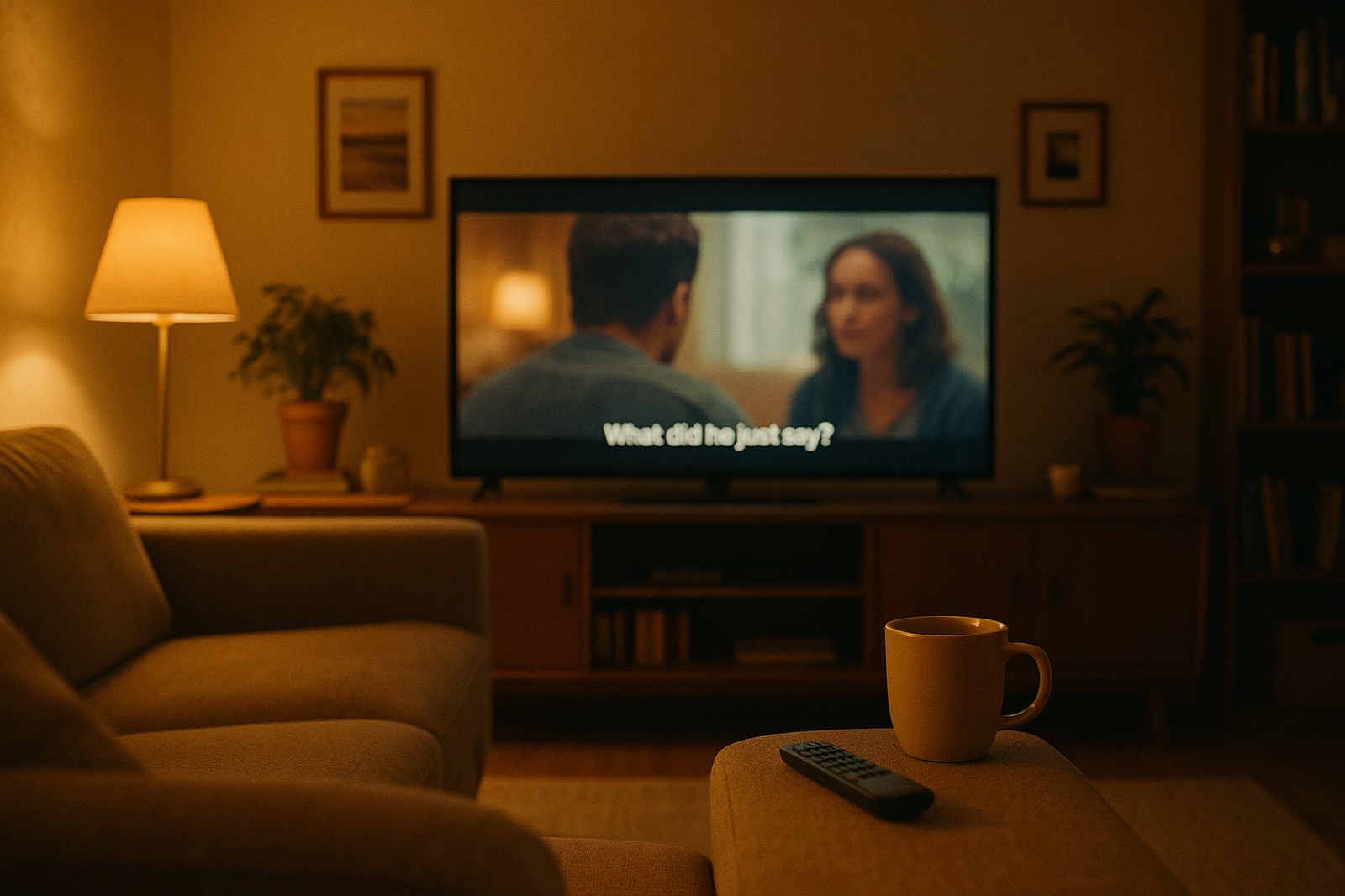
You are three minutes into an episode. Someone says something that clearly matters. You rewind. They say it again. You still miss it.
So you turn the subtitles on. And then you leave them on. For everything. Even the shows in your own language. Even the ones with no accents and no explosions.
And somewhere in there, a small worry shows up: is something wrong with my ears?
Almost certainly not. Something is wrong with the sound. And once you follow that thread, it gets stranger and far more interesting than a volume knob.
Why Do I Need Subtitles to Watch TV? Your Ears Are Probably Fine
Start with the clue that breaks the hearing theory wide open.
If subtitles were about ears wearing out, the people using them most would be the oldest people. They are not. In two American surveys, the heaviest subtitle users were the youngest viewers by a wide margin. In a YouGov survey of 1,000 US adults in mid-2023, 63% of under-30s said they prefer subtitles on when watching in a language they already know. For people aged 45 to 64, it was 29%.
The youngest ears in the room are the ones asking for the words in writing.
So it is not your hearing. It is the distance between how the sound was made and where you are sitting.
Five Things Stacked Against the Dialogue
There is no single villain here. There are about five, and they stack.
- The mix was never made for your TV. A film or a big-budget series is mixed for a room with many speakers. In that room, dialogue gets a speaker all to itself, sitting behind the screen and pointed straight at you. Music and effects go everywhere else. Your television has to fold all of those channels down into two small speakers. Depending on how it does that fold, the voices can end up sitting quieter than the music and effects that were already living in the left and right channels.
- The speakers got worse as the pictures got better. A thin panel has almost nowhere to put a decent speaker. Many sets now fire their sound downward or backward, into your floor or your wall, rather than at your face.
- The gap between quiet and loud is deliberate. A cinema is dark, sealed and silent, so a whisper can be a whisper. Your room is not. There is a fan, a fridge, a road, other people. The whisper loses and the explosion still wins.
- Actors are performing more quietly on purpose. Naturalistic delivery is a style choice, not a mistake. Real people mumble, trail off and talk over each other, so performances that do the same feel true. They are also harder to catch.
- The lines have things layered on top of them. Score, room tone, weather, traffic. All of it is placed under dialogue by design, and all of it is competing for the same two little speakers.
None of that is your fault, and none of it is fixed by leaning forward.
The Odd Part: Reading the Words Changes What You Hear
Here is where this stops being a story about equipment.
Researchers at the MRC Cognition and Brain Sciences Unit in Cambridge ran a set of experiments on exactly this. Ediz Sohoglu, Jonathan Peelle, Bob Carlyon and Matt Davis played people deliberately degraded, hard-to-understand speech and asked them to rate how clear it sounded. Sometimes, just before a word played, the listener was shown that same word in writing.
When people had read the word first, they reported that the speech sounded clearer, as the researchers put it, exactly as if the speech was less noisy. The sound itself had not changed at all. Only the knowledge had.
Then they measured what the brain was doing, and got the result that makes this worth writing about. When speech was genuinely, physically clearer, activity in the hearing region of the brain went up. When speech only seemed clearer because the person had read it first, activity went down.
Less work, not more. The brain was not straining harder to decode the sound. It had already made a prediction about what was coming, so there was less left to figure out.
That is not a crutch. That is your brain being handed the answer a beat early and doing what it does best. It is the same machinery that makes you start building your reply before the other person has finished talking — useful most of the time, and occasionally embarrassing.
If you want to feel this happen in your own head, there is a demonstration called sine-wave speech, built from work published in Science in 1981 by Robert Remez and colleagues. A sentence is stripped down to a few whistling tones. Played cold, most people hear science-fiction bleeping and nothing else. Then you are told what it says, you play it again, and the sentence is simply there. Obvious. And you cannot go back to hearing whistles. The Cambridge unit keeps examples online if you want to try it.
And There Is a Time Limit On It
The same team went looking for the edges of the effect, and this is the detail almost nobody mentions.
The written word only helps if it arrives in time. In their follow-up work, the boost was strongest when the text came before the speech, and it fell away once the text arrived more than about 120 milliseconds after the speech had started. Their explanation is that the words are being matched against a very short-lived acoustic trace — the fading echo of what you just heard, which lasts only a few hundred milliseconds.
A tenth of a second. That is the window.
Which quietly explains something you have already noticed. Subtitles that appear a moment before the line lands feel like magic. Subtitles that lag half a second behind feel useless, or worse, distracting. Same words. Wrong moment.
So Is It Really “Half of Us”?
You will see that figure everywhere, and it is worth being careful with.
One widely quoted survey, run by the language platform Preply with 1,265 US respondents, found that about half said they use subtitles most of the time, with usage falling steadily by age group — roughly 70% of Gen Z down to about 35% of baby boomers.
The YouGov survey mentioned earlier asked a slightly different question and got a noticeably different answer: 38% of Americans said they prefer subtitles on, while 53% prefer them off.
Both are self-reported preferences. Both are American. And they asked different things, which is exactly why the numbers disagree. So “half of us” is a headline, not a measurement.
What both surveys do agree on is the age gap — and the age gap points away from failing ears, not toward them.
What Helps Tonight, Without Buying Anything
You do not need new equipment. Most of this is sitting in a menu you have never opened.
- Come off the cinematic sound mode. Anything called “surround”, “cinema”, “movie” or “theatre” is widening the very gap that is losing you the words. Look for “standard”, “speech”, “clear voice” or “dialogue” instead.
- Turn night mode on. It may be called night mode, auto volume, or dynamic range control. It squashes the distance between the whisper and the explosion. It is the single most useful switch on most sets.
- Tell your TV the truth about your speakers. If a menu asks what you are listening on, say TV speakers or stereo. A set that believes it is feeding a full surround system will fold the mix badly.
- Give the sound somewhere to go. If your speakers fire downward or backward, a hard surface underneath and a few centimetres of space behind the set can genuinely help.
- And leave the subtitles on if you like them. Now you know what they are actually doing, that is not a surrender. That is a tool.
It is also a small window into how you take things in generally. Some people catch information best by ear, some need to see it written, some need to do it with their hands. If you have never thought about which one you are, this quick learning style quiz is a surprisingly useful ten minutes. It explains a lot more than television.
Words Somebody Made Plain
There is something quietly lovely buried in all of this, and it has nothing to do with televisions.
The finding is not that we have stopped listening. It is almost the opposite. It is that understanding does not arrive after hearing, politely waiting its turn. Understanding arrives first, and then the hearing becomes possible. Knowing what a thing says is part of how you hear it at all.
Which makes it strange to run into a line in one of the oldest texts we have, thousands of years before anyone mixed a soundtrack, that says: write it down. Make it plain. Put it somewhere a person can catch it while they are hurrying past. There is another instruction in the same tradition about writing words on doorframes, at eye level, on the way in and the way out — where a person will read them without meaning to.
Whoever thought that up understood something a sound engineer now has brain scans for. Saying it is not the same as landing it. And sometimes the kind thing is not to say it louder. It is to write it plainly enough to be caught.
It is an old idea about God, actually — that the point was never to broadcast at people from a distance, but to be genuinely understood by them. Which is a different job entirely, and a much more patient one.
Anyway. Back to the remote.
Tonight, when a line goes past and you catch it because you read it a half-second early, that is not your ears giving out. That is your brain doing the thing it was built to do, using the help it was given. The words were made plain, and you caught them.
That has always been a good way to be spoken to. It is also a good reminder for the next time you have something important to say to someone who keeps missing it. Louder is rarely the answer. Plainer usually is.
(If reading rather than listening is quietly becoming your default, you might also like this piece on why reading slumps are not a discipline problem.)
What Do You Think?
Here is the argument worth having: are subtitles making us better viewers or lazier ones? One side says they are a legitimate tool that gets more of the story into more people, including everyone watching in a second language or a noisy room. The other side says we are papering over sound mixing that has genuinely got worse, and letting the industry off the hook for it.
Which one are you? Drop your answer in the comments — especially if you have opinions about a particular show.
Share This
- Turns out subtitles are not a sign your hearing is going. Researchers found that reading a word first makes speech genuinely sound clearer — and your brain does less work, not more. Great piece on this at bgodinspired.com
- The strongest argument that subtitle use is not about failing ears: the heaviest users are the youngest viewers. 63% of under-30s prefer them on. My ears are fine. The mix is not. (bgodinspired.com)
- Just learned there is roughly a tenth of a second window where a subtitle helps you hear a line. Later than that and it stops working. Which explains everything about badly-timed captions. bgodinspired.com
Questions People Ask About Subtitles
Why do I need subtitles to watch TV even though my hearing is fine?
Because modern film and television dialogue is mixed for rooms with many speakers, where voices get a dedicated centre speaker aimed at the audience. A television has to fold that mix down into two small speakers, which are often thin, and often pointed at the floor or the wall rather than at the viewer. Add a deliberately wide gap between quiet and loud passages, naturalistic quiet acting, and layers of music and background sound, and dialogue loses. Subtitle use is heaviest among the youngest viewers, which is strong evidence the cause is the sound rather than the listener’s hearing.
Do subtitles actually make speech sound clearer, or do they just help you follow along?
Both, and the first one is measurable. Researchers at the MRC Cognition and Brain Sciences Unit in Cambridge (Sohoglu, Peelle, Carlyon and Davis) played listeners degraded speech and showed some of them the matching word in writing beforehand. Those listeners rated the speech as sounding clearer, even though the audio was identical. Brain recordings showed activity in the hearing regions going down, not up, when text had been read first, suggesting the brain predicts the incoming sound rather than working harder to decode it.
Is it true that half of people watch TV with subtitles on?
It depends which survey is being quoted, and the figure is less settled than headlines suggest. A Preply survey of 1,265 US respondents found around half said they use subtitles most of the time. A YouGov survey of 1,000 US adults in mid-2023 found 38% prefer subtitles on and 53% prefer them off. Both are American, both are self-reported preferences, and they asked different questions. The finding both agree on is the age gap: under-30s use subtitles far more than older viewers.
What TV setting makes dialogue easier to hear?
Three settings do most of the work, and all are free. First, switch off any “surround”, “cinema” or “movie” sound mode and choose “standard”, “speech”, “clear voice” or “dialogue” instead. Second, turn on night mode, auto volume, or dynamic range control, which reduces the distance between quiet dialogue and loud effects. Third, if the television asks what audio system it is connected to, set it to TV speakers or stereo, because a set that thinks it is feeding a surround system will fold the mix down badly.
Why do subtitles that lag behind the dialogue feel so useless?
Because the helpful effect of reading a word is time-limited. In follow-up experiments from the Cambridge group, the clarity boost was strongest when the text appeared before the speech, and it declined once the text arrived more than roughly 120 milliseconds after the speech began. The researchers link this to the very brief acoustic trace the brain holds after a sound, which lasts only a few hundred milliseconds. A subtitle arriving after that window has closed has nothing left to attach itself to.