
 0
 0
The first thing Akira Kurosawa puts on screen in Ikiru is an X-ray.
Not a face. Not a city. A grey plate of a man’s stomach, held up to the light. A narrator tells you, flatly, that there is a cancer growing in it, and that the man does not know yet.
Ten seconds in, the film has given away its own ending. Most searches for an Ikiru ending explained go straight to the last ten minutes. The pattern is already set in the first ten seconds. Kurosawa keeps handing you outcomes and keeping the moments that produced them off screen.
Ikiru was made at Toho in 1952, directed by Kurosawa and written by him with Shinobu Hashimoto and Hideo Oguni. The title is Japanese for “to live,” and the film has circulated in English as To Live. It runs 143 minutes. Takashi Shimura plays Kanji Watanabe, who runs the Citizen’s Section of a Tokyo city office and has sat at the same desk for decades.
His wife is dead. His son Mitsuo and daughter-in-law Kazue live with him and mostly talk about his pension. At work, a young woman in his own section, Toyo Odagiri, has given everyone a nickname. Watanabe’s is “The Mummy.”
The circle Kurosawa draws in the first ten minutes
Before the X-ray has faded from your mind, a group of women from Kuroe-cho arrive at the counter. There is a sinkhole in their neighbourhood. Standing water, mosquitoes, children playing in it. They would like it drained and turned into a small park.
What follows is one of the great comic sequences in any film about work, and it is funny for about ninety seconds before it stops being funny.
The women are sent to Engineering. Engineering sends them to Environmental Health. Then Disease Prevention. Pest Control. Sewage. Roads. City Planning. Fire. Child Welfare. A ward representative. Eventually the Deputy Mayor’s office hears them out politely and sends them back to the Citizen’s Section, which is where they started.
They have travelled in a perfect circle. Watanabe’s first words in the film are to pass the thing along.
Hold on to the shape of that circle. The film ends by drawing it again.
Two experiments, and both of them fail
Watanabe gets his diagnosis and goes looking for an answer. The film gives him two tries.
The first is pleasure. He falls in with a novelist he has just met, who appoints himself a guide to the Tokyo night and walks him through the bars and the dance halls. It is loud and bright and it does not work. Kurosawa shoots it like a fever. Somewhere in the middle of it Watanabe asks the band for an old song from his youth and sings it crying, and everybody around him keeps dancing.
This is a very old result. A man with money and a deadline works through every pleasure available and finds the bottom of each one. Solomon ran that same experiment three thousand years earlier and wrote down the same finding.
The second try is a person. He starts following Toyo around, which the film is honest enough to make a little awful. She is young, he is her boss, and she has no idea why he will not leave her alone.
It comes to a head in a café. He tells her he is dying. He says he envies her, and asks her to teach him how to live.
Her answer is the best thing in the film, and it is almost nothing. She says all she does is work and eat. She has left the office for a factory where she makes wind-up toy rabbits, and she likes it, because somewhere a child is playing with one. She puts a rabbit on the table and suggests he might make something too.
Downstairs, a birthday party starts singing. Watanabe goes down the staircase and out. The turning point of this film happens on the stairs of a café, not in a hospital.
He goes back to the office, pulls the Kuroe-cho application out of the pile, and says the thing the whole film has been waiting for. It is not impossible.
Kurosawa kills him at the halfway point
Here is the structural decision that makes Ikiru what it is. During the writing, the death was moved to the middle of the script, a restructuring credited to co-writer Hideo Oguni.
So the narrator comes back, for nearly the first time since the X-ray, and says Watanabe is dead. And the film hands its entire second half to a room of men in black at his wake, drinking, with his photograph propped in front of them.
They do not know what happened. That is the second half. They argue about it.
Did he know he was dying? Did he actually get that park built, or did the Parks Committee build it while he hung around looking strange? Flashbacks come out of the argument, and Kurosawa stages them as literal reconstructions, as if the men’s memories were footage. They do not settle anything.
Here is the part I did not notice until the third time through.
There is no flashback of Watanabe winning.
You never see the meeting where he changes somebody’s mind. You never see a signature. The film will show you him waiting in corridors, standing in offices, bowing, waiting again. It will show you the finished park. But the moment of victory, the scene every other version of this story exists to deliver, is simply not in the movie.
What you get instead is the opening ceremony, where the Deputy Mayor and the Parks Committee make the speeches and Watanabe’s name is in none of them. He is sitting in the back row.
And when reporters later float the idea that dying in his own park might have been a silent protest, the Deputy Mayor produces the autopsy — internal haemorrhage, gastric cancer — and explains that the project was a team effort, well within the office’s ordinary duties.
He is not even lying, exactly. There is no document that says otherwise.
The most famous scene in Ikiru arrives secondhand
Late in the wake, a policeman comes in. He lights incense. He is uncomfortable. He did not know Watanabe.
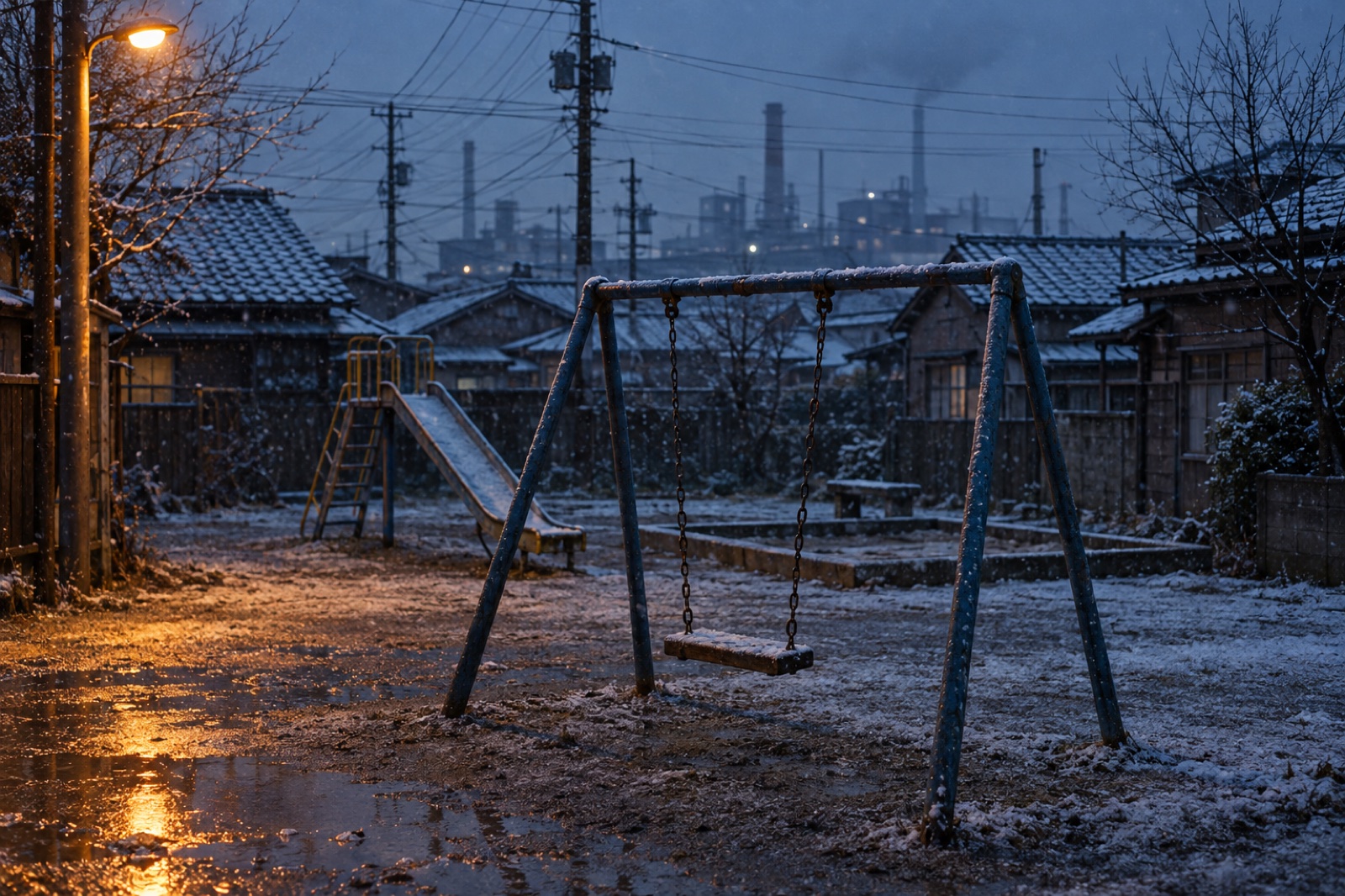
He says he saw the man the night before, in the new playground, in the snow, sitting on one of the swings and singing. He says he has felt sick about it ever since, because he should have brought him in out of the cold and did not.
He is not bringing the room a triumph. He is bringing an apology.
Then the film cuts to it. Watanabe on a child’s swing, snow coming down, singing “Gondola no Uta,” a ballad from 1915 — the same old song he had been crying through in the dance hall months earlier.
That is the image everyone keeps from this film. It is also the last flashback in the picture.
And it only exists because a stranger in a uniform happened to walk past, and felt guilty about it, and raised it at a wake where nobody had asked him.
Kurosawa gives his hero exactly one moment of visible happiness, and then routes it to us through the single witness who misread it.
What Ikiru does with a good deed nobody can prove
Line up what the film actually leaves standing.
The park is real. Children are in it. And there is no usable record of who made it happen. The speeches name the wrong people. The press gets a cause of death. The colleagues who were in the building cannot agree, and by morning most of them have stopped trying. The one man who watched Watanabe’s last hour did not know his name and thought he had failed him.
A lesser film fixes this. It gives you the scene where Watanabe wins, and then a second scene where everyone finally understands. Kurosawa refuses both — and the film is not bitter about the refusal. That is the strange, steady thing in it. The park works whether or not the story of the park survives.
There is a very old teaching shaped exactly like that. It says to do your good so quietly that your left hand does not know what your right hand is doing. The reason it gives is not modesty, and it is not humility either. The reason is that God sees what is done in secret, and that seeing is the whole of it. The witnessing was never the part that made it count. That sits in Matthew 6, and it has been read as a rule about showing off for so long that the harder half gets missed: it is also a promise to anyone whose best work went unrecorded.
Watanabe never says anything like this. Ikiru has no interest in religion and does not reach for it. But it builds its entire second half on that claim, and then declines to supply the applause, which is a much harder thing to do than to say.
Take that away and you are left with the position the novelist in the dance hall is standing on, and which the film quietly tests to destruction — that if nothing means anything, the night is as good an answer as the park. Watanabe tried the night first. He is the one who tells us it did not hold.
The swing is still moving
The morning after the wake, the men go back. A new chief sits in Watanabe’s chair. A new matter comes across the counter. He passes it to Engineering.
The circle from the first ten minutes closes exactly. One man stands up to object, then sits down, and the stacks of paper on the desks rise up and hide him.
Then the playground. Children on it, in daylight, loud. A boy gets off a swing and runs, and the swing keeps going by itself for a second or two after he is gone.
On the overpass above, a man stops, looks down at the park, and walks on. The film never tells you who he is, and people have been arguing about him ever since.
If you want a Kurosawa film that puts the victory on screen, it arrives two years later and it is Seven Samurai. This one withholds it on purpose.
All Watanabe got for a signature was an empty swing, still moving, for about two seconds, with nobody watching it but us.
Ikiru: Questions and Answers
What does the ending of Ikiru mean?
The ending of Ikiru (1952) argues that a life’s worth does not depend on anyone being able to prove it. Kanji Watanabe gets the Kuroe-cho playground built and then dies on one of its swings. At his wake his colleagues cannot agree whether he did it, the Deputy Mayor’s office takes the public credit, and the men who swear they will change are back at their desks passing paperwork the next morning. Kurosawa shows the park full of children anyway. The good held; the story of the good did not.
Does Watanabe actually build the playground in Ikiru?
Yes, though Ikiru goes out of its way never to show him succeeding. There is no scene of Watanabe persuading an official or signing an approval. The film shows him waiting in corridors and standing in offices, then shows the completed park, and leaves the connective moment out. His role is argued over at the wake and omitted from the speeches at the opening ceremony, where he sits in the back row.
What song does Watanabe sing on the swing in Ikiru?
He sings “Gondola no Uta,” a Japanese ballad from 1915, often known in English as “The Gondola Song” or “Life Is Brief.” It appears twice in Ikiru: once in a crowded dance hall, where Watanabe asks for it and weeps through it while the room keeps dancing, and once in the snow on the playground swing. The second time reaches us only as a flashback inside a policeman’s account at the wake.
Why does Ikiru reveal that Watanabe is dying in the very first scene?
Because Ikiru is not built on suspense. The opening X-ray and narration remove any question of whether Watanabe will survive, which frees the film to ask what he will do instead. Kurosawa repeats the move at the midpoint, announcing Watanabe’s death and handing the rest of the film to his wake. Both times the outcome is given early and the meaning is withheld.
Is Ikiru based on a true story?
No. Ikiru is not based on a real person or a real Tokyo park. Its screenplay was partly built from Leo Tolstoy’s 1886 novella The Death of Ivan Ilyich, about a bureaucrat who realises on his deathbed that he has lived wrongly — an influence the film’s writers acknowledged. The city-hall satire draws on the general texture of postwar Japanese municipal bureaucracy rather than a documented case.
One question I keep arguing about
The man on the overpass at the end. Is he evidence that something in that office actually changed — or is he just the next Watanabe, with decades at the same desk still ahead of him, having a feeling he will have forgotten by Monday?
I have gone back and forth on it for years. Tell me which way you read him, and why, in the comments.
Share this
Watched Ikiru again and finally noticed: Kurosawa never shows Watanabe win. No meeting, no signature, no moment of triumph. You get the corridors and then you get the finished park. The whole victory happens off screen and the film is completely calm about it.
The most famous image in Ikiru — the old man on the swing in the snow — only reaches us because a policeman who didn’t know him felt guilty for not bringing him in out of the cold. The film’s greatest moment is delivered as an apology by someone who misread it.
Ikiru spends its first ten minutes sending a group of women in a circle through nine city departments, and its last ten minutes drawing exactly the same circle again. Everything that matters happens in between, and nobody in the building can prove it did.



