 0
0
 0
0
A six-year-old draws a picture and shows it to the grown-ups. They tell him it is a hat.
It is not a hat. It is a boa constrictor digesting an elephant. So he draws it a second time with the elephant clearly visible inside the snake, and this time the grown-ups tell him to put the crayons away and apply himself to geography, history, arithmetic and grammar.
That is page one of The Little Prince, the 1943 novella written and illustrated by the French pilot Antoine de Saint-Exupéry. He puts his entire argument on the table before the story has started. Then he spends the rest of the book proving he meant it.
The Little Prince meaning starts with a test you already failed
Most people looking for the Little Prince meaning are really asking about the fox, or about the ending. Both come later. The book opens with something smaller and sharper: a test, handed to you on the first page, that you almost certainly failed.
You looked at the drawing. You saw a hat.
Saint-Exupéry is not being cute about it. He is setting the rule the whole book runs on — that things have an inside, that the inside is the part that matters, and that most adults have quietly stopped looking for it. Not because they are cruel. Because they are busy, and because looking costs time they have decided they do not have.
Hold onto that word. Time. It is the engine of everything that follows.
Six planets, six grown-ups, one verb each
Before the prince reaches Earth he visits six small planets, and each one holds exactly one adult: a king, a conceited man, a tippler, a businessman, a lamplighter and a geographer.
Look at how they are built. Each is reduced to a single repeating verb. The king commands. The conceited man is admired. The tippler drinks to forget that he is ashamed of drinking. The businessman counts stars he believes he owns. The lamplighter lights and extinguishes. The geographer records.
Five of those six loops feed nothing but themselves. The exception is the lamplighter, whose planet now spins so fast that his lamp goes on and off every minute and never lets him rest. And the lamplighter is the only one the prince likes — the only one, he says, he could have made his friend. The reason he gives is not that the lamplighter is kind, or wise, or right. It is that the lamplighter is busy with something other than himself.
That is the standard this book quietly applies to every adult in it. Not goodness. Attention pointed outward.
The geographer is the most interesting failure of the six. He is a scholar of oceans, rivers and mountains who has never seen one, because exploring is beneath a geographer’s dignity — explorers do that. And when the prince mentions the flower on his own planet, the geographer refuses to write it down. Flowers, he explains, are ephemeral. They do not last, so they do not count.
The prince leaves that planet carrying the word ephemeral like a splinter. It is the first moment it occurs to him that his rose is going to die.
Five thousand roses and the worst afternoon of his life
His rose had told him she was the only one of her kind in the universe. Then he walks into a garden on Earth and finds five thousand roses, every one of them identical to her, in a single garden.
This is the low point of the book and it is worth sitting with, because it is a very modern kind of grief. Nothing has been taken from him. He has lost nothing at all. He has simply discovered that what he loved is not rare — and the discovery does the same damage a loss would.
He lies down in the grass and cries. Not because his rose is gone. Because she turned out to be ordinary.
The fox says two things, and everybody quotes one
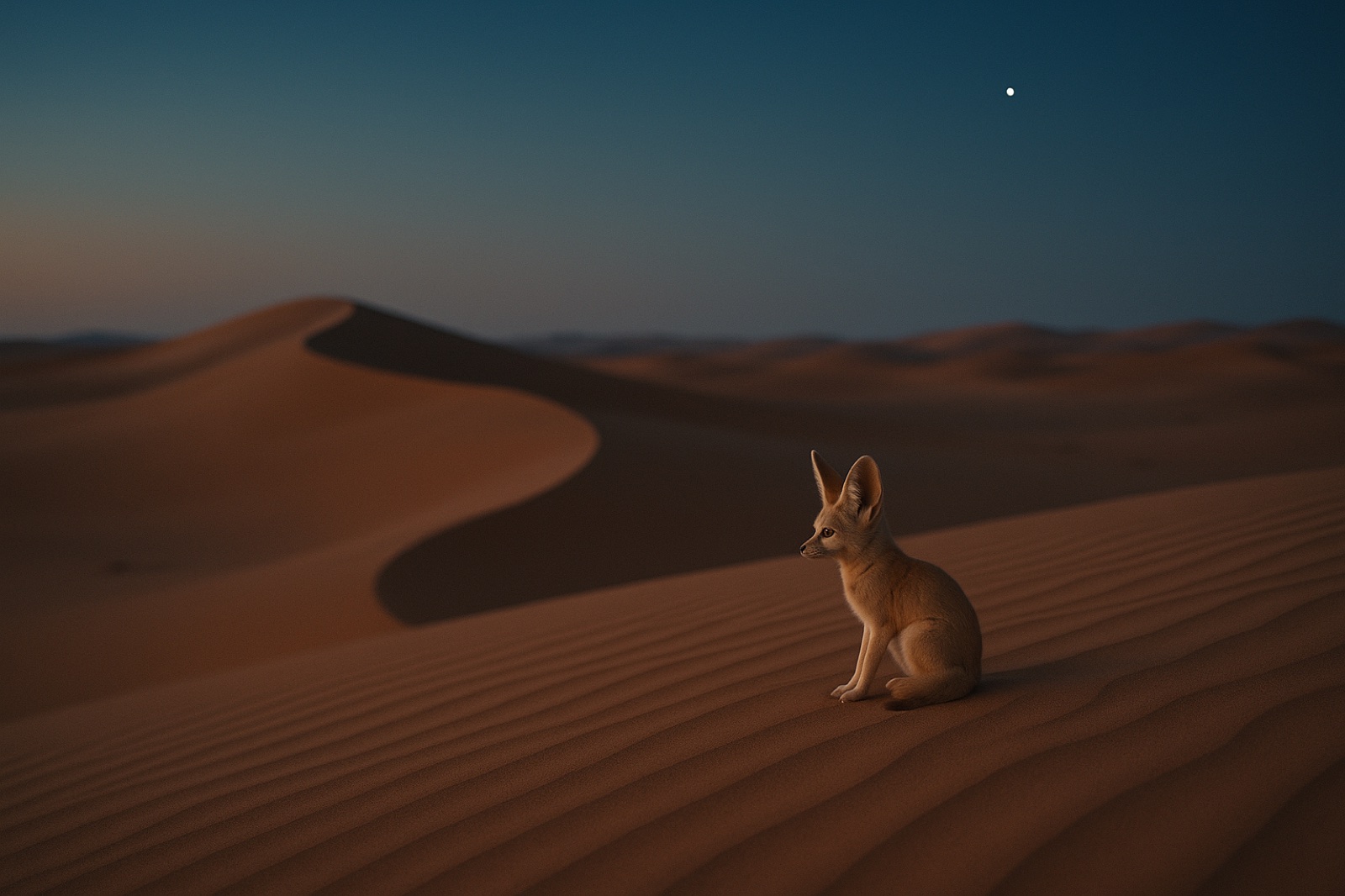
Then the fox turns up and asks to be tamed.
The famous line arrives at the end of that scene: it is only with the heart that one can see rightly, and what is essential is invisible to the eye. It has been on posters for eighty years. It is doing time on a hundred thousand graduation cards right now.
But the fox says something else first, and that is the line that actually answers the garden. He tells the prince it is the time he has wasted on his rose that makes his rose important.
Wasted. Not spent, not invested, not given. Saint-Exupéry reaches for the exact word an efficiency expert would use as an insult, and uses it as the definition of love.
That one sentence resolves the crisis in the garden without contradicting a thing the prince saw. The five thousand roses are real. His rose genuinely is one of thousands. She is not unique because of anything she has or does. She is unique because of the hours, and the hours are not in the flower. They are not anywhere in the universe except in him.
Which is precisely what “invisible to the eye” means. The poster line is not a sentiment. It is the conclusion of an argument, and the argument is about accounting.
Then the fox adds the part that keeps the whole thing honest, and this is why he is not a greeting card: you become responsible, forever, for what you have tamed. The hours do not only make the rose valuable. They make her yours to answer for. Nothing in this book is free.
The same landscape, drawn twice
Here is the thing about The Little Prince that almost nobody notices, and once you have seen it you cannot read the ending the same way again.
The last two drawings in the book are the same drawing.
The narrator shows you the patch of desert where the prince appeared on Earth and where he disappeared from it. Then he turns the page and shows you the identical landscape a second time — two low hills, one star — and tells you it is the loveliest and saddest landscape in the world, and that he has drawn it again so you will be sure to recognise it if you are ever standing there.
The second drawing is empty. The boy is not in it.
So the book opens with a picture that looks like nothing much until you understand what is inside it, and closes with a picture that looks like nothing much until you understand what has been taken out of it. The same test, given twice, once at each end of the book. The first time, you failed. The last page is Saint-Exupéry checking whether anything changed in between.
Why the fox asks for four o’clock
There is one more thing the fox says, and it is the least quoted line in the most quoted chapter of the book.
He asks the prince to come back at the same hour every day. If you come at four in the afternoon, the fox says, then at three I will already begin to be happy, and happier as the hour gets closer. But if you come at any hour at all, I will never know when to get my heart ready. One must observe the proper rites.
The prince asks what a rite is. The fox tells him rites are what make one day different from other days, one hour different from other hours. His own hunters have one: every Thursday they dance with the village girls. Because of it, Thursday is a good day to be a fox.
Read that again as instructions rather than as charm, because instructions are what they are. The fox is spelling out the mechanism by which something invisible becomes something you can actually feel arriving. Pick an hour. Keep it. Repeat it until the hour itself starts carrying the weight.
That method is much older than this book, and the fox did not invent it. It is the oldest working technology human beings have for staying in contact with what cannot be seen. Long before anyone called it a habit or a practice, people who wanted to keep something invisible in view did exactly this — they fixed the hour and defended it. In the book of Daniel, a man living in exile keeps three appointed times a day at an open window and refuses to move them even after keeping them has been made a capital offence. He is not doing it to acquire information. He is doing it for the fox’s reason. By the third hour, he has already begun.
The oldest name for that is prayer, and the mechanics are the fox’s mechanics exactly. Not the words. The hour. Time wasted on purpose, on something that will never turn up in a geographer’s ledger, until the wasting is the thing that makes it yours.
The Little Prince is not a religious book and the fox is not a preacher. But Saint-Exupéry found the machinery, and he wrote it down accurately.
The last page asks you for something
On the final page the narrator asks the reader for a favour, and it is a strange one. If you are ever travelling in that part of the desert, he says, and a small boy appears with golden hair who laughs and will not answer your questions, do not hurry past. Write to me. Send word that he has come back.
It is an absurd request and he means it entirely. He has spent the whole book earning the right to make it.
So look at that drawing one more time. Two hills, one star, nothing else — the emptiest picture in the book. He gave it enough hours that the emptiness turned into a face. Then he printed it twice and handed you the coordinates.
One question for the room
Is The Little Prince a children’s book that adults adopted, or an adult book wearing a children’s book as a disguise so it can get past your defences? Both readings hold up, and they produce completely different endings. Tell us where you land in the comments — readers split hard on this one.
If you like this kind of reading, we did the same thing with the sentence everyone quotes from Cormac McCarthy — what “carrying the fire” actually means in The Road, another book about what one person manages to hand another across a desert. And for a novel where the hours a man refused to give are the whole tragedy, there is what really destroys Okonkwo in Things Fall Apart. If the fox’s line about wasted time landed somewhere close to home, our free What Are My Core Values? assessment is a quiet way to find out where your own hours are actually going.
Questions people ask about The Little Prince
What is The Little Prince actually about?
The Little Prince, Antoine de Saint-Exupéry’s 1943 novella, is usually described as a story about a boy from a tiny asteroid who visits Earth. What it is arguing is narrower than that: it claims that the things which matter most cannot be verified by looking, and that they become real only through time deliberately given to them. The fox states it directly in chapter 21 — it is the time you have wasted on your rose that makes your rose important. Every adult the prince meets on his six planets is a person who has stopped giving time to anything outside himself.
What does the fox mean in The Little Prince?
The fox in The Little Prince is the book’s teacher, and he teaches three connected things. First, taming: bonds are built, not found, and they make one creature unique to another out of thousands who look identical. Second, that the time “wasted” on something is what makes it matter — which is why the prince’s ordinary rose is not replaceable by any of the five thousand roses in the garden. Third, rites: the fox asks the prince to come at the same hour each day, because a fixed hour lets the heart prepare, and because rites are what make one day different from other days.
What does the ending of The Little Prince mean?
At the end of The Little Prince, the prince lets a snake bite him so he can leave his body behind and return to his own planet and his rose, and the narrator finds no body the next morning. The book deliberately does not tell you whether he made it. The narrator’s final gesture is to draw the empty desert landscape twice and ask readers who ever pass through it to send him word if the boy appears. The ending is not built to resolve — it is built so that the reader is left holding the same uncertainty the narrator is.
Why does the little prince’s rose matter if there are five thousand identical roses?
Because uniqueness in The Little Prince is not a property of the flower. When the prince finds a garden of five thousand roses that look exactly like his, he is devastated, because his rose had claimed to be the only one of her kind in the universe. The fox’s answer does not deny what he saw. It relocates the value: the prince watered her, sheltered her under a glass globe and listened to her complaints, and those hours exist nowhere except in him. That is the sense in which what is essential is invisible to the eye.
Is The Little Prince a children’s book?
The Little Prince is published and sold as a children’s book, and Saint-Exupéry dedicated it to his friend Léon Werth — then corrected the dedication to Léon Werth when he was a little boy. It is also, in plain content, a book about loneliness, memory, responsibility and death, written by a working pilot who had already survived a crash in the Sahara in 1935 and who disappeared on a reconnaissance flight in July 1944. It has since been translated into hundreds of languages and dialects, which suggests the question of who it was written for was settled long ago in favour of everybody.
If you want to share this
“The fox in The Little Prince says it is the time you have WASTED on your rose that makes your rose important. Saint-Exupéry picked the word an efficiency expert would use as an insult and made it the definition of love.”
“The Little Prince opens with a drawing that looks like a hat until you see what is inside it, and ends with the same desert landscape printed twice — the second time with the boy removed. Same test, one at each end of the book.”
“Everyone quotes the fox’s line about the heart. Almost nobody quotes the one before it: come at four o’clock, and by three I will already be happy. Rites are what make one day different from other days.”