 0
 0
Palace Walk opens on a woman waking up in the dark. Nothing has happened. No noise, no bad dream, no child calling out. It is simply midnight, and midnight is when she wakes.
She does not need a clock for this. Her husband is out. He will come home at some hour she is not told in advance, and when he does, her job is to be awake, meet him, and hold the lamp over his head so he can see where to put his feet on the stairs.
Most people looking for the Palace Walk meaning are after what the novel says about Egypt, or the 1919 revolution, or tradition losing a fight with the modern world. All of that is genuinely in there. But the whole book is already sitting in that lamp, on the first page, before anyone has said a word.
A Street, a Family, and a Man Nobody Questions
Naguib Mahfouz published this novel in Arabic in 1956 as Bayn al-Qasrayn — “Between the Two Palaces” — named after a real street in the old quarter of Cairo. It is the first of three linked novels that English readers know as the Cairo Trilogy, followed by Palace of Desire and Sugar Street. The English translation, by William M. Hutchins and Olive E. Kenny, came out in 1990. Mahfouz, an Egyptian, had won the Nobel Prize in Literature two years before that.
The story runs from 1917 to 1919, in a Cairo under British occupation. The house belongs to al-Sayyid Ahmad Abd al-Jawad, a merchant with a shop and a reputation. Amina is his wife. Yasin is his eldest son, from an earlier marriage. Then come Fahmy, a law student; the two daughters, Khadija and Aisha; and Kamal, the youngest, still small enough that nobody watches him closely.
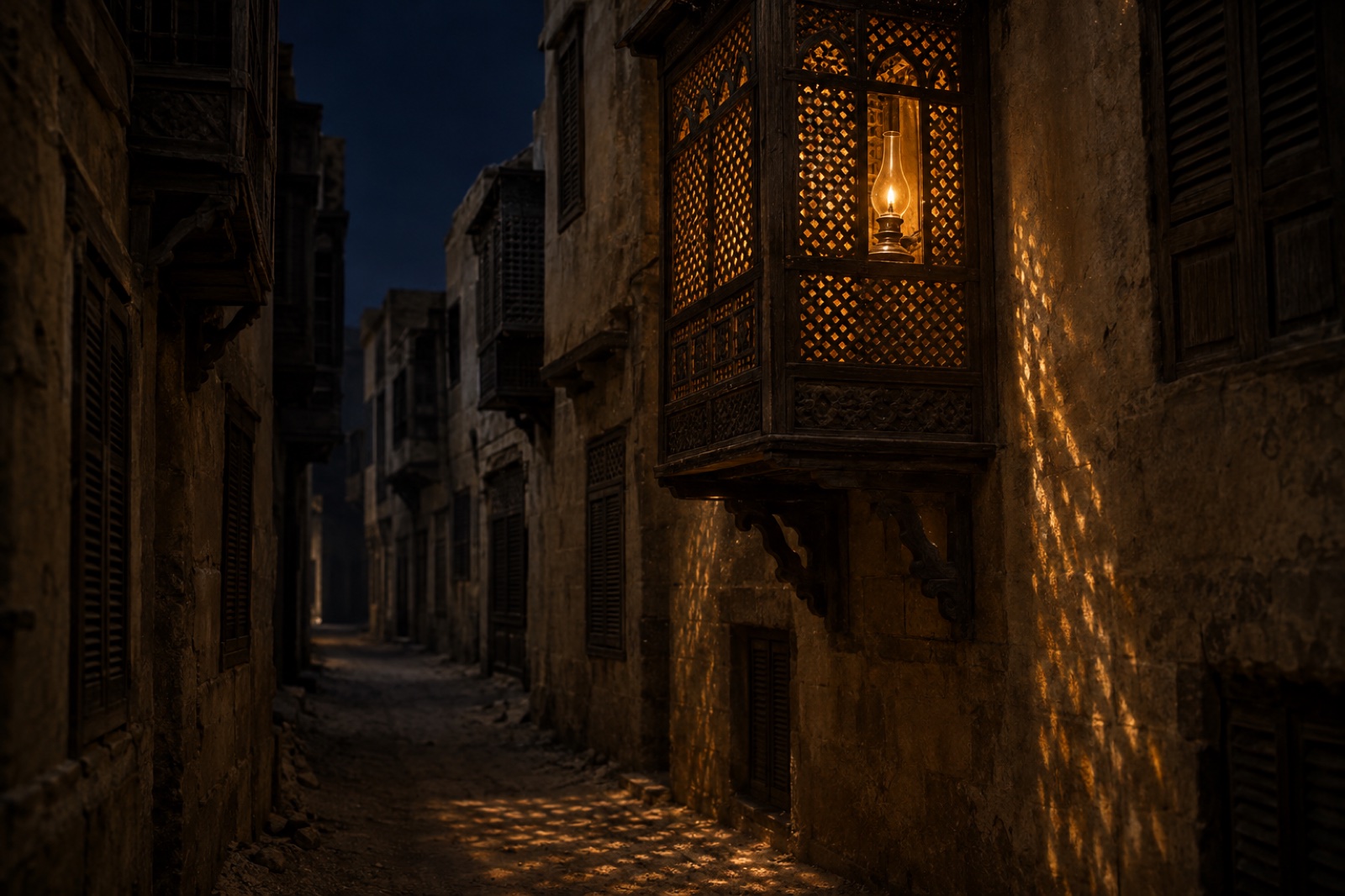
The house runs on his rules, and his rules are not complicated. Amina does not go outside. The daughters look at the street through a carved wooden lattice — the screened balcony box that old Cairo calls a mashrabiya — and the street never looks back. Nobody raises a subject he has not raised first. There is no arguing, because there is no mechanism for it.
From the inside, this reads as piety. He is strict about prayer, strict about drink, strict about where his family’s eyes go. The household’s picture of him is close to worshipful, and Mahfouz lets you sit in that picture for a long time before he shows you anything else.
The Second Life, and Why It Is Not a Disguise
At night, al-Sayyid Ahmad drinks. He listens to music. He keeps a circle of friends his family will never meet, and he spends time with women, including a singer named Jalila who had once been his. None of this is a secret he is actively guarding. It is just a part of his life that has no door into the other part.
Here is where Mahfouz does something harder than he had to. He does not write this man as a cynic. The easy version of this character knows he is a fraud, and uses religion as a stick. That version is a simple story and we have all read it.
Al-Sayyid Ahmad is not that. His religion is real. He believes. He feels genuine shame before God, in private, and it does not change a thing about tomorrow night. The novel presents both halves of him as sincere, which means you cannot dismiss him, which means you have to deal with him.
His sons work it out eventually, in different ways. Yasin learns what his father does and recognises himself in it; he is relieved, in a way, to find out that the appetite he already had has a respectable address. Fahmy learns the same thing and something inside him breaks. He had been living under a law he assumed was universal. It turns out to have had an exemption written into it the whole time.
And still — this is the thing that should bother you — the novel never gives you a scene where anybody says it to his face. Not once. Four hundred pages, two grown sons who know, and nobody can open their mouth. It is the same pressure that runs under Tony Soprano’s seven years of therapy, where a man can describe himself accurately for a decade and never once be under any obligation to change.
What the Lamp Is Actually For
Go back to Amina on the stairs.
She waits up. She comes down. She holds the lamp over his head and lights his way home.
The one instrument in that house for seeing in the dark is handed, every single night, to the one person in it who is not allowed to see. She is the light source for a journey she must never ask about. Mahfouz does not underline this. He just gives her the lamp and lets her carry it for the length of a trilogy.
Once you notice it, the whole shape of the book changes, because you realise al-Sayyid Ahmad is not hiding. Hiding is work. Hiding means risk, and cover stories, and a nervous man checking the stairs. He does none of that. He does not need to. He is not concealed — he is simply unaskable.
That is why his two lives never collide. A contradiction only hurts when something forces both halves into the same room and makes you look at them together. Nothing in his world can do that. No wife, no son, no friend, no institution. So he goes on being two whole people who never meet, and he is not even lying, because lying requires a question.
Mahfouz measures everyone in that family in one unit, and it is not money or faith or love. It is permission to cross a threshold. He crosses it twice a night and answers to no one. The children cross it on terms he sets. And Amina does not cross it at all.
It is a close cousin of what Muriel Barbery does with a Paris concierge in The Elegance of the Hedgehog — a whole inner life kept invisible to the building it serves. The difference is the direction. Renée hides something good. Amina is handed something she is forbidden to look at.
The One Day Amina Crosses the Threshold
Then the plot lets her move, exactly once.
Her husband goes to Port Said on business. The children work on her for days and finally talk her into walking out to the mosque of al-Husayn to pray. She goes. It is the single act of her own initiative in the novel, and what she chooses to do with it is pray.
On the way home she faints in the heat and a motorcar hits her in the road. It breaks her collarbone. The children get a doctor and the bone is set.
Her husband comes back and learns she left the house without his permission. Now watch what he does, because the sequence is the point. He waits. He waits until the collarbone has healed. And then he sends her away, to her mother’s house, for weeks.
That pause is not mercy and it is not rage. It is procedure. A man in a temper throws his wife out while her shoulder is still in a sling. A man applying a rule waits for her to be well, so the punishment can be clean and separate and exactly what he decided it should be. He is being orderly. That is so much worse.
And set the two crossings side by side, which is what Mahfouz has quietly arranged for you. He leaves the house in the dark, for drink and music and company, every night of his life, and comes home to a lamp held over his head. She leaves the house in daylight, once, to pray, and comes home broken and is then exiled from it.
The novel makes no comment on that. It does not need to. It puts the two facts in the same book and lets them touch.
Who Was Ever Allowed to Ask Him
So the question the book leaves you holding is not really whether al-Sayyid Ahmad is a hypocrite. That is too easy, and it lets the reader off.
The question is quieter and much worse. In his entire life, who was ever in a position to ask him?
This is an old problem, and the oldest sharp words about it are not aimed at liars. The angriest things Jesus is recorded as saying were not directed at the obviously dissolute — those were the people He kept turning up for dinner with. They were directed at respectable, religious, publicly impeccable men. And the image He reached for was a kitchen object: you scrub the outside of the cup and the platter, and the inside stays full of what it was always full of (Matthew 23:25).
The next sentence is the half nobody quotes, and it is the surprising one. It is not “stop washing the cup.” It is: clean the inside first, and then the outside will be clean too. The order, not the deletion. The outside was never the problem. The sequence was.
Which is precisely al-Sayyid Ahmad. His outside is immaculate and it is not even fake. He really does pray. The trouble is that nothing in his life ever ran the other way — inside first — because nothing in his life could reach the inside at all. He had authority and no one above him. That is not a religion. That is a structure.
And it is worth saying plainly where that warning points, because it is easy to misread. Mahfouz was an Egyptian Muslim writing about his own city, with real tenderness for the people in that house, including the man at the head of it. What he found there is not Egyptian and it is not Muslim. It is what happens to any human being who holds power that nobody is permitted to question — in a household, in a company, in a government, and very much inside churches. A page like this one, on a site that writes about God, has no standing at all to point at a shopkeeper in 1917. The cup line was addressed to the people who were sure it was about somebody else.
After the Lamp
The novel ends in the street, not the house. Fahmy — the son who could not unlearn what he found out about his father — goes into the nationalist movement against the British occupation. He marches in a demonstration his group had been assured was permitted. British bullets go into the crowd and he does not come home. The news reaches al-Sayyid Ahmad at his shop.
There is something almost unbearable in that, and it is not the irony. It is that the man who could never be told anything is finally told something, by strangers, in the middle of a working day, and there is no version of his authority that can touch it.
And Amina is where she has been since the first page. Behind the lattice, in the dark, listening to the street.
Four words open this novel: she woke at midnight. The first time through, it is a domestic detail, the kind of sentence you read past on your way into the story. When you come back to it afterwards, it is the loudest line in the book. Somebody in that house had to stay up. Somebody had to hold the light.
Questions About Palace Walk
What is Palace Walk by Naguib Mahfouz actually about?
On the surface, Palace Walk is about one middle-class Cairo family between 1917 and 1919, under British occupation, as Egypt moves toward the revolution of 1919. Underneath that, it is about authority without accountability. The father, al-Sayyid Ahmad Abd al-Jawad, enforces strict religious discipline on his household while living a second life of drink, music and other women at night — and the novel’s real subject is that nobody in his world is permitted to mention it to him.
What happens to Amina in Palace Walk?
Amina is al-Sayyid Ahmad’s wife and is not allowed to leave the house. While he is away on business in Port Said, her children persuade her to walk out and pray at the mosque of al-Husayn. On the way home she faints in the heat and is struck by a motorcar, breaking her collarbone. Once her husband learns she left without permission, he waits for the bone to heal and then sends her to her mother’s house for several weeks as punishment.
Who dies at the end of Palace Walk?
Fahmy, the second son and a law student, dies at the end of Palace Walk. He has joined the nationalist movement against the British occupation, and he is shot during a demonstration that the marchers believed had been permitted. His father learns of his death at his shop. Fahmy is the son who was most damaged by discovering his father’s double life, which makes his death land harder than a plot summary suggests.
Is Palace Walk part of a series, and do you need to read all three?
Palace Walk is the first novel in Naguib Mahfouz’s Cairo Trilogy, followed by Palace of Desire and Sugar Street, which carry the same family forward across decades. Palace Walk works completely on its own and ends at a real stopping point, so you do not need the other two to finish it. They deepen it rather than complete it — especially for Kamal, the youngest son, who becomes the centre of the later books.
Is Palace Walk based on a true story?
The family in Palace Walk is fictional, but the setting is not. Bayn al-Qasrayn is a real street in old Cairo, the British occupation of Egypt is historical fact, and the 1919 revolution the novel ends in genuinely happened and genuinely cost hundreds of Egyptian lives. Mahfouz grew up in that part of Cairo, and the novel reads like a reconstruction of a world he knew rather than an invention of one.
Your Turn
Here is the thing the novel refuses to settle. Is al-Sayyid Ahmad’s piety genuine, or has he simply never once been in a room where it could be tested? Mahfouz hands you evidence for both and then walks off. And the harder half of the question: how much do you think Amina knew, and for how long? Tell me how you read them in the comments — I have changed my mind about her twice.
That chapter the cup line comes from is short, and a lot sharper than its reputation. If you would rather read it in context than take my word for it, the whole Book of Matthew is here free — as a PDF and as a 28-chapter audiobook.
Share This
- Palace Walk hands the only lamp in the house to the one person forbidden to see where it is going. Mahfouz never comments on this. He just makes her carry it for a whole trilogy.
- The scariest detail in Palace Walk: when he finds out his wife left the house, he waits for her broken collarbone to heal first, and then exiles her. Rage would have been kinder. That is procedure.
- Four hundred pages, two grown sons who know exactly what their father does at night, and not one scene where anybody says it to his face. Palace Walk is not a book about a liar. It is a book about a man nobody is allowed to ask.