 0
0
 0
0
Amazon is closing Mechanical Turk on September 30, after twenty-one years. If you have never heard of it, that is almost the point. It was the quiet marketplace where companies posted tiny digital jobs — label this image, transcribe this audio clip, read this sentence and say whether it sounds angry — and people around the world picked them up, a few cents at a time.
Most of the coverage is treating this as a small business story. A service that peaked years ago, out-competed by newer data-labeling companies, finally switched off. That is all true.
But there is something in the name that almost nobody is mentioning, and once you see it, the whole twenty-one years reads differently.
What Amazon Actually Announced
The details are straightforward. Mechanical Turk launched in 2005. At its peak it had more than 500,000 workers. Amazon says it reviewed its programs and services and decided to shut it down on September 30, 2026. Two related services, SageMaker Ground Truth and Amazon Augmented AI, close the same day, which means Amazon is stepping out of the business of organizing human data work altogether.
The work itself was called, in Amazon’s own paperwork, a Human Intelligence Task. That phrase existed because there was a category of thing software could not do yet, and a person had to do it instead. Every one of those tasks was a small admission: this part still needs a human.
The Original Mechanical Turk Was a Cabinet With a Person Inside
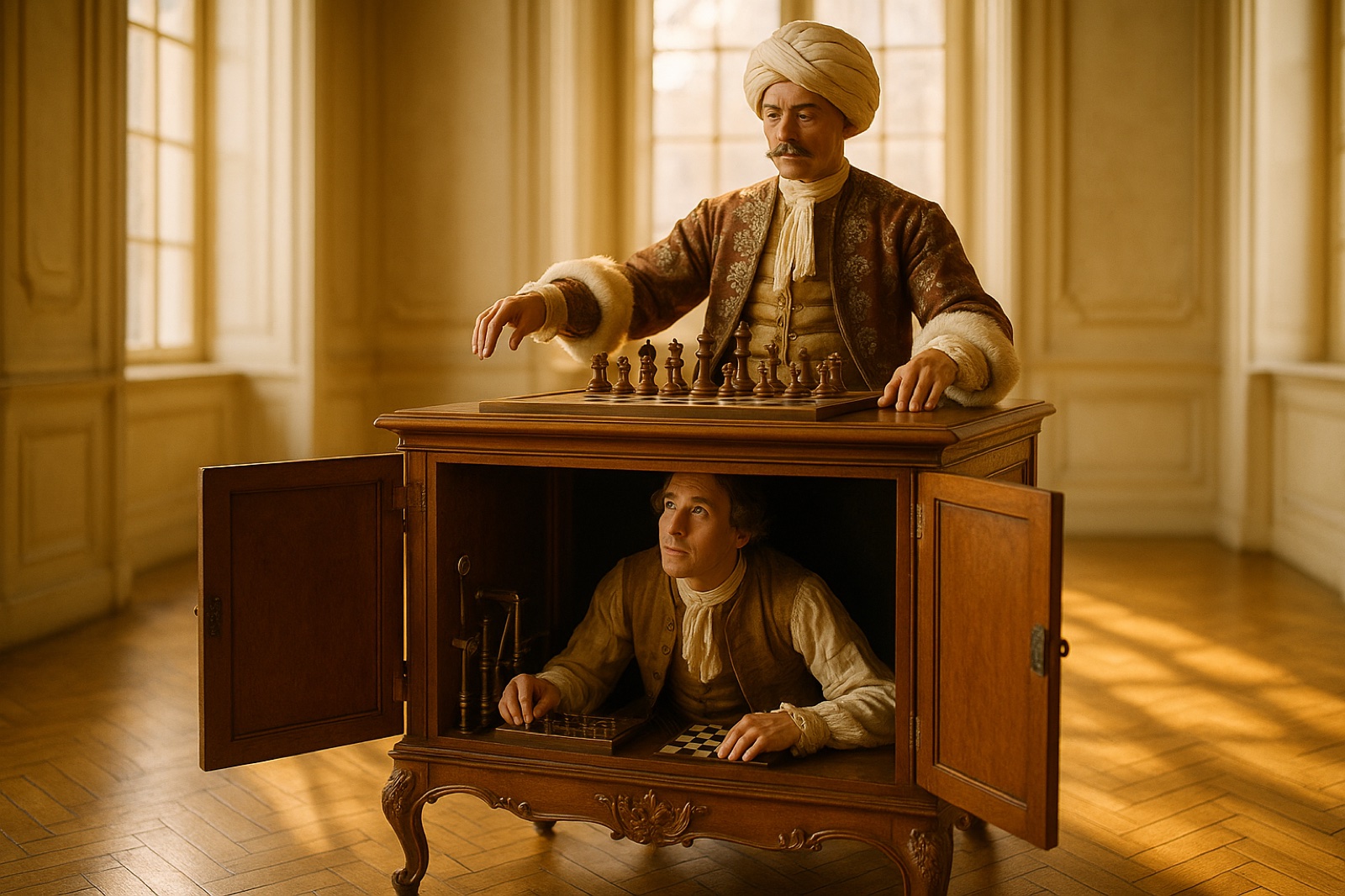
In 1770, an inventor named Wolfgang von Kempelen unveiled a machine for the Habsburg court in Vienna. It was a life-sized figure in robes and a turban, seated at a wooden cabinet with a chessboard on top. Wind it up, and it played chess. Well.
It toured for close to eighty-four years. It beat Napoleon Bonaparte. It beat Benjamin Franklin. Crowds across Europe and the Americas paid to watch a machine think, and left arguing about what they had just seen.
It was not a machine. Inside the cabinet, folded into the space behind the gears, sat a human chess master. He tracked the game on a small board by candlelight and moved the figure’s arm with levers. That was the entire invention: a person, hidden, doing the thinking, while a wooden man got the applause.
The Part of the Trick Everybody Misses
Here is the detail that stayed with me, and it is the one that makes this more than a fun piece of trivia.
Before each performance, Kempelen would slide open the doors on the side of the cabinet and show the audience the inside. Look — gears. Only gears. No room for anybody. He was not hiding the cabinet. He was opening it.
The demonstration of transparency was part of the deception. The operator shifted position as the doors opened, and the audience walked away having personally verified there was nobody in there. That verification was what made the illusion hold for eight decades. People did not believe the Turk was a machine because they were fooled into not looking. They believed it because they looked, and looked in the way they were invited to look.
That is a very old trick, and it has never stopped working.
Amazon Knew Exactly What It Was Naming
This is the part that makes the name so strange. Amazon did not stumble into the reference. Jeff Bezos described the service as “artificial artificial intelligence” — his own phrase, said out loud, more than once.
Read that again. Not artificial intelligence. Artificial artificial intelligence. Intelligence that is pretending to be the fake thing, which is to say: real human minds, arranged to look like software.
So Amazon named its human-labor marketplace after the most famous machine in history that was secretly a person, and then said the quiet part on the record. There was no cover-up here. The name was an admission. It is just that hardly anybody was listening, because the name sounded like a clever bit of branding rather than a description.
And for twenty-one years, it worked exactly as advertised. A company sent a request into what looked like a service. Somewhere, a person read it, thought about it, and sent an answer back. The company got a result that felt automatic. The thinking was real. It was simply arranged so you would not notice it happening.
Nobody Wrote Down the First Ones
Historians have since worked out the names of several people who sat inside the original Turk during its later years — Johann Allgaier, Jacques Mouret, William Schlumberger, and a handful of others. Skilled players. Real careers, in a sense.
But the operators from Kempelen’s own original tour are unknown. Not disputed. Not contested between historians. Simply lost. The people who were the machine at the very beginning — the ones who actually beat the famous men, who sat in the heat and the dark and won — nobody wrote their names down.
They were not forgotten by accident. Their whole job was to not exist. Being undetectable was the work, and they were good at it, and the price of being that good was that the record kept the inventor’s name and the losers’ names and not theirs.
It is worth sitting with how normal that arrangement still feels. We have built an enormous amount of the modern world on the principle that the highest compliment you can pay a person’s labor is that you cannot tell they were there. The seamless checkout. The instant answer. The thing that just works. Somebody is almost always in the cabinet.
Which is why it lands oddly when you run into the older idea — the one that keeps showing up in the ancient wisdom traditions, long before anybody was building automatons — that a person’s worth was never located in their output at all. That the value was assigned at the start, by God, on purpose, before the work began and regardless of whether anyone ever saw it. That is a genuinely strange claim in a world organized around results. It says the invisible operator was never actually invisible. Just unwitnessed by us.
You can hold that or leave it. But it is the only frame I know of that does not require a person to be seen in order to count.
What Happens on September 30
Practically: the marketplace closes, the tasks stop, and the people who earned money there will move to the newer platforms that took the business — the same pattern as any service shutting down. Some of them relied on that income. Most people reading about the closure will never think about it again.
What does not close is the arrangement. There is more hidden human work behind our automatic-feeling world now than there was in 2005, not less. Every system that answers instantly was taught to, by someone. The cabinet got much larger and much better at staying shut.
So maybe the useful thing to take from a twenty-one-year-old marketplace switching off is smaller and closer to home than a debate about technology. Somewhere today, something is going to work smoothly for you, and it is going to feel like it happened by itself.
It probably didn’t. That is all. Just notice.
A Few Things Worth Doing With This
- Pick one thing that worked today and trace it backward. The clean data, the fast answer, the shelf that was full. Follow it back one step to a person. You do not have to do anything about it — just complete the thought.
- Say the thank-you out loud where it can be heard. Most invisible work stays invisible because nobody ever names it in the room. Naming it costs nothing and takes four seconds.
- If you are the person in the cabinet right now — doing work that keeps something running while nobody knows your part in it — the unseen-ness is not a verdict on the value. Those are two separate things, and it is worth refusing to let them collapse into one.
If that last one hit closer than expected, our free What Is My Purpose? assessment is built for exactly that knot — the gap between what you do and what you are worth. It takes a few minutes and costs nothing. This is also the same tension underneath what AI cannot actually take from you, and it is why workplace loneliness keeps rising even in rooms full of coworkers — being present and being seen turn out not to be the same thing.
Discussion Question
Kempelen opened the cabinet doors to prove there was nobody inside, and that is precisely why people believed him. Do you think we are any harder to fool now than an audience in 1770 — or just fooled by better-designed openness? Tell us where you land in the comments.
Share This
- Amazon is shutting down Mechanical Turk after 21 years. It was named after a 1770 chess “robot” that was actually a guy hiding in a cabinet. Amazon knew. Bezos literally called the service “artificial artificial intelligence.”
- The wildest detail about the original Mechanical Turk: the inventor opened the cabinet before every show to prove nobody was inside. That WAS the trick. People believed it because they checked.
- We know the names of the men who operated the Mechanical Turk in its later years. The ones from the original tour? Lost. They beat Napoleon and Franklin and nobody wrote their names down — because being undetectable was the job.
Common Questions
What is Amazon Mechanical Turk and why is it shutting down?
Amazon Mechanical Turk was an online marketplace, launched in 2005, where businesses posted small digital jobs called Human Intelligence Tasks — image labeling, audio transcription, survey responses — that people completed for small payments. Amazon announced it will close the platform on September 30, 2026, after twenty-one years, following an internal review of its programs. Its decline is generally attributed to competition from newer data-labeling companies such as Scale AI, Mercor and Prolific.
Why is it called the Mechanical Turk?
It is named after an 18th-century chess-playing “automaton” built in 1770 by Wolfgang von Kempelen for the Habsburg court in Vienna. The machine appeared to play chess on its own, but a human chess master was concealed inside the cabinet, following the game on a small board and operating the figure’s arm with levers. Amazon chose the name deliberately: founder Jeff Bezos described the service as “artificial artificial intelligence,” meaning human work presented as though it were software.
Was the original Mechanical Turk a real machine?
No. It was an illusion, and a very durable one — it toured for roughly eighty-four years and defeated opponents including Napoleon Bonaparte and Benjamin Franklin. Its apparent intelligence came entirely from a hidden human operator. Before performances, its inventor would open the cabinet’s doors to display the internal clockwork, which convinced audiences no person could fit inside; the operator repositioned as the doors opened, so the demonstration of transparency was itself part of the deception.
Who were the people hidden inside the Mechanical Turk?
Several operators from the machine’s later decades have been identified by historians, including Johann Allgaier, Jacques Mouret and William Schlumberger, all strong chess players of their era. The operators from Kempelen’s original tour, however, are unknown — their names were never recorded, because remaining undetected was the essential requirement of the role.
What else is closing along with Mechanical Turk?
Amazon SageMaker Ground Truth and Amazon Augmented AI are scheduled to close on the same date, September 30, 2026. Taken together, the three closures mean Amazon is exiting the business of coordinating human-powered data collection and labeling, a market now served largely by independent specialist companies.