 0
0
 0
0
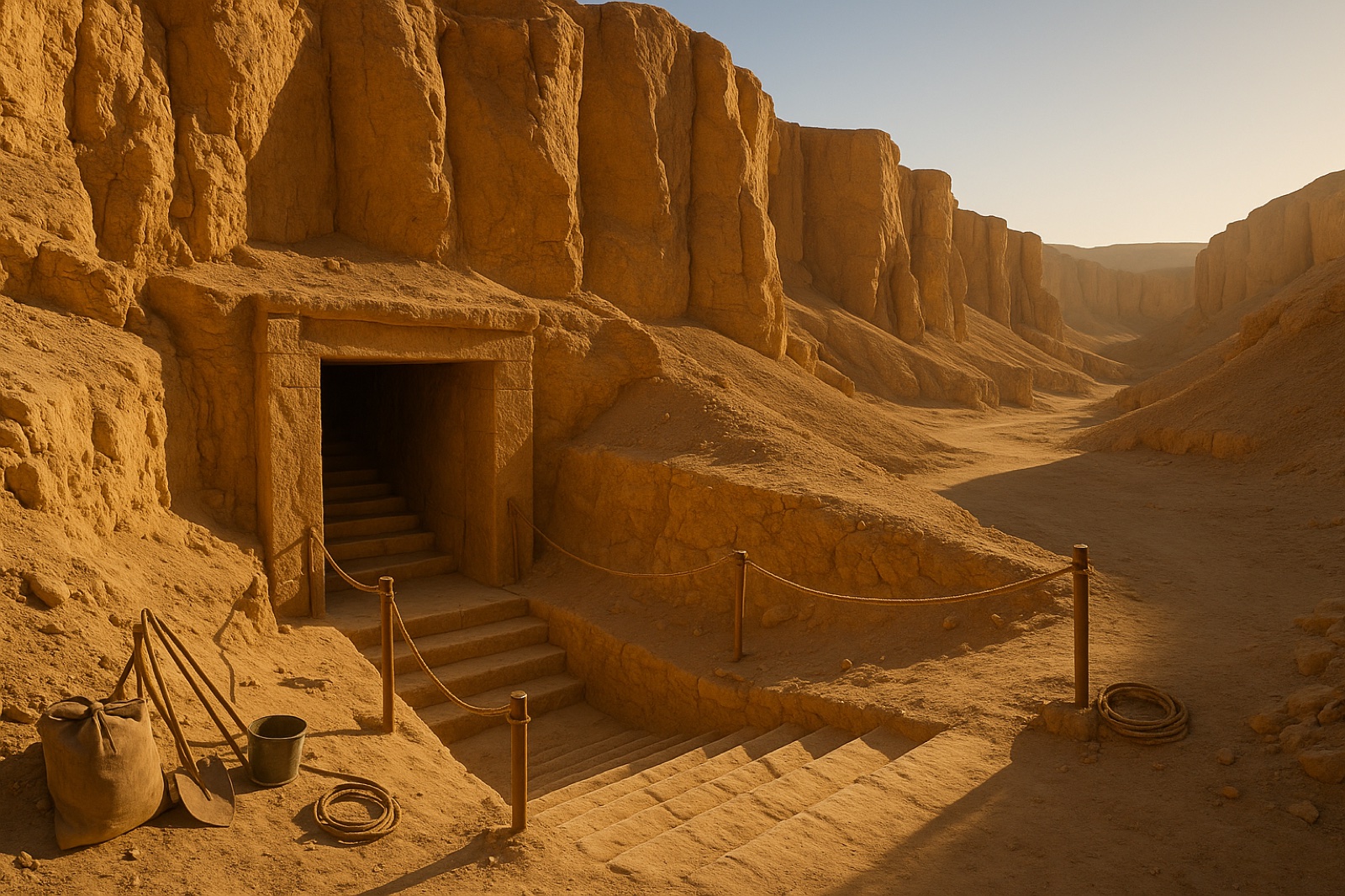
In February 2025, a joint Egyptian-British archaeological team stood in a narrow, flood-damaged passage in the hills west of Luxor and confirmed something Egyptologists had been chasing for more than a century: the last missing royal tomb of Egypt’s 18th Dynasty. It was the first pharaoh’s tomb found in Egypt since Howard Carter opened Tutankhamun’s burial chamber in 1922. And because of who this particular pharaoh was, the discovery is doing something few archaeology stories do — it’s reviving a debate that’s been running for 3,500 years: who was the real pharaoh of the Exodus?
The find has been quietly making the rounds in 2026 archaeology roundups, which is a little unusual, because the actual dig work happened years earlier. The entrance and main passage of the tomb, now catalogued as Tomb C4, were first uncovered back in 2022 in a remote stretch of desert called Valley C, about a mile and a half west of the famous Valley of the Kings. For a while, researchers weren’t even sure whose tomb they were looking at — early theories pointed to a royal wife. It took three more years of careful excavation, and a handful of shattered alabaster jar fragments inscribed with two names, to settle the question.
The Clue That Cracked It: Broken Jars With Two Names
Those jar fragments are the whole story. Ancient Egyptian tombs were looted constantly — often within a generation of the burial — so intact grave goods naming the tomb’s owner are rare. What survived in Tomb C4 were pieces of alabaster vessels inscribed with the name of King Thutmose II, paired with the name of his wife and half-sister, Hatshepsut, the woman who would go on to rule Egypt as one of its only female pharaohs. It’s the first physical object ever linked to Thutmose II’s actual burial, and it’s what allowed archaeologists to finally close the book on the last open seat in the 18th Dynasty’s royal tomb roster.
The tomb itself turned out to be surprisingly modest — plain by later royal standards, with traces of blue-painted plaster, a ceiling scattered with yellow stars, and fragments of the Amduat, the religious text that guided a pharaoh’s soul through the underworld. Researchers now believe the tomb flooded roughly six years after Thutmose II was buried there, which may explain why so little was left behind: his body and belongings were likely moved to a secondary, still-undiscovered location soon after. Finding that second tomb, if it exists, is now the team’s next target.
Why an 18th Dynasty Tomb Keeps Dragging People Into a Much Older Argument
Here’s where it gets interesting for people who’ve never opened a history book on purpose. The 18th Dynasty — the family line that produced Thutmose II, Hatshepsut, Thutmose III, and eventually Tutankhamun — is also the dynasty most frequently pointed to by scholars who place the Exodus story in the mid-15th century BC. That dating rests on a chronological detail in the Hebrew scriptures that places the Exodus 480 years before Solomon’s temple was built, which lands almost exactly inside this dynasty’s reign.
If that dating holds, the candidates read like a cast list from Tomb C4’s own family tree: Thutmose III, whose decades-long reign and military campaigns fit the profile of the “pharaoh of the oppression”; Hatshepsut herself, sometimes floated as the Egyptian princess who could have raised an adopted Hebrew child in the palace; and Amenhotep II, Thutmose III’s son, who some scholars argue is the best fit for the pharaoh who actually let the Israelites go. None of it is settled. Other historians favor a much later date and point instead to Ramesses II, three centuries after this dynasty ended, largely because of a place name — Raamses — mentioned directly in the Exodus narrative itself. There’s no inscription, no tomb, no smoking gun that definitively names any of them. Just a very old story and a very long list of suspects.
What Tomb C4 actually does is smaller and, honestly, more useful than “solving” any of that: it completes the physical record of a dynasty historians have been trying to fully map for a hundred years. That’s what’s making it interesting to Egyptologists debating the era’s exact chronology — and it’s also why the man at the center of the Exodus story keeps circling back into headlines that, on the surface, have nothing to do with him.
It’s not the first time a dig has reopened an argument people assumed was purely a matter of belief. A basalt stone found in northern Israel in the 1990s did something similar for a different Bible-adjacent figure — it’s the inscription that convinced most serious historians King David was a real historical ruler, not a later legend. And just last year, researchers proposed that Herod the Great built his own monumental tomb directly over a much older, much more modest one — a discovery that, in its own way, reopened a conversation about what actually lasts after a person is gone. Archaeology keeps doing this: turning up physical evidence that doesn’t prove a story outright, but makes it much harder to file away as pure myth.
A Debate That Refuses to Stay in the Past
Here’s what’s easy to miss in a story about broken jars and flooded passageways: this argument has stayed alive for thirty-five centuries, and nobody has ever fully explained why. Most disputes from the ancient world quietly die the moment the people who cared about them are gone. Nobody argues about which official managed grain shipments under a forgotten mid-level vizier. But “who was the pharaoh of the Exodus” gets typed into search bars by the thousands, month after month, by people who’ve never read the book of Exodus and may not even believe it happened.
Maybe that’s just human curiosity about a good unsolved mystery. Or maybe it’s evidence of something a little bigger — that certain stories, the ones about ordinary people escaping something they had no power to escape on their own, about a promise that outlasted every empire that tried to bury it, simply refuse to become purely academic. Ancient wisdom has a habit of doing that. It doesn’t stay behind glass in a museum case. It keeps finding new doors to walk back through.
Whether or not Tomb C4’s secondary burial site is ever found, the debate it reopened isn’t going anywhere. Egyptologists will keep excavating the Theban hills looking for hard answers. Historians will keep arguing about a 480-year verse and a place name called Raamses. And somewhere in a search bar, someone who just watched a documentary or scrolled past a headline will keep typing the same six words their grandparents’ generation typed too — still curious, still not entirely sure why the question won’t let go of them.
Discussion Question
If archaeologists ever found a single inscription that definitively named the pharaoh of the Exodus, do you think it would finally settle the debate — or just open ten new ones? Drop your take in the comments.
Share This
- Egypt just found its last missing 18th Dynasty royal tomb — the first pharaoh’s tomb discovered since King Tut in 1922. And it’s reopening a 3,500-year-old question nobody’s ever fully answered: who was the real pharaoh of the Exodus?
- Broken alabaster jars just helped archaeologists close a hundred-year-old mystery in the Valley of the Kings. The bigger question they reopened is a lot older than 100 years.
- People have been arguing about who the pharaoh of the Exodus really was for 3,500 years. A new tomb discovery in Egypt just gave that argument fresh evidence — and no final answer.
Questions People Are Asking
Was the tomb found in 2025 actually the tomb of the pharaoh from the Exodus story?
No. The tomb belongs to Thutmose II, who is not among the leading scholarly candidates for the Exodus pharaoh. The discovery matters because it completes the archaeological record of the 18th Dynasty — the dynasty many scholars believe was reigning during the traditional Exodus timeframe — not because it identifies the Exodus pharaoh directly.
Who do historians think the pharaoh of the Exodus actually was?
There’s no scholarly consensus. The leading candidates include Thutmose III and Amenhotep II, favored by historians who date the Exodus to the mid-15th century BC based on a chronology reference in the Hebrew scriptures, and Ramesses II, favored by historians who date it roughly three centuries later based on a place name mentioned directly in the Exodus account. No inscription or artifact has ever definitively confirmed any of them.
Why was Thutmose II’s tomb so hard to find?
Its entrance and main passage were actually located in 2022, but researchers initially weren’t certain whose tomb it was — early evidence pointed toward a royal wife. It took until 2025 for alabaster jar fragments bearing Thutmose II’s name, alongside Hatshepsut’s, to confirm ownership. Flooding shortly after the original burial likely means his body and most of his grave goods were relocated to a still-undiscovered second tomb.
Why is this called the biggest Egyptian tomb discovery in a century?
Because it’s the first tomb belonging to a pharaoh discovered anywhere in Egypt since Howard Carter found Tutankhamun’s tomb in 1922. Every royal tomb found in the intervening hundred years has belonged to a non-royal official, a wife, or another member of the royal household — not a reigning king.
Is there any physical evidence at all connecting a specific pharaoh to the Exodus story?
No single inscription or artifact has been found that names a pharaoh in connection with the biblical Exodus narrative specifically. The debate remains built on chronology, place names, and circumstantial historical fit rather than direct archaeological proof, which is part of why it has stayed unresolved for so long.