 0
0
 0
0
Maybe it was a TV show. Maybe a video game, a song, or a short clip that popped up late at night. Someone said it like a plain fact: Adam had a wife before Eve. Her name was Lilith. And the Bible left her out.
If that made you stop and wonder, you are not alone. So who is Lilith in the Bible? And if she was really Adam’s first wife, why did nobody tell you?
Here is the short answer first. The Hebrew word behind the name Lilith appears in the Bible exactly once, in Isaiah 34:14, in a list of wild creatures living in a ruined land. The King James Version translates it “screech owl.” The Bible never calls Lilith a woman, a wife, or anyone Adam knew. The story of Adam’s first wife comes from a different book, written well over a thousand years after Isaiah.
Nothing was cut out. You can check every step of this yourself. And by the end, I think you will see something in Genesis that the legend covers up.
Who Is Lilith in the Bible? The One Verse With Her Name
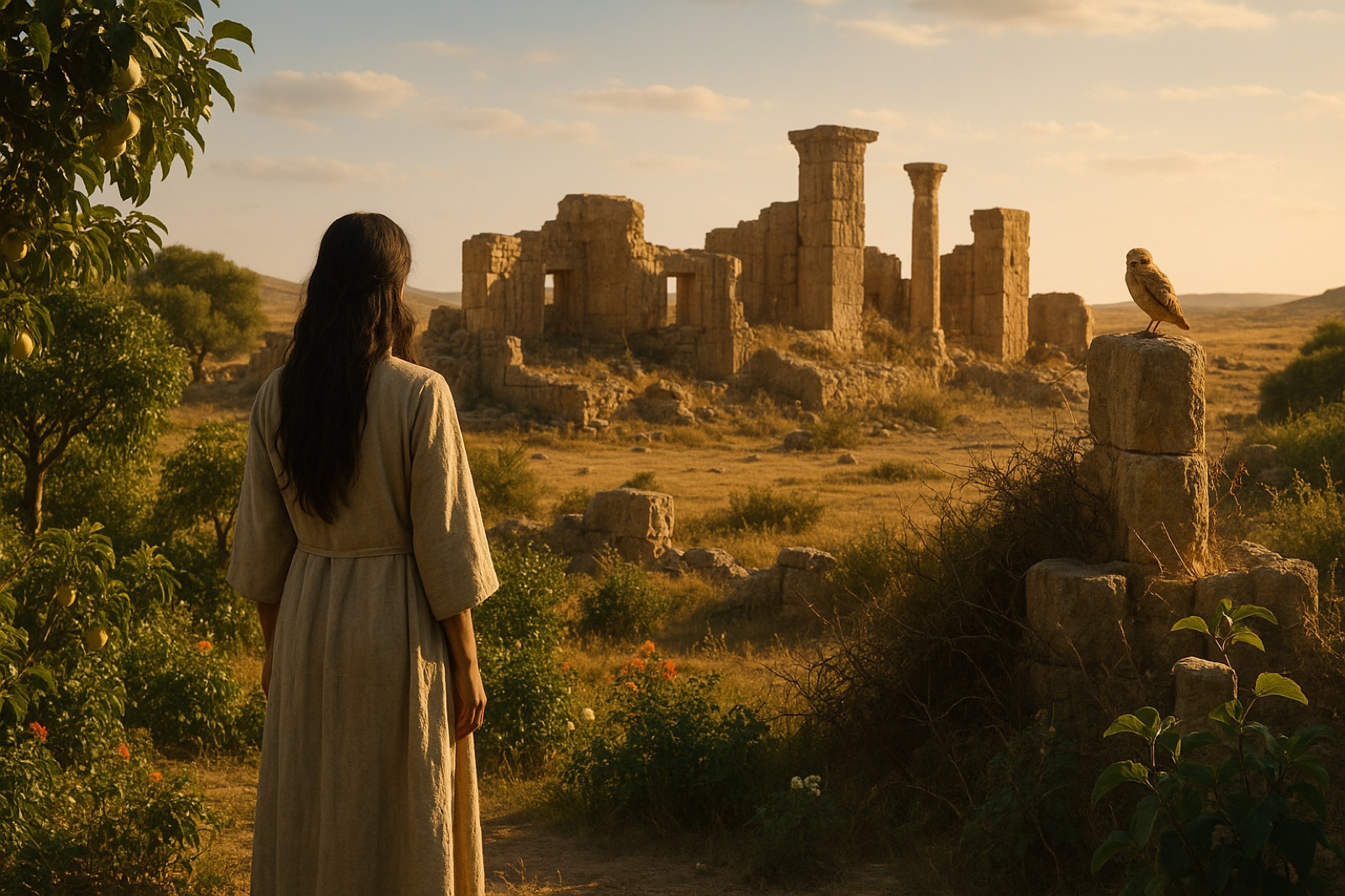
Isaiah 34 is a poem about a land under judgment. The chapter names the place: Idumea, also known as Edom, and its city Bozrah (Isaiah 34:5-6). The picture is of a proud kingdom turned into an empty ruin. Thorns grow in the palaces. Wild animals move in.
Then comes the list of what lives there now:
“The wild beasts of the desert shall also meet with the wild beasts of the island, and the satyr shall cry to his fellow; the screech owl also shall rest there, and find for herself a place of rest.”
Isaiah 34:14
Where the King James Version says “screech owl,” the Hebrew says lilit. That is the word behind the name Lilith. It appears here and nowhere else in the Hebrew Bible.
Look at what the verse does not say. No garden. No Adam. No marriage. No argument. Just a creature of the night settling down in a broken place, in the same list as owls, ravens and vultures (Isaiah 34:11, 15).
That is the whole record. One word, in one verse, in a list.
Why the King James Bible Says “Screech Owl”
Nobody is fully sure what kind of creature Isaiah meant, and translators have been honest about that for a long time. The word lilit sounds like the Hebrew word for night. So the choices have gone two ways: a night bird, or a night spirit.
- King James Version: “screech owl”
- English Standard Version: “night bird”
- New American Standard Bible (1995): “night monster”
- Revised Standard Version: “night hag”
- New Revised Standard Version: “Lilith”
Here is a detail most people never see. The King James translators printed a second choice in the margin beside “screech owl.” It reads “night monster.” They were not hiding anything. They put both readings on the page and let the reader see the question.
There is more. The oldest full copy of Isaiah we have is the Great Isaiah Scroll, found among the Dead Sea Scrolls. It writes the word as a plural. Not one famous Lilith, but a kind of creature, more than one.
People living around ancient Israel did tell stories about night spirits with a name like this. Old writings from Mesopotamia speak of spirits called lilitu. One of the Dead Sea Scrolls, known as Songs of the Sage, names Lilith in a list of harmful spirits. So Isaiah may have picked a word his first readers already knew, the kind of thing you would expect to find in a haunted ruin.
Bird or spirit, the point of the verse is the same. This place is so empty that only wild things live there.
Where the Story of Adam’s First Wife Really Comes From
So where does the wife story come from? Follow the dates.
First, the Talmud. The Babylonian Talmud is a huge collection of Jewish teaching, put together in the centuries after the time of Jesus. It mentions Lilith a few times: a spirit with long hair, with wings, one who might harm a person sleeping alone in a house. In the Talmud she is a night demon. She is still not Adam’s wife.
Then, the Alphabet of Ben Sira. This is where the story finally shows up. It is a book by an unknown author, written somewhere between about 700 and 1000 AD. In it, God makes a woman named Lilith from the earth, the same way Adam was made. The two quarrel over who is in charge. She says they are equal, because both came from the earth. Then she speaks God’s secret name, flies away, and will not come back. Three angels are sent after her, and the tale ends by explaining why people used charms with the angels’ names to protect newborn babies.
That book was written well over a thousand years after Isaiah. It is also an odd book. Some scholars have argued it was written as satire, closer to a joke than a history. Others disagree. Either way, it was never part of the Bible, for Jews or for Christians. Janet Howe Gaines walks through this whole history in an article for the Biblical Archaeology Society.
So the timeline looks like this. A night creature in a ruin, in Isaiah. Then a night demon in folklore. Then, many centuries later, a first wife with a full backstory. The story grew with each telling. The Bible’s part never changed: one word in one verse.
This is a common pattern with stories that sit just outside the Bible. We have looked at two others: what the Book of Enoch is and why it isn’t in the Bible, and who the Nephilim really were.
The Gap in Genesis the Legend Tried to Fill
Why would anyone come up with a first wife at all? Because careful readers noticed something real.
Genesis seems to tell the making of the first woman twice. In chapter 1, man and woman arrive together:
“So God created man in his own image, in the image of God created he him; male and female created he them.”
Genesis 1:27
Then in chapter 2, Adam is alone, and the woman is made later, from his side (Genesis 2:21-22). Long ago, some readers asked: is the woman in chapter 1 a different woman from the one in chapter 2? The Lilith story is one answer to that question. It puts a stranger in the gap.
But the Bible answers the question itself. Twice.
First, Genesis 5 looks back and sums it up: “Male and female created he them; and blessed them, and called their name Adam, in the day when they were created” (Genesis 5:2). The very next verse goes straight on to Adam’s son Seth. One couple. One family line.
Second, Jesus was once asked a hard question about marriage. He answered by quoting both chapters in one breath:
“Have ye not read, that he which made them at the beginning made them male and female, And said, For this cause shall a man leave father and mother, and shall cleave to his wife: and they twain shall be one flesh?”
Matthew 19:4-5
“Made them male and female” is from Genesis 1. “Cleave to his wife” is from Genesis 2. Jesus reads them as one story about one couple. Chapter 1 is the wide view. Chapter 2 walks in close and shows how it happened.
“This Is Now”: What Adam Really Said
Now read chapter 2 slowly, because this is the part the legend covers up.
God says, “It is not good that the man should be alone” (Genesis 2:18). Then something odd happens. Before the woman comes, the animals come. Every beast and every bird is brought to Adam to be named. And at the end of that long parade: “but for Adam there was not found an help meet for him” (Genesis 2:20).
There is the “before” in the story. Not an earlier wife. A long line of creatures, and not one of them a match.
Then the woman is brought to him, and Adam speaks. These are the first human words the Bible records:
“This is now bone of my bones, and flesh of my flesh: she shall be called Woman, because she was taken out of Man.”
Genesis 2:23
“This is now.” You can hear the relief in it. At last. After all that looking, here is someone like me. The first thing a human being says in the Bible is joy at another person.
The legend turns Eve into a second try, the one who came along after the first wife didn’t work out. Genesis says the opposite. She is the one Adam had been waiting for.
The Name Eve Was Given on the Worst Day
There is one more verse, and it is the one I can’t get past.
In Genesis 3, everything goes wrong. Adam and his wife hide. Adam blames her. Then he hears the hardest words anyone had heard yet: “for dust thou art, and unto dust shalt thou return” (Genesis 3:19).
That is a death sentence. Now look at the very next thing Adam does:
“And Adam called his wife’s name Eve; because she was the mother of all living.”
Genesis 3:20
In Hebrew, the name Eve sounds like the word for living. Adam has just been told he will die. He turns to the woman beside him, the one he blamed a few verses earlier, and calls her Life.
She has no children yet. Nothing about that day looks like a beginning. But God had just spoken of her children to come (Genesis 3:15-16), and Adam believed it. He named her for a future he could not see.
That is faith, on the worst day of his life.
And here is where it lands for you and me. Under the surface, the Lilith legend is a story about being replaced. The first one didn’t work out, so here is another. Many of us carry a quiet fear that sounds just like that. That we were somebody’s second choice. That we are the backup plan. That someone better came first.
Genesis has no such person in it. The woman in the garden was met with “at last” and named “life.” Nobody in that story is a spare. And the God who made her with that much care did not make you by accident either.
A good place to start: The Beginner’s Guide to Feeling God’s Presence Every Day. A short video guide and companion PDF for noticing God in the ordinary parts of your day, even the days that are full of questions. Get the free guide. Free.
What to Do When Someone Says “The Bible Left This Out”
You will hear more claims like this one. They are nothing to be afraid of. Two verses after the night creature, Isaiah gives an open invitation: “Seek ye out of the book of the LORD, and read” (Isaiah 34:16). Faith that checks is still faith. Here are three things you can do in the next ten minutes.
- Read the verse for yourself. Open Isaiah 34 and read verses 11 to 16. It takes about two minutes. Notice what kind of list the word sits in.
- Save three small questions. The next time a video says the Bible hid something, ask: Where is it written? When was that written? What did the Bible say before that? Type those three into the notes on your phone now, so they are ready.
- Tell one person “at last.” Genesis 2:23 is a man saying he is glad someone exists. Send a message today to someone who may feel like a second choice. Tell them plainly that you are glad they are in your life.
If more questions come up as you read, you can ask them with our free Bible Answers AI assistant (it opens in ChatGPT).
A Prayer for the Wondering
God, I heard something that made me wonder what else I haven’t been told. Thank You that I am allowed to look, and that the truth holds up when I do. When I feel like a second choice or a backup plan, remind me how the first woman was welcomed, and that You made me on purpose too. Help me keep asking honest things and keep reading for myself. Amen.
Let’s Talk About It
Why do you think the story of Adam’s “first wife” has lasted so long, even though it is not in the Bible? Tell us what you think in the comments.
Share This
- “The word behind the name Lilith appears in the Bible once. Isaiah 34:14. In a list of wild animals. The King James Version says ‘screech owl.'”
- “The first human words in the Bible are a man saying ‘at last’ about another person. Genesis 2:23. Nobody in that garden was a backup plan.”
- “Adam was told he would return to dust. In the very next verse, he named his wife Life. (Genesis 3:19-20)”
Lilith in the Bible: Questions and Answers
Who is Lilith in the Bible?
Lilith is not a character in the Bible. The Hebrew word lilit, the source of the name, appears once, in Isaiah 34:14, in a list of wild creatures living in the ruins of Edom. The King James Version translates it “screech owl,” with “night monster” in the margin. Other translations say “night bird,” “night hag” or “Lilith.” The Bible never describes Lilith as a woman or as anyone connected to Adam.
Was Lilith Adam’s first wife?
The Bible never says Adam had a wife before Eve. The story of Lilith as Adam’s first wife first appears in the Alphabet of Ben Sira, an anonymous book written between about 700 and 1000 AD, well over a thousand years after Isaiah. Genesis 5:2 and Matthew 19:4-5 both treat the man and woman of Genesis 1 and Genesis 2 as the same couple, Adam and Eve.
Why does the King James Bible say “screech owl” in Isaiah 34:14?
The King James Bible says “screech owl” in Isaiah 34:14 because its translators understood the Hebrew word lilit, which sounds like the Hebrew word for night, as a bird of the night. They also printed “night monster” in the margin as a second possible meaning. The verse sits in a list of desert animals and birds, which is why several translations choose a bird.
Where does the story of Lilith and Adam come from?
The story of Lilith and Adam comes from the Alphabet of Ben Sira, a book by an unknown author dated between about 700 and 1000 AD. In that book, Lilith is made from the earth like Adam, argues with him about being equal, speaks God’s secret name and flies away. Older Jewish writings in the Talmud mention Lilith only as a night demon, not as Adam’s wife. Some scholars think the Alphabet of Ben Sira was written as satire.
Is Lilith mentioned in Genesis?
No. Lilith is not mentioned anywhere in Genesis. Genesis names only one wife of Adam, Eve, whom Adam called “the mother of all living” (Genesis 3:20). The idea of an earlier wife grew from readers comparing Genesis 1:27, where male and female are created together, with Genesis 2, where the woman is made after Adam. The Bible itself treats these as two views of the same event.