 0
0
 0
0
There’s a moment that happens to almost everyone, usually somewhere around a milestone birthday. You look at the thing you always meant to do — the business, the mission trip, the degree, the hard conversation, the mountain — and a quiet voice says: that window’s closed now. That was for younger you.
Nobody has to tell you this. You just start believing it. You start asking for smaller things. Safer things. Things that fit the years you think you have left instead of the calling you actually have.
An 85-year-old man named Caleb never got that memo. And the thing he asked for, at an age when everyone around him expected him to ask for rest, is one of the most quietly radical requests in the entire Bible.
The Spy Who Wouldn’t Back Down
To understand why Caleb’s request in Joshua 14 lands the way it does, you have to go back forty-five years, to a moment when Caleb was a much younger man doing a much more dangerous job.
Israel was camped on the edge of the Promised Land. Moses sent twelve men into Canaan to scout it out — one leader from each tribe. Caleb was one of them. All twelve saw the same land. All twelve saw the same fortified cities. And all twelve saw the same thing that scared ten of them into a panic: the Anakim.
The Anakim weren’t a metaphor. They were a real people group described as unusually large and physically imposing, and their presence in the hill country was enough to make ten seasoned spies report back that the mission was hopeless — “we were in our own sight as grasshoppers” (Numbers 13:33). Fear spread through the whole camp that night.
Caleb and Joshua were the only two who didn’t join the panic. Caleb’s exact words, recorded a chapter earlier, still cut through: “Let us go up at once, and possess it; for we are well able to overcome it” (Numbers 13:30). He wasn’t denying the giants existed. He was denying that the giants were bigger than God.
It cost him. Because the other ten spies won the argument that day, an entire generation — Caleb and Joshua included — spent the next four decades wandering the wilderness instead of entering the land God had already promised them.
Forty-Five Years of Waiting for a Promise
This is the part of Caleb’s story that gets skipped over, and it’s the part that makes his request at 85 make sense. Caleb didn’t get punished for his faith. He got caught in the consequences of everyone else’s fear anyway. He watched a whole generation die in the wilderness — for unbelief that wasn’t his. He buried friends. He raised a family in tents. He waited.
And somewhere in those forty-five years, he could have gone quiet. He could have decided that the promise God made him back when he was forty was a young man’s promise, meant for a young man’s body, and that by the time Israel actually crossed into Canaan, someone else could have the mountain.
He didn’t. When the land was finally being divided up tribe by tribe, Caleb walked up to Joshua — his old friend, the only other person alive who remembered that day the ten spies lost their nerve — and reminded him of what God had said forty-five years earlier. Then he made his request.
The Mountain He Actually Asked For
“And now, behold, the LORD hath kept me alive, as he said, these forty and five years… and now, lo, I am this day fourscore and five years old. As yet I am as strong this day as I was in the day that Moses sent me… Now therefore give me this mountain, whereof the LORD spake in that day; for thou heardest in that day how the Anakims were there, and that the cities were great and fenced: if so be the LORD will be with me, then I shall be able to drive them out, as the LORD said” (Joshua 14:10-12).
Read that request slowly. Caleb is 85 years old. He has just watched an entire generation die without seeing this land. He has, by any human measure, earned an easy inheritance — a quiet valley, fertile and undefended, somewhere at the back of the line. Nobody would have blinked if he’d asked for that.
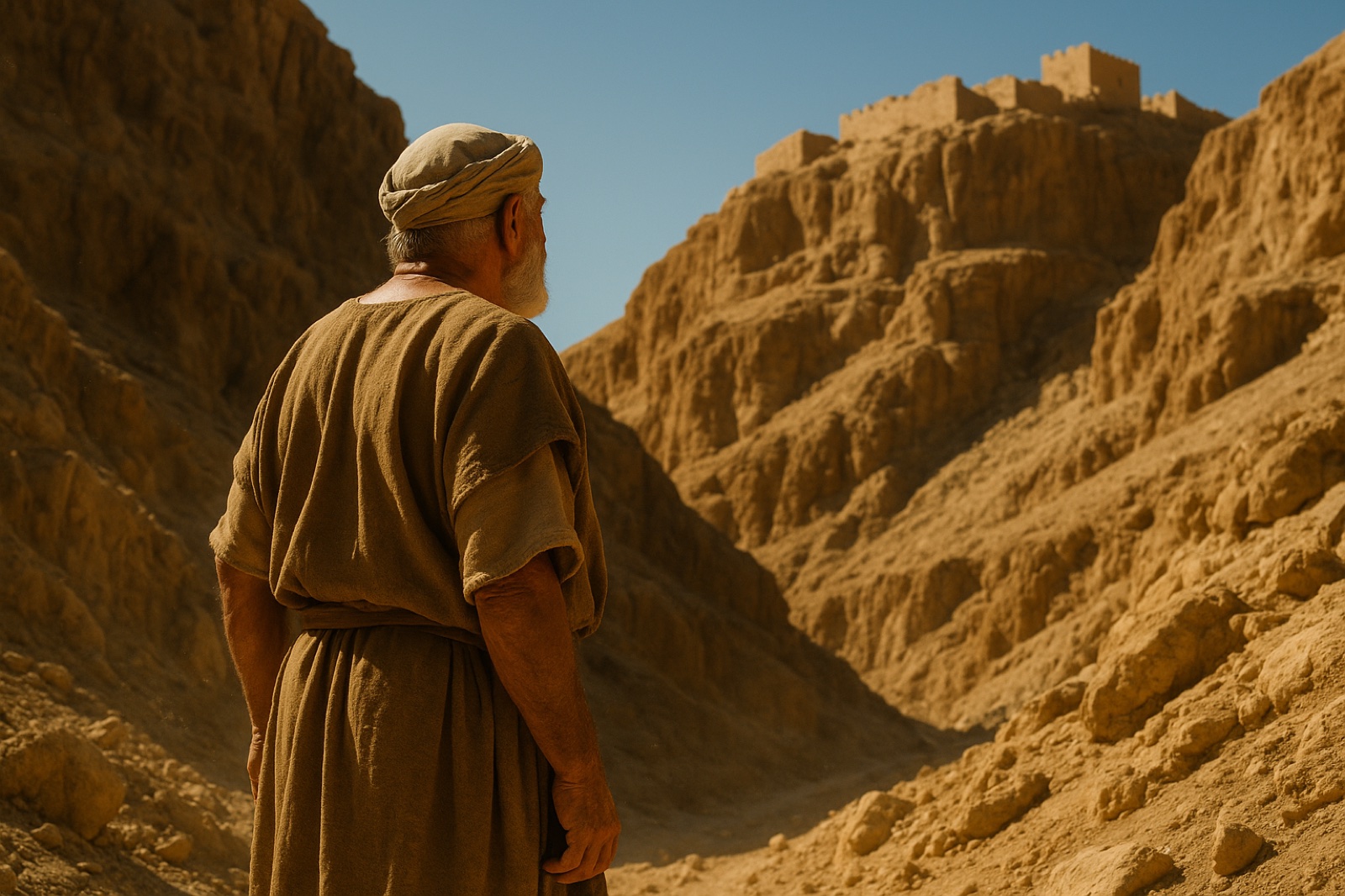
Instead, he asks for Hebron. The hill country. The exact territory where the Anakim — the very giants that made ten grown men weep with fear forty-five years earlier — were still living. He asks, by name, for the hardest ground on the map.
He doesn’t ask for it despite his age. He points to his age as the reason he’s ready. “I am this day fourscore and five years old… as my strength was then, even so is my strength now.” Caleb isn’t in denial about being 85. He’s saying that whatever strength carried him through four decades of waiting is still available for the job he was originally promised.
Why This Wasn’t About Being Tough at 85
Here’s what’s easy to miss if you read this as a story about an unusually tough old man: Caleb’s request wasn’t fueled by stubbornness. Joshua 14:8-9 gives the actual reason twice, in Caleb’s own recounting — he had “wholly followed the LORD.” Not partially. Not mostly, except when it got hard. Wholly, for forty-five years, with nothing to show for it but a promise he hadn’t seen fulfilled yet.
That’s the thread this article has been walking toward. Purpose, in Caleb’s story, was never tied to a season of life. It wasn’t a young man’s assignment that expired when his hair went gray. It was tied to whether he kept following God — and that’s a question with the same answer at 25 and at 85.
The culture around Caleb had a category for 85-year-olds, the same way ours does. Step back. Let the younger ones take the hill. Enjoy what’s left. Caleb had every reason to accept that category — the waiting, the losses, the decades of unfinished promise. He rejected it anyway, not because he had something to prove, but because the God who called him hadn’t changed His mind, and neither had Caleb.
If you’ve ever quietly assumed your best years of usefulness are behind you — that God’s biggest assignments for you were the ones you missed in your thirties, or the ones you’re now too tired, too old, or too late for — Caleb’s mountain is worth sitting with. The window you think closed may have simply been waiting for you to walk back up to it and ask.
What This Looks Like Monday Morning
This isn’t a call to do something reckless. Caleb didn’t demand the mountain out of pride — he asked in front of Joshua, with a plan, trusting God for the outcome. Here’s how to actually put that same posture into practice this week.
Actions to Take
- Name the “someday” you shelved because of timing. Take five minutes today and write down one thing — a calling, a conversation, a skill, a ministry, a dream — that you quietly filed under “that was for a different season of my life.” Just name it. Don’t solve it yet.
- Ask God for it specifically, out loud, today. Not a vague “show me your will” prayer — Caleb didn’t ask Joshua for “whatever’s available.” He named Hebron. Name your mountain in prayer, specifically, the way you’d name it to a friend.
- Take one concrete step toward it before the week ends. Make the call. Send the email. Sign up for the thing. Caleb’s faith showed up as an actual request to an actual person — his faith moved his feet, not just his feelings.
A Few Questions Worth Sitting With
- What’s one assignment you’ve assumed is “closed” that you’ve never actually asked God about lately?
- Whose fear, not your own, might be the reason you’re still waiting on something God already promised you?
- If you knew your strength for this specific thing was fully intact right now, what would you ask for instead of what you’re currently settling for?
A Prayer for the Mountain You’ve Been Avoiding
God, I’ve quietly decided some doors are closed to me now — because of my age, my past, or just how long I’ve been waiting. I confess I’ve been asking You for smaller things than what You actually promised me. Give me Caleb’s kind of memory — one that remembers what You said instead of how tired I feel. Show me the mountain I’ve been walking past, and give me the courage to name it out loud to You today. I still want to follow You wholly, not partially. Amen.
One question for you: If you’re honest, is there a “mountain” you’ve mentally handed over to someone younger, safer, or less tired than you — and what would it take to walk back up and ask for it again?
Share This
- “I asked God for the safe valley. Caleb asked for the mountain full of giants — at 85. Reading Joshua 14 different today.”
- “Your purpose doesn’t have a retirement age. Caleb asked for the hardest ground on the map at 85 — and got it. #Joshua14”
- “Forty-five years of waiting didn’t make Caleb ask for less. It made him ready to ask for exactly what he was promised.”
Questions People Ask About Caleb in the Bible
Who was Caleb in the Bible?
Caleb was one of the twelve spies Moses sent into Canaan in the book of Numbers, and one of only two — along with Joshua — who trusted God’s promise that Israel could take the land despite the powerful people already living there. Because of his faith, God promised Caleb he would personally inherit the land he had scouted (Numbers 14:24).
How old was Caleb when he asked for the mountain in Joshua 14?
Caleb was 85 years old. He tells Joshua directly that 45 years had passed since Moses first sent him to spy out the land, when he would have been about 40 (Joshua 14:10).
What mountain did Caleb ask for?
Caleb asked for Hebron, in the hill country of Judah — the exact territory still occupied by the Anakim, the same people whose size had frightened the other ten spies decades earlier (Joshua 14:12, Joshua 14:15).
Who were the Anakim?
The Anakim were an ancient people known for their unusual size and strength, living in the hill country of Canaan, including Hebron. Their presence was the primary reason ten of the twelve spies discouraged Israel from entering the Promised Land in Numbers 13.
Did Caleb actually take the mountain?
Yes. Joshua 14:13-15 records that Joshua blessed Caleb and gave him Hebron as his inheritance, and Caleb went on to drive out the Anakim who lived there, exactly as he had asked.
If Caleb’s story speaks to a season you’re in right now, you might also find encouragement in how Nehemiah carried a decades-long assignment without burning out, or in these five “purpose quotes” that turn out to be Bible verses in disguise.