 0
0
 0
0
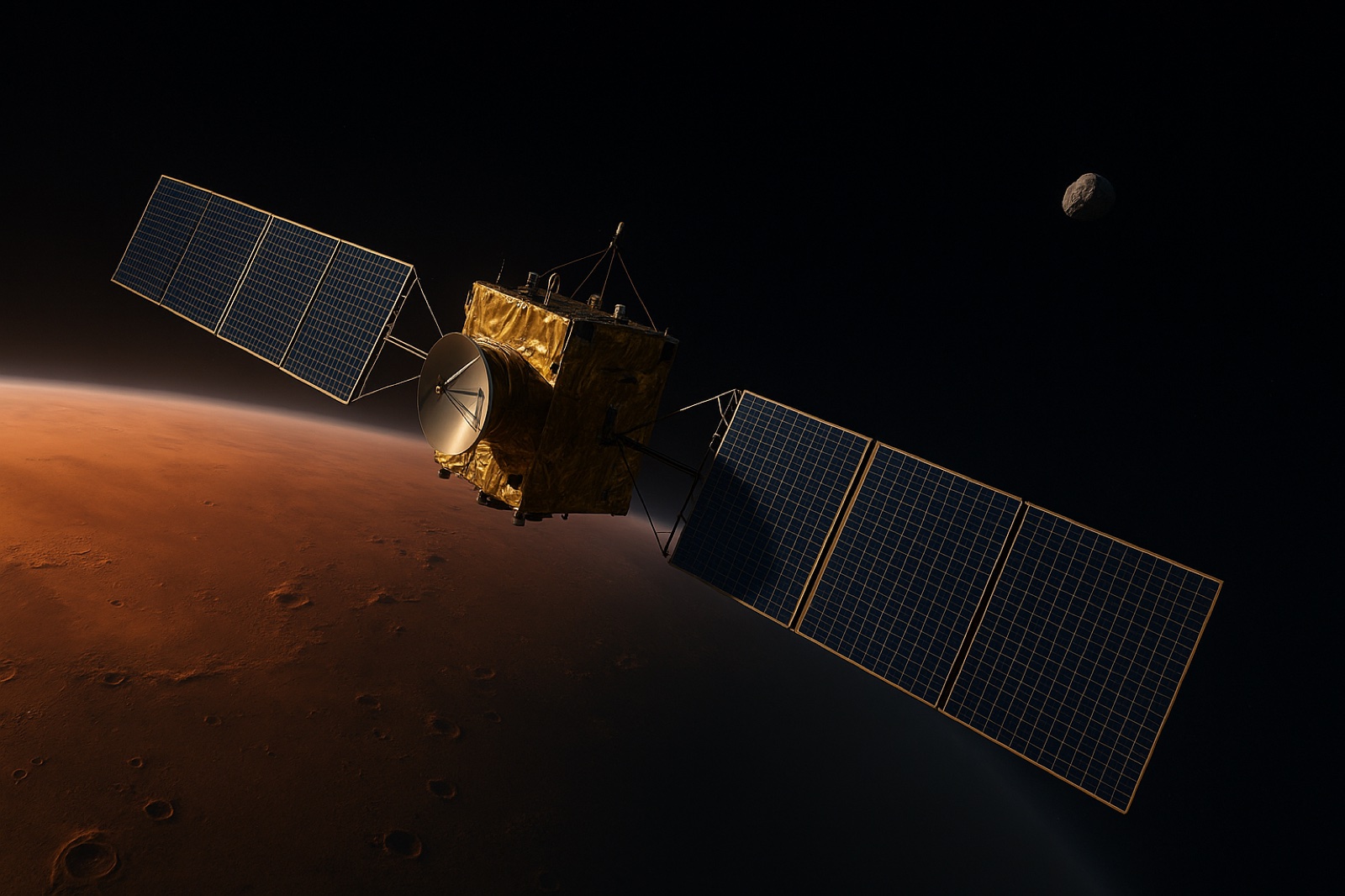
On May 15, 2026, a spacecraft the size of a tennis court skimmed past Mars at just under 2,900 miles from the surface — close enough to catch detailed images of windblown craters and the planet’s south polar ice cap. It wasn’t stopping. It wasn’t even supposed to slow down. NASA’s Psyche mission borrowed a boost of speed from Mars’s gravity, bent its flight path by about one degree, and kept going — because Mars was never the real destination. It was a detour, built into the plan from the very beginning, on the way to somewhere far stranger.
The actual destination is an asteroid that isn’t made of rock or ice like almost everything else floating between Mars and Jupiter. It’s made of metal.
A 140-Mile-Wide Chunk of Metal, Floating in Space
The asteroid is called Psyche — the same name as the spacecraft chasing it — and scientists think it might be the leftover core of a planet that never finished forming. Billions of years ago, in the crowded, violent early solar system, small worlds called planetesimals were colliding, melting, and separating into layers, the same way oil settles apart from water. Heavy metal sank toward the center. Lighter rock floated on top. Most of those baby planets eventually merged into the planets we have today, or got shattered apart entirely.
Psyche may be one that got shattered — leaving only its metal heart drifting through space ever since. At about 140 miles across, it’s the largest object of its kind that we know of. Nothing else like it has ever been visited up close. That’s the whole point of the mission: humanity has sent spacecraft to rock, to ice, to gas giants — but never, until now, to something built almost entirely out of metal.
Why NASA’s Psyche Mission Needed a Detour Through Mars
Here’s the part that’s easy to miss: the Psyche spacecraft could not fly straight to the Psyche asteroid, not efficiently. Carrying enough fuel to power the entire six-year trip on thrust alone would have made the spacecraft too heavy to launch in the first place. So NASA’s navigators built in a stop nobody asked for — a close pass by Mars, timed with extraordinary precision, so the planet’s gravity could do work no onboard engine could do alone.
It worked exactly as planned. Mars’s gravity handed Psyche a free boost of roughly 1,000 miles per hour and bent its path by about one degree relative to the sun — a change too small to notice with the naked eye, but exactly the adjustment needed to line up a rendezvous with an asteroid nearly three years and hundreds of millions of miles away. The mission’s navigation team confirmed that Psyche flew by Mars on exactly the trajectory needed to set it on a path to reach the asteroid in the summer of 2029.
No extra fuel. No do-over. A single, carefully aimed detour, planned years in advance, engineered to look like a delay and function like a shortcut.
Why Study a Core You’ll Never Actually Touch
Every rocky planet — Earth included — is thought to carry a dense metal core at its center, shaped by the same separation process that likely built the real Psyche billions of years ago. But no drill, no probe, nothing humans have ever built could survive the pressure and heat required to reach Earth’s own core and look at it directly. It sits roughly 1,800 miles beneath our feet, permanently out of reach.
The asteroid Psyche offers something rare: a planetary core that’s already exposed, already reachable, floating in space where a spacecraft can actually get close enough to study it. Researchers who study how planets form have compared it to being handed a cutaway model of something normally sealed inside every rocky world in the solar system — a shortcut to understanding a part of our own planet we will never be able to visit ourselves.
The Part of the Trip That Looked Like a Waste of Time
If you only looked at a map, the Mars flyby looks like a step backward. The spacecraft is headed out to the asteroid belt, and here it is, swinging back toward an inner planet, spending months of travel time on a stop that isn’t even the destination. Out of the way. Inefficient. Almost pointless — unless you already know how the story ends.
People who study long, hard journeys keep running into a version of this same shape. One of the oldest stories in recorded history is about a young man sold into slavery by his own brothers, dragged hundreds of miles in the wrong direction, and left in a foreign country’s prison for years before anything good happened to him. By any measure at the time, that detour looked like the end of his story, not a chapter in it. It took decades before he could look back and see the whole route — and when he finally did, he told the very brothers who sold him that what looked like ruin had actually placed him exactly where an entire region needed him to be, right on time, to survive a famine nobody saw coming.
Nobody watching that detour happen in real time could have called it a plan. It only looked like one from the far end — the way Psyche’s swing past Mars only makes sense once you already know 2029 is coming. Some people call that coincidence. Others have spent a very long time calling it something bigger, quietly keeping track of details nobody else was tracking.
It’s the same shape people keep finding in the middle of their own waiting — the years that felt like the wrong direction, the plans that stalled for reasons nobody explained at the time. Some of the oldest writing we have on record comes from someone who waited years for an answer that didn’t come on his timeline, and came to trust that the silence wasn’t the same thing as being ignored. Even the seasons that feel like uprooting have shown up, again and again, as necessary — not despite the timing, but because of it.
What Happens Next
Psyche won’t reach its actual destination until the summer of 2029. When it does, it will spend roughly two years orbiting the metal asteroid, moving progressively closer — from more than 400 miles out down to less than 40 — mapping its surface, studying its composition, and trying to confirm whether this strange metal world really is what scientists think it is: the exposed core of a planet that almost was.
The best endings to detour stories tend to make the detour make sense — but only once you’ve actually arrived. For now, Psyche is still three years and hundreds of millions of miles from that moment. It’s simply doing, quietly and precisely, exactly what it was built to do: taking the long way, on purpose, toward something worth the wait.
Talk About It
If you found out, years later, that a costly detour in your own life had actually placed you exactly where you needed to be — would you call that luck? Or something else? Tell us in the comments.
Share This
- A NASA spacecraft just swung past Mars on purpose — not to visit it, but to steal a little of its gravity on the way to a 140-mile-wide chunk of pure metal floating in space. Wild detour, wilder destination.
- NASA’s Psyche mission took the “wrong” direction on purpose so it could arrive exactly on time in 2029. Sometimes the detour really is the plan.
- The asteroid NASA is chasing might be the leftover metal core of a planet that never finished forming. We’ve never visited anything like it before.
Quick Questions, Answered
What is NASA’s Psyche mission?
NASA’s Psyche mission is a spacecraft launched in October 2023 to study a metal-rich asteroid also named Psyche, located in the asteroid belt between Mars and Jupiter. It’s the first mission ever sent to study a world made mostly of metal instead of rock or ice.
What happened during the Mars flyby?
On May 15, 2026, the Psyche spacecraft flew within about 2,900 miles of Mars, using the planet’s gravity to gain roughly 1,000 miles per hour of speed and shift its flight path without using any fuel. The close pass also let the mission test its science instruments on Mars as a stand-in for the asteroid.
When will Psyche reach the asteroid?
The spacecraft is expected to arrive at the asteroid Psyche in the summer of 2029, roughly six years after launch, and will then spend about two years orbiting it.
Why is the asteroid Psyche important to scientists?
At about 140 miles across, Psyche is the largest known metal-rich asteroid and may be the exposed metal core of a small planet that broke apart or never finished forming billions of years ago. Studying it up close could reveal what the interior of a planet — including Earth’s own core — actually looks like.
What is a gravity assist?
A gravity assist is a technique where a spacecraft flies close to a planet and uses its gravity to change speed or direction without burning extra fuel. It lets missions reach distant destinations using far less propellant than a direct flight would require.