 0
0
 0
0
You know the feeling. You’re three weeks into a project that should have taken one. Every time you fix one problem, two more show up. Some people doubt you’ll finish. A few are quietly rooting for you to fail. And somewhere around week two, you stop asking “when will this be done” and start asking “why am I even doing this.”
That’s burnout. Not the Instagram-therapy-speak version — the real thing. The kind where you’re not tired because you’re lazy, you’re tired because you’ve been carrying two jobs at once for too long: doing the actual work, and defending the work from everything trying to stop it.
Which is exactly the position a man named Nehemiah was in about 2,400 years ago. And if you’ve ever wondered who was Nehemiah in the Bible, the short answer is this: he’s the guy who finished an impossible project, under constant threat, in 52 days — and Scripture tells us exactly how.
Who Was Nehemiah in the Bible, Really?
Nehemiah wasn’t a priest, a prophet, or a warrior. He was a cupbearer — basically the Persian king’s trusted personal attendant. It was a good job. Safe. Comfortable. Close to power.
Then he got news from home: Jerusalem’s walls, torn down over a century earlier, were still rubble. The city his people were trying to rebuild their lives in had no protection at all. When he heard it, Nehemiah sat down and wept. Then he mourned, fasted, and prayed for days before he did anything else.
He didn’t have a plan yet. He just had a broken thing he couldn’t stop thinking about.
Eventually, he asked the king for permission to go rebuild it himself. He got it. And when he arrived in Jerusalem, he found exactly what he expected: a demolished wall, a discouraged population, and — almost immediately — organized opposition. Local officials named Sanballat, Tobiah, and Geshem mocked the project, spread rumors that it was a cover for rebellion, and eventually plotted an ambush to stop construction altogether.
This is the part people skip past when they tell this story. Nehemiah didn’t rebuild a wall in peacetime. He rebuilt it while being actively opposed, the entire time, by people with real power to hurt him.
One Hand on the Trowel, One Hand on the Sword
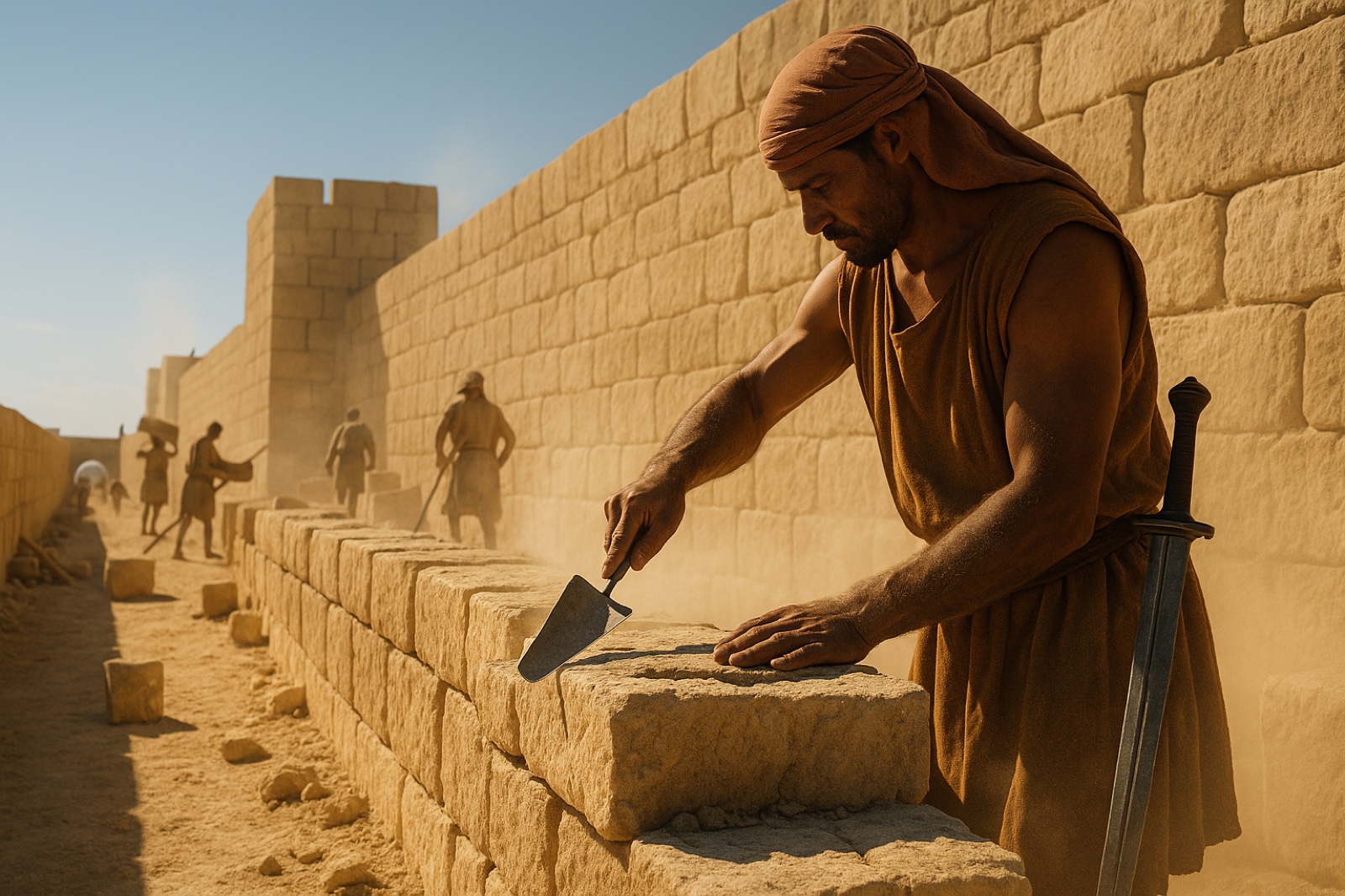
Here’s how the workers responded, in their own words, recorded in Nehemiah 4:17: “They which builded on the wall, and they that bare burdens, with those that laded, every one with one of his hands wrought in the work, and with the other hand held a weapon.”
Read that again slowly. These weren’t soldiers standing guard while someone else worked. They were the same people — one hand carrying stone, the other hand ready to fight, at the same time, for the entire length of the project. Nehemiah goes on to describe workers who slept in their clothes with their weapons within reach, because the threat never fully went away.
And they still finished. Fifty-two days, start to finish, for a wall that had sat in ruins for over a century. Even their enemies noticed something was different — the surrounding nations perceived that the work had been done with God’s help, because there was no natural explanation for how a demoralized, exhausted, constantly-threatened crew finished that fast.
So what kept them going? It wasn’t more energy. It wasn’t a better schedule. It was something Nehemiah said out loud right before the work started: “Ye see the distress that we are in… come, and let us build up the wall of Jerusalem, that we be no more a reproach” (Nehemiah 2:17). He named the actual reason, out loud, before a single stone moved. Not “because I said so.” Not “because it’s our job.” Because the wall meant their families would stop living exposed and ashamed. Because it mattered, specifically, to them.
What Burnout Research Keeps Rediscovering
Modern burnout research — going back to the foundational work of psychologist Christina Maslach in the 1970s — found something that surprises most people. Burnout isn’t primarily caused by working too many hours. It’s caused by working hard for a reason that’s stopped feeling real. Two people can work the exact same brutal schedule; the one who can still answer “why does this matter” tends to hold up. The one who can’t, breaks down — even if their hours are lighter.
That’s the antidote researchers keep landing on, decades later: not rest alone, not fewer hours alone, but reconnecting to purpose. And that is precisely what Nehemiah’s crew never lost. They worked exhausted. They worked afraid. They worked with a weapon in one hand the entire time. But they never once forgot why the wall mattered, and that’s what let them out-endure people who had every material advantage over them.
That’s the part of this story most people miss when they read it as ancient history. Nehemiah isn’t a story about God removing the opposition. The enemies were real for all 52 days. It’s a story about what happens when you can’t set down the threat, but you also never set down the reason.
Two Actions You Can Take Right Now
- Write the actual reason on a sticky note. Not “finish the project” — the real, human reason underneath it. Nehemiah’s was “so my people stop living in shame.” Yours might be “so my kids see what finishing looks like” or “so this stops costing me sleep.” Put it somewhere you’ll see it in the next ten minutes.
- Name your Sanballat. Nehemiah’s opposition had actual names and faces — that’s part of why he could keep working instead of just feeling generally anxious. What’s the specific voice, person, or doubt working against you right now? Naming it, even just to yourself, takes it out of the vague, exhausting background noise and turns it into something you can actually hold a weapon against.
God, I’m tired in a way that rest alone hasn’t fixed. I’ve been carrying the work and guarding it from everything trying to stop it, and I don’t always remember why I started. Help me hold onto the real reason today — not the deadline, the actual reason underneath it. Give me what Nehemiah’s crew had: enough clarity to keep both hands full and still not quit. Amen.
Something to Think About
If you had to say out loud, in one sentence, the real reason behind whatever you’re grinding through right now — not the task, the reason underneath it — what would you say? Tell us in the comments.
“Burnout isn’t about hours. It’s about forgetting why. Nehemiah rebuilt a wall in 52 days under constant threat because he never let go of the reason.”
“Nehemiah’s crew worked with a trowel in one hand and a sword in the other — for the entire project. That’s not just a Bible fact. That’s a burnout cure.”
“I just learned the guy who rebuilt Jerusalem’s wall in 52 days did it exhausted, threatened, and outnumbered. What saved him wasn’t strength. It was never forgetting why.”
Questions and Answers
Who was Nehemiah in the Bible?
Nehemiah was a Jewish cupbearer serving the Persian king when he learned Jerusalem’s walls were still in ruins. He asked for permission to return and rebuild them, then led that rebuilding effort himself despite active opposition, finishing the wall in just 52 days.
What does Nehemiah 4:17-18 mean?
It describes the construction crew literally working with one hand while holding a weapon in the other, because the threat of attack from local enemies never fully stopped during the rebuilding project. It’s a picture of doing necessary work while staying alert to real opposition, without letting either one stop the other.
How long did it take Nehemiah to rebuild the wall?
Fifty-two days — remarkable given the wall had been in ruins for over a century and the crew faced organized opposition the entire time.
What can Nehemiah teach us about burnout?
That burnout isn’t cured primarily by more rest or fewer hours — it’s cured by staying connected to the actual reason the work matters. Nehemiah’s crew worked exhausted and threatened but never lost sight of why the wall mattered, which is what let them outlast people with every material advantage.
Who opposed Nehemiah while he rebuilt the wall?
Regional officials named Sanballat, Tobiah, and Geshem mocked the project, spread rumors, and eventually planned an ambush to try to stop construction.
If burnout has you wondering whether anyone your age has ever felt this stretched thin, Solomon ran a version of this same audit 3,000 years ago. And if what you’re really craving right now isn’t less work but less exposure to it, it’s worth reading about why “quiet cracking” has become the word for falling apart while still showing up. Sometimes the answer really is the harder path — choosing the inconvenient thing on purpose is its own kind of Nehemiah move.