 0
0
 0
0
Maybe you were reading Exodus on your own. You got past the Red Sea, past the Ten Commandments, and then chapter 21 opened with a sentence that made your stomach drop: “If thou buy an Hebrew servant…”
Or maybe someone else found it first. A friend, a coworker, a comment under a video. “Your Bible has rules for owning people. Explain that.”
If that question has been sitting in you, you are not a bad believer for feeling it. It is a fair question. Why did God allow slavery in the Bible? The honest answer does not pretend the hard verses aren’t there. But it also shows you something most people never get told: the Law of Moses said a thing about runaway slaves that one of the most famous law codes of the ancient world, and the United States Congress in 1850, both said the exact opposite of.
Why Did God Allow Slavery in the Bible? The Short, Honest Answer
Here is the answer in plain words, before we dig.
Israel did not invent slavery. It was already everywhere when the Law was given, woven into how poor families survived debt and how nations treated people taken in war. The Law of Moses did not abolish it in one stroke. That is true, and it is worth saying out loud.
What the Law did was put limits and protections around servants that were unusual for its world. It made kidnapping a person a crime punishable by death. It set a release date for Hebrew servants. It freed a servant whose master injured them. And it told Israel not to hand an escaped slave back to his master.
Some of the verses are still genuinely hard, and we will look at those too. But there is a reason written underneath every one of these rules, and it changes how you read the whole thing.
One Runaway, Three Very Different Laws
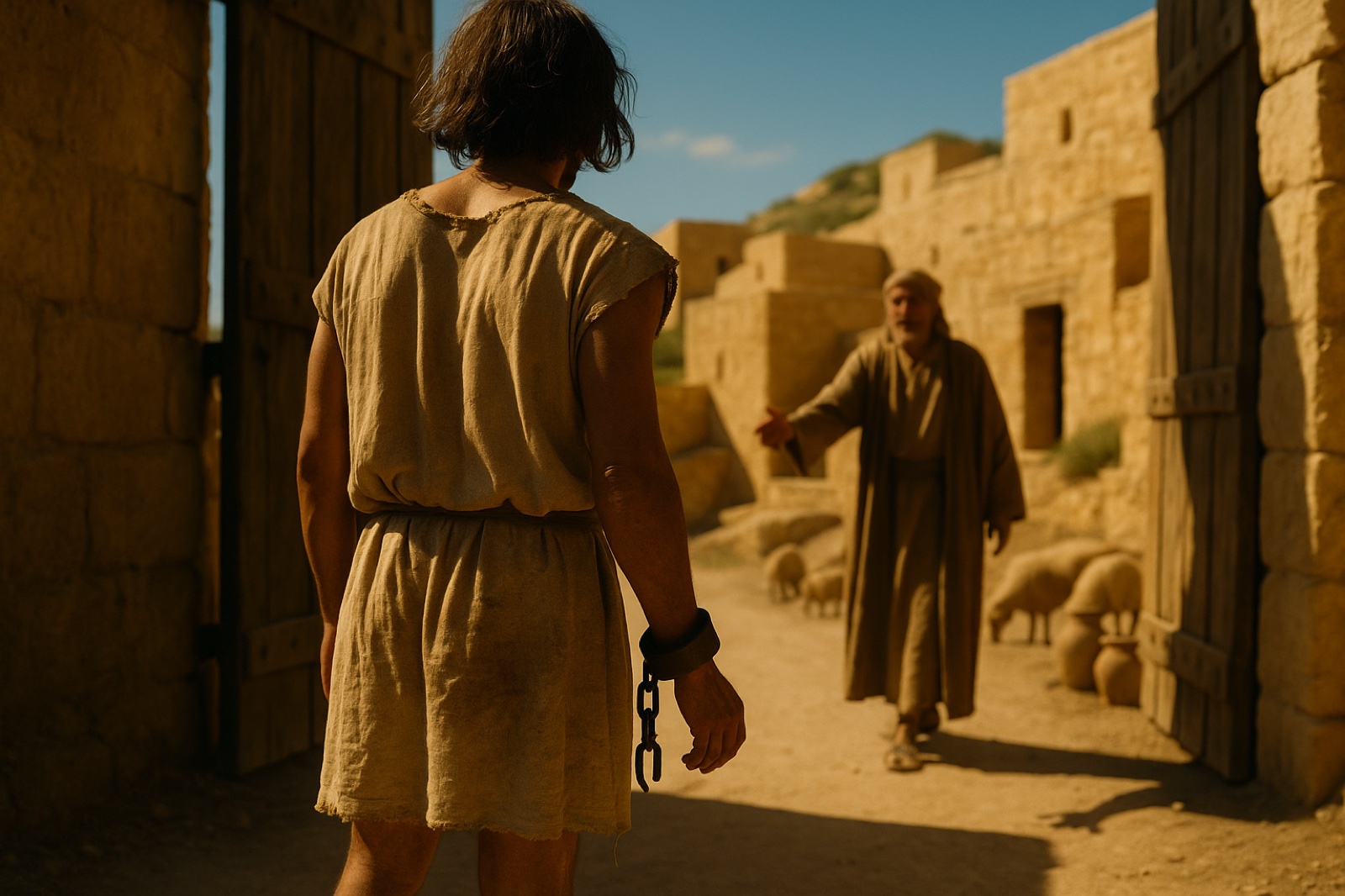
Picture one person. They have escaped a master, and they are standing at the gate of a town, asking to be let in. What should the town do?
Babylon’s answer
The Code of Hammurabi comes from ancient Babylon and is older than the Law of Moses. It is one of the most famous law codes in history. Here is what it said about that person at the gate, in a standard English translation:
“If any one receive into his house a runaway male or female slave of the court, or of a freedman, and does not bring it out at the public proclamation of the major domus, the master of the house shall be put to death.” (Law 16)
Hide a runaway, and you die. The law right before it was just as strict: taking a slave “outside the city gates” was also punishable by death (Law 15). And the law right after it paid a reward. Anyone who caught runaway slaves in the open country and brought them back was to be paid “two shekels of silver” by the master (Law 17).
Notice the word “it.” The runaway is property. The law protects the owner.
America’s answer, in 1850
Now jump forward thousands of years. In 1850, the United States passed the Fugitive Slave Act. People who had escaped slavery in the southern states and reached free states in the north could be seized and sent back.
Anyone who helped an escaped person, hid them, or blocked their capture faced a fine of up to $1,000 and up to six months in prison. The official who decided each case was paid $10 if the person was sent back into slavery, and only $5 if the person was set free.
Different country, different century, same shape as Babylon: punish the helper, reward the return.
The Law of Moses’ answer
Now read Deuteronomy:
“Thou shalt not deliver unto his master the servant which is escaped from his master unto thee: He shall dwell with thee, even among you, in that place which he shall choose in one of thy gates, where it liketh him best: thou shalt not oppress him.” (Deuteronomy 23:15-16, KJV)
Don’t send him back. Let him live among you. Don’t oppress him.
And look closely at the small words, because they are the gold here. Babylon punished anyone who took a slave out through the city gates. Deuteronomy tells the escaped person to pick which gate they want to live inside: “in that place which he shall choose… where it liketh him best.” The first thing this law hands a runaway is not a verdict. It is a choice. The Babylonian runaway was an “it.” This one is a “he,” with preferences the law tells you to respect.
We should be precise about one thing. Many Bible scholars think this command mainly had in view a slave fleeing into Israel from a master in another land, since the escaped person comes “unto thee” and settles “in one of thy gates.” That may be right. Even on that reading, Israel was being told to become a place of refuge for escaped slaves instead of a place that returned them, which is exactly what its neighbours did not do.
And people in 1850 noticed. American abolitionists put these two verses in front of the public again and again to oppose the new law. A minister in Stoneham, Massachusetts, preached on Deuteronomy 23:15-16 in response to it. Samuel May Jr. printed the same verses at the top of a pamphlet explaining what the Fugitive Slave Act required. They could see it plainly: Congress had commanded the very thing the Law of Moses forbade.
What Else the Law of Moses Put Around a Servant
Deuteronomy 23 does not stand alone. A few more laws show the same pattern. If you want the background on the word itself, our study of the Hebrew word for servant, eved, shows how one word covered everyone from a debt worker to a king’s officer.
Kidnapping a person was a capital crime.
“And he that stealeth a man, and selleth him, or if he be found in his hand, he shall surely be put to death.” (Exodus 21:16, KJV)
Think about how the Atlantic slave trade began: human beings seized by force and sold. Under this verse, that act, and even being found holding the person, was a death-penalty crime. Centuries later Paul listed “menstealers” among the people who stand against sound teaching (1 Timothy 1:10).
Hebrew servants went free. “Six years he shall serve: and in the seventh he shall go out free for nothing” (Exodus 21:2). Leviticus goes further. If a fellow Israelite became poor and had to sell himself, “thou shalt not compel him to serve as a bondservant: But as an hired servant, and as a sojourner, he shall be with thee” (Leviticus 25:39-40).
An injured servant walked free. “And if a man smite the eye of his servant, or the eye of his maid, that it perish; he shall let him go free for his eye’s sake” (Exodus 21:26). The same was true for a knocked-out tooth (verse 27).
Put that next to Hammurabi again. In Babylon, if someone put out the eye of another man’s slave, “he shall pay one-half of its value” (Law 199). The payment went to the owner. In Exodus, when a master injures his own servant, the payment is the servant’s freedom.
Freedom came with provisions. “And when thou sendest him out free from thee, thou shalt not let him go away empty: Thou shalt furnish him liberally out of thy flock, and out of thy floor, and out of thy winepress” (Deuteronomy 15:13-14). A freed servant was not pushed out the door with nothing.
The Verses That Are Genuinely Hard
It would be dishonest to stop there. So here are two passages that trouble careful readers, including many who love the Bible deeply.
“Both thy bondmen, and thy bondmaids, which thou shalt have, shall be of the heathen that are round about you; of them shall ye buy bondmen and bondmaids… they shall be your bondmen for ever: but over your brethren the children of Israel, ye shall not rule one over another with rigour.” (Leviticus 25:44, 46, KJV)
The release dates and the gentler terms were for fellow Israelites. People from other nations could be held for life and passed on to children. The protections were real, but they were not equal.
“And if a man smite his servant, or his maid, with a rod, and he die under his hand; he shall be surely punished. Notwithstanding, if he continue a day or two, he shall not be punished: for he is his money.” (Exodus 21:20-21, KJV)
A master who beat a servant to death was to be punished. But those last four words, “for he is his money,” are hard to read. There is no need to rush past them.
Christians have wrestled with these verses for a very long time, and not everyone lands in the same place. Some point out that this was a legal system meeting a broken world where it was, restraining the worst of it rather than pretending it away. Others simply say, honestly, that these passages hurt and they hold that tension in faith. You are allowed to be in either place.
What history shows is that the Bible cannot be read as a clean argument for slavery. In 1850 both sides opened the same book. Defenders of the Fugitive Slave Act pointed to Paul sending a runaway named Onesimus back to his master. But in that very letter Paul asked the master to take him back “not now as a servant, but above a servant, a brother beloved” (Philemon 1:16). The people who used that letter to send human beings back into chains had to skip that line to do it.
The Reason Written Underneath the Rules
Here is the thing most people read past. When the Law explains why a servant should be treated well, it almost never argues from fairness or economics. It gives one reason, over and over.
Why send a freed servant away with food and animals? “And thou shalt remember that thou wast a bondman in the land of Egypt, and the LORD thy God redeemed thee: therefore I command thee this thing to day” (Deuteronomy 15:15).
Why can’t an Israelite be sold as a slave? “For they are my servants, which I brought forth out of the land of Egypt: they shall not be sold as bondmen” (Leviticus 25:42).
And how does God introduce the Ten Commandments in the first place? “I am the LORD thy God, which have brought thee out of the land of Egypt, out of the house of bondage” (Exodus 20:2).
Before a single rule is given, God chooses to be known as the one who got slaves out. Not the God of Israel’s kings. Not the God of its wealth. The God of the people who used to make bricks for Pharaoh.
So these laws were not written from the master’s chair. They were written to a nation of former slaves by a God who defines their whole relationship by a jailbreak. That memory is why the runaway is not sent back. It is why the injured servant walks out. And it is the same memory that later generations of enslaved people heard in the Exodus story when they sang about Moses and Pharaoh. We looked at that in what Juneteenth reveals about the God of the Bible.
This is the turn. You came asking why God allowed slavery. The Bible hands you something unexpected: the measuring stick to judge every slave system that has ever existed, including the parts of its own world that its laws did not fully close. “Remember you were a slave, and God set you free” is a seed. It was planted inside an ancient legal code, and it kept growing until it cracked the code open.
When Jesus stood up in the synagogue in Nazareth, He read what He had come to do: “to preach deliverance to the captives, and recovering of sight to the blind, to set at liberty them that are bruised” (Luke 4:18). And Paul wrote that in Christ “there is neither bond nor free” (Galatians 3:28). The direction was never back toward the master’s house. It was always out through the gate.
If you still have questions after all this, that’s alright. You can keep exploring them with our free Bible Answers AI assistant (it opens in ChatGPT).
Actions to Take Today
- Read the two sides together. Open to Deuteronomy 23:15-16, then Leviticus 25:44-46. Read both slowly. Write down one honest question you still have. You don’t have to answer it today. Faith can hold a question.
- Change how you answer the challenge. Next time someone says “the Bible supports slavery,” don’t argue. Ask, “Which verse are you thinking of?” Then read it together, and show them Deuteronomy 23:15 and Exodus 21:16 too. A shared reading does more than a won debate.
- Look at today’s “menstealers.” Forced labour and human trafficking still exist in almost every country. Spend five minutes finding out the warning signs, and the helpline or reporting number where you live. The command not to send the runaway back still has people attached to it.
Journaling Prompts
- When you hit a hard verse, what do you usually do with it: skip it, hide it, or bring it to God? What would it look like to bring it to God honestly this week?
- The Law told Israel to “remember that thou wast a bondman.” What is something God has brought you out of that you are in danger of forgetting? How would remembering it change the way you treat someone who is still stuck?
A Prayer for When the Bible Is Hard to Read
God, some of these verses hurt to read, and I don’t want to pretend they don’t. Thank You that You chose to be known as the God who brings people out of the house of bondage. Help me hold my questions honestly without letting go of You. Teach me to be a gate that opens for people who are running from something, not one that sends them back. Amen.
Discussion Question
Why do you think a law given thousands of years ago would tell people not to return a runaway slave, when a modern nation in 1850 demanded the opposite? Share your thoughts in the comments below. We read every one.
Share This
- “Babylon paid a reward for returning runaway slaves. America’s 1850 law did too. Deuteronomy 23:15 said: don’t send them back. I never knew that.”
- “I used to skip the hard verses about slavery in the Bible. Turns out the Law’s reason for every protection was the same: remember you were slaves, and God set you free.”
- “The first thing the Law of Moses gave an escaped slave wasn’t a verdict. It was a choice: live wherever you like best. That detail stopped me.”
Questions People Ask About God and Slavery in the Bible
Why did God allow slavery in the Bible?
Slavery already existed across the ancient world when the Law of Moses was given, mostly as debt servitude and the treatment of war captives. The Law did not abolish it outright, but it regulated it with protections unusual for that time: kidnapping a person was punishable by death (Exodus 21:16), Hebrew servants were released in the seventh year (Exodus 21:2), injured servants were set free (Exodus 21:26-27), and escaped slaves were not to be returned to their masters (Deuteronomy 23:15-16). Some passages, such as Leviticus 25:44-46, remain genuinely difficult, and Christians have wrestled with them honestly for centuries.
What does Deuteronomy 23:15 say about runaway slaves?
Deuteronomy 23:15-16 in the King James Version says: “Thou shalt not deliver unto his master the servant which is escaped from his master unto thee: He shall dwell with thee, even among you, in that place which he shall choose in one of thy gates, where it liketh him best: thou shalt not oppress him.” Many scholars believe it mainly concerned slaves fleeing into Israel from other lands. Either way, it made Israel a place of refuge rather than a place that returned escaped slaves.
How was the Law of Moses different from the Code of Hammurabi on slavery?
The Code of Hammurabi, from ancient Babylon, made hiding a runaway slave punishable by death (Law 16) and paid a reward of two shekels of silver to anyone who returned runaways to their masters (Law 17). Deuteronomy 23:15-16 forbade returning an escaped slave. Hammurabi’s Law 199 required someone who put out the eye of another man’s slave to pay the owner half the slave’s value, while Exodus 21:26 required a master who destroyed his own servant’s eye to set that servant free.
Did abolitionists use the Bible against the Fugitive Slave Act?
Yes. After the United States passed the Fugitive Slave Act of 1850, which punished anyone who helped an escaped slave with a fine of up to $1,000 and up to six months in prison, many Christian abolitionists pointed to Deuteronomy 23:15-16, which forbids returning an escaped slave to a master. Ministers preached on the passage, and abolitionist Samuel May Jr. printed it alongside his summary of the law. Defenders of slavery, meanwhile, often pointed to Paul sending Onesimus back to Philemon.
Does the Bible condemn kidnapping people to sell them as slaves?
Yes. Exodus 21:16 in the King James Version says: “And he that stealeth a man, and selleth him, or if he be found in his hand, he shall surely be put to death.” Deuteronomy 24:7 gives the same penalty for anyone who steals and sells a fellow Israelite, and in the New Testament, 1 Timothy 1:10 lists “menstealers” among those whose actions are contrary to sound doctrine. Seizing people by force and selling them was at the heart of the Atlantic slave trade.