 0
0
 0
0
Somebody handed you a folded paper programme. Or a message came through on your phone. And somewhere near the bottom, in small letters, it said: Repast to follow.
So you stood there — maybe in a car park, maybe in a hallway, maybe still in your seat with your coat on your lap — and thought: what is that? Am I invited? Do I need to bring something? Is it rude to go? Is it rude not to go?
Here is the short answer first, because you probably do not have time for a long one right now.
Repast Meaning: The Short Version
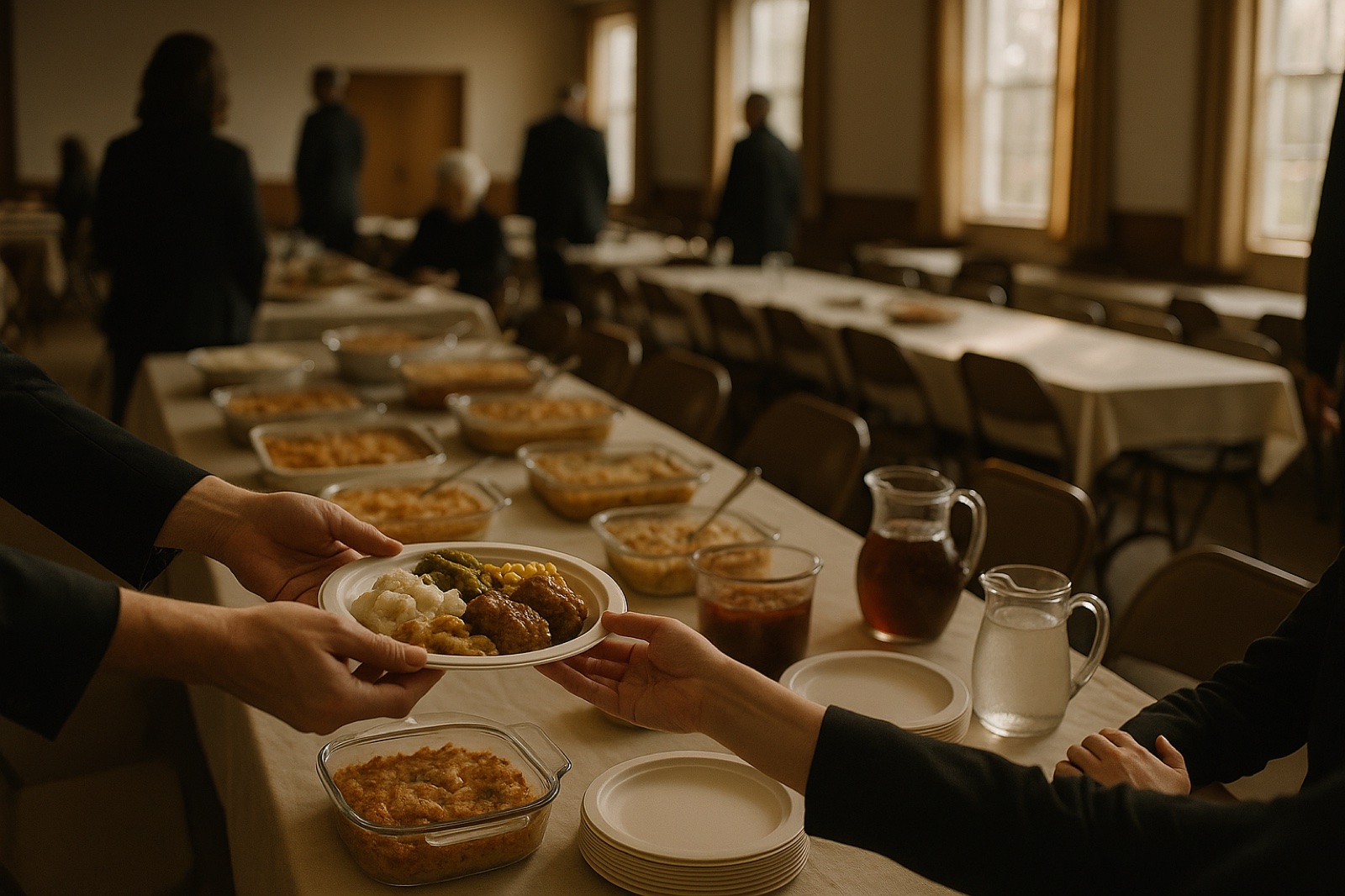
A repast is the meal after a funeral.
That is the whole meaning. It is not a second ceremony. There is no order of service. Nobody is going to call on you to speak, sing, or say anything clever.
It is food, chairs, and people who are very tired.
It usually happens straight after the burial or the service. It might be in a church hall, at the family’s home, in a room at the funeral home, or at a restaurant somebody booked for the afternoon. It can last one hour or five.
And “repast to follow” means you are invited. You do not need a separate card or a special word from the family. If you were welcome at the service, you are welcome at the meal.
When It Happens, and How Long You Should Stay
Most repasts begin within an hour of the burial. People arrive in waves — the family last, usually, because they have been dealing with the cemetery.
How long should you stay? Long enough to be seen, long enough to eat something, and long enough to say one sentence to the person who is grieving most.
That can be forty minutes. It does not have to be four hours.
Leaving early is normal. People slip out all afternoon. Nobody is keeping a list.
What to Bring (And What to Do If You Have Nothing to Bring)
If the family has asked for food, bring food. A tray of something that does not need reheating is worth more than something that needs an oven and a serving spoon nobody can find.
If you have not been asked, you do not have to bring anything at all. This is the part people get wrong. A repast is usually hosted — by the family, by their church, by a friend, by a club or union the person belonged to. Somebody has already thought about the food.
And if money is tight, read this part twice: you are not required to arrive holding something. A grieving family will not remember what you carried. They will remember that your face was in the room.
If you want to help and cannot buy anything, there is always work to do. Someone has to carry chairs. Someone has to wash up. Someone has to sit with the elderly aunt nobody is talking to. That is a gift, and it costs nothing.
What to Say When You Get There
Short is better than clever. Honest is better than polished.
“I am so sorry.” “I loved him.” “I do not know what to say, but I wanted to be here.” All of those land perfectly well.
What you want to avoid is explaining the death to the person who just lived through it — the reasons, the lessons, the silver linings. It is worth knowing what not to say to someone who is grieving, because most of the painful lines come from people who meant it kindly.
And if the person who died was someone’s mother or father, the hardest part for them does not start today. It starts in about three weeks, when everyone else goes back to normal. There is a lot to be said for staying past the funeral.
A good place to start:
The Beginner’s Guide to Feeling God’s Presence Every Day
A short guide for the ordinary days — the kitchen, the commute, the hour after everyone has gone home — when you want to feel that you are not carrying it alone.
Get the free guide
Free.
The Word Itself Has Nothing to Do With Funerals
Here is a small surprise. “Repast” is not a funeral word.
It came into English in the late 1300s from Old French, and it simply meant a meal. Any meal. Breakfast was a repast. A feast was a repast. Underneath it sits the Latin repascere — to feed again.
That is all the word has ever promised. Not a ritual. Not a speech. To feed again.
Which, if you think about what grief actually does to a person, is an oddly exact description of the job. People stop eating when someone dies. They forget. They do not feel hungry and then suddenly they are shaking. The meal after the funeral is the moment somebody puts a plate in front of them and starts them off again.
In the United States the word is most strongly associated with Black families and Black churches, where the repast has long been organised by a bereavement committee or by the groups the person belonged to — a church, a union, a sorority. That is where most people in English-speaking countries first meet the word, which is exactly why so many people have to look it up.
Nearly Every Culture Has a Repast. They Just Use a Different Name.
Once you know what to look for, you see it everywhere.
- In parts of northern England it is the funeral tea.
- Chinese families may hold a consolation feast.
- Irish and Scottish traditions fold the food into the wake.
- Catholic communities sometimes call it a mercy meal.
- In Jewish practice the first meal after the burial has its own name: seudat havra’ah, the meal of consolation.
Different rooms, different food, same instinct. Somebody died, so now we eat together.
The Oldest Version of This Rule Is Stricter Than Ours
That Jewish meal of consolation is worth a closer look, because it is not a suggestion. It is a rule, and the rule runs in the opposite direction from the one you would expect.
The mourner is not supposed to provide that first meal. Traditional Jewish law holds that mourners may not eat their own food at the meal after the burial — neighbours and friends must bring it to them. It is the community’s job, not the family’s.
The classic foods are round. Hard-boiled eggs and lentils. One traditional explanation is that an egg is sealed shut with no opening, like a mourner who has no words; another is that a lentil has no eye, because the one who died is no longer seen. Modern practice is gentler, and guests now usually share the meal rather than only the mourners eating. But the older sources are strict enough that a mourner with nobody to bring them food was told to wait until nightfall rather than cook for themselves.
Sit with that for a second. The tradition would rather a grieving person go hungry for an afternoon than let them be the one doing the feeding.
Keep pulling that thread and you reach something older than any of these names.
In some of the oldest writing we have about grief, the meal is never argued for. It is simply assumed, the way weather is assumed. And in one passage, where a people are being warned that every good thing is about to be withdrawn from them, the worst picture God reaches for is not fire and it is not war. It is this: a day coming when nobody breaks bread for their mourning, and nobody hands them the cup of comfort for their father or their mother.
No repast. That was the image of being truly alone.
Which is a strange, quiet compliment to a folding table in a church hall on a Saturday afternoon.
You Do Not Have to Be Good at This
Nobody at a repast is being assessed.
You will not say the perfect thing, because there is no perfect thing. You may cry at the wrong moment. You may laugh at the wrong moment too, and that is also fine — laughing at a funeral is far more normal than people admit.
If you are the one grieving and the whole day feels like a fog you are watching from outside, that is not a failure either. It might help to see what stage of grief you are in — not to put yourself in a box, but because naming the thing often loosens its grip a little.
Here is the whole job, if you want it in a list:
- Go.
- Eat something, even a little. It helps other people eat.
- Say one short, true sentence to the person closest to the loss.
- Stay long enough to be more than a signature in a book.
- Before you leave, find one practical thing to offer — a lift, a meal next week, the washing up right now.
- Then actually do the thing you offered.
That is it. That is the entire art of the repast, and you already know how to do all six.
Questions People Ask About a Repast
What does repast mean at a funeral?
A repast is the meal held after a funeral service or burial, where family and friends gather to eat together. The word itself simply means “a meal” and comes from Old French and Latin roots meaning to feed again. It is informal, there is no set programme, and in most cases anyone who attended the funeral is welcome.
Is a repast the same thing as a wake?
No. A wake usually happens before the funeral, often the evening before, and is centred on viewing or sitting with the body and receiving visitors. A repast happens after the funeral service or burial and is centred on a shared meal. Some traditions blend the two, but the timing is the clearest difference: a wake comes first, a repast comes last.
Am I invited to the repast if I only attended the funeral service?
Usually yes. When a funeral programme or notice says “repast to follow,” that is a general invitation to everyone attending the service. If the meal is limited to close family, the family will normally say so directly or leave it off the programme entirely. If you are genuinely unsure, ask any family member or funeral director present; nobody will find the question rude.
What should I bring to a repast?
Bring food only if the family has asked for it, and choose something that can be served cold or at room temperature so it does not need an oven. If no request has been made, bring nothing. Most repasts are hosted and catered by the family, their church, or a community group. Your presence is the contribution that matters, and offering to help carry, serve, or clean up is worth more than a dish.
How long should you stay at a repast?
Around thirty to sixty minutes is appropriate for most guests who are not close family. Stay long enough to eat something and to speak briefly with the people closest to the person who died. Close friends and family often stay for several hours. Leaving quietly before the gathering ends is completely normal and is not considered rude.
One Thing Worth Thinking About
Some people say the funeral is for the dead and the meal afterwards is for the living. Others say it is the other way round — that the service is the formality and the meal is where the person is actually remembered.
Which do you think matters more, the funeral or the meal that follows it? Tell us in the comments; we read them.
If You Want to Pass This On
Someone you know is going to get handed a programme that says “repast to follow” and have no idea what it means. These are written so you can copy one straight out:
- “Found out today that ‘repast’ just means ‘a meal’ — from a Latin word meaning to feed again. Which is exactly what the meal after a funeral is for. You stop eating when someone dies. Somebody has to start you off again. https://bgodinspired.com/index.php/real-life/repast-meaning/”
- “If you have ever stood in a car park wondering whether you are invited to the repast: you are. Go. Eat something. Say one true sentence. That is the whole job. https://bgodinspired.com/index.php/real-life/repast-meaning/”
- “In traditional Jewish law, a mourner is not allowed to make their own first meal after a burial — the community has to bring it. The tradition would rather you went hungry than let you be the one doing the feeding. That is a remarkable way to think about showing up for people. https://bgodinspired.com/index.php/real-life/repast-meaning/”