 0
0
 0
0
It is the end of your first day. The new job, the new ward, the new classroom. Nobody showed you where anything was. Three things went wrong before lunch. On the way out, someone pats your shoulder and says, “Well. That was a baptism of fire.”
The baptism of fire meaning most people know is just that. A hard first test. Being thrown in at the deep end and having to swim.
But the phrase did not start on a factory floor or a hospital ward. It started on the bank of a river, with a man in camel hair making a promise. And the surprising part is that both meanings, the promise and the ordeal, are in the Bible. Jesus used one of them about Himself.
Baptism of Fire Meaning: What People Mean Today
Today, a “baptism of fire” is a hard first experience of something. It is your first week in a job that turns out to be chaos. Your first night alone with a newborn. Your first time leading a team when everything breaks at once.
The idea behind it is simple. You did not get a gentle start. You got the hardest version first, and you came out the other side knowing something you could not have learned any other way.
If that is where you are right now, you are not doing it wrong. A rough start is not proof you are in the wrong place. Keep reading, because the oldest version of this phrase has something to say to you.
If you would like to read the whole story this phrase comes from, the way it was meant to be heard, this free copy of Matthew is a good place to start.
Where “Baptism of Fire” Comes From
The everyday meaning came into English from soldiers. In French, a soldier’s first time under enemy fire was his baptême du feu, his baptism of fire. English writers picked up the phrase in the 1800s.
One famous use came in August 1870, at the start of the war between France and Prussia. After a small battle at Saarbrücken, the French emperor Napoleon III sent a telegram to his wife about their son, who was fourteen. It began: “Louis has received his baptism of fire” (Battle of Saarbrücken). A first battle, survived. That is the sense we still use.
But the phrase is older than any army that used it. Long before it meant a soldier’s first battle, church writers used the same words in Greek, baptisma pyros. They used it for the gift of God’s Spirit, and later for Christians who died for their faith, some of them by burning (Online Etymology Dictionary).
Every one of those uses goes back to a single sentence spoken at the Jordan River.
What John the Baptist Actually Said
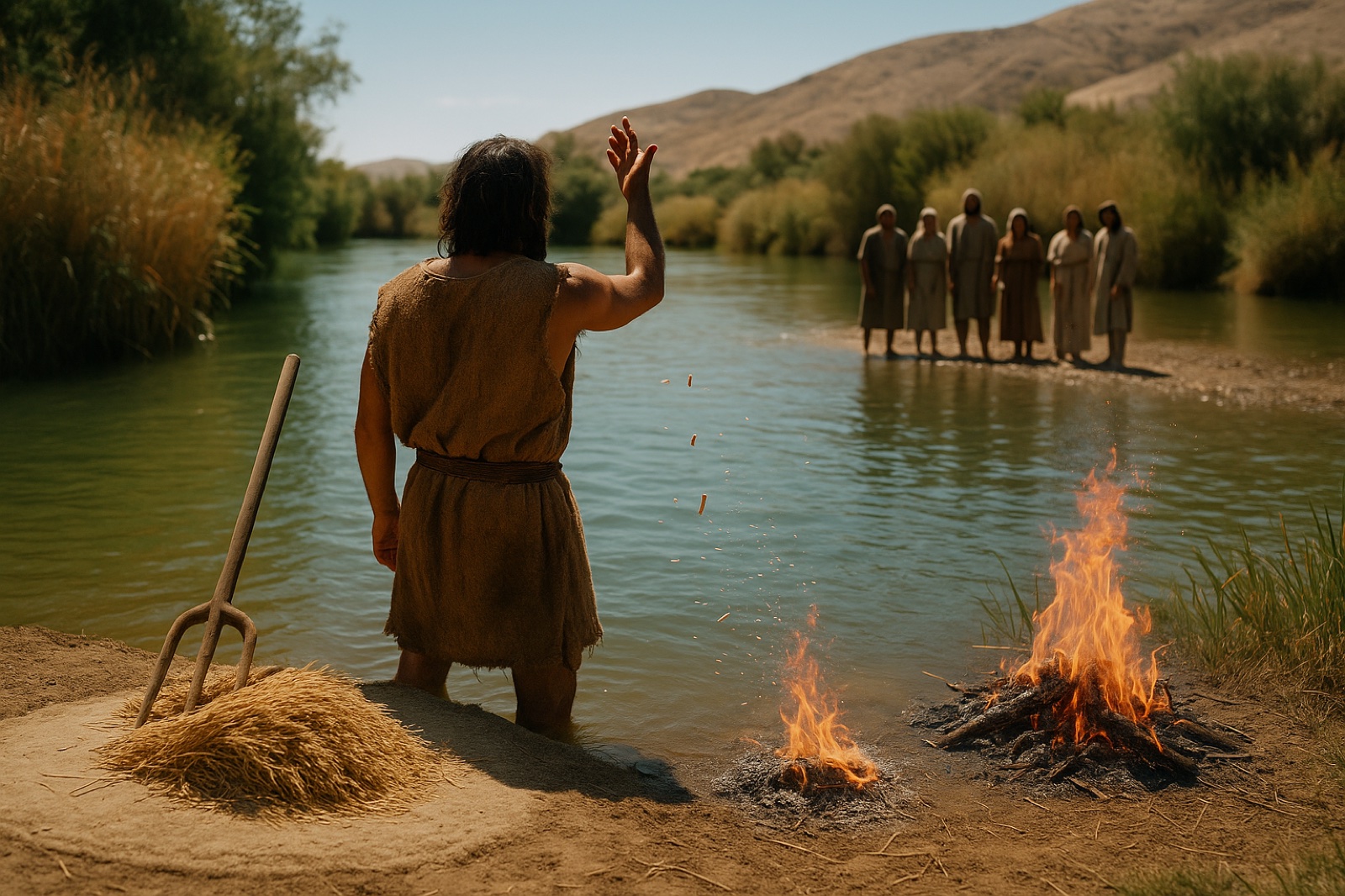
John the Baptist was out in the wild country near the Jordan. Crowds came out from the towns to be baptized by him in the river. (If you have ever wondered why Jesus Himself got in line to be baptized by John, that story is worth your time too.)
John knew his water was not the main event. So he told the crowd someone was coming after him:
“I indeed baptize you with water unto repentance: but he that cometh after me is mightier than I, whose shoes I am not worthy to bear: he shall baptize you with the Holy Ghost, and with fire:” (Matthew 3:11, KJV)
The word “baptize” comes from a Greek word that means to dip or plunge something under. So John is saying: I put you under water. The One coming after me will put you under the Holy Spirit, and under fire.
That sounds frightening until you read the very next sentence. Most people stop before it.
The Sentence Everyone Skips
“Whose fan is in his hand, and he will throughly purge his floor, and gather his wheat into the garner; but he will burn up the chaff with unquenchable fire.” (Matthew 3:12, KJV)
The “fan” here is not something you cool yourself with. It is a winnowing fork, a farm tool. The “floor” is a threshing floor, a hard patch of ground where grain was cleaned.
Here is how it worked. After the harvest, the farmer tossed the grain up into the wind with the fork. The heavy wheat fell back down. The light, dry husks around it, the chaff, blew off to the side. Then the wheat was gathered into the barn, and the chaff was swept up and burned.
Look at where the fire goes in John’s picture. It does not go on the wheat. The wheat goes into the barn. The fire is for the chaff, the dry husk that was wrapped around the grain and was never the grain at all.
Christians have read John’s “fire” in more than one way, and it is honest to say so. Some point to the day of Pentecost, when “there appeared unto them cloven tongues like as of fire, and it sat upon each of them” (Acts 2:3, KJV). Some point to verse 12 and say this is fire as judgment. Many say it is both, the same way a refiner’s fire in the prophet Malachi both cleans the silver and burns away what is not silver (Malachi 3:2-3). (Our piece on what Pentecost means goes deeper on that day.)
Either way, the fire in John’s promise has a job. It sorts. It cleans. It is not there for nothing.
The Surprise: Jesus Called His Own Ordeal a Baptism
Here is the part that changes how the modern phrase sounds.
You might think “baptism of fire” as “a brutal ordeal” is just people getting the Bible wrong. It is not. Jesus Himself used the word “baptism” to mean a terrible thing He had to go through.
In Luke, He says:
“I am come to send fire on the earth; and what will I if it be already kindled? But I have a baptism to be baptized with; and how am I straitened till it be accomplished!” (Luke 12:49-50, KJV)
“Straitened” means pressed in, hemmed in. Jesus is talking about the suffering and death waiting for Him in Jerusalem. He calls it a baptism, a going-under. And He says He feels the weight of it before it comes.
In Mark, two of His friends, the brothers James and John, ask for the best seats beside Him in His glory. He answers:
“Ye know not what ye ask: can ye drink of the cup that I drink of? and be baptized with the baptism that I am baptized with?” (Mark 10:38, KJV)
They say, “We can.” And Jesus tells them they will.
These are the same two brothers who once asked if they should “command fire to come down from heaven” on a village that turned Jesus away (Luke 9:54, KJV). They wanted to bring fire on other people. (We wrote about that day, and what Jesus did instead, in our piece on crossing the Rubicon.) Jesus told them the fire they would meet was a different kind. It would be the hard road He was about to walk first. Years later, Acts records that King Herod “killed James the brother of John with the sword” (Acts 12:2, KJV). James went under the same baptism his teacher did.
So both meanings are in the Bible. John promised a baptism of fire that would clean and fill people. Jesus named a baptism He would suffer. The modern phrase did not wander away from the Bible. It kept half of it.
What This Means for Your Baptism of Fire
Put those two halves together, and your rough start looks different.
First, you are not the first one under. When Jesus talked to James and John, He did not say “your baptism.” He said “the baptism that I am baptized with.” He went under first. Whatever you are walking into, you are not walking into a place He has never been.
Second, the fire has a job. In John’s picture, the fire does not touch the wheat. It takes the chaff. A hard first season often burns off things you did not need anyway. The need to look like you have it all together. The old idea that you should never have to ask for help. The fear of looking new. Those are husks. They can go. You stay.
Third, a baptism has an other side. Nobody stays under the water. The whole point of going under is coming up. A baptism of fire is not a place you live. It is something you pass through.
Peter, who walked with Jesus and later had his own share of fire, wrote to people having a hard time: “Beloved, think it not strange concerning the fiery trial which is to try you, as though some strange thing happened unto you” (1 Peter 4:12, KJV). In other words, this is not a sign that something has gone wrong with you. It is the road. People you love have walked it, and so did Jesus.
A good place to start: The Book of Matthew, in Immersive Storytelling Format. The whole Gospel as an audiobook and a readable PDF, from John at the river all the way to the empty tomb, so you can hear the story this phrase came from. Get the free guide. Free.
Actions to Take
- Name your fire. Write one sentence: “My baptism of fire right now is ____.” Seeing it written down makes it the size it really is, not the size it feels at 2am.
- Name one husk. Under it, write one thing this hard season could burn off that you do not need. Maybe it is pretending you already know how. Maybe it is never asking a question. Tomorrow, let that one go once. Ask the question.
- Find someone who came out the other side. Think of one person who has done the thing you are doing now: the job, the diagnosis, the new baby, the move. Send them a short message today asking what helped them in their first month. People who have been through the fire are usually glad to be asked.
Journaling Prompts
- Think back to an earlier baptism of fire in your life. What did it burn off that you are glad is gone?
- What would change about this week if you believed you are going through something Jesus has already gone through?
- What are you most afraid this season will take from you? Is it wheat, or is it chaff?
A Prayer
God, this is harder than I thought it would be, and I feel like I am in over my head. Thank You that Jesus went under first, and that I am not walking into anything You do not already know. Let this fire take the things I do not need, my pride and my fear of looking new, and keep what is really me. Help me remember there is another side to this, and bring me up out of it. Amen.
Discussion Question
Do you think a hard first experience makes people stronger, or do some starts just hurt? We would love to hear what you think. Tell us in the comments.
Share This
- “Had no idea ‘baptism of fire’ came from John the Baptist. And in his picture the fire never touches the wheat. It only burns the chaff. That is a better way to think about a hard first week.”
- “Jesus called His own suffering a baptism, and told His friends they would go through ‘the baptism that I am baptized with.’ Whatever you are going under right now, He went first.”
- “The fire takes the husk. You stay.”
“The fire takes the husk. You stay.”
Questions About Baptism of Fire
What does baptism of fire mean?
A baptism of fire is a hard first experience of something, such as a chaotic first week in a new job or a first time leading a team in a crisis. The phrase came into English in the 1800s from the French baptême du feu, which described a soldier’s first battle. The words themselves go back much further, to John the Baptist’s promise in Matthew 3:11 that the One coming after him would baptize “with the Holy Ghost, and with fire.”
Where does the phrase baptism of fire come from?
The phrase “baptism of fire” comes from Matthew 3:11 in the Bible, where John the Baptist says the One coming after him “shall baptize you with the Holy Ghost, and with fire” (KJV). Early church writers used the Greek baptisma pyros for the gift of the Holy Spirit and later for martyrdom. In the 1800s the French military phrase baptême du feu, meaning a soldier’s first time in battle, gave English its modern sense of a difficult first test.
What is the baptism of fire in the Bible?
In the Bible, the baptism of fire is promised by John the Baptist in Matthew 3:11 and Luke 3:16. Christians read it in different ways. Some connect it to Pentecost in Acts 2, when the Holy Spirit appeared as “tongues like as of fire.” Others connect it to judgment, because Matthew 3:12 describes chaff burned “with unquenchable fire.” Many read it as both: a fire that cleans and refines what belongs to God and burns away what does not.
Did Jesus talk about a baptism of suffering?
Yes. In Luke 12:50 Jesus says, “But I have a baptism to be baptized with; and how am I straitened till it be accomplished!” (KJV), speaking of the suffering and death waiting for Him in Jerusalem. In Mark 10:38-39 He asks James and John if they can “be baptized with the baptism that I am baptized with,” and tells them they will. This shows that using “baptism” to mean a terrible ordeal goes back to Jesus Himself.
Is “baptism of fire” a bad thing?
A baptism of fire is hard, but it is not only a bad thing. In everyday speech it means a tough first experience that a person comes through stronger and wiser. In the Bible, John the Baptist describes a fire that burns away chaff while the wheat is gathered safely into the barn, which is a picture of something being cleaned and kept rather than destroyed.