 0
0
 0
0
You’re reading through Genesis, maybe on a reading plan, and you hit it. Jacob marries two sisters in the same week. A few chapters earlier, Abraham has a child with his wife’s servant. Later on, a good man named Elkanah has two wives, and a woman named Hannah cries so hard at a holy festival that she can’t eat.
And a question sneaks in. Why did God allow polygamy? If these are the heroes of the faith, was God fine with it?
Maybe a friend threw that question at you as a reason not to trust the Bible. Maybe you grew up in a home where your father had more than one wife, and the question isn’t about ancient history at all. Either way, it’s a fair question. And the Bible’s answer is more honest than most people expect.
Why Did God Allow Polygamy? The Honest Short Answer
Here’s the part people don’t like to say out loud. The Old Testament never gives an ordinary man a flat rule that says “only one wife.” Polygamy happened, and the law of Moses made rules around it.
But allowed is not the same as approved. Genesis never once calls a two-wife home good. It does something sharper. It tells the stories plainly and lets you watch what happens. And what happens, every single time, is pain.
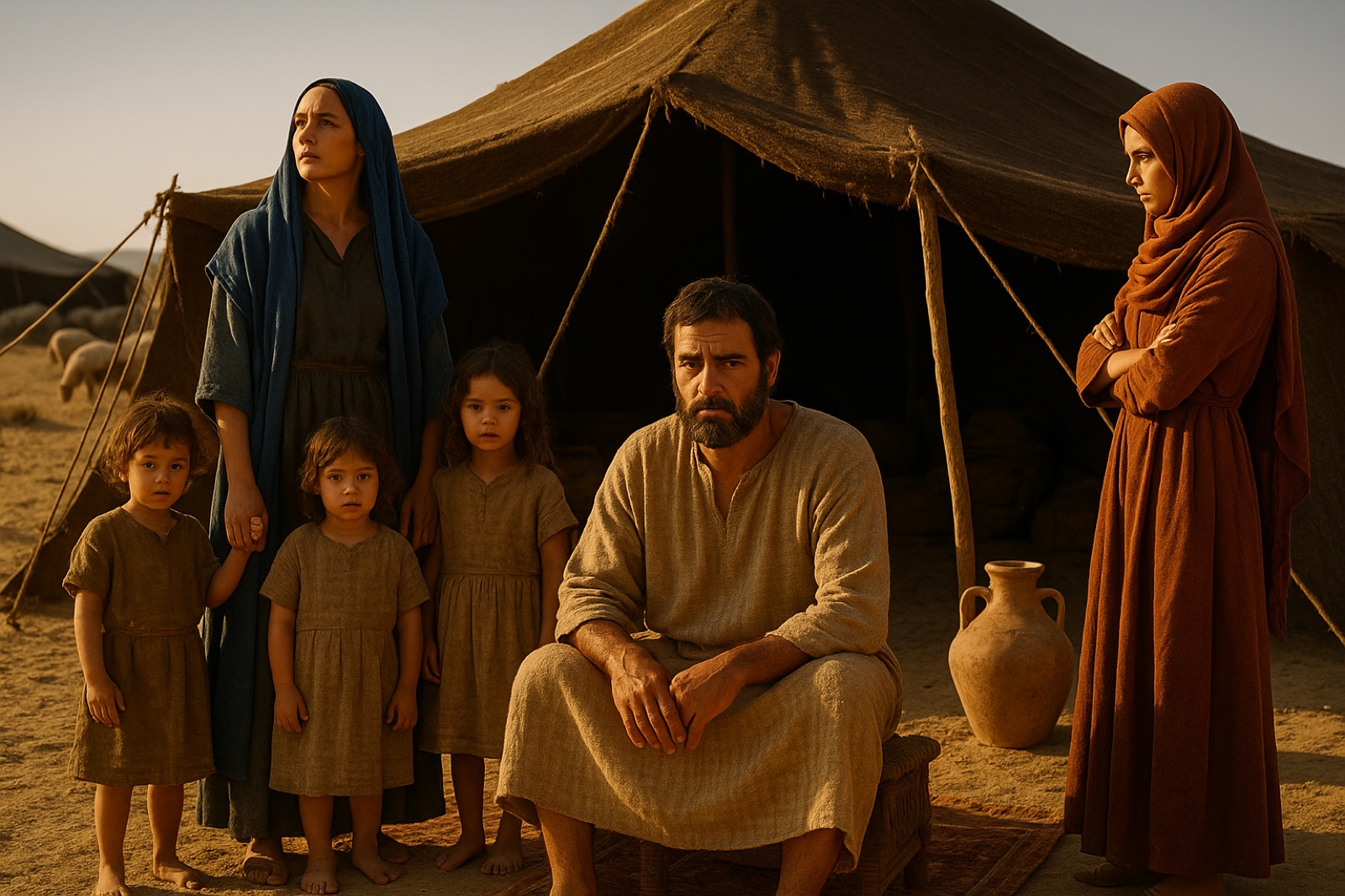
The Bible doesn’t hand you a lecture on this. It hands you a set of family portraits and trusts you to notice the faces.
The First Man With Two Wives Was Bragging About a Killing
The first man in the Bible with more than one wife isn’t Abraham. It’s a man named Lamech, from the family line of Cain, the man who killed his own brother.
“And Lamech took unto him two wives: the name of the one was Adah, and the name of the other Zillah.” — Genesis 4:19, KJV
A few verses later, Lamech gathers his two wives and speaks to them in a kind of song. Here’s what he wants them to hear:
“Adah and Zillah, Hear my voice; ye wives of Lamech, hearken unto my speech: for I have slain a man to my wounding, and a young man to my hurt. If Cain shall be avenged sevenfold, truly Lamech seventy and sevenfold.” — Genesis 4:23-24, KJV
So the Bible’s first picture of a man with two wives is a man bragging to both of them that he killed someone, and promising revenge seventy-seven times over.
That’s not a random placement. Genesis puts it right there, in the family of the first murderer, before any of the heroes arrive. It sets the tone. (Many readers hear an echo much later, when Peter asks Jesus how often to forgive and Jesus answers, “Until seventy times seven” — Matthew 18:22. Lamech’s number was for revenge. Jesus made it about mercy.)
Every Household That Tried It Got Hurt
Sarai and Hagar
Abram and Sarai couldn’t have children. So Sarai made a plan that was normal in her world: give her servant Hagar to her husband, and count Hagar’s child as her own.
“And Abram hearkened to the voice of Sarai.” — Genesis 16:2, KJV
It went wrong almost at once. Hagar got pregnant and began to look down on Sarai. Sarai blamed Abram. Abram basically said, “She’s your servant, do what you want.”
“And when Sarai dealt hardly with her, she fled from her face.” — Genesis 16:6, KJV
A pregnant woman ran away into the desert. That’s where the plan led. Years later, Hagar and her son were sent away again with some bread and a bottle of water. (We looked closely at what happened to her out there in Hagar in the Bible: The Only Person Who Named God.)
Leah and Rachel
Jacob wanted Rachel. He was tricked into marrying her older sister Leah first, then married Rachel a week later. Genesis doesn’t soften what that house felt like. Jacob “loved also Rachel more than Leah” (Genesis 29:30), and the very next verse says it even more bluntly:
“And when the LORD saw that Leah was hated, he opened her womb: but Rachel was barren.” — Genesis 29:31, KJV
Then the jealousy ran the other way. Rachel had Jacob’s love but no children, and “Rachel envied her sister; and said unto Jacob, Give me children, or else I die” (Genesis 30:1).
At one point the two sisters bargain over which of them will spend the night with their husband. The price is a handful of mandrake plants Leah’s son found in a field. Listen to Leah: “Is it a small matter that thou hast taken my husband?” (Genesis 30:15). Leah’s whole story is its own heartbreak, and we’ve told it in Leah Named Her Fourth Son After She Stopped Trying to Be Loved by the Wrong Person.
Hannah and Peninnah
“And he had two wives; the name of the one was Hannah, and the name of the other Peninnah: and Peninnah had children, but Hannah had no children.” — 1 Samuel 1:2, KJV
Elkanah loved Hannah. But every year, when the family went to worship, Peninnah went after her.
“And as he did so year by year, when she went up to the house of the LORD, so she provoked her; therefore she wept, and did not eat.” — 1 Samuel 1:7, KJV
Here’s a small thing most people read right past: Peninnah never says a single word in the story. She’s never given a line. We only see what her words did to Hannah.
Notice the pattern. Three families, spread across hundreds of years. Contempt. Jealousy. Favoritism. A woman crying at a holy festival. The writers never stop to say “this was wrong.” They don’t have to.
The Hebrew Word for a Second Wife Means “Rival”
This is the detail that’s easiest to miss in English. In 1 Samuel 1:6, the KJV calls Peninnah Hannah’s “adversary”:
“And her adversary also provoked her sore, for to make her fret, because the LORD had shut up her womb.” — 1 Samuel 1:6, KJV
The Hebrew word there is tsarah (צָרָה). It’s the word for a rival wife. And it’s spelled exactly like the everyday Hebrew word for trouble or distress. In a home with two wives, the other wife and “the trouble” sounded the same.
The law of Moses uses the same root. When it forbids a man from marrying his wife’s sister while she’s still alive, it gives the reason in a single word:
“Neither shalt thou take a wife to her sister, to vex her, to uncover her nakedness, beside the other in her life time.” — Leviticus 18:18, KJV
“To vex her” is litsror: to make her a rival. That is exactly what happened to Leah and Rachel. The law named the wound before it made the rule.
What the Law of Moses Actually Did: Protect the One Getting Hurt
If the law didn’t ban polygamy, what did it do? Read the rules closely and a pattern shows up. They mostly protect the person with the least power.
One rule sits in a section about a young woman sold as a servant and taken as a wife, the most vulnerable woman in any house. If the man took another wife, she could not be pushed aside:
“If he take him another wife; her food, her raiment, and her duty of marriage, shall he not diminish.” — Exodus 21:10, KJV
And here’s one that reads almost as if it were written with Leah in mind:
“If a man have two wives, one beloved, and another hated, and they have born him children, both the beloved and the hated; and if the firstborn son be hers that was hated…” — Deuteronomy 21:15, KJV
The law’s answer is that the unloved wife’s son still gets the firstborn’s “double portion” (Deuteronomy 21:17). And in Hebrew, “hated” in Deuteronomy 21:15 is the very same word Genesis used for Leah: senuah. “The LORD saw that Leah was hated.” The law takes the exact shape of Leah’s life and says: her children will not pay for it.
Even kings got a warning: “Neither shall he multiply wives to himself, that his heart turn not away” (Deuteronomy 17:17).
So think of these laws less like a seal of approval and more like a guardrail on a dangerous mountain road. A guardrail doesn’t mean the cliff edge is a good idea. It means people are going to drive there anyway, and someone cares enough to keep them from going over.
“From the Beginning It Was Not So”
Centuries later, some religious teachers tried to trap Jesus with a question about divorce. Jesus didn’t argue about Moses’ rules. He went back further, to the first pages of Genesis.
“Have ye not read, that he which made them at the beginning made them male and female, And said, For this cause shall a man leave father and mother, and shall cleave to his wife: and they twain shall be one flesh?” — Matthew 19:4-5, KJV
When they pushed back and asked why Moses allowed divorce, He answered:
“Moses because of the hardness of your hearts suffered you to put away your wives: but from the beginning it was not so.” — Matthew 19:8, KJV
We’ve written about what this means for divorce in Matthew 19 on Divorce: They Asked About the Rules. Jesus Went Back to the Beginning. But look at one small word in verse 5, because it matters a lot for this question.
Open Genesis 2:24 and it reads, “they shall be one flesh.” The Hebrew there has no number in it. Now look at how Jesus’ words are recorded in Matthew: “they twain shall be one flesh.” Twain means two. Matthew’s Greek says hoi duo, “the two.” The old Greek translation of Genesis that many Jews of Jesus’ day read has “the two” as well.
To be fair, Jesus was answering a question about divorce, not about having more than one wife. But when He pointed people back to what marriage was meant to be, the words He used counted the people in it. Two. Not three. Not four.
And notice the phrase “hardness of your hearts.” That’s the key to the whole polygamy question. God’s law sometimes met people where they actually were, hard-hearted and stuck in the customs of their age, without pretending that was where they were meant to stay.
If you want to keep digging into hard Bible questions like this one, you can explore them with our free Bible Answers AI assistant (it opens in ChatGPT).
The God Who Told the Truth Also Went Looking for the Hurt
Read these stories side by side and something else shows up.
In every one of these broken households, God comes near. And not mainly to the man in charge. God comes near to the women the arrangement was crushing.
- When Hagar sat down in the desert so she wouldn’t have to watch her son die of thirst: “God heard the voice of the lad” (Genesis 21:17).
- When Leah was the unwanted wife: “the LORD saw that Leah was hated” (Genesis 29:31).
- When Hannah had been mocked year after year: “the LORD remembered her” (1 Samuel 1:19), and she had a son named Samuel.
That’s what the question “Why did God allow polygamy?” can miss. The Bible doesn’t show a God who shrugged at the arrangement. It shows a God who told the truth about what it cost, and then went straight to the people paying for it.
And that’s good news for anyone living inside a family that isn’t the way it should be.
Maybe you’re the Leah in your house: the one who’s loved less, and you know it. Maybe you’re the child of a first wife or a second wife, and you grew up feeling the rivalry in the walls. In many parts of the world this isn’t an ancient question at all. Maybe your family is blended, and every holiday feels like Peninnah’s festival: same table, sharp words, someone crying in the other room.
Scripture doesn’t pretend your family is fine. And God isn’t waiting for your household to be arranged right before coming close. God saw Leah. God heard Hagar’s boy. God remembered Hannah. None of them lived in the family they should have had. All of them were seen.
Actions to Take Today
- Read 1 Samuel 1:1-8 slowly. It takes about three minutes. Notice who gets words and who doesn’t. Then ask yourself: whose voice is missing in my own home?
- Send one message to the “less-loved” person in your family. The sibling who always got compared. The stepchild. The in-law who sits at the edge of the table. One honest line like “I was thinking about you today” takes two minutes and costs nothing.
- Save two references in your phone right now: Genesis 4:19-24 and 1 Samuel 1:6-7. Next time someone uses this question against the Bible, don’t argue. Show them the stories and ask, “Does this read like a book that approves of it?”
Journaling Prompts
- Which person in these stories do you understand most from the inside: Hagar, Sarai, Leah, Rachel, Hannah, or even Peninnah? What is it about their spot that feels familiar?
- Where in your family have you felt like the one with the smaller portion? What would change if you believed God saw that exact spot?
- Is there a place where you’ve been the Peninnah, making someone else’s life harder because you were hurting too?
A Prayer for When Your Family Isn’t What It Should Be
God, my family doesn’t look like the one You meant from the beginning, and some days I feel like the one who’s loved less. You saw Leah when nobody else did, and You heard Hagar’s boy crying in the desert. Please see me in the exact place where I’m hurting. Keep me from becoming someone else’s rival just because I’m in pain. Show me one person in my home I can love a little better today. Amen.
What Do You Think?
Why do you think the Bible tells these family stories so plainly, without stopping to say “this was wrong”? Does that make the Bible easier or harder for you to trust? Share your thoughts in the comments below.
Share This
- “Genesis never calls a two-wife home good. It just tells you what happened: contempt, jealousy, tears at a holy festival. And God showing up for the women it hurt.”
- “I always wondered why God allowed polygamy. Then I learned the Hebrew word for a second wife is ‘rival.’ The Bible was telling the truth the whole time.”
- “God saw Leah. God heard Hagar’s boy. God remembered Hannah. None of them lived in the family they should have had. All of them were seen.”
Questions People Ask About Polygamy in the Bible
Why did God allow polygamy in the Old Testament?
The Old Testament records polygamy and regulates it, but never calls it good. The law of Moses worked with people as they were, which Jesus called “the hardness of your hearts” in Matthew 19:8. Its rules about multiple wives mostly protect the vulnerable wife and her children, as in Exodus 21:10 and Deuteronomy 21:15-17. Every polygamous household the Bible describes, from Abraham to Jacob to Elkanah, is shown full of jealousy and grief.
Who was the first person in the Bible to have two wives?
The first man in the Bible recorded with two wives is Lamech, a descendant of Cain, in Genesis 4:19. His wives were Adah and Zillah. In Genesis 4:23-24 he tells them he has killed a man and boasts of revenge “seventy and sevenfold,” which makes him a dark first example rather than a model.
Does the Bible forbid having more than one wife?
The Old Testament has no direct command forbidding an ordinary man from having more than one wife, though Deuteronomy 17:17 warns Israel’s kings not to “multiply wives.” The New Testament points back to marriage as two people: Jesus quotes Genesis in Matthew 19:5 as “they twain shall be one flesh,” and 1 Timothy 3:2 says a church leader must be “the husband of one wife.”
What does the Hebrew word tsarah mean in 1 Samuel 1:6?
In 1 Samuel 1:6, the KJV word “adversary,” describing Peninnah, translates the Hebrew word tsarah, which is used for a rival wife. It is spelled the same as the common Hebrew word for trouble or distress, and it shares a root with “to vex her” in Leviticus 18:18, where the law of Moses forbids marrying a wife’s sister while the wife is alive.
Did God bless polygamous families in the Bible?
God cared for people inside polygamous families, but the Bible presents that care as mercy toward those who were hurting, not approval of the arrangement. Genesis 21:17 says God heard Hagar’s son in the wilderness, Genesis 29:31 says the LORD saw that Leah was hated, and 1 Samuel 1:19-20 records Hannah giving birth to Samuel after years of being provoked by her rival Peninnah.