 0
0
 0
0
You did not plan to read it. You opened the news app to check the weather, and there it was near the bottom of the screen — your sign, three sentences about your week. Your eyes were halfway through before you decided anything.
Then comes the small, uncomfortable question. Is it a sin to read your horoscope?
Most answers you will find come in two flavours. One shouts at you. The other shrugs. Neither takes your real question seriously — because your real question usually is not “did I break a rule?” It is “where am I supposed to get direction from?”
That is a fair question. Let’s take it seriously.
The Short Answer, and Why It Is Not Enough
The Bible does speak to this directly, and it is not hidden. Deuteronomy 18 lists a set of practices Israel was told to stay away from — “that useth divination, or an observer of times, or an enchanter, or a witch” — and calls them an abomination. If you came looking for a rule, that is the rule.
But if the rule were the whole story, the Bible would be a very strange book. Because one of the four Gospels opens with foreign star-readers travelling for months to kneel in front of a newborn Jesus.
Both of those are in there. So the honest answer takes a little longer than yes or no. Stay with me — the middle of this is more interesting than either shouting or shrugging.
Isaiah Dares the Astrologers to Save Somebody
Isaiah 47 is written to Babylon, and that detail matters more than it looks.
Babylon was the ancient world’s centre of star-watching. Their sky records were careful, patient, mathematical work kept over generations. Reading the heavens was not a fringe hobby there. It was the empire’s best available technology for knowing what was coming.
Which is exactly what makes this line land the way it does:
“Thou art wearied in the multitude of thy counsels. Let now the astrologers, the stargazers, the monthly prognosticators, stand up, and save thee from these things that shall come upon thee.”
— Isaiah 47:13, KJV
Read what is actually being asked. Not “your charts are inaccurate.” Not “your stargazers are fools.” Just this: fine — let them save you.
That is the whole argument in four words. The objection was never to looking up. The objection is that a chart can describe and it cannot rescue. “Monthly prognosticators” is the old King James phrase for people whose job was to announce what each new month would bring. They had a system for the month ahead. They had nothing for the person standing in front of them.
And look at the line just before it. Thou art wearied in the multitude of thy counsels. Wearied. Not condemned first — tired first. Babylon had more sources of guidance than anybody on earth, and all that guidance had worn it out.
If you have ever had a group chat, three apps and a horoscope all telling you something different about your own life, Isaiah described you thousands of years ago. And the first thing the passage notices about you is not your sin. It is your tiredness.
The Wise Men Were Professional Star-Readers
Now hold Isaiah 47 next to Matthew 2.
“…behold, there came wise men from the east to Jerusalem, Saying, Where is he that is born King of the Jews? for we have seen his star in the east, and are come to worship him.”
— Matthew 2:1-2, KJV
The word behind “wise men” is magi. They were not Israelites and they did not have the Hebrew scriptures. They came from the east — the direction of Babylon and Persia, the same part of the world Isaiah had been writing to. Reading the sky was their profession.
So notice what happens. God met them inside their job. There was no waiting until their theology was corrected first. The first non-Jewish people in Matthew’s Gospel to worship Jesus arrived using the only language they had, and God answered in it.
Meeting people where they are is not a modern ministry slogan. It is chapter two.
If the story stopped there, you would have a tidy answer: the stars are fine, God uses them. But it does not stop there. And the next part is the part almost nobody quotes.
The Star Took Them to the Wrong Address
Read Matthew 2 slowly and count what the star actually did.
The star got them to Jerusalem. Jerusalem was the wrong city.
They had to stop and ask for directions — from Herod, of all people. And the answer did not come out of the sky. Herod called in the chief priests and the scribes, and they answered out of a scroll: Bethlehem, because of what the prophet had written. A written word supplied the address the star could not.
Only after that does the star appear again:
“When they had heard the king, they departed; and, lo, the star, which they saw in the east, went before them, till it came and stood over where the young child was.”
— Matthew 2:9, KJV
When they had heard the king. After the scripture. Not before it.
And that detour was not free. Herod now knew a rival had been born, and roughly when — information the magi themselves handed him. What he did with it fills the rest of the chapter, and it is the darkest thing in the Christmas story.
So the Bible’s most famous star-following story turns out, read closely, to also be a story about the limits of star-following. The sky was enough to start them walking. It was not enough to get them there. It brought them to the right country and the wrong town, with a dangerous king standing in the gap.
A horoscope can raise a question. It cannot give you an address.
Where Your Daily Horoscope Actually Came From
This part is worth knowing, because it quietly changes what you think you are reading.
The sky records the magi worked from were the product of centuries of patient observation. The horoscope column in your news app is not that. It is a newspaper feature, and it has a birthday.
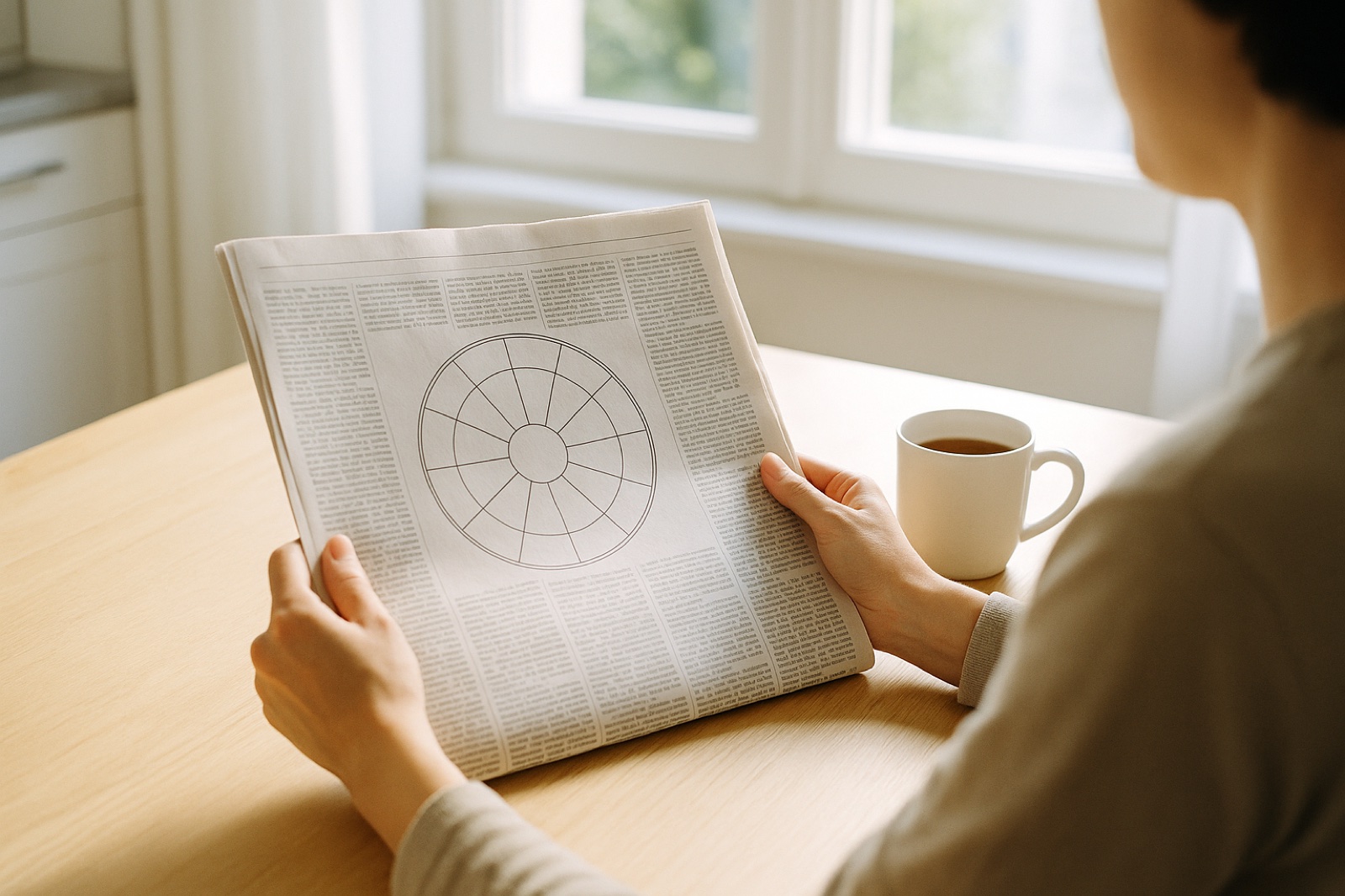
In August 1930, Britain’s Sunday Express ran an astrological piece about a newborn royal — Princess Margaret, born three days earlier — written by an astrologer named R.H. Naylor. Readers liked it. The paper’s editor then asked Naylor for something repeatable: predictions for every reader, week after week. Naylor’s solution was to slice the sun’s yearly path into twelve equal thirty-degree sections, name each after a constellation, and write a block of text for each one. Smithsonian Magazine has told the story in detail.
That is where “what’s your sign?” comes from. Not from Babylon. From a British newspaper that needed a column able to speak to every reader at once.
Which tells you something about the format itself. Sun-sign horoscopes were built to fit everybody, because commercially they had to — a column that only worked for a handful of readers is a column that gets cut. So when a horoscope seems to know you, that is the design working exactly as intended. It is not the sky bending down to your particular Tuesday.
The same thing turns out to be true of a lot of what we reach for. We looked at it from another angle in where “angel numbers” really came from — a practice that feels ancient and is mostly recent.
The Better Question: What Am I Actually Asking For?
Here is where this stops being about rules.
Nobody reads a horoscope because they have concluded that a planet governs their week. People read it for the same reason Babylon kept star-readers on staff: something is coming, and they would like a hint. The desire underneath it is not rebellion. It is the desire not to be blindsided.
That desire is not a sin. That is just being a person.
The trouble is what the sky can offer back. A chart can hand you a mood. It cannot know your name, your Monday, the conversation you are dreading, or the thing you have not told anyone. And it never once asks you a question back.
Then there is this:
“If any of you lack wisdom, let him ask of God, that giveth to all men liberally, and upbraideth not; and it shall be given him.”
— James 1:5, KJV
Sit on upbraideth not for a second. It is an old word for scolds. God gives wisdom to anyone who asks — and does not lecture them for having to ask.
Which means the person who has been reading their horoscope for years, quietly, a little embarrassed about it, is not disqualified from asking. That verse was written for exactly that person.
And that is the real difference, far more than the rule is. A horoscope gives you a forecast from something that cannot hear you. Prayer gets you wisdom from Someone who can. One is a broadcast. The other is a conversation.
Which is also where Isaiah’s line turns out to be kind rather than cruel. “Let them save you” is not mockery aimed at a lost person. It is God pointing out that you deserve better than a system that cannot answer you back.
So, Is It a Sin to Read Your Horoscope? The Honest Answer
Scripture’s instruction is clear enough, and treating star signs as your source of direction is the thing it warns against. That part is not really in dispute.
But shame has never once moved a person from a horoscope to God, and God does not appear to work that way either — God walked a group of star-readers the entire distance to Bethlehem, meeting them in the only language they knew, and corrected the route along the way.
So do not start with quitting. Start with replacing. The habit is not really about astrology. It is about wanting a word for today, and that want has somewhere far better to go. If you have been circling a similar question about a different practice, we worked through it in is manifesting a sin — a different practice, and a different answer, without the shaming.
Actions to Take
- Name the real question out loud. Next time you catch yourself reading the horoscope, do not close the app in guilt. Finish the thought out loud, to God: “That is what I actually want to know about today.” Ten seconds, and it changes who you are asking.
- Swap the format tomorrow morning. Instead of the horoscope, use our free Bible Verse for How I Feel tool. It does the honest version of what the horoscope pretends to do — you say how today feels, and it gives you scripture written for that. Two minutes, no cost, no sign-up.
- Put James 1:5 where your eyes land first. Write it out by hand on any scrap of paper and stick it to the back of your phone, or beside the door. You will read it more times this week than you will read any horoscope.
Journaling Prompts
- When you reach for a horoscope, what is the thing you are quietly hoping it will tell you? Write out the exact sentence you would want it to say.
- Where in your life do you currently have no map at all? Name it plainly, without trying to solve it in the same breath.
- What would change about tomorrow if you genuinely believed God was not annoyed by your question?
A Prayer You Can Pray Right Now
God, I have been looking for a hint about my life anywhere I can find one, and You know exactly where I have been looking. I am not going to pretend otherwise. What I actually want is to stop feeling blindsided, and to know that Someone sees the week ahead of me. Give me wisdom the way You promised — freely, and without scolding me for needing to ask. And when I do not get the whole map at once, help me take the next step anyway. Amen.
Discussion Question
Why do you think horoscopes have stayed so popular in an age that trusts data more than almost anything else? Share your thoughts in the comments — we read every one.
Share This
- The wise men in Matthew 2 were professional star-readers — and their star still took them to the wrong city. They only found Bethlehem after somebody read them scripture. I had never noticed that before.
- Your daily horoscope is not ancient. The star-sign column was invented for a British newspaper in 1930 because the editor wanted something repeatable. That completely changed how I read it.
- Isaiah never says the astrologers are wrong. He says: let them save you. That is a much harder question, and a much kinder one.
Questions People Ask
Is it a sin to read your horoscope?
The Bible speaks against seeking direction from the stars. Deuteronomy 18:10-12 lists divination and “an observer of times” among practices called an abomination, and Isaiah 47:13 challenges astrologers, stargazers and “monthly prognosticators” to save the person relying on them. Glancing at a horoscope column is not the same act as building life decisions on it, but scripture consistently treats the sky as something God made rather than something that speaks for God.
Were the wise men in the Bible astrologers?
The wise men of Matthew 2 are called magi, and they came from the east — the region of Babylon and Persia, where reading the sky was a recognised profession. Matthew 2:2 records them saying, “we have seen his star in the east, and are come to worship him.” The Bible presents them favourably as the first non-Jewish people to worship Jesus, without endorsing astrology as a practice.
Did the star lead the wise men straight to Jesus?
No. Matthew 2 shows the star bringing the magi to Jerusalem, where they had to ask King Herod for directions. Herod’s chief priests and scribes named Bethlehem from the writings of the prophet. Matthew 2:9 says the star went before them only afterwards: “When they had heard the king, they departed; and, lo, the star, which they saw in the east, went before them, till it came and stood over where the young child was.”
When was the daily newspaper horoscope invented?
The modern star-sign horoscope column dates to 1930. Britain’s Sunday Express published an astrological piece by R.H. Naylor about the newborn Princess Margaret in August 1930, and the paper’s editor then commissioned a regular column carrying predictions for all readers. Naylor divided the sun’s yearly path into twelve thirty-degree sections named after constellations — the twelve sun signs still used in horoscope columns today.
What does the Bible say to do instead of reading a horoscope?
James 1:5 offers the direct alternative: “If any of you lack wisdom, let him ask of God, that giveth to all men liberally, and upbraideth not; and it shall be given him.” The verse promises wisdom to anyone who asks for it, and states plainly that God does not scold the person for asking.