 0
0
 0
0
Somewhere in a lab at the University of Surrey, a team of researchers did something that sounds almost too simple to matter. They built a battery. And instead of drying it out during manufacturing — the standard move for decades — they left the water inside.
What happened next is the kind of accident that turns into a headline. The battery didn’t just work. It worked better. And along the way, it did something nobody was really trying to build: a way to turn seawater into drinking water at the same time it stores power.
It sounds like a small footnote in a chemistry journal. It might turn out to be one of the more quietly important ideas of the year.
The Battery That Can Turn Seawater Into Drinking Water
The material at the center of this is called sodium vanadate hydrate — a mouthful, but the idea behind it is simple. It’s a sodium-based alternative to the lithium batteries in your phone and your car, and “hydrate” is the key word: this version keeps water locked inside its structure instead of removing it.
Conventional wisdom in battery science says water is a problem. It degrades performance, causes instability, gets engineered out before a battery ever reaches a shelf. The Surrey team did the opposite. They kept the water in, and the battery’s power storage nearly doubled — while holding up over 400-plus charge cycles without breaking down.
Dr. Daniel Commandeur, one of the researchers behind the work, described it simply: the goal now is systems that use seawater as “a completely safe, free and abundant electrolyte” — while producing fresh water as a byproduct of the very same process.
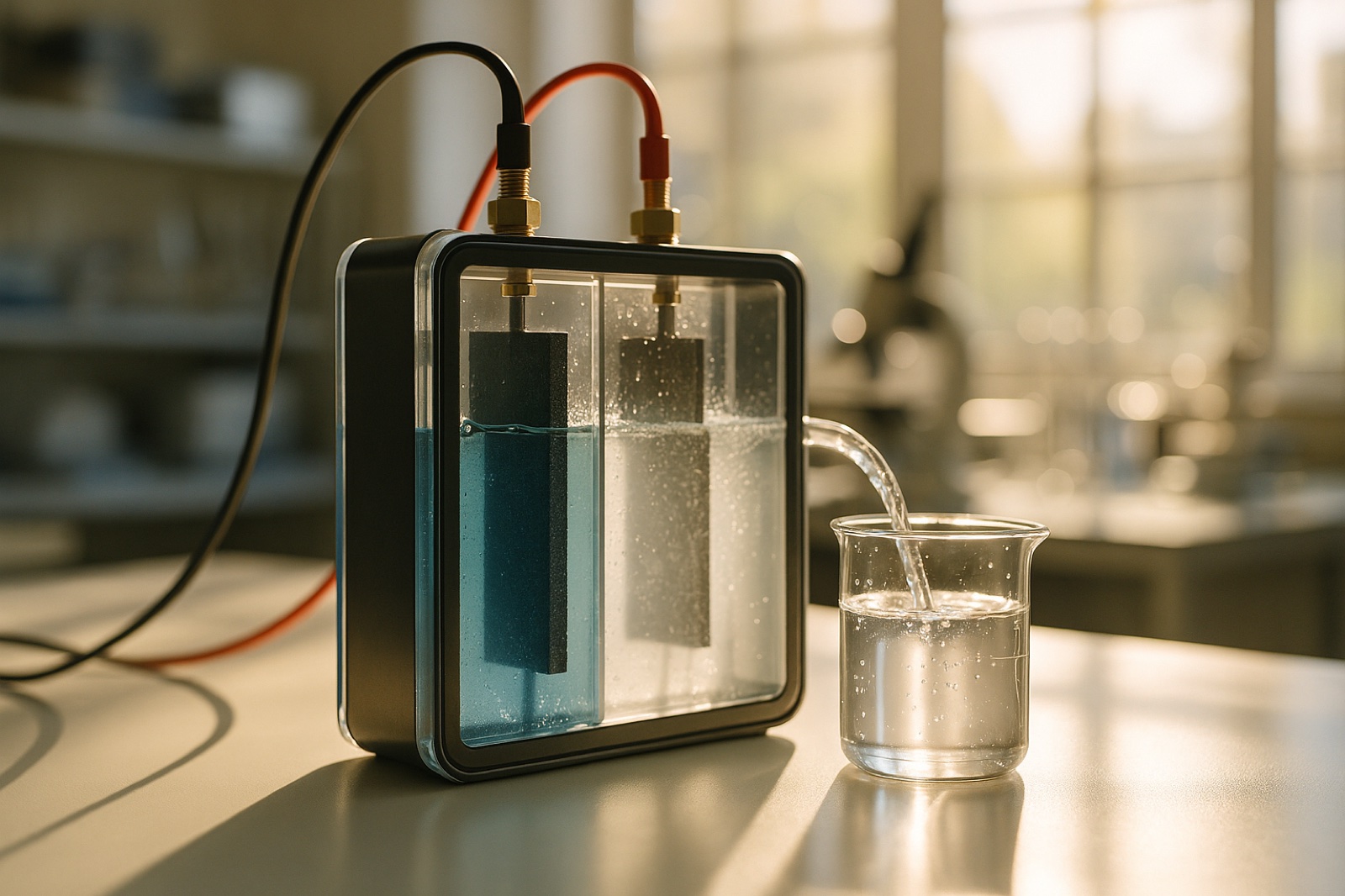
That second part is the twist. When the team tested the material in salt water, it didn’t just tolerate it. It pulled the sodium ions out of the water, while a graphite electrode handled the chloride, and what came out the other side was water with the salt removed. A battery, quietly desalinating water while it charges.
Why This Matters More Than It Sounds Like It Should
Here’s the part that’s easy to miss if you’re not thinking about it: a huge number of people on this planet live near an ocean and nowhere near enough fresh water. Coastal regions with abundant sun, abundant wind, and abundant seawater — but a real, daily shortage of anything safe to drink.
Traditional desalination plants exist, but they’re expensive, energy-hungry, and require serious infrastructure. A technology that could store renewable energy and turn seawater into drinking water in the same process, using cheap and abundant sodium instead of expensive lithium, isn’t just a clever lab result. It’s a genuine answer to a problem that a real portion of the world wakes up to every single day.
It’s not the only place researchers have found a gap between “enough” and “satisfied.” A separate study on food and appetite found the same kind of pattern — the body registering “full” while something in it still isn’t settled.
The research is still early. Nobody is claiming a finished product. But the underlying idea — that the very thing engineers spent years trying to remove from a battery might be the thing that makes it useful in a completely different way — is the kind of reversal that tends to age well.
An Old Promise About Water That Never Runs Out
There’s a story, thousands of years old now, about a man who stopped at a well in the middle of the day and asked a woman for a drink of water. It’s a strange little scene on its surface — an ordinary request, an ordinary well. But he told her something that didn’t make sense at the time: that the water she kept coming back to that well for would always leave her thirsty again. And that there was another kind of water — his to give — that would mean she’d never be thirsty in the same way again.
It’s easy to read that today as a nice metaphor and move on. But there’s something almost literal about it showing up again here, in a lab, in 2026 — the discovery that the very water people go without, the water an entire region can be thirsty for, might be drawn out of the sea itself by something never designed to hold it. Ancient wisdom keeps landing on the same idea from a dozen different directions: the thing that actually satisfies isn’t always where you’d expect to find it, and sometimes it’s sitting in the last place anyone thought to look. People have been naming this same ache for centuries, long before anyone had the science to explain why it shows up.
Maybe that’s worth sitting with for a second before you move on with your day — not as a lesson, just as a coincidence too specific to fully ignore.
What Happens Next
The Surrey team’s next steps involve scaling the material and testing it in real-world seawater conditions outside a controlled lab environment. If it holds up, the timeline for something like this reaching an actual coastal community is still likely years out, not months. Science like this rarely moves as fast as the headline suggests.
But for now, there’s a battery sitting in a lab in the UK that does two things at once that used to require two separate machines — storing power, and turning seawater into something you could actually drink. And somewhere in that very specific, very modern breakthrough, an old idea about thirst and what actually ends it is still, quietly, holding up.
One Question Worth Sitting With
If something as ordinary as a battery can be redesigned to solve a thirst problem nobody thought it could touch — what’s one thing in your own life you assumed was “just how it works,” that might actually be solvable if you looked at it from a different angle?
Drop your answer in the comments. We’d genuinely like to know what you land on.
If This Got You Thinking
“A battery that turns seawater into drinking water while it charges. Science just did something that sounds like a parable. 🌊🔋” (Read the full story: https://bgodinspired.com/index.php/bible-resources/bible-and-science/seawater-drinking-water-battery-living-water/)
“Wild: leaving water INSIDE a battery nearly doubled its power — and let it pull the salt out of seawater at the same time. Read this one. https://bgodinspired.com/index.php/bible-resources/bible-and-science/seawater-drinking-water-battery-living-water/”
“The thing engineers spent years trying to remove from batteries might be the exact thing that saves coastal communities without clean water. Story of the week. https://bgodinspired.com/index.php/bible-resources/bible-and-science/seawater-drinking-water-battery-living-water/”
Quick Questions
Q: How does a battery turn seawater into drinking water?
A: Researchers at the University of Surrey found that a sodium vanadate hydrate battery — one that keeps water inside its structure instead of removing it during manufacturing — can pull sodium ions out of seawater while a graphite electrode removes chloride ions. The result is desalinated water produced as part of the same process that stores electrical power.
Q: Why did keeping water inside the battery improve its performance?
A: Standard battery manufacturing removes water because it’s traditionally viewed as destabilizing. The Surrey team found the opposite: leaving water in nearly doubled the battery’s power storage capacity while maintaining stability over 400-plus charge cycles.
Q: Is this desalination battery technology available now?
A: No. As of August 2026, this is early-stage research. The technology has been demonstrated in lab conditions, but real-world testing and scaling are still ahead, and any practical deployment is likely years away.
Q: Why is sodium used instead of lithium in this battery?
A: Sodium is far more abundant and less expensive than lithium, making sodium-based batteries a more sustainable and scalable option — especially for a technology aimed at coastal regions that may not have access to expensive infrastructure.
Q: What does this discovery have to do with the old story about “living water”?
A: In one of the Bible’s best-known encounters, a man meets a woman at a well and tells her that the water she kept returning for would always leave her thirsty again, but the water he offered would mean she’d never be thirsty in the same way again. This modern discovery — that the very water a region is thirsty for might be drawn out of the sea itself — echoes that ancient idea: what actually satisfies isn’t always where people expect to find it.