 0
0
 0
0
The worst thing that can happen to a strand of DNA is a double-strand break. Both sides of the ladder snap at once. There is no intact copy left to read from, no template to check the repair against. It is the kind of damage that causes mutations, and it is the kind of damage that kills cells outright.
So it is a genuinely strange finding that newborn neurons break their own DNA — routinely, in enormous numbers, in every healthy brain that has ever been built. Not as an accident. As part of the construction.
What Scientists Saw When They Watched Neurons Move
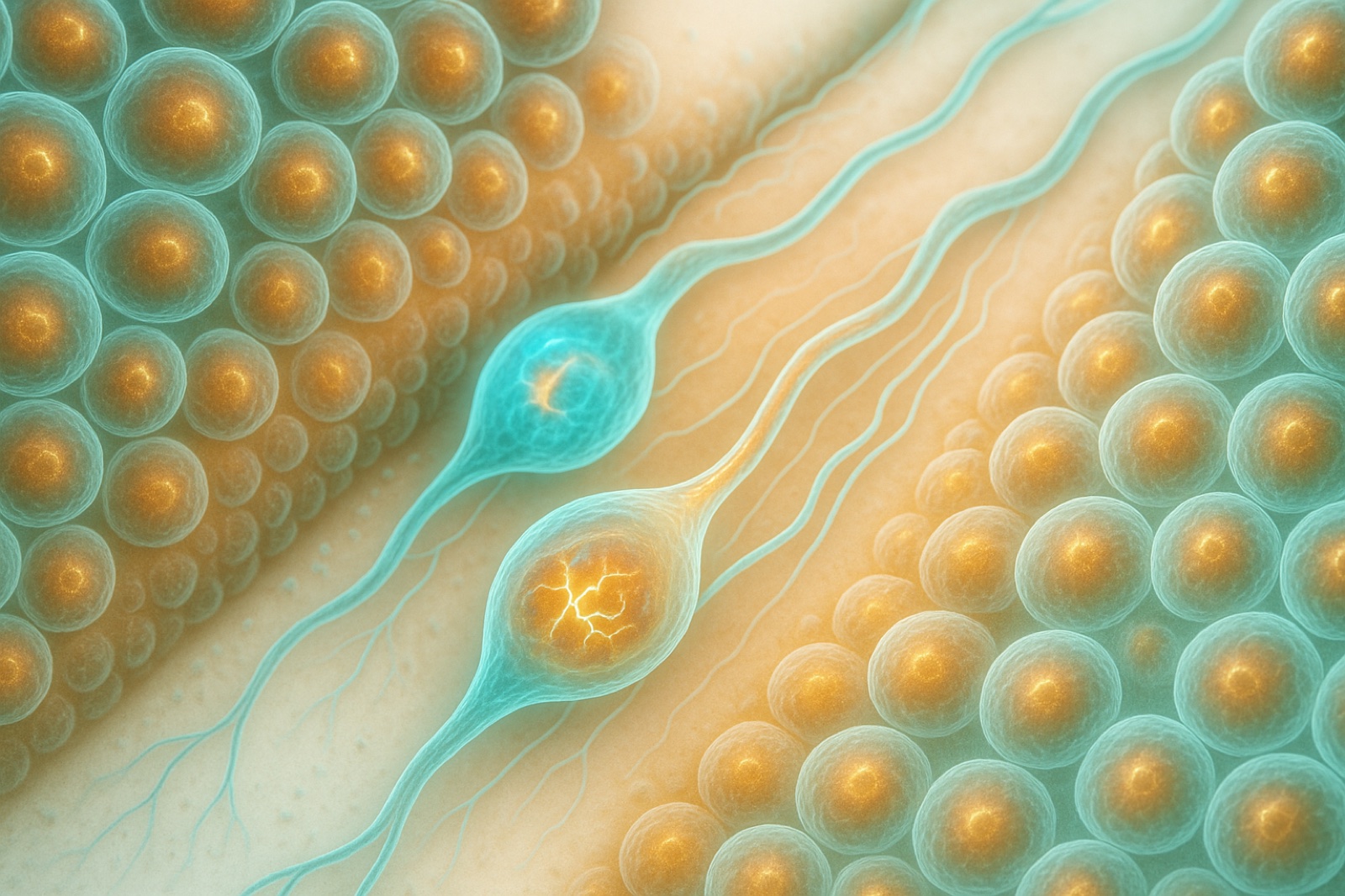
A brain is not assembled where its parts are made. Neurons are born deep inside the developing brain and then have to travel outward to the place they will spend the rest of their life. The journey is short by any human measure and brutal by a cell’s. They squeeze through gaps narrower than they are, deforming as they go, pushing between other cells the entire way.
A team at Kyoto University’s Institute for Integrated Cell-Material Sciences went looking at what that journey costs. What they found, published in the journal Nature, is that the squeezing itself snaps the DNA — both strands, over and over, while the cell is still moving.
To be sure the confinement was the cause and not something else in the tissue, they also built tiny artificial channels that mimic the tight spaces of a growing brain, and pushed neurons through those. Same result. The damage tracks the squeeze.
Why Neurons Break Their Own DNA and Survive It
The mechanism turns out to be almost mundane. An enzyme called Topoisomerase II beta spends its working life relieving tension in coiled DNA — it makes a controlled cut, lets the strand unwind, and then closes it again. Under the mechanical stress of a cell being squeezed, that enzyme gets caught mid-job. The cut gets made. The closing does not happen.
Then, once the neuron reaches where it is going, a repair system called non-homologous end joining finds the loose ends and rejoins them. Most of the breaks are closed within about a day, and the neurons carry on working normally afterward.
Mineko Kengaku, the study’s senior author, put it plainly: “Somehow neurons can repair [the damage] very quickly without any sign of mutations or bad effect.” And on whether this is a malfunction at all: “It seems to be a normal developmental event.”
Notice the order there, because it is easy to read past. The repair does not happen during the journey. It happens after arrival. The cell travels the whole distance carrying the damage, and only puts itself back together once it has somewhere to stand.
The Detail That Changes the Whole Story
Here is the part that makes this more than a curiosity.
The breaks are not scattered at random across the genome. They concentrate in regions that are not essential — the stretches a cell can afford to have cut and re-joined. The critical genes are largely spared.
That is the difference between a developing neuron and a cancer cell being pushed through the same kind of tight space. Cancer cells under that mechanical stress often die, or come out the other side genuinely broken. The neuron does not, because the damage lands where damage can be absorbed.
Which means this is not simply a cell surviving an ordeal by being tough. Something about how the whole system is arranged puts the cost in the one place the cost can be paid.
What Happens When the Repair Does Not Work
The researchers tested the other side of it too, using mice engineered without Ligase 4, one of the enzymes that does the rejoining. Take the repair away and you would expect obvious, immediate damage.
That is not what happened. Those mice developed normally. There were no clear early abnormalities. The problem showed up much later, in adulthood, as difficulty with balance.
Jan Lammerding, a researcher who works on how cells handle mechanical stress and was not part of the study, called the work “very impressive” for showing how unrepaired damage can “result in long-term functional changes reflective of neurodegenerative diseases.”
It is worth being careful about how much weight that carries. This was a study in mice. The team is explicit that the limits of this tolerance — how much breakage is survivable, and what exactly happens when repair is incomplete — remain open questions. Whether the same thing happens more intensely in people has not been established.
Kengaku did note one implication that is hard to shake, though: “During development, neurons have to migrate, and if the brain size is larger, then neurons have to migrate longer distances.” A human brain is far larger than a mouse’s. The journey is correspondingly longer. Nobody has measured what that means yet.
This is not the only place the brain has turned out to be quietly rebuilding itself while nobody was watching — scientists recently caught the adult brain repairing itself using cells that were dismissed as filler for a century. And the pattern of damage that stays silent for years before surfacing shows up elsewhere too, in what researchers have found about how childhood stress changes the brain long after it ends.
What This Says About Getting Anywhere
There is something in this that is hard to file away as just cell biology.
The damage was not evidence that the journey went wrong. It was evidence that the journey happened. A neuron that arrived without a scratch would be a neuron that never moved.
And the repair was not an emergency measure improvised after the fact. Non-homologous end joining was already there, already built in, before the first break ever occurred. Nothing scrambled to respond once the damage started. The mending was written into the design alongside the moving. People who talk about being made by God have been saying something close to this for a very long time, in far less technical language: that the cost of going somewhere was never a surprise, and neither was the fixing.
What the cell cannot do is repair while it is still squeezing. That part only happens on the other side.
The Thing Worth Sitting With
Every person reading this has a brain that was assembled this way. Billions of cells made a hard trip, broke doing it, and were put back together after they got there. It is not a metaphor for how you were made. It is a literal description of it.
If that kind of thing pulls at you, the same instinct is worth following further out — our free How Old Is the Universe? explorer walks through what the actual measurements say, at whatever pace you want to take it.
One Question for You
Do you think we would treat setbacks differently if we assumed, by default, that the damage was part of the route rather than a sign we took the wrong one? Tell us what you think in the comments below.
Share This
“Newborn brain cells snap both strands of their own DNA squeezing through the developing brain — then repair it after they arrive. That’s not a bug. That’s how a brain gets built.”
“The breaks aren’t random. They land in the parts of the genome a cell can afford to lose. Something about the design puts the cost where the cost can be paid.”
“A neuron can’t repair itself while it’s still squeezing through. That only happens once it gets where it’s going. Been thinking about that all day.”
Common Questions About Neurons Breaking Their Own DNA
Do neurons really break their own DNA?
Yes. Research from Kyoto University’s Institute for Integrated Cell-Material Sciences, published in the journal Nature in 2026, found that newborn neurons in the developing brain sustain double-strand DNA breaks as they squeeze through the confined spaces of growing brain tissue. The breaks are frequent and appear to be a normal part of brain development rather than a sign of disease. The study was carried out in mice.
Why does squeezing through tight spaces break a cell’s DNA?
An enzyme called Topoisomerase II beta normally makes controlled cuts in DNA to relieve tension as the strand coils and uncoils, then seals the cut again. When a cell is under mechanical stress from being compressed, that enzyme becomes trapped mid-process. The cut is made but not resealed, leaving a double-strand break behind.
How does a neuron repair a double-strand DNA break?
Through a repair pathway called non-homologous end joining, which locates the severed ends and rejoins them directly. In the Kyoto University study, most breaks were repaired within roughly a day, after the neuron had finished migrating and reached its destination. The neurons then functioned normally.
Why doesn’t this damage cause mutations or cancer?
The breaks are not distributed randomly. They concentrate in non-essential regions of the genome and largely spare critical genes, which is a key reason neurons survive the process. Cancer cells subjected to similar mechanical stress frequently do not fare as well. Researchers have said the limits of this tolerance are not yet fully understood.
What happens if the DNA repair fails?
In mice engineered to lack Ligase 4, an enzyme involved in the rejoining process, development still appeared normal at first with no obvious early abnormalities. Balance problems emerged later, in adulthood. Researchers have described this as evidence that unrepaired damage of this kind can produce long-term functional changes, though how far the finding extends beyond mice remains an open question.
Does this happen in human brains too?
It has not been directly established. The research was conducted in mice. Study author Mineko Kengaku has observed that larger brains require neurons to migrate longer distances, which raises the question of whether the effect is more pronounced in humans — but that has not been measured, and researchers have said further investigation is needed.